
Development of a MILP model to design windphotovoltaic

- Slides: 15
Development of a MILP model to design wind-photovoltaic stand-alone electrification projects for isolated communities in developing countries Bruno Domenech Technical University of Catalonia (UPC)
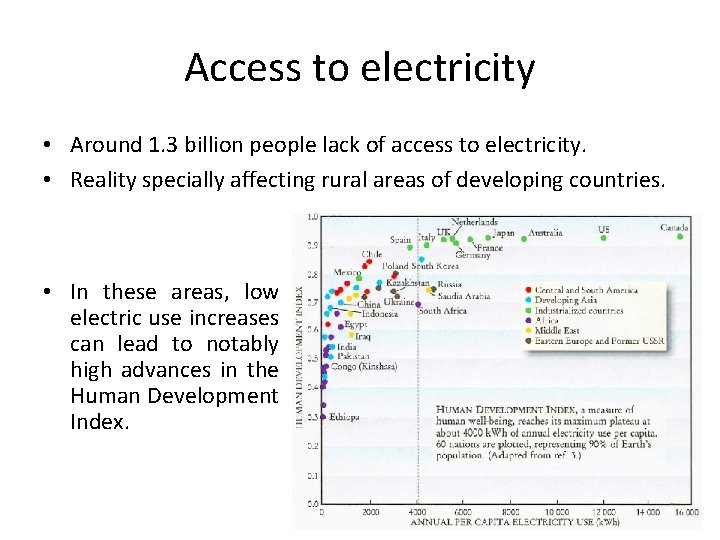
Access to electricity • Around 1. 3 billion people lack of access to electricity. • Reality specially affecting rural areas of developing countries. • In these areas, low electric use increases can lead to notably high advances in the Human Development Index.
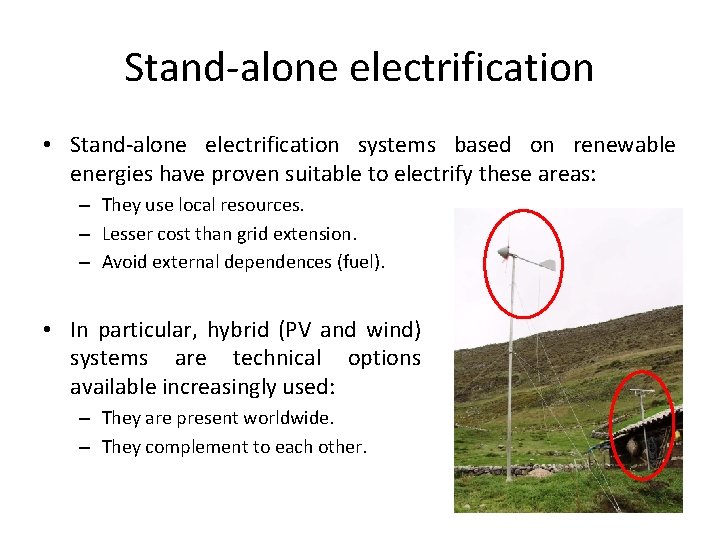
Stand-alone electrification • Stand-alone electrification systems based on renewable energies have proven suitable to electrify these areas: – They use local resources. – Lesser cost than grid extension. – Avoid external dependences (fuel). • In particular, hybrid (PV and wind) systems are technical options available increasingly used: – They are present worldwide. – They complement to each other.
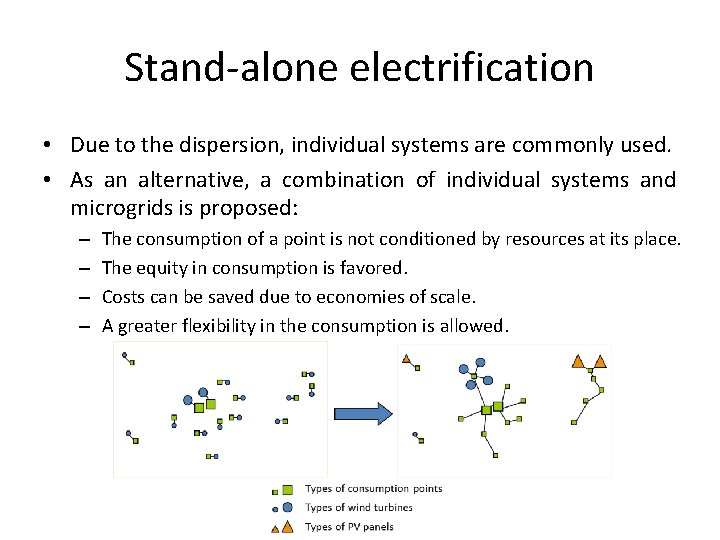
Stand-alone electrification • Due to the dispersion, individual systems are commonly used. • As an alternative, a combination of individual systems and microgrids is proposed: – – The consumption of a point is not conditioned by resources at its place. The equity in consumption is favored. Costs can be saved due to economies of scale. A greater flexibility in the consumption is allowed.
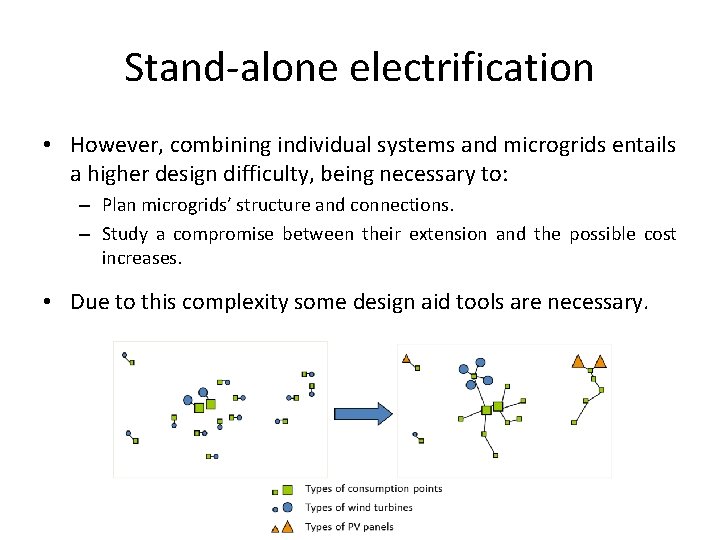
Stand-alone electrification • However, combining individual systems and microgrids entails a higher design difficulty, being necessary to: – Plan microgrids’ structure and connections. – Study a compromise between their extension and the possible cost increases. • Due to this complexity some design aid tools are necessary.
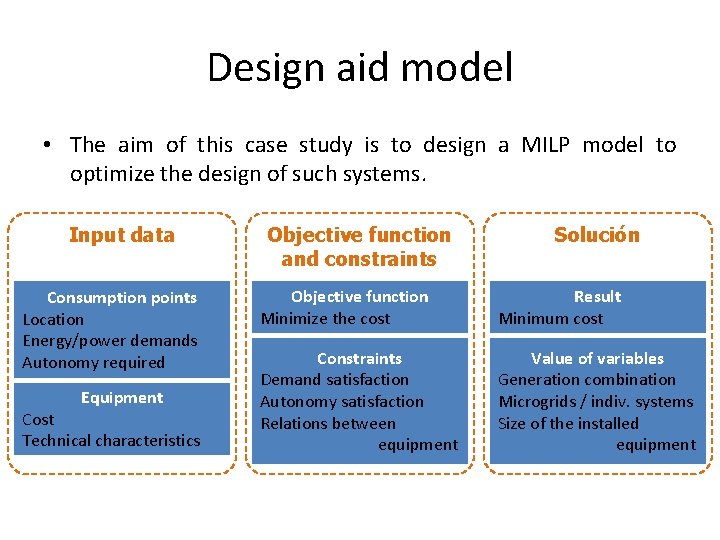
Design aid model • The aim of this case study is to design a MILP model to optimize the design of such systems. Input data Consumption points Location Energy/power demands Autonomy required Equipment Cost Technical characteristics Objective function and constraints Solución Objective function Minimize the cost Result Minimum cost Constraints Demand satisfaction Autonomy satisfaction Relations between equipment Value of variables Generation combination Microgrids / indiv. systems Size of the installed equipment
Activities • Class activity (3 points). – Development of a MILP model in three-member groups (2 points). – Debate between all the class to definitely solve the model (1 point). – The expected time for this activity is 2 hours (1 + 1). • Homework activity (7 points). – Development of a MILP model in three-member groups extending the previous one (4 points). – Resolution of the model using specialized software (3 hours). – The expected time for this activity is 2 hours (4 + 6).
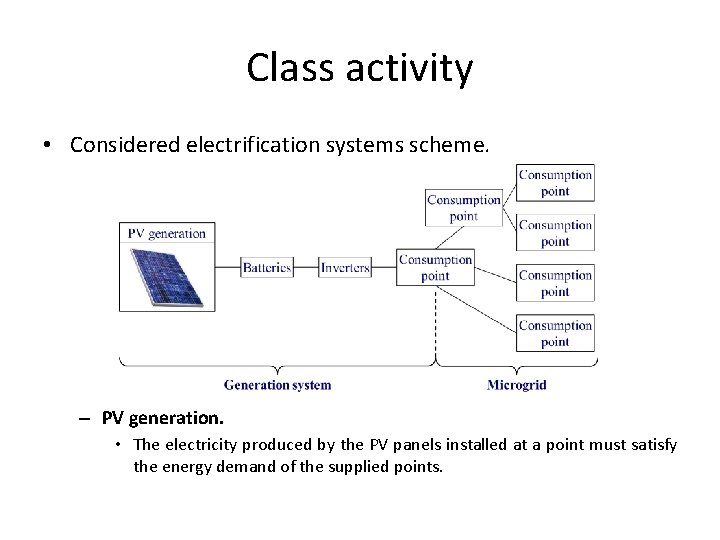
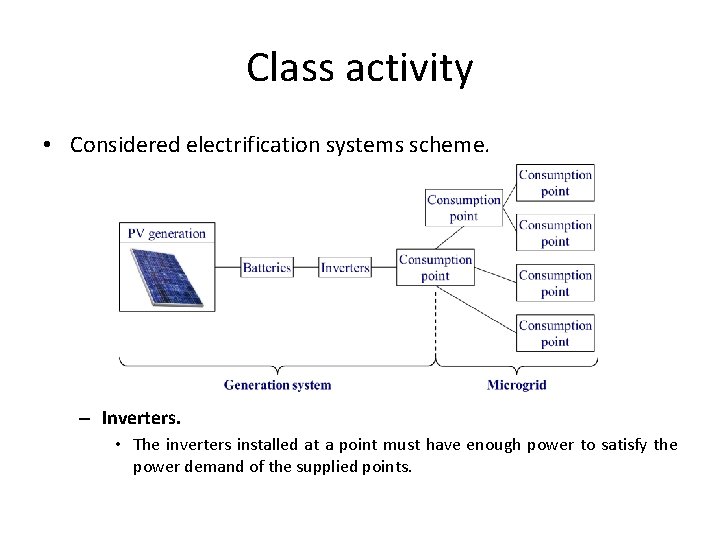
Class activity • Considered electrification systems scheme. – PV generation. • The electricity produced by the PV panels installed at a point must satisfy the energy demand of the supplied points.
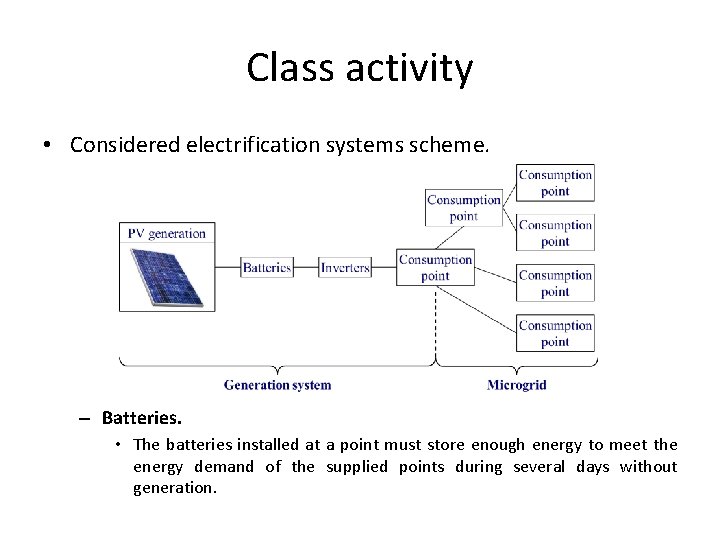
Class activity • Considered electrification systems scheme. – Batteries. • The batteries installed at a point must store enough energy to meet the energy demand of the supplied points during several days without generation.
Class activity • Considered electrification systems scheme. – Inverters. • The inverters installed at a point must have enough power to satisfy the power demand of the supplied points.
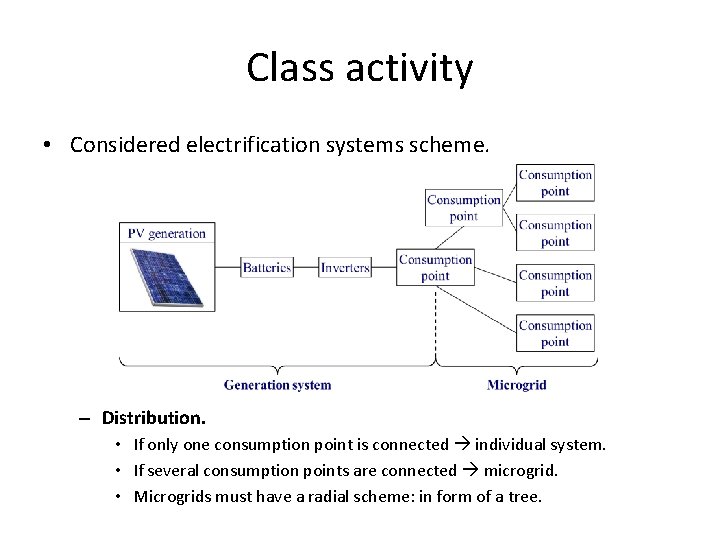
Class activity • Considered electrification systems scheme. – Distribution. • If only one consumption point is connected individual system. • If several consumption points are connected microgrid. • Microgrids must have a radial scheme: in form of a tree.
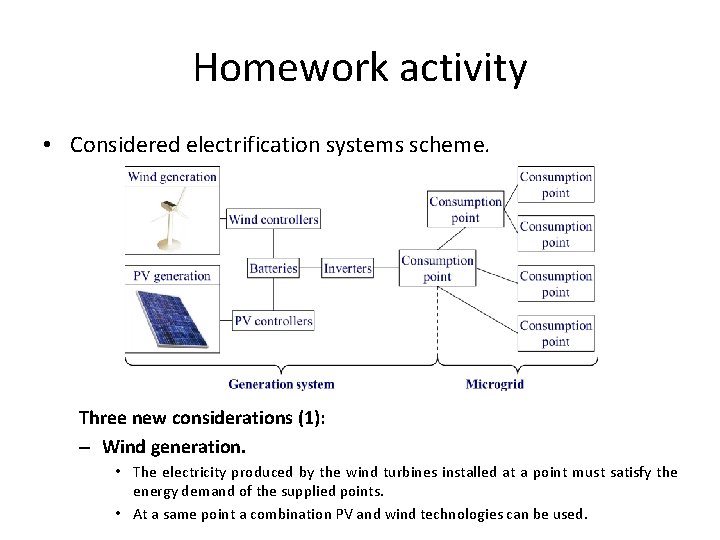
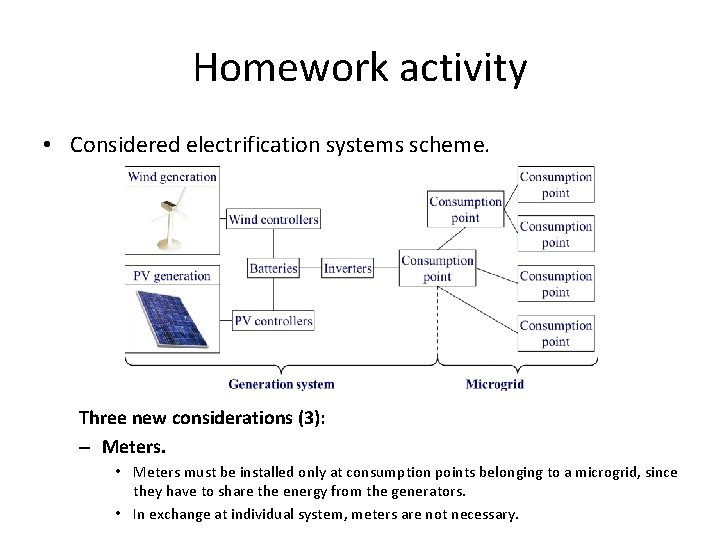
Homework activity • Considered electrification systems scheme. Three new considerations (1): – Wind generation. • The electricity produced by the wind turbines installed at a point must satisfy the energy demand of the supplied points. • At a same point a combination PV and wind technologies can be used.
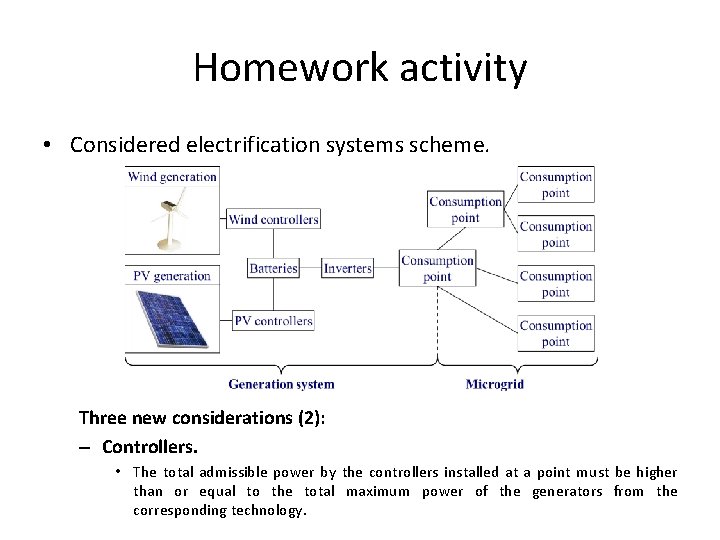
Homework activity • Considered electrification systems scheme. Three new considerations (2): – Controllers. • The total admissible power by the controllers installed at a point must be higher than or equal to the total maximum power of the generators from the corresponding technology.
Homework activity • Considered electrification systems scheme. Three new considerations (3): – Meters. • Meters must be installed only at consumption points belonging to a microgrid, since they have to share the energy from the generators. • In exchange at individual system, meters are not necessary.
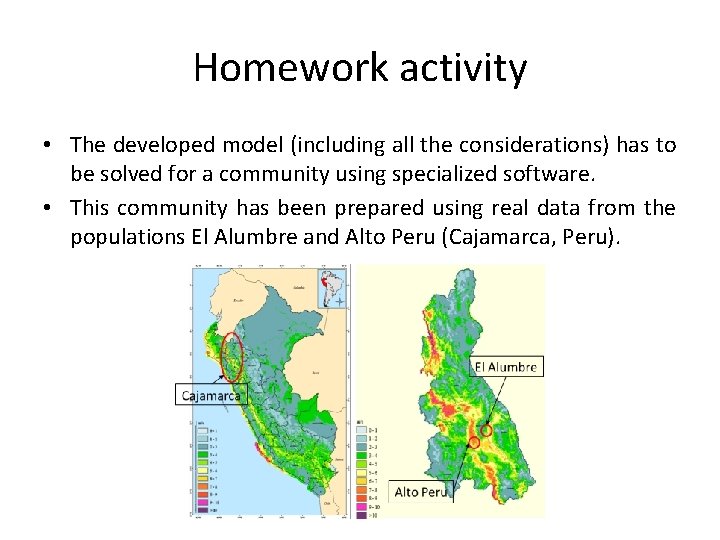
Homework activity • The developed model (including all the considerations) has to be solved for a community using specialized software. • This community has been prepared using real data from the populations El Alumbre and Alto Peru (Cajamarca, Peru).