
Development of a long range pinger Test device
- Slides: 4
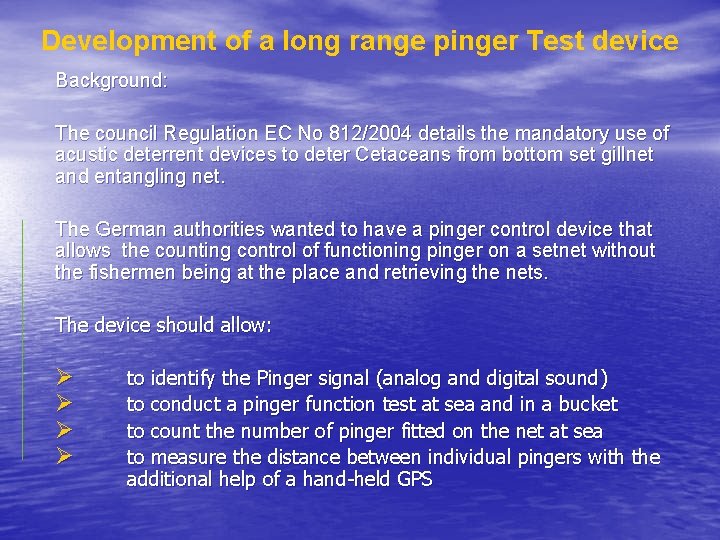
Development of a long range pinger Test device Background: The council Regulation EC No 812/2004 details the mandatory use of acustic deterrent devices to deter Cetaceans from bottom set gillnet and entangling net. The German authorities wanted to have a pinger control device that allows the counting control of functioning pinger on a setnet without the fishermen being at the place and retrieving the nets. The device should allow: Ø Ø to identify the Pinger signal (analog and digital sound) to conduct a pinger function test at sea and in a bucket to count the number of pinger fitted on the net at sea to measure the distance between individual pingers with the additional help of a hand-held GPS
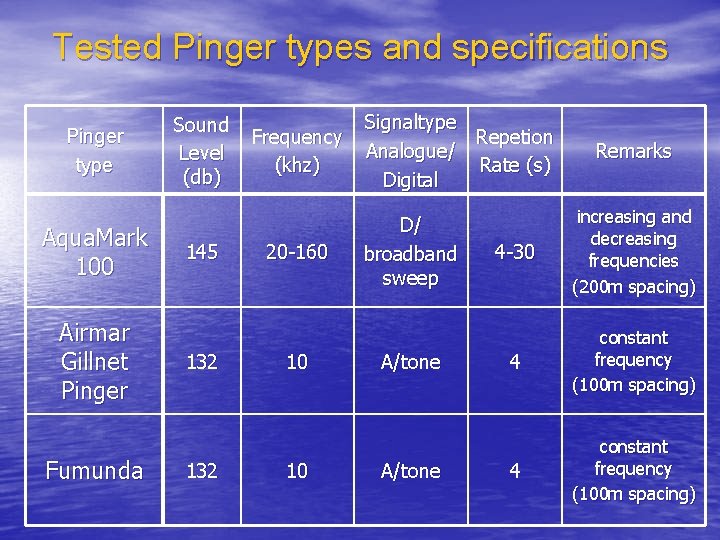
Tested Pinger types and specifications Pinger type Aqua. Mark 100 Airmar Gillnet Pinger Fumunda Sound Level (db) 145 132 Frequency (khz) 20 -160 10 10 Signaltype Repetion Analogue/ Rate (s) Digital D/ broadband sweep A/tone Remarks 4 -30 increasing and decreasing frequencies (200 m spacing) 4 constant frequency (100 m spacing)
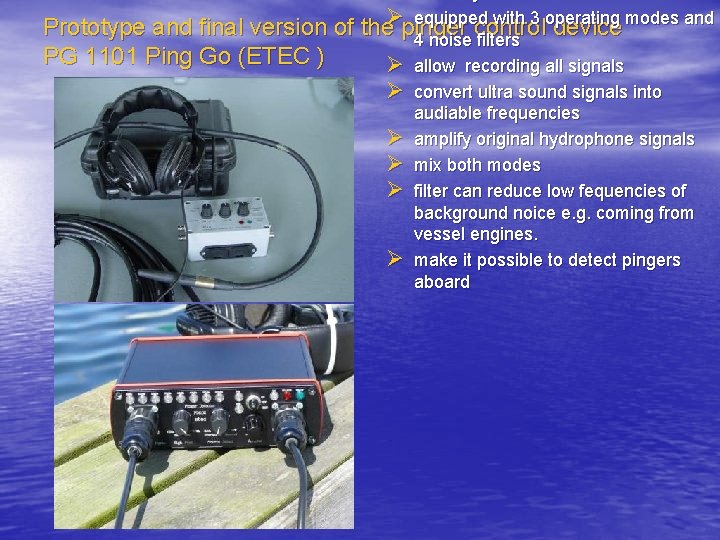
equipped with 3 operating modes and Prototype and final version of theØpinger control device 4 noise filters PG 1101 Ping Go (ETEC ) Ø allow recording all signals Ø convert ultra sound signals into Ø Ø audiable frequencies amplify original hydrophone signals mix both modes filter can reduce low fequencies of background noice e. g. coming from vessel engines. make it possible to detect pingers aboard
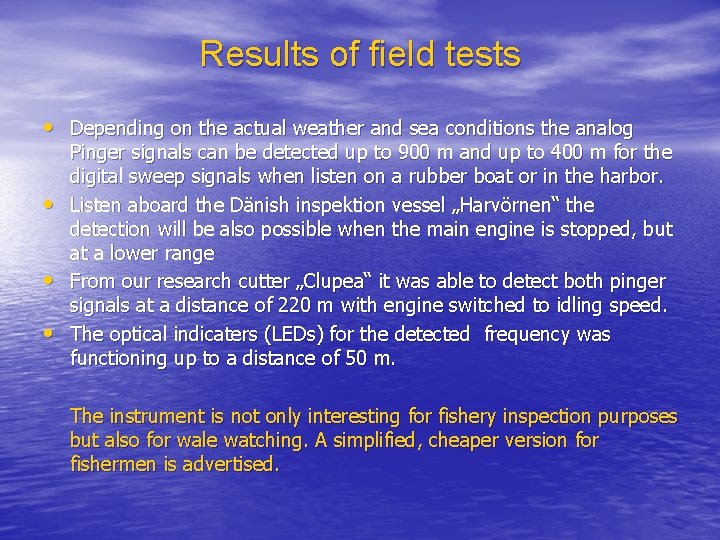
Results of field tests • Depending on the actual weather and sea conditions the analog • • • Pinger signals can be detected up to 900 m and up to 400 m for the digital sweep signals when listen on a rubber boat or in the harbor. Listen aboard the Dänish inspektion vessel „Harvörnen“ the detection will be also possible when the main engine is stopped, but at a lower range From our research cutter „Clupea“ it was able to detect both pinger signals at a distance of 220 m with engine switched to idling speed. The optical indicaters (LEDs) for the detected frequency was functioning up to a distance of 50 m. The instrument is not only interesting for fishery inspection purposes but also for wale watching. A simplified, cheaper version for fishermen is advertised.