
Development of a Large Area Gammaray Detector Camden
- Slides: 1
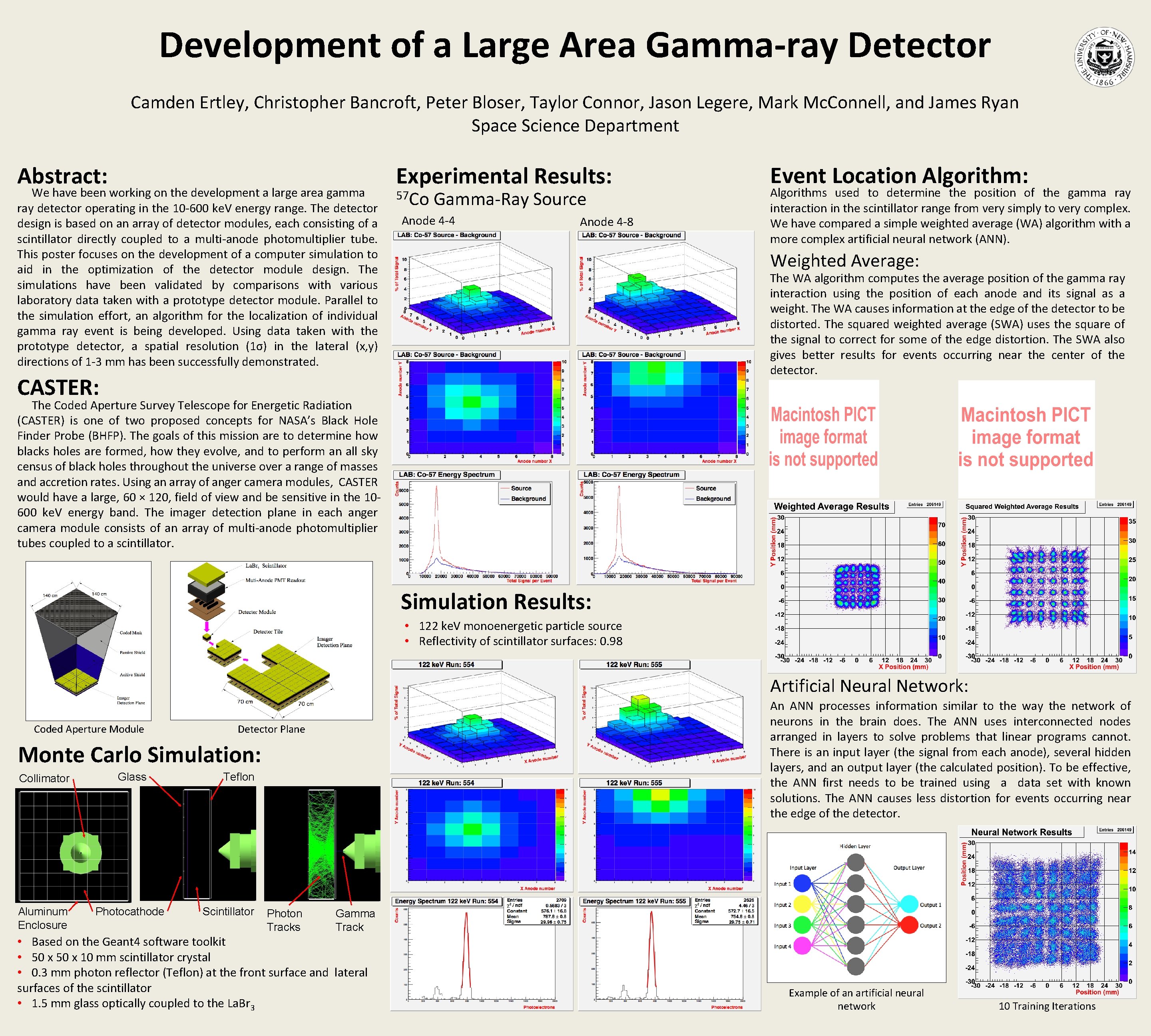
Development of a Large Area Gamma-ray Detector Camden Ertley, Christopher Bancroft, Peter Bloser, Taylor Connor, Jason Legere, Mark Mc. Connell, and James Ryan Space Science Department Abstract: We have been working on the development a large area gamma ray detector operating in the 10 -600 ke. V energy range. The detector design is based on an array of detector modules, each consisting of a scintillator directly coupled to a multi-anode photomultiplier tube. This poster focuses on the development of a computer simulation to aid in the optimization of the detector module design. The simulations have been validated by comparisons with various laboratory data taken with a prototype detector module. Parallel to the simulation effort, an algorithm for the localization of individual gamma ray event is being developed. Using data taken with the prototype detector, a spatial resolution (1σ) in the lateral (x, y) directions of 1 -3 mm has been successfully demonstrated. Experimental Results: 57 Co Gamma-Ray Source Anode 4 -4 Anode 4 -8 Event Location Algorithm: Algorithms used to determine the position of the gamma ray interaction in the scintillator range from very simply to very complex. We have compared a simple weighted average (WA) algorithm with a more complex artificial neural network (ANN). Weighted Average: The WA algorithm computes the average position of the gamma ray interaction using the position of each anode and its signal as a weight. The WA causes information at the edge of the detector to be distorted. The squared weighted average (SWA) uses the square of the signal to correct for some of the edge distortion. The SWA also gives better results for events occurring near the center of the detector. CASTER: The Coded Aperture Survey Telescope for Energetic Radiation (CASTER) is one of two proposed concepts for NASA’s Black Hole Finder Probe (BHFP). The goals of this mission are to determine how blacks holes are formed, how they evolve, and to perform an all sky census of black holes throughout the universe over a range of masses and accretion rates. Using an array of anger camera modules, CASTER would have a large, 60 × 120, field of view and be sensitive in the 10600 ke. V energy band. The imager detection plane in each anger camera module consists of an array of multi-anode photomultiplier tubes coupled to a scintillator. Simulation Results: • 122 ke. V monoenergetic particle source • Reflectivity of scintillator surfaces: 0. 98 Artificial Neural Network: Coded Aperture Module An ANN processes information similar to the way the network of neurons in the brain does. The ANN uses interconnected nodes arranged in layers to solve problems that linear programs cannot. There is an input layer (the signal from each anode), several hidden layers, and an output layer (the calculated position). To be effective, the ANN first needs to be trained using a data set with known solutions. The ANN causes less distortion for events occurring near the edge of the detector. Detector Plane Monte Carlo Simulation: Collimator Glass Aluminum Enclosure Photocathode Teflon Scintillator Photon Tracks Gamma Track • Based on the Geant 4 software toolkit • 50 x 10 mm scintillator crystal • 0. 3 mm photon reflector (Teflon) at the front surface and lateral surfaces of the scintillator • 1. 5 mm glass optically coupled to the La. Br 3 Example of an artificial neural network 10 Training Iterations