
DEVELOPMENT OF A FAST AND EFFICIENT ALGORITHM FOR

- Slides: 33
DEVELOPMENT OF A FAST AND EFFICIENT ALGORITHM FOR P 300 EVENT RELATED POTENTIAL DETECTION IN A MOBILE ENVIRONMENT A MASTER’S THESIS PROPOSAL BY ELLIOT FRANZ ADVISOR: IYAD OBEID, PHD
PRESENTATION OVERVIEW 1. Background 2. EEG processing 3. Goals 4. Methodology 5. Data collection/processing 6. Preliminary work 7. Proposed work
1. ) BACKGROUND OVERVIEW Ø Brain Computer Interfaces (BCIs) Ø P 300 Event Related Potential (ERP) Ø P 300 Speller Ø EEG Hardware Ø Emotiv EPOC
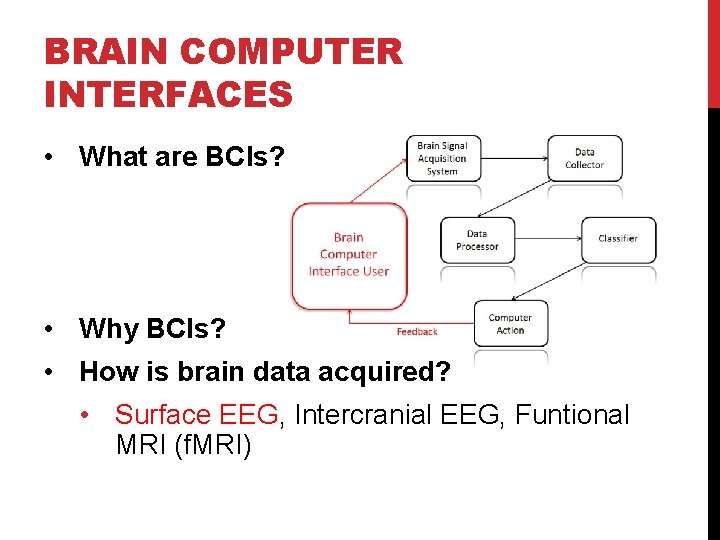
BRAIN COMPUTER INTERFACES • What are BCIs? • Why BCIs? • How is brain data acquired? • Surface EEG, Intercranial EEG, Funtional MRI (f. MRI)
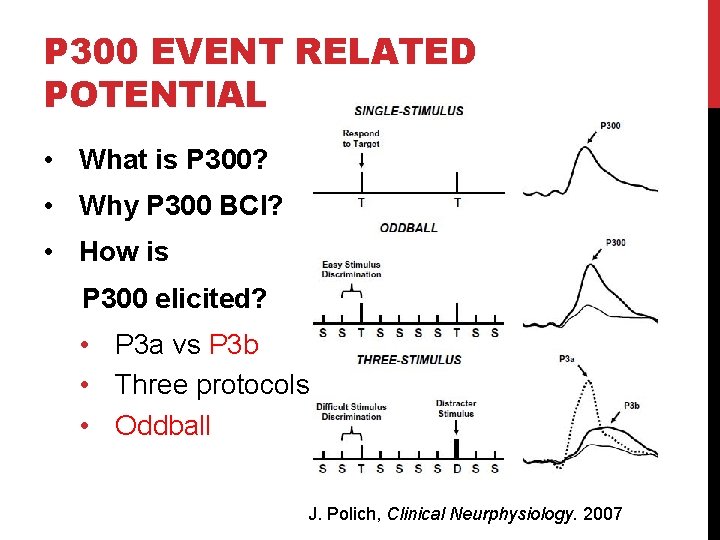
P 300 EVENT RELATED POTENTIAL • What is P 300? • Why P 300 BCI? • How is P 300 elicited? • P 3 a vs P 3 b • Three protocols • Oddball J. Polich, Clinical Neurphysiology. 2007
FACTORS WHICH AFFECT P 300 • A variety of biological factors affect the latency and the amplitude of the P 300 ERP • • • Eating food Body temperature Exercise Rarity of target Inter-stimulus Interval (ISI)
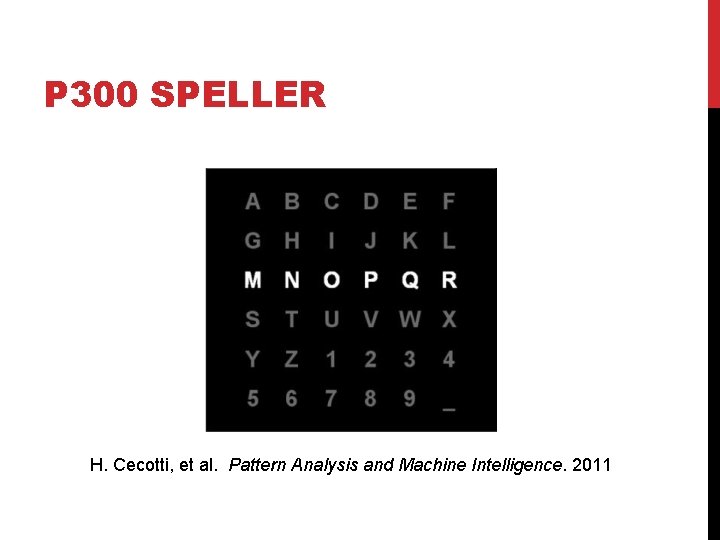
P 300 SPELLER H. Cecotti, et al. Pattern Analysis and Machine Intelligence. 2011
EEG HARDWARE • Electrodes • Material (e. g. , Ag/Ag. Cl, Saline) • Size/Shape (e. g. , Cup, disk) • Signal enhancers (e. g. , conductive jelly) • Wires • Amplifiers • Analog to Digital (A/D) converters
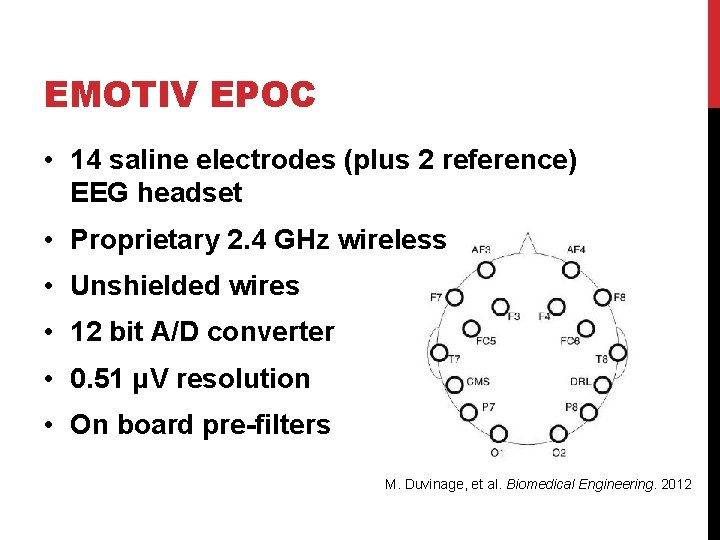
EMOTIV EPOC • 14 saline electrodes (plus 2 reference) EEG headset • Proprietary 2. 4 GHz wireless • Unshielded wires • 12 bit A/D converter • 0. 51 μV resolution • On board pre-filters M. Duvinage, et al. Biomedical Engineering. 2012
PRESENTATION OVERVIEW 1. Background 2. EEG processing 3. Goals 4. Methodology 5. Data collection/processing 6. Preliminary work 7. Proposed work
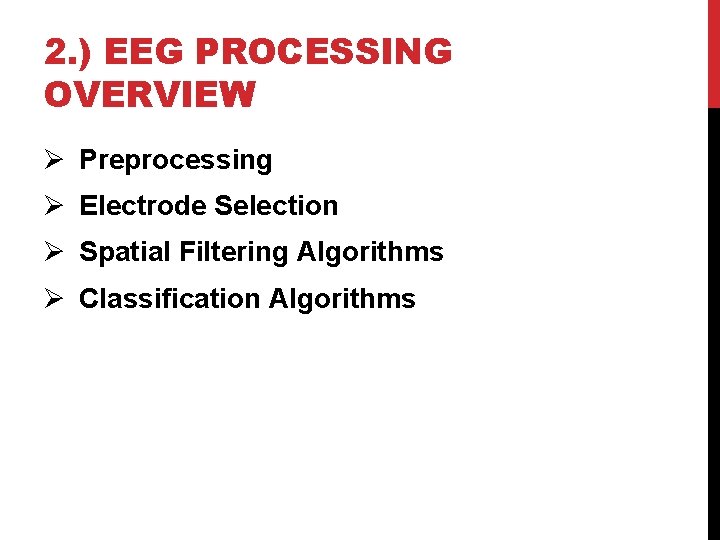
2. ) EEG PROCESSING OVERVIEW Ø Preprocessing Ø Electrode Selection Ø Spatial Filtering Algorithms Ø Classification Algorithms
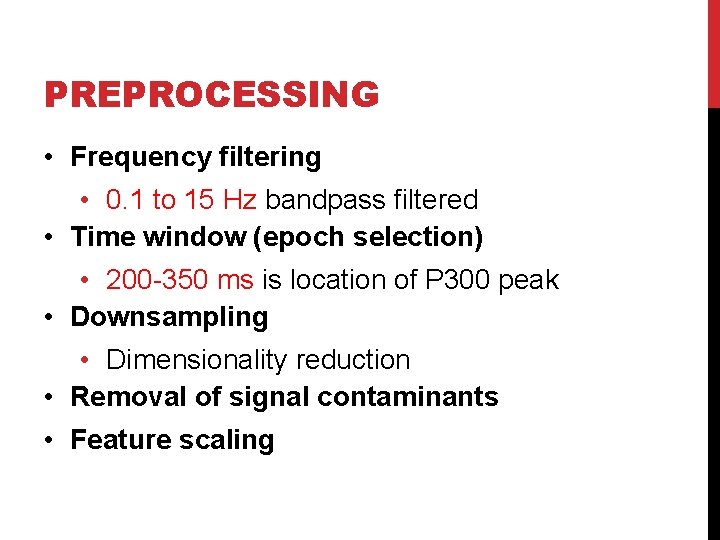
PREPROCESSING • Frequency filtering • 0. 1 to 15 Hz bandpass filtered • Time window (epoch selection) • 200 -350 ms is location of P 300 peak • Downsampling • Dimensionality reduction • Removal of signal contaminants • Feature scaling
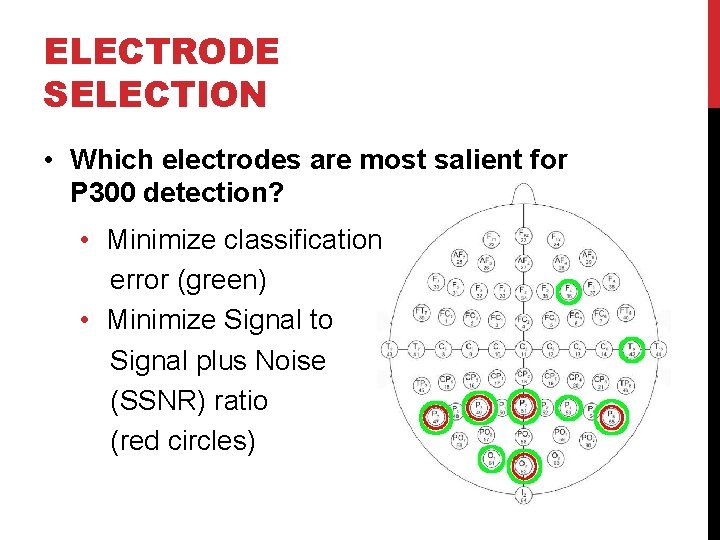
ELECTRODE SELECTION • Which electrodes are most salient for P 300 detection? • Minimize classification error (green) • Minimize Signal to Signal plus Noise (SSNR) ratio (red circles)
SPATIAL FILTERING • Goal: Use information contained in neighboring electrodes to filter noise and isolate important signal components • Averaging, Independent Component Analysis (ICA), Principle Component Analysis (PCA), Singular Value Decomposition (SVD), x. DAWN
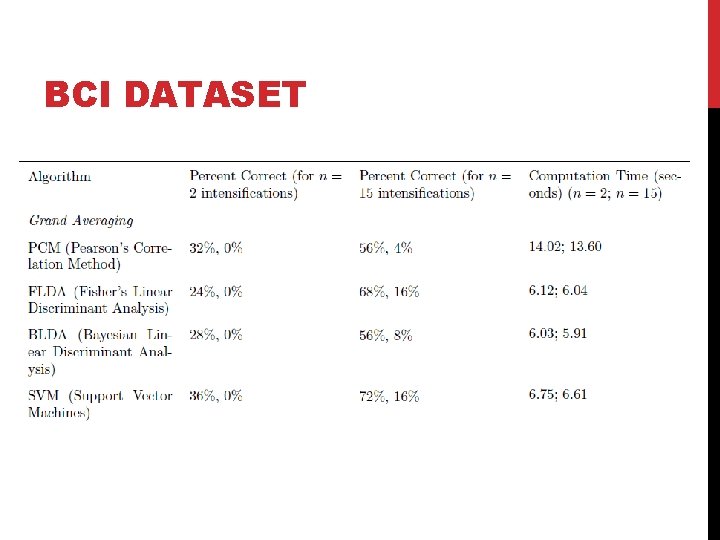
CLASSIFICATION ALGORITHMS • Goal: Use features (data points in a given epoch) to determine whether or not the given epoch contains a P 300 • Binary classification problem • Pearson’s Correlation Method (PCM), Fisher’s Linear Discriminant Analysis (FLDA), Bayesian Linear Discriminant Analysis (BLDA), Support Vector Machines (SVM)
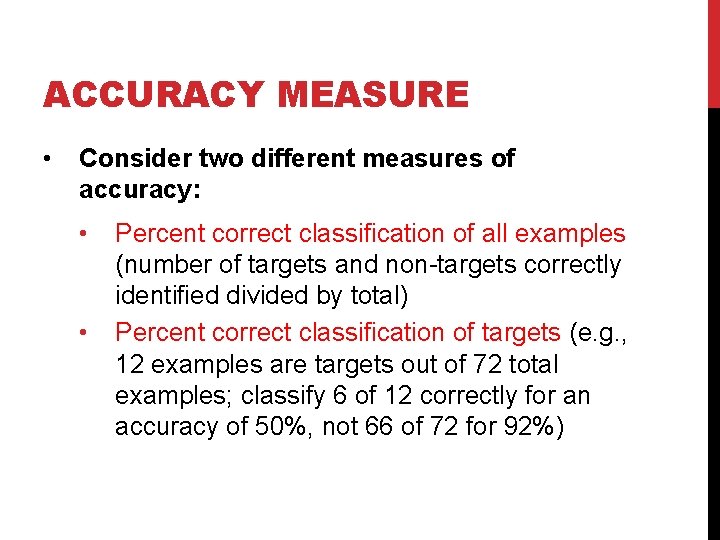
ACCURACY MEASURE • Consider two different measures of accuracy: • • Percent correct classification of all examples (number of targets and non-targets correctly identified divided by total) Percent correct classification of targets (e. g. , 12 examples are targets out of 72 total examples; classify 6 of 12 correctly for an accuracy of 50%, not 66 of 72 for 92%)
PRESENTATION OVERVIEW 1. Background 2. EEG processing 3. Goals 4. Methodology 5. Data collection/processing 6. Preliminary work 7. Proposed work
3. ) GOALS Ø Test all combinations of spatial filtering and classification algorithms on the BCI dataset (metrics = speed and accuracy) Ø Test the following hypothesis on the BCI data and EPOC data: Given a low number of row/column intensifications of the P 300 matrix, can we eliminate nontargets and still successfully classify spelled characters averaging less rare targets (less rare ~ 45%)?
PRESENTATION OVERVIEW 1. Background 2. EEG processing 3. Goals 4. Methodology 5. Data collection/processing 6. Preliminary work 7. Proposed work
4. ) METHODOLOGY • BCI dataset • Using data from both subjects, train each combination of spatial filter and algorithm with 60 characters and test accuracy on the remaining 25 • Emotiv EPOC • Collect P 300 data following the same procedure (e. g. , flashing duration, ISI) as the BCI data were collected • Train and test algorithms
PRESENTATION OVERVIEW 1. Background 2. EEG processing 3. Goals 4. Methodology 5. Data collection/processing 6. Preliminary work 7. Proposed work
5. ) DATA COLLECTION • All data collection for the EPOC will be done using the Test Bench acquisition software provided with the device • Collection from 8 parietal electrodes • The P 300 matrix will be implemented in Open. Vi. BE • Event tags (e. g. , row or column flashing) will be recorded with Test Bench as well using a COM port emulator
DATA PROCESSING • After data are collected from the EPOC using Test Bench, they will be converted to CSV file format and imported to MATLAB • Every combination of spatial filtering algorithm and classification algorithm will be tested on the EPOC and BCI data (subjects A and B, 60 training characters and 25 test characters each)
DATA PROCESSING CONT’D • MATLAB performance analytics and classification accuracy measures (e. g. , computation time and percent of correctly identified rows and columns) will be used • The fastest and most accurate algorithm from both the EPOC and BCI dataset will be selected to test the experimental hypothesis: “After a low number of intensification cycles, a percentage of the least likely rows and columns can be ruled out to improve speller throughput. ”
POTENTIAL HURDLES • There may be not be a single algorithm which is most accurate for the EPOC and BCI datasets • The algorithm chosen will need to be adjusted to ‘rank’ the rows and columns from most to least likely • It is possible that the algorithm will only be able to confidently eliminate a smaller percentage (e. g. , 25%) of rows and columns • This testing is based on the knowledge that 50% rare stimuli elicit the same P 300 response as 17% rare stimuli
PRESENTATION OVERVIEW 1. Background 2. EEG processing 3. Goals 4. Methodology 5. Data collection/processing 6. Preliminary work 7. Proposed work
6. ) PRELIMINARY WORK SUMMARY • Used 85 characters from Subject B of the BCI dataset • Divided into n=2 and n=15 repetitions • Preprocessed data • Grand averaging of 8 electrodes • Trained on 60, tested on remaining 25 • Accuracy measure: Percent correct characters and rows and columns
ACCURACY MEASURE • Consider two different measures of accuracy: • • Percent correct classification of all examples (number of targets and non-targets correctly identified divided by total) Percent correct classification of targets (e. g. , 12 examples are targets out of 72 total examples; classify 6 of 12 correctly for an accuracy of 50%, not 66 of 72 for 92%)
BCI DATASET
EMOTIV EPOC • Connected and tested EPOC • Recorded 23 seconds of brain data • Installed Open. Vi. BE • Currently working on Open. Vi. BE P 300 program implementation and COM port emulator for exporting of event tags
PRESENTATION OVERVIEW 1. Background 2. EEG processing 3. Goals 4. Methodology 5. Data collection/processing 6. Preliminary work 7. Proposed work
7. ) PROPOSED WORK • Complete simulations with BCI dataset (evaluate all combinations of algorithms on both subjects) • Obtain P 300 data using the Emotiv EPOC and subject acquired data to the same analysis as the BCI data • Test experimental hypothesis and establish a rejection threshold based on experimental results (e. g. , can safely eliminate 25% of unlikely rows and columns after two rounds of intensifications)
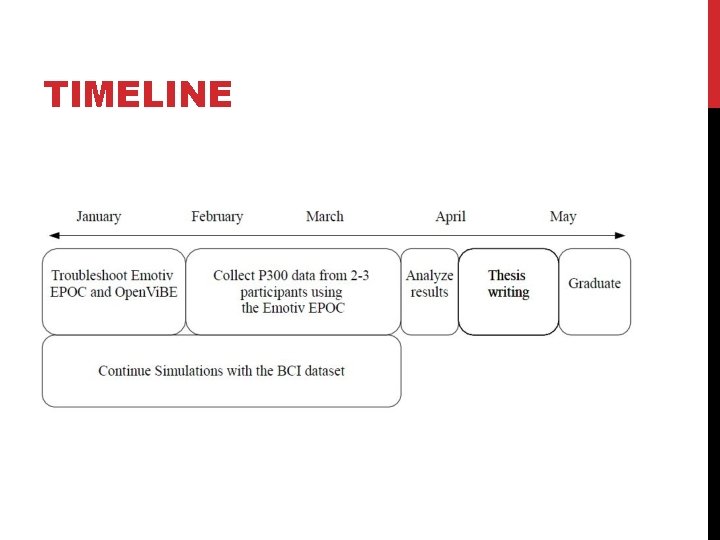
TIMELINE