
Development of a CIPAC washing method for longlasting


- Slides: 23
Development of a CIPAC washing method for long-lasting insecticidal nets (LN) Testing of the CIPAC washing agent concentration Olivier Pigeon (CRA-W, Gembloux) Yumiko Kozuki (Sumitomo) Tsunehisa Fujita (Sumitomo) Markus Mueller (Agroscope, Waedenswil) Bruno Patrian (Agroscope, Waedenswil) Martin Rodler (Syngenta) 55 th CIPAC Technical Meeting Beijing, China, 15 June 2011
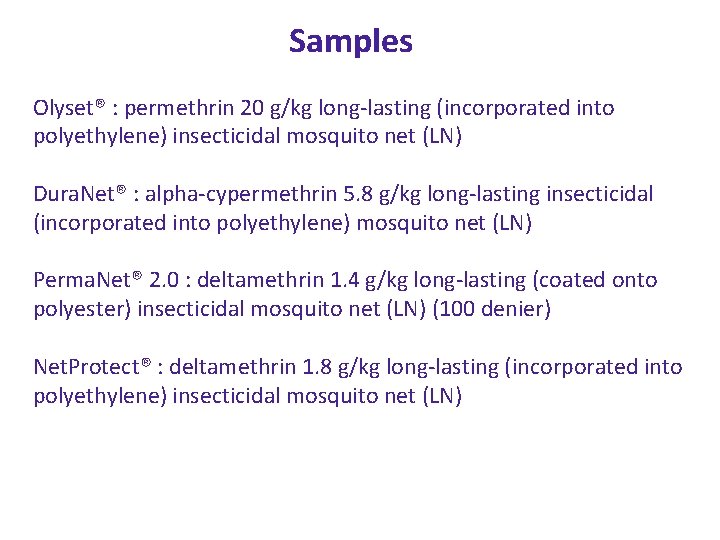
Samples Olyset® : permethrin 20 g/kg long-lasting (incorporated into polyethylene) insecticidal mosquito net (LN) Dura. Net® : alpha-cypermethrin 5. 8 g/kg long-lasting insecticidal (incorporated into polyethylene) mosquito net (LN) Perma. Net® 2. 0 : deltamethrin 1. 4 g/kg long-lasting (coated onto polyester) insecticidal mosquito net (LN) (100 denier) Net. Protect® : deltamethrin 1. 8 g/kg long-lasting (incorporated into polyethylene) insecticidal mosquito net (LN)
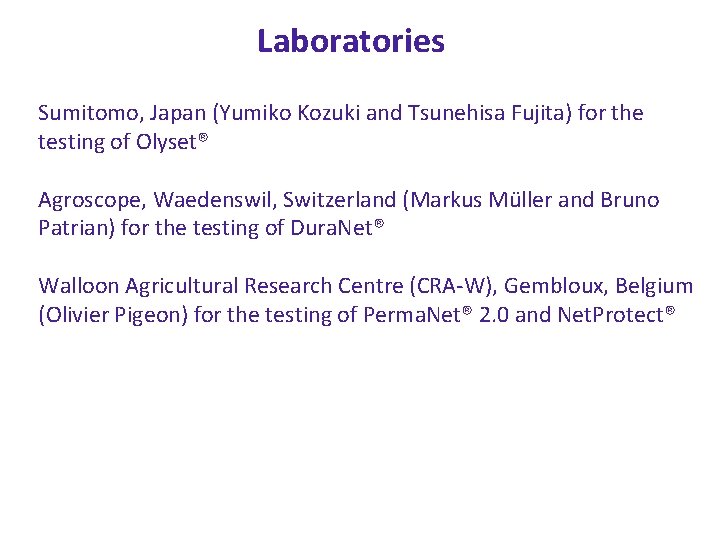
Laboratories Sumitomo, Japan (Yumiko Kozuki and Tsunehisa Fujita) for the testing of Olyset® Agroscope, Waedenswil, Switzerland (Markus Müller and Bruno Patrian) for the testing of Dura. Net® Walloon Agricultural Research Centre (CRA-W), Gembloux, Belgium (Olivier Pigeon) for the testing of Perma. Net® 2. 0 and Net. Protect®
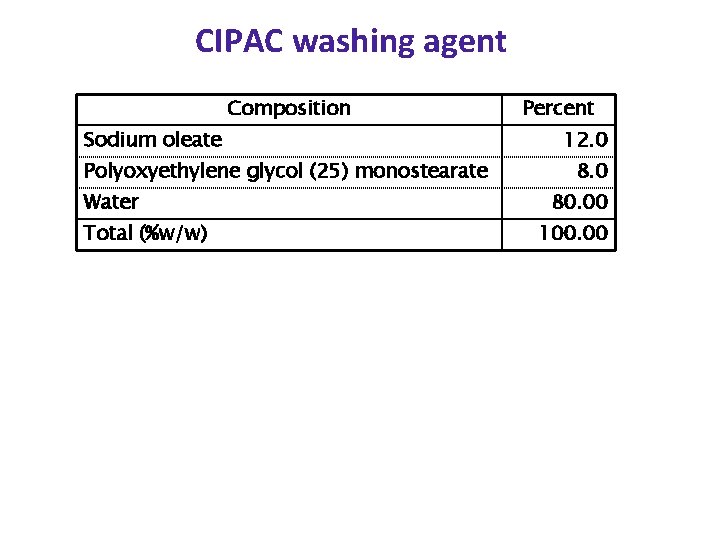
CIPAC washing agent Composition Sodium oleate Polyoxyethylene glycol (25) monostearate Water Total (%w/w) Percent 12. 0 80. 00 100. 00
CIPAC washing agent 1. Heat Polyoxyethylene glycol (25) monostearate up to 50゚C for decreasing the viscosity 50 ゚C Heating Waxy Polyoxyethylene glycol (25) monostearate Liquid Polyoxyethylene glycol (25) monostearate 2. Prepare the water phase Ion-exchanged water 5
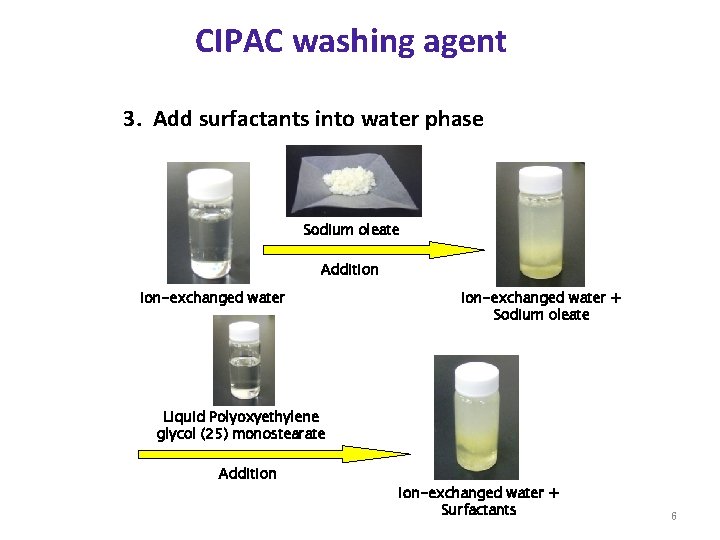
CIPAC washing agent 3. Add surfactants into water phase Sodium oleate Addition Ion-exchanged water + Sodium oleate Liquid Polyoxyethylene glycol (25) monostearate Addition Ion-exchanged water + Surfactants 6
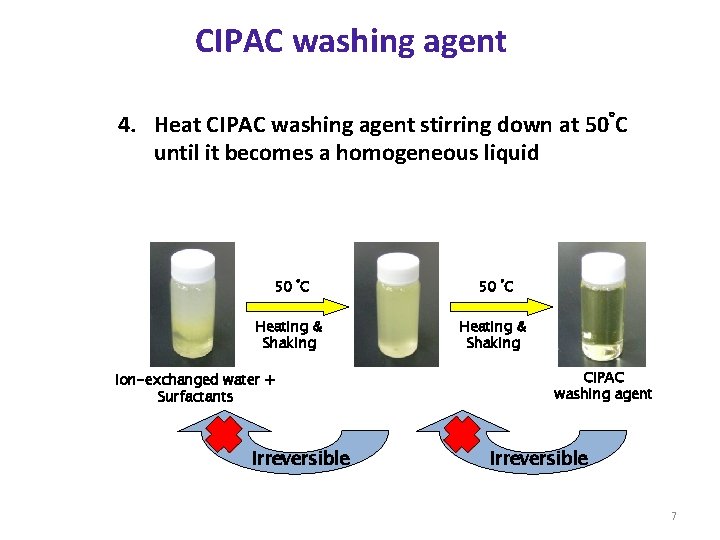
CIPAC washing agent 4. Heat CIPAC washing agent stirring down at 50゚C until it becomes a homogeneous liquid 50 ゚C Heating & Shaking Ion-exchanged water + Surfactants Irreversible CIPAC washing agent Irreversible 7
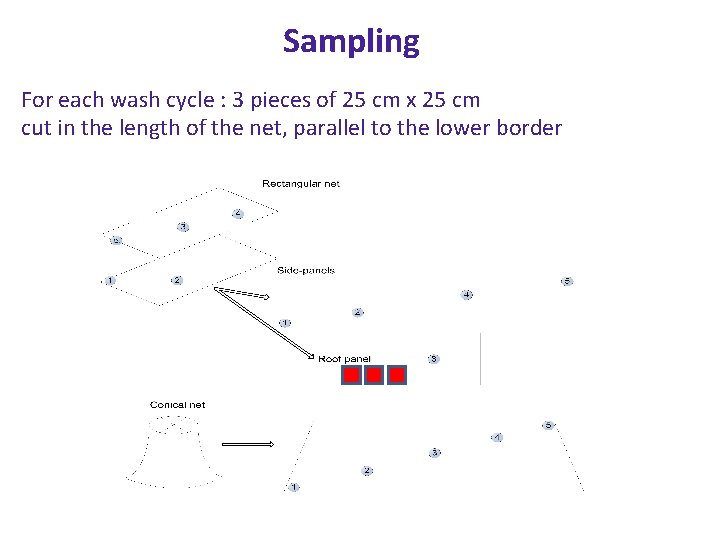
Sampling For each wash cycle : 3 pieces of 25 cm x 25 cm cut in the length of the net, parallel to the lower border
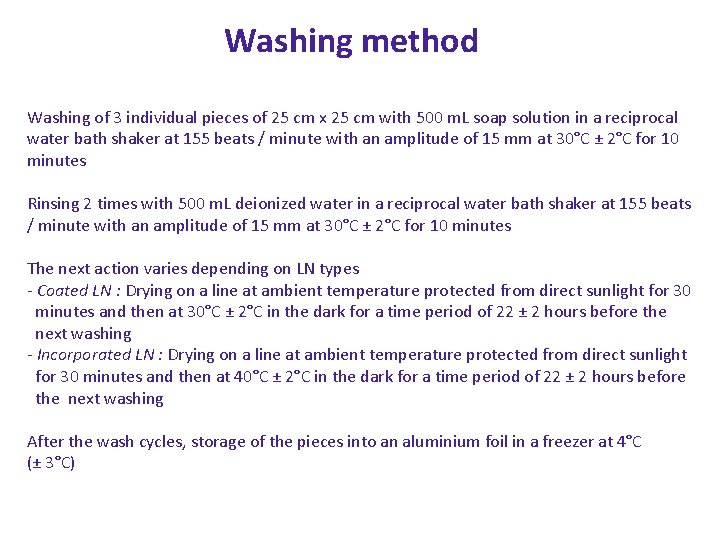
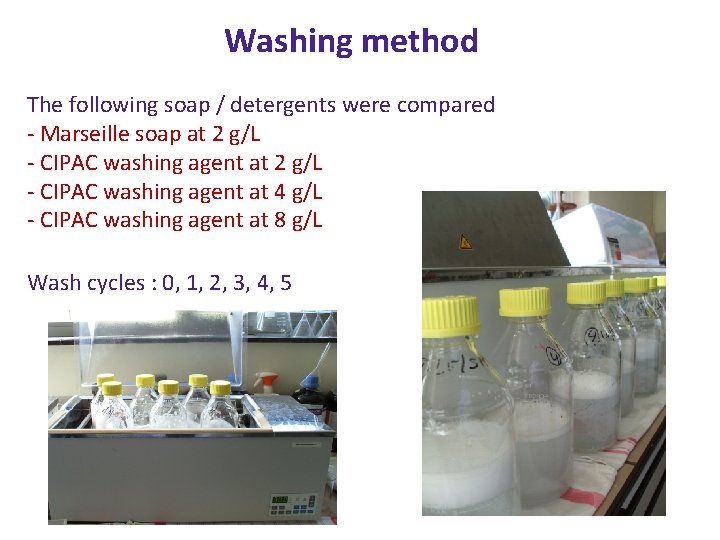
Washing method Washing of 3 individual pieces of 25 cm x 25 cm with 500 m. L soap solution in a reciprocal water bath shaker at 155 beats / minute with an amplitude of 15 mm at 30°C ± 2°C for 10 minutes Rinsing 2 times with 500 m. L deionized water in a reciprocal water bath shaker at 155 beats / minute with an amplitude of 15 mm at 30°C ± 2°C for 10 minutes The next action varies depending on LN types - Coated LN : Drying on a line at ambient temperature protected from direct sunlight for 30 minutes and then at 30°C ± 2°C in the dark for a time period of 22 ± 2 hours before the next washing - Incorporated LN : Drying on a line at ambient temperature protected from direct sunlight for 30 minutes and then at 40°C ± 2°C in the dark for a time period of 22 ± 2 hours before the next washing After the wash cycles, storage of the pieces into an aluminium foil in a freezer at 4°C (± 3°C)
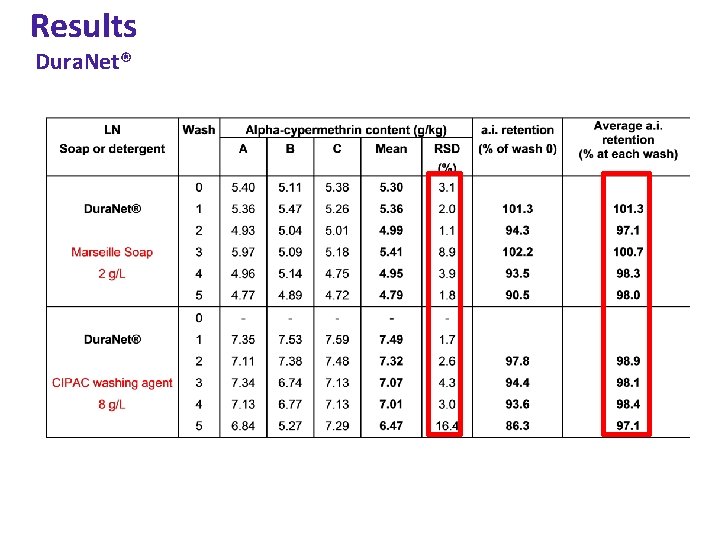
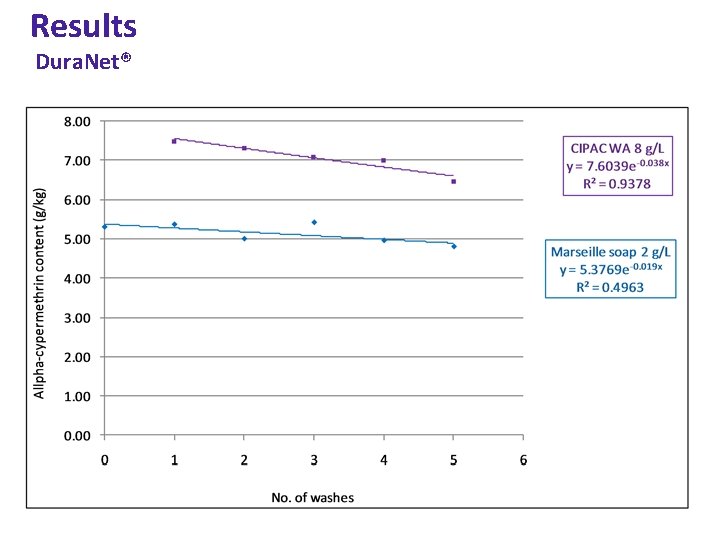
Washing method The following soap / detergents were compared - Marseille soap at 2 g/L - CIPAC washing agent at 4 g/L - CIPAC washing agent at 8 g/L Wash cycles : 0, 1, 2, 3, 4, 5
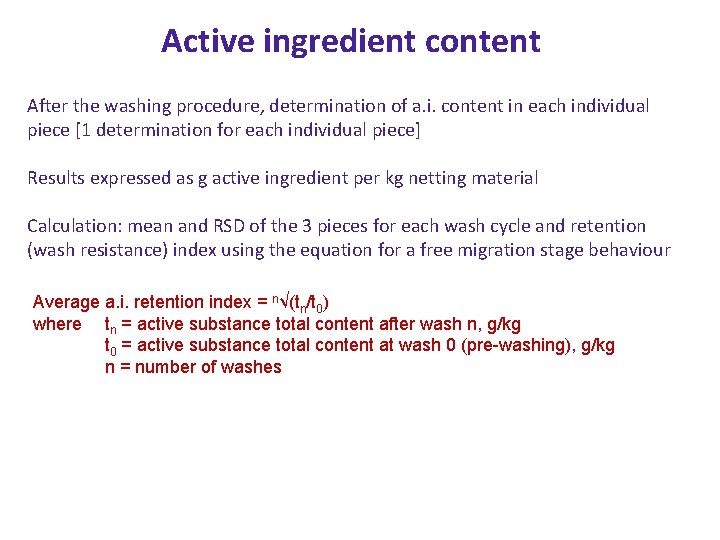
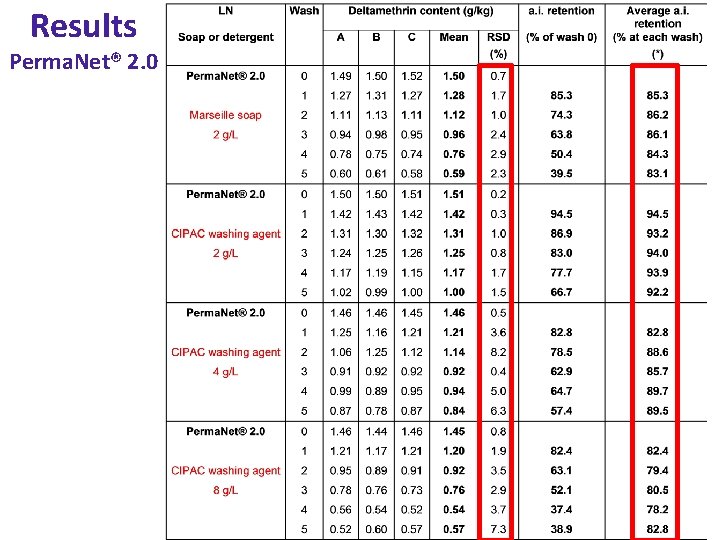
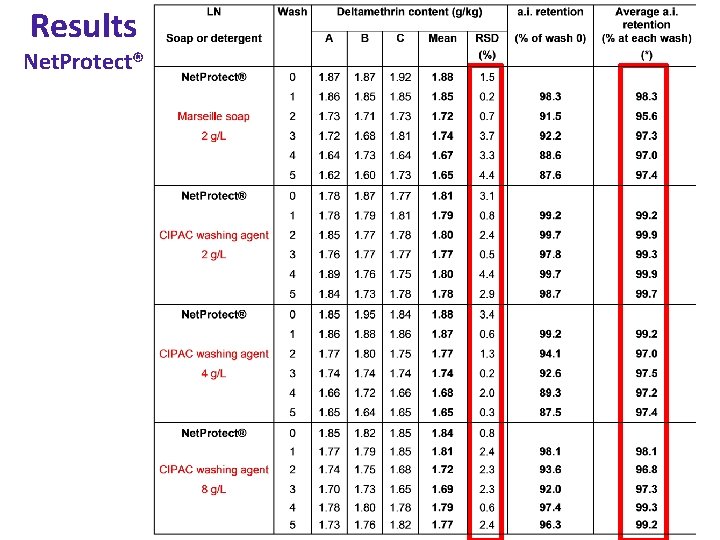
Active ingredient content After the washing procedure, determination of a. i. content in each individual piece [1 determination for each individual piece] Results expressed as g active ingredient per kg netting material Calculation: mean and RSD of the 3 pieces for each wash cycle and retention (wash resistance) index using the equation for a free migration stage behaviour Average a. i. retention index = n√(tn/t 0) where tn = active substance total content after wash n, g/kg t 0 = active substance total content at wash 0 (pre-washing), g/kg n = number of washes
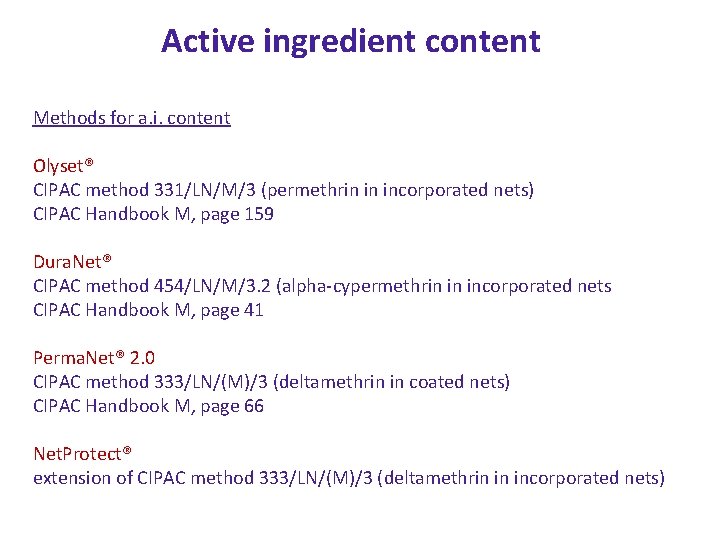
Active ingredient content Methods for a. i. content Olyset® CIPAC method 331/LN/M/3 (permethrin in incorporated nets) CIPAC Handbook M, page 159 Dura. Net® CIPAC method 454/LN/M/3. 2 (alpha-cypermethrin in incorporated nets CIPAC Handbook M, page 41 Perma. Net® 2. 0 CIPAC method 333/LN/(M)/3 (deltamethrin in coated nets) CIPAC Handbook M, page 66 Net. Protect® extension of CIPAC method 333/LN/(M)/3 (deltamethrin in incorporated nets)
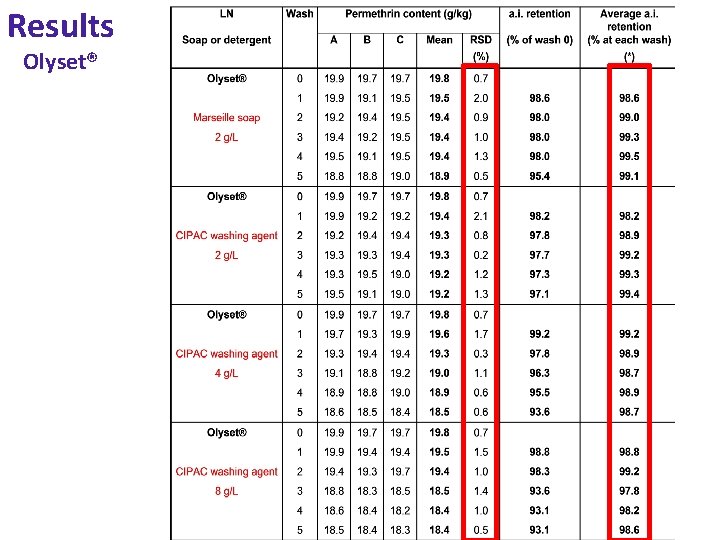
Results Olyset®
Results Olyset®
Results Perma. Net® 2. 0
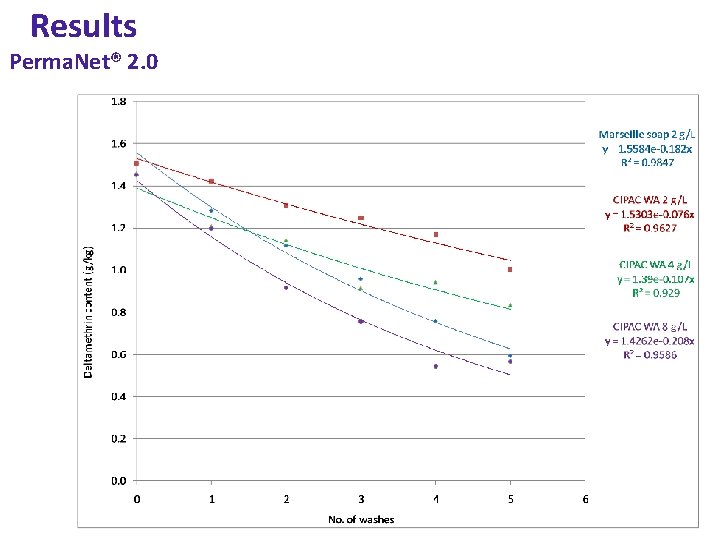
Results Perma. Net® 2. 0
Results Net. Protect®
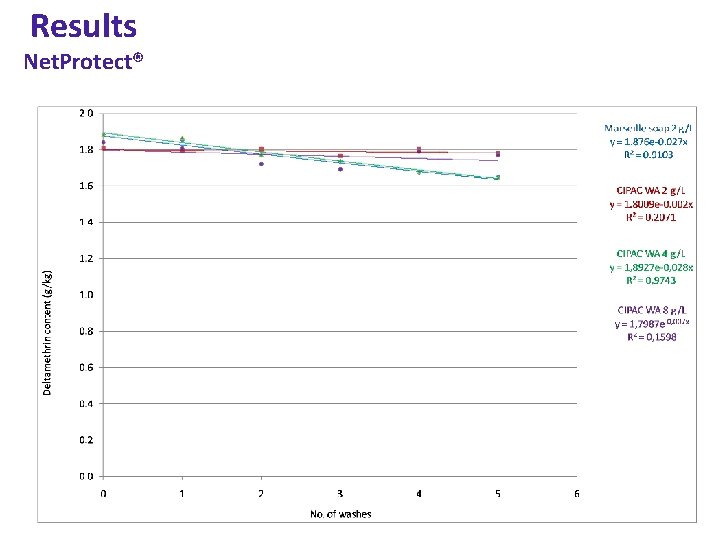
Results Net. Protect®
Results Dura. Net®
Results Dura. Net®
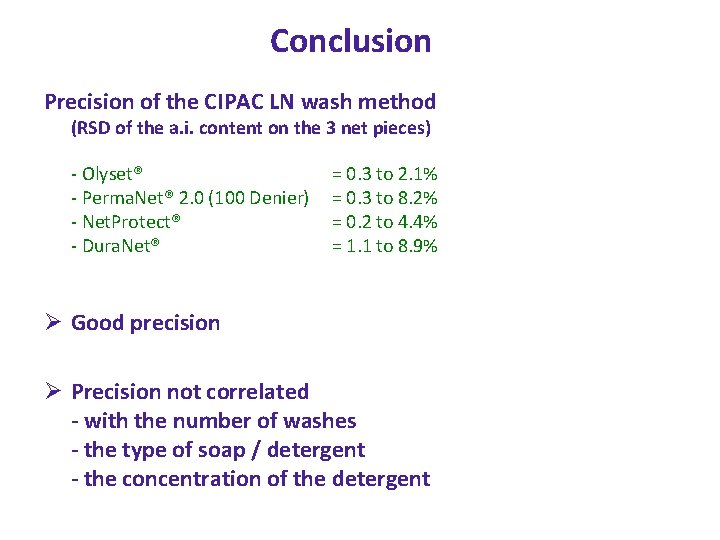
Conclusion Precision of the CIPAC LN wash method (RSD of the a. i. content on the 3 net pieces) - Olyset® - Perma. Net® 2. 0 (100 Denier) - Net. Protect® - Dura. Net® = 0. 3 to 2. 1% = 0. 3 to 8. 2% = 0. 2 to 4. 4% = 1. 1 to 8. 9% Ø Good precision Ø Precision not correlated - with the number of washes - the type of soap / detergent - the concentration of the detergent
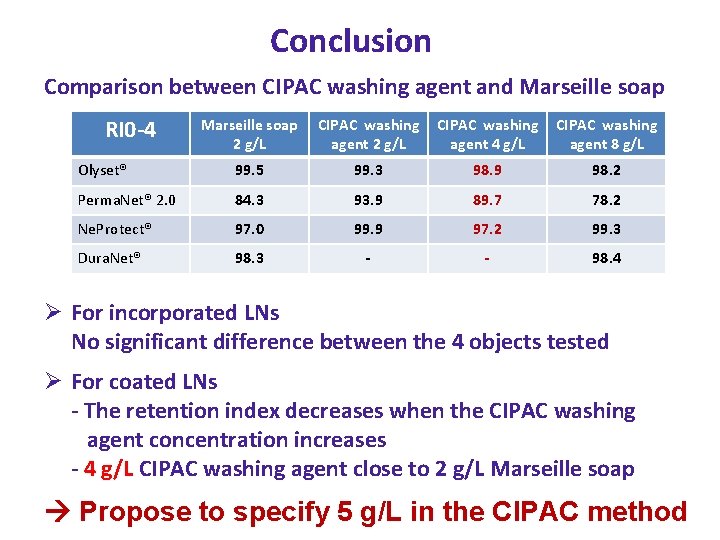
Conclusion Comparison between CIPAC washing agent and Marseille soap RI 0 -4 Marseille soap 2 g/L CIPAC washing agent 4 g/L CIPAC washing agent 8 g/L Olyset® 99. 5 99. 3 98. 9 98. 2 Perma. Net® 2. 0 84. 3 93. 9 89. 7 78. 2 Ne. Protect® 97. 0 99. 9 97. 2 99. 3 Dura. Net® 98. 3 - - 98. 4 Ø For incorporated LNs No significant difference between the 4 objects tested Ø For coated LNs - The retention index decreases when the CIPAC washing agent concentration increases - 4 g/L CIPAC washing agent close to 2 g/L Marseille soap Propose to specify 5 g/L in the CIPAC method
Thank you for your attention “LNPAC” Olivier Pigeon (CRA-W, Gembloux) Yumiko Kozuki (Sumitomo) Tsunehisa Fujita (Sumitomo) Markus Mueller (Agroscope, Waedenswil) Bruno Patrian (Agroscope, Waedenswil) Martin Rodler (Syngenta)