
Development of a calibration concept for the MErcury
Development of a calibration concept for the MErcury Thermal Infrared Spectrometer Thomas Saeuberlich, Eckehard Lorenz, Wolfgang Skrbek, Ingo Walter, Carsten Paproth, Joern Helbert German Aerospace Center (DLR) Optical Information Systems Rutherfordstr. 2, 12489 Berlin, Germany Folie 1 AITA 9, MERTIS Team – MERTIS Calibration, Oct 2007
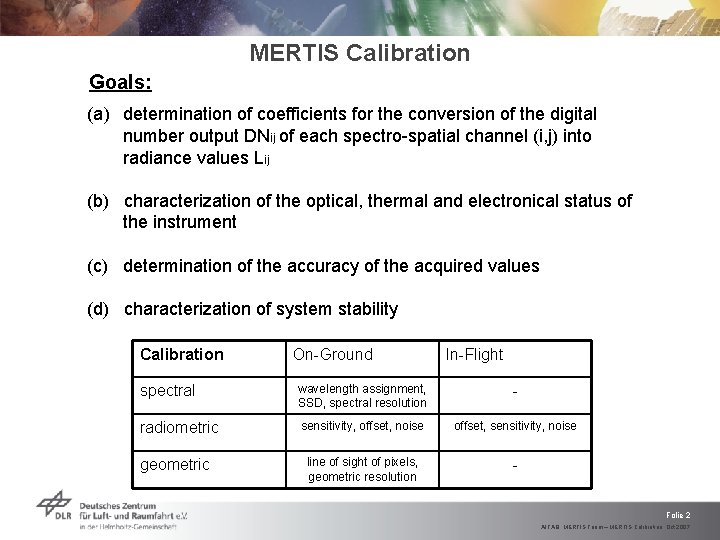
MERTIS Calibration Goals: (a) determination of coefficients for the conversion of the digital number output DNij of each spectro-spatial channel (i, j) into radiance values Lij (b) characterization of the optical, thermal and electronical status of the instrument (c) determination of the accuracy of the acquired values (d) characterization of system stability Calibration On-Ground In-Flight spectral wavelength assignment, SSD, spectral resolution - radiometric sensitivity, offset, noise offset, sensitivity, noise line of sight of pixels, geometric resolution - geometric Folie 2 AITA 9, MERTIS Team – MERTIS Calibration, Oct 2007
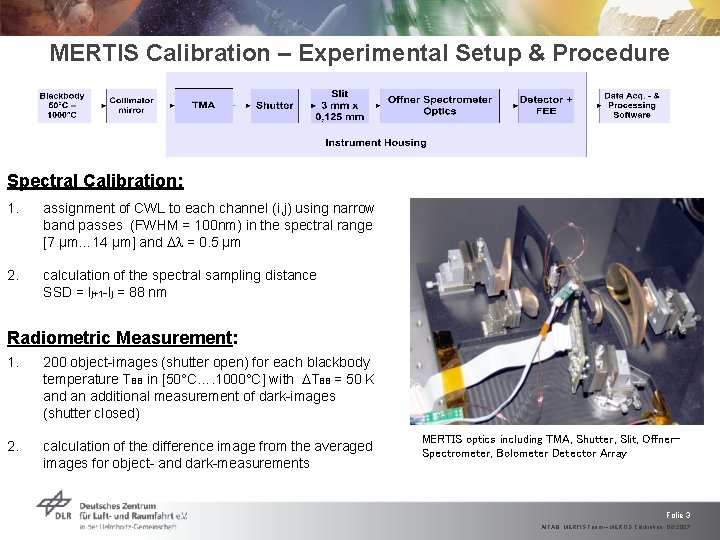
MERTIS Calibration – Experimental Setup & Procedure Spectral Calibration: 1. assignment of CWL to each channel (i, j) using narrow band passes (FWHM = 100 nm) in the spectral range [7 µm… 14 µm] and Dl = 0. 5 µm 2. calculation of the spectral sampling distance SSD = lj+1 -lj = 88 nm Radiometric Measurement: 1. 200 object-images (shutter open) for each blackbody temperature TBB in [50°C…. 1000°C] with DTBB = 50 K and an additional measurement of dark-images (shutter closed) 2. calculation of the difference image from the averaged images for object- and dark-measurements MERTIS optics including TMA, Shutter, Slit, Offner. Spectrometer, Bolometer Detector Array Folie 3 AITA 9, MERTIS Team – MERTIS Calibration, Oct 2007
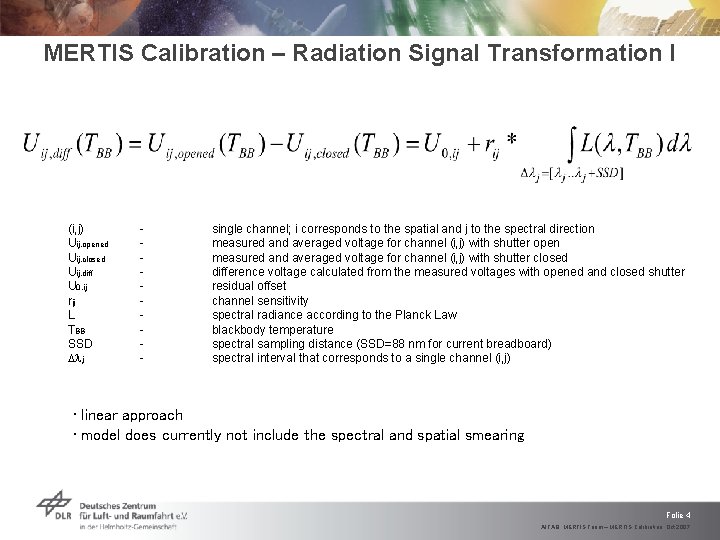
MERTIS Calibration – Radiation Signal Transformation I (i, j) Uij, opened Uij, closed Uij, diff U 0, ij rij L TBB SSD Dlj - single channel; i corresponds to the spatial and j to the spectral direction measured and averaged voltage for channel (i, j) with shutter open measured and averaged voltage for channel (i, j) with shutter closed difference voltage calculated from the measured voltages with opened and closed shutter residual offset channel sensitivity spectral radiance according to the Planck Law blackbody temperature spectral sampling distance (SSD=88 nm for current breadboard) spectral interval that corresponds to a single channel (i, j) • linear approach • model does currently not include the spectral and spatial smearing Folie 4 AITA 9, MERTIS Team – MERTIS Calibration, Oct 2007

MERTIS Calibration – Radiation Signal Transformation II blackbody @ 50°C e tur • calculation of the calibration coefficients (residual offset U 0 and sensitivity rij) by a linear fit ra pe ob • verification of linear dependence between the incoming (integrated) radiance and the measured voltages for channel (88, 88) m t te jec spectral direction (index j) spatial direction (index i) blackbody @ 1000°C 6. 3µm 16. 8 µm 37 < i < 137 slit height The cross marks channel (i, j) = (88, 88) that corresponds to a spectral position of 9µm within the area illuminated by the blackbody Folie 5 AITA 9, MERTIS Team – MERTIS Calibration, Oct 2007
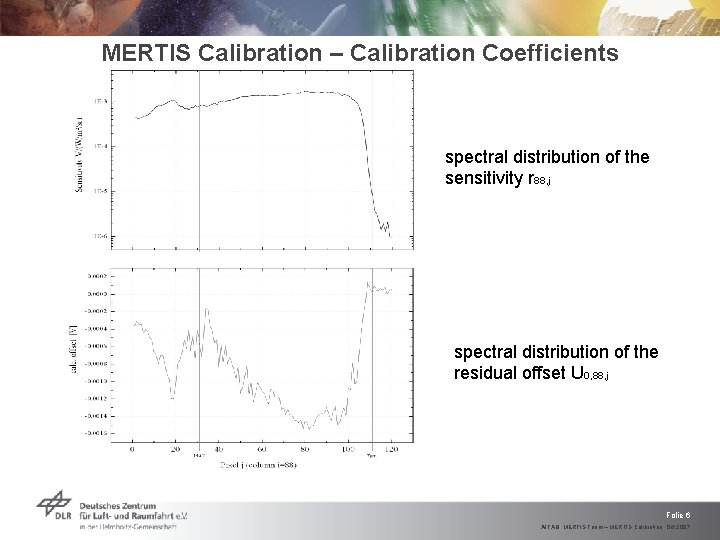
MERTIS Calibration – Calibration Coefficients spectral distribution of the sensitivity r 88, j spectral distribution of the residual offset U 0, 88, j Folie 6 AITA 9, MERTIS Team – MERTIS Calibration, Oct 2007
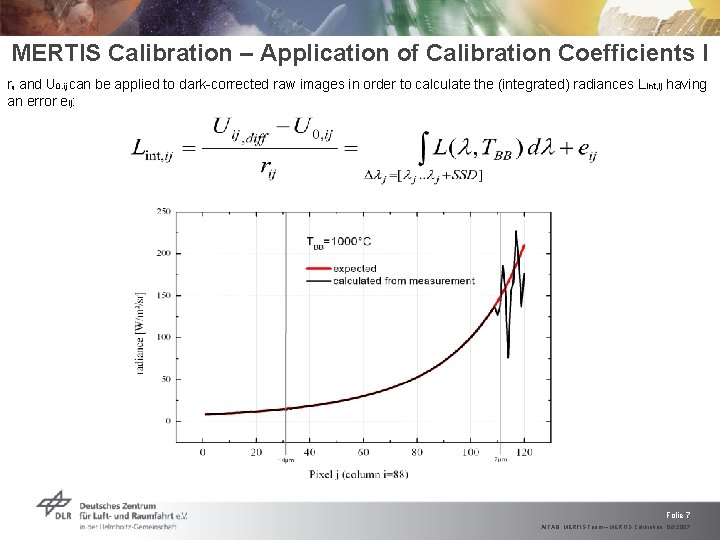
MERTIS Calibration – Application of Calibration Coefficients I rij and U 0, ij can be applied to dark-corrected raw images in order to calculate the (integrated) radiances Lint, ij having an error eij: Folie 7 AITA 9, MERTIS Team – MERTIS Calibration, Oct 2007
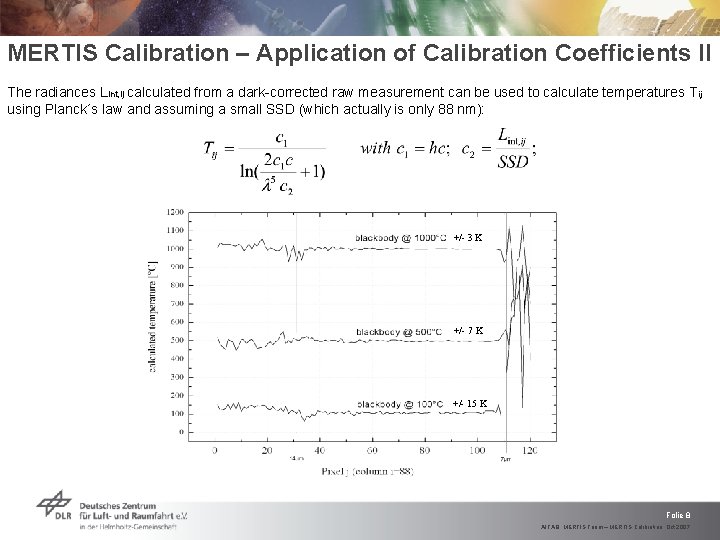
MERTIS Calibration – Application of Calibration Coefficients II The radiances Lint, ij calculated from a dark-corrected raw measurement can be used to calculate temperatures Tij using Planck´s law and assuming a small SSD (which actually is only 88 nm): +/- 3 K +/- 7 K +/- 15 K Folie 8 AITA 9, MERTIS Team – MERTIS Calibration, Oct 2007
MERTIS Calibration – Conclusion • a spectro-radiometric calibration procedure for 1 st MERTIS prototype has been developed • 2 -step background correction used • linear approach for modeling the signal transformation from an incoming radiance into a measured voltage • approach verified by calculating the temperature of the reference radiator for each spectral channel in the spectral interval [7 µm… 14 µm] • the temperature error is ± 3 K…± 15 K depending on the object temperature (1000°C – 100°C) • topics of the following investigations: • model has to be extended by the spectral and spatial smearing effects caused by the optics • determination of the spectral and spatial resolution Folie 9 AITA 9, MERTIS Team – MERTIS Calibration, Oct 2007
- Slides: 9