
DEVELOPMENT EXPERIENCE 1947 1990 ON THE EVE OF

- Slides: 17
DEVELOPMENT EXPERIENCE 1947 1990
ON THE EVE OF INDEPENDENCE Indian Economy – Before the British Rule: Independent Economy � Indian Economy During the British Rule: Was it a Vibrant or a Stagnant Economy? Was it a Backward or a Developing Economy? � Analysis of performance in the : Agricultural Sector Industrial Sector Foreign Trade Demographic Profile of the country Occupational Structure Economic & Social Infrastructure �
ON THE EVE OF INDEPENDENCE Supplier of raw material Consumer of finished goods Growth by only 2% in the first half of the 20 th Century
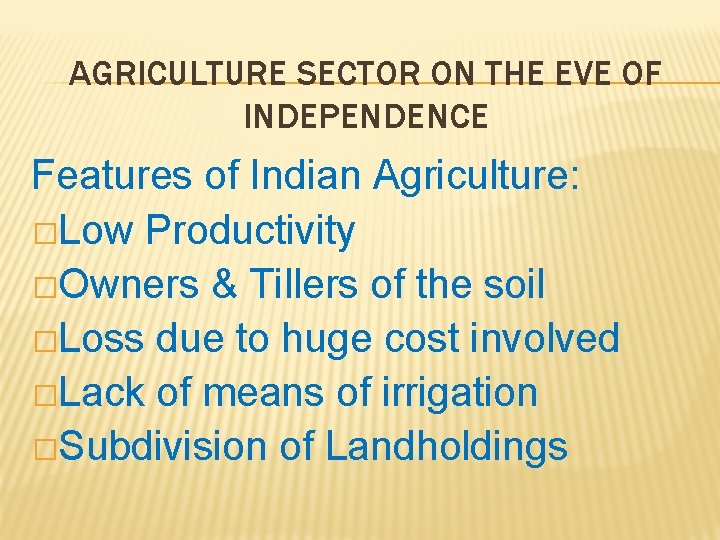
AGRICULTURE SECTOR ON THE EVE OF INDEPENDENCE Features of Indian Agriculture: �Low Productivity �Owners & Tillers of the soil �Loss due to huge cost involved �Lack of means of irrigation �Subdivision of Landholdings
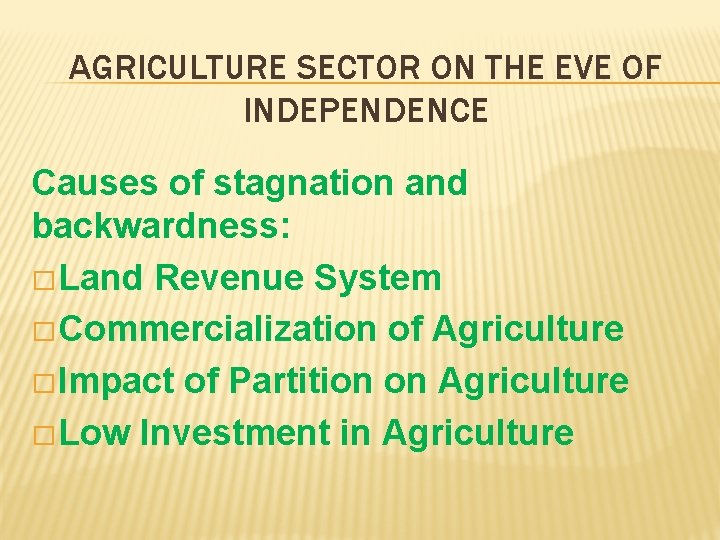
AGRICULTURE SECTOR ON THE EVE OF INDEPENDENCE Causes of stagnation and backwardness: � Land Revenue System � Commercialization of Agriculture � Impact of Partition on Agriculture � Low Investment in Agriculture
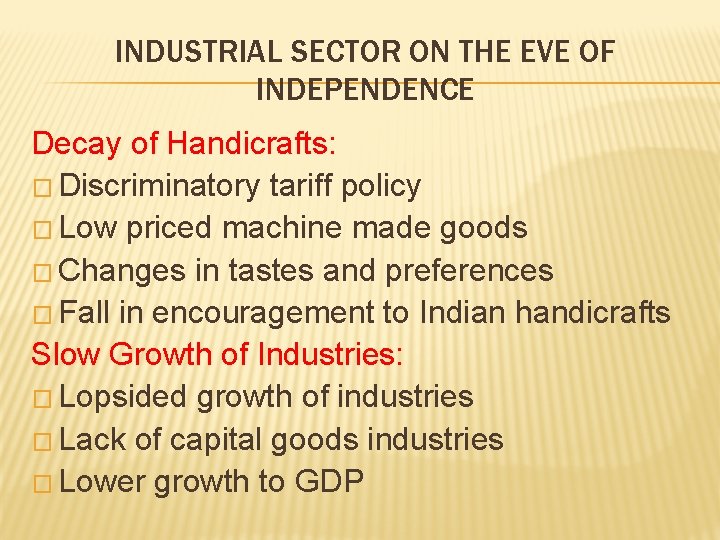
INDUSTRIAL SECTOR ON THE EVE OF INDEPENDENCE Decay of Handicrafts: � Discriminatory tariff policy � Low priced machine made goods � Changes in tastes and preferences � Fall in encouragement to Indian handicrafts Slow Growth of Industries: � Lopsided growth of industries � Lack of capital goods industries � Lower growth to GDP
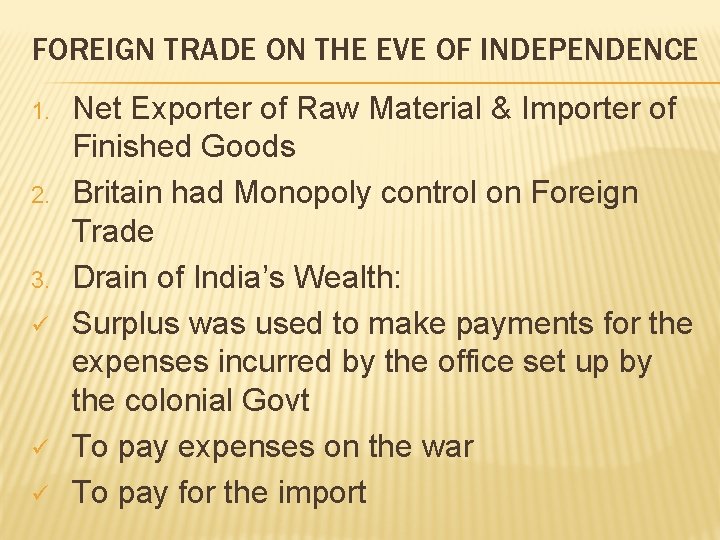
FOREIGN TRADE ON THE EVE OF INDEPENDENCE 1. 2. 3. ü ü ü Net Exporter of Raw Material & Importer of Finished Goods Britain had Monopoly control on Foreign Trade Drain of India’s Wealth: Surplus was used to make payments for the expenses incurred by the office set up by the colonial Govt To pay expenses on the war To pay for the import
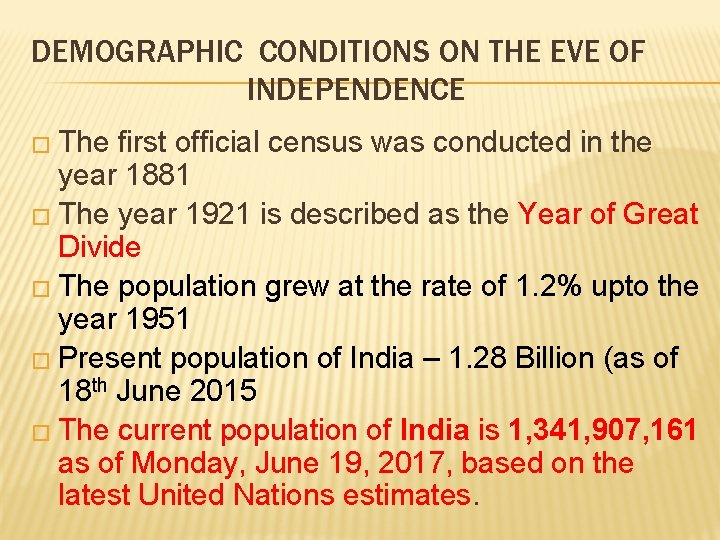
DEMOGRAPHIC CONDITIONS ON THE EVE OF INDEPENDENCE � The first official census was conducted in the year 1881 � The year 1921 is described as the Year of Great Divide � The population grew at the rate of 1. 2% upto the year 1951 � Present population of India – 1. 28 Billion (as of 18 th June 2015 � The current population of India is 1, 341, 907, 161 as of Monday, June 19, 2017, based on the latest United Nations estimates.
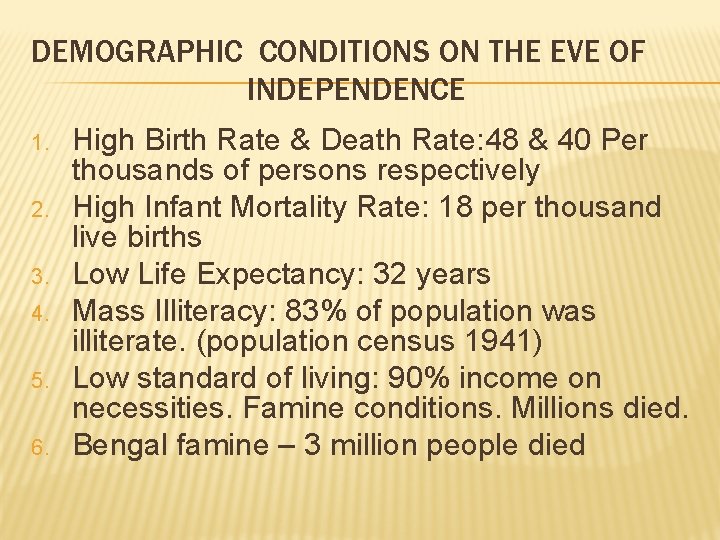
DEMOGRAPHIC CONDITIONS ON THE EVE OF INDEPENDENCE 1. 2. 3. 4. 5. 6. High Birth Rate & Death Rate: 48 & 40 Per thousands of persons respectively High Infant Mortality Rate: 18 per thousand live births Low Life Expectancy: 32 years Mass Illiteracy: 83% of population was illiterate. (population census 1941) Low standard of living: 90% income on necessities. Famine conditions. Millions died. Bengal famine – 3 million people died
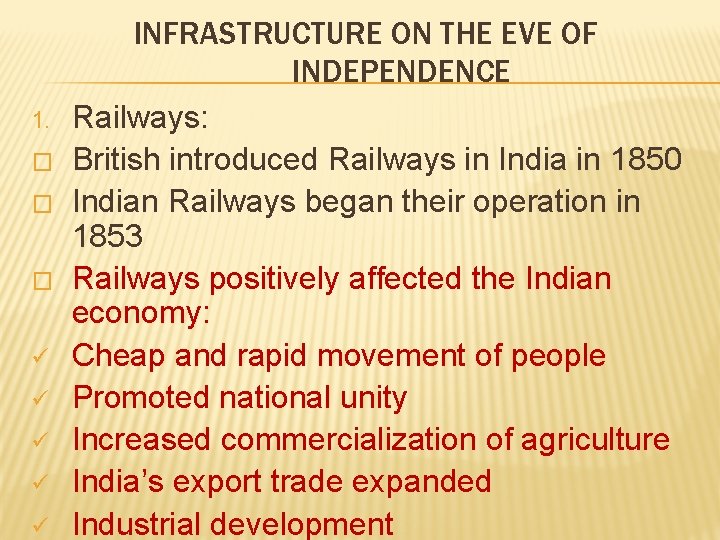
1. � � � ü ü ü INFRASTRUCTURE ON THE EVE OF INDEPENDENCE Railways: British introduced Railways in India in 1850 Indian Railways began their operation in 1853 Railways positively affected the Indian economy: Cheap and rapid movement of people Promoted national unity Increased commercialization of agriculture India’s export trade expanded Industrial development
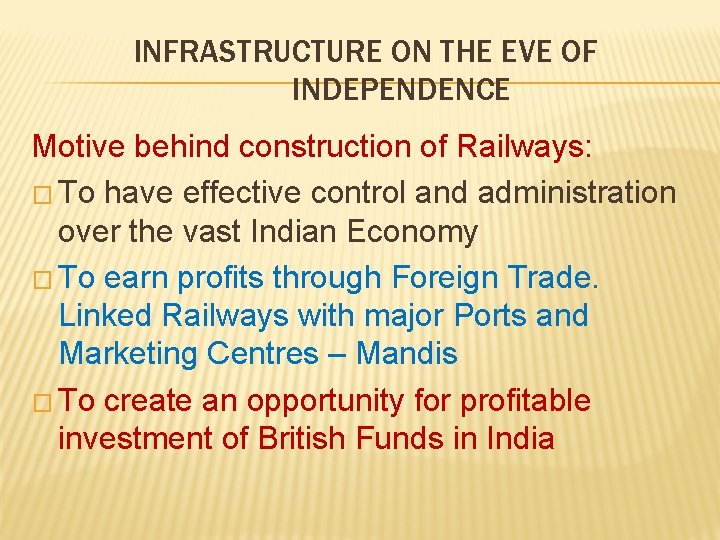
INFRASTRUCTURE ON THE EVE OF INDEPENDENCE Motive behind construction of Railways: � To have effective control and administration over the vast Indian Economy � To earn profits through Foreign Trade. Linked Railways with major Ports and Marketing Centres – Mandis � To create an opportunity for profitable investment of British Funds in India
INFRASTRUCTURE ON THE EVE OF INDEPENDENCE 2. Roads: � Roads were built primarily to mobilize army within India � For carrying raw materials to the nearest railway station or ports to be sent to Britain 3. Communication: � Modern Postal System started in India in 1837 � Telecommunication was introduced in India � First Telegraphy line was opened in 1857
OCCUPATIONAL STRUCTURE ON THE EVE OF INDEPENDANCE Distribution of workforce among different sectors � Pre- dominance of Agriculture sector: Primary Sector – 72. 7% Secondary Sector – 17. 2% Tertiary Sector – 10. 6% � Growing Regional Variation: Tamilnadu, Andhrapradesh, Kerala, Karnataka, West Bengal - dependence reduced Orissa, Punjab , Rajastahan – dependence increased
IMPACT OF BRITISH RULE ON OUR ECONOMY Positive Effects: 1. Commercialization of Agriculture 2. Spread of Railways, Roadways & Communication – economic & social growth. Greater cultural affinity, support system to combat famines 3. Efficient System of Administrationready reckoner for the politicians & planners 4. Significant transition from barter system to monetary system of exchange
IMPACT OF BRITISH RULE ON OUR ECONOMY Negative Effects: 1. Commercialization of Agriculture led to famines and scarcities 2. New Land Revenue System led to stagnation, backwardness and fall in productivity of land 3. Decline of Handicrafts: a) Industrial Revolution b) Decline of Princely Courts c) New class that was influenced by