
DEVELOPMENT ECONOMICS ECO 323 LECTURE NOTE PREPARED BY
DEVELOPMENT ECONOMICS (ECO 323) LECTURE NOTE PREPARED BY MR. ALADEJANA S. A COLLEGE OF MANAGEMENT & SOCIAL SCIENCES DEPARTMENT OF ECONOMICS SAMUEL ADEGBOYEGA UNIVERSITY, OGWA, EDO STATE, NIGERIA.
COURSE OUTLINE � � � � Meaning and Measurement of Economic Development. Theories of Economic Development. Structure Features of Underdevelopment. Classical theory of Development. Rowstow stage theory. Marxian theory of Development. The Lewis theory of Economic Development. Modern theories of Development.

MEANING AND MEASUREMENT OF ECONOMIC DEVELOPMENT The term development may mean different things to difference people, it is important that we have some working definition or care perspective on its meaning. Without such a perspective and some agreed measurement criteria, we would be unable to determine which country was actually developing and which was not. (1)Traditional Economic measures or perspective. (2)The New Economic view of Development.
THREE CORE VALUES OF DEVELOPMENT The appropriate answer for developing nations today is not necessarily the same as it would have been in previous decades. But at least three basic components or core value serve as a conceptual basic and practical guideline for understanding the inner meaning of development. These core values are-: 1. Sustenance: The ability to meet basic needs. 2. Self-Esteem: To be a person 3. Freedom from servitude: To be able to choose. 2. Self-Esteem: To be a person
The Three Objectives of Development 1. To increase the availability and distribution of basic life-sustaining goods such as food, shelter, health, and protection, 2. To raise levels of living. 3. To expand the range of economic and social choices available to individuals and nations.

INDEXS FOR MEATURING ECONOMIC DEVELOPMENT. � � � � Economic Development can be measured by certain indexes: 1. Real Gross National Product (GNP) 2. Real per capital income 3. The ratio of agriculture to industry. 4. Literacy rate. 5. Life Expectancy. 6. Per capita food production. 7. Output worker ratio.
TOPIC 2. CLASSICAL THEORY OF DEVELOPMENT 1. 2. Classical theory of development 2. The critical evaluation of the Classical theory of Development.
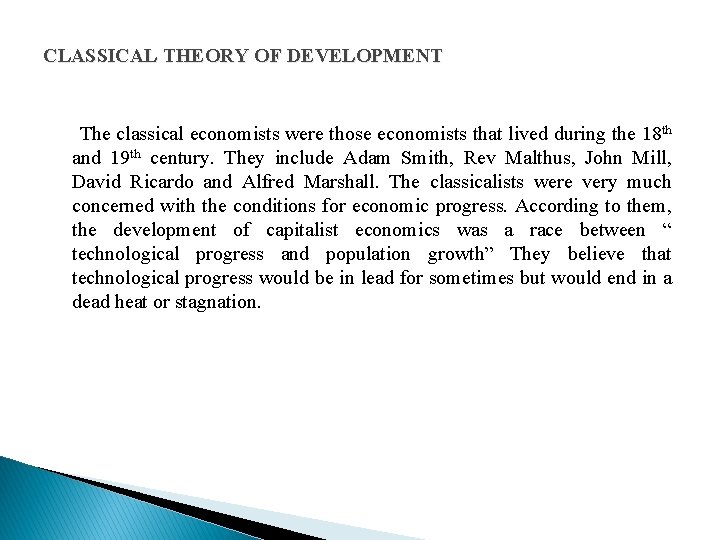
CLASSICAL THEORY OF DEVELOPMENT The classical economists were those economists that lived during the 18 th and 19 th century. They include Adam Smith, Rev Malthus, John Mill, David Ricardo and Alfred Marshall. The classicalists were very much concerned with the conditions for economic progress. According to them, the development of capitalist economics was a race between “ technological progress and population growth” They believe that technological progress would be in lead for sometimes but would end in a dead heat or stagnation.
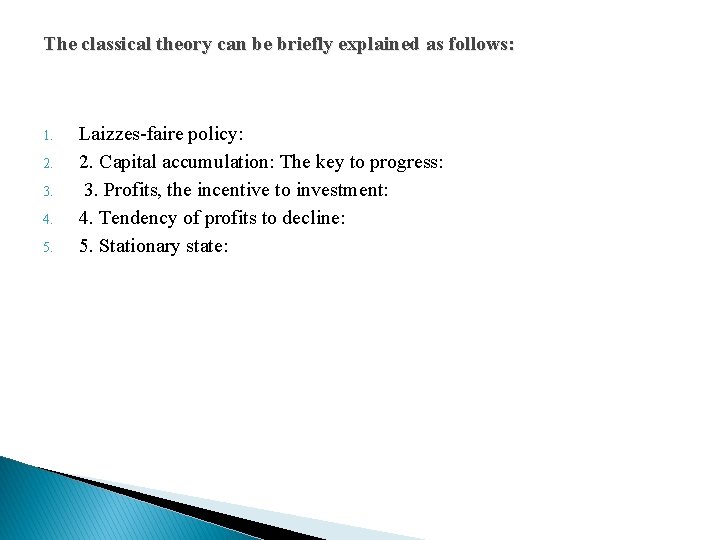
The classical theory can be briefly explained as follows: 1. 2. 3. 4. 5. Laizzes-faire policy: 2. Capital accumulation: The key to progress: 3. Profits, the incentive to investment: 4. Tendency of profits to decline: 5. Stationary state:
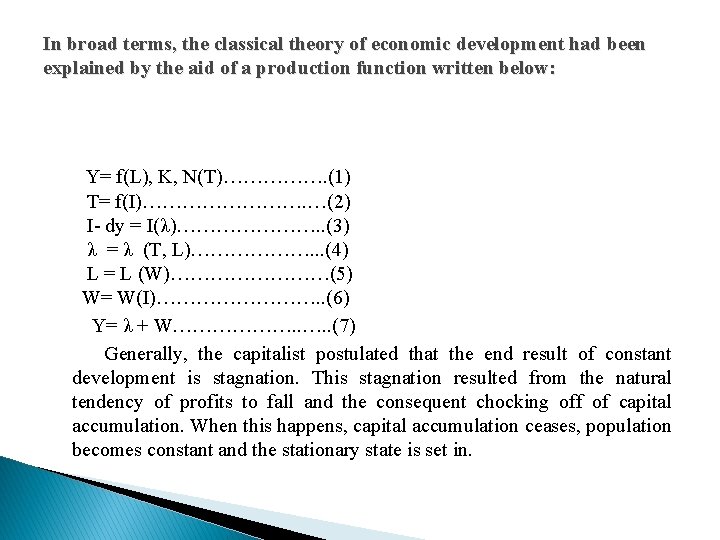
In broad terms, the classical theory of economic development had been explained by the aid of a production function written below: Y= f(L), K, N(T)……………. (1) T= f(I)…………. …(2) I- dy = I(λ)…………………. . (3) λ = λ (T, L)………………. . . (4) L = L (W)…………(5) W= W(I)…………. . (6) Y= λ + W………………. . (7) Generally, the capitalist postulated that the end result of constant development is stagnation. This stagnation resulted from the natural tendency of profits to fall and the consequent chocking off of capital accumulation. When this happens, capital accumulation ceases, population becomes constant and the stationary state is set in.
TOPIC 3. ROWSTOW STAGE THEORY. 1. Introduction 2. The five stages of Economic Growth 3. Critical Appraisal of Rows tow's Growth theory. Introduction W. W Rowstow is a stage theorist of economic growth. He looked at the stage of economic growth through the capitalism framework. He distinguishes five of economic growth: 1. The traditional society 2. The pre-conditions for take off 3. The take off 4. The drive to maturity and 5. The stage of high mass consumption.
CRITICAL APPRAISAL OF ROWSTOW’S GROWTH THEORY: Rowstow’ s growth theory is the widely circulated and highly commented piece of economic literature. Nevertheless, it has been severally criticized, and its authenticity defeated for several reasons. 1. Traditional society not essential for development: 2. Overlapping in the stages: 3. countries need not follow the same path to development: 4. take-off stage criticized: 5. The stage of drive to maturity is misleading:
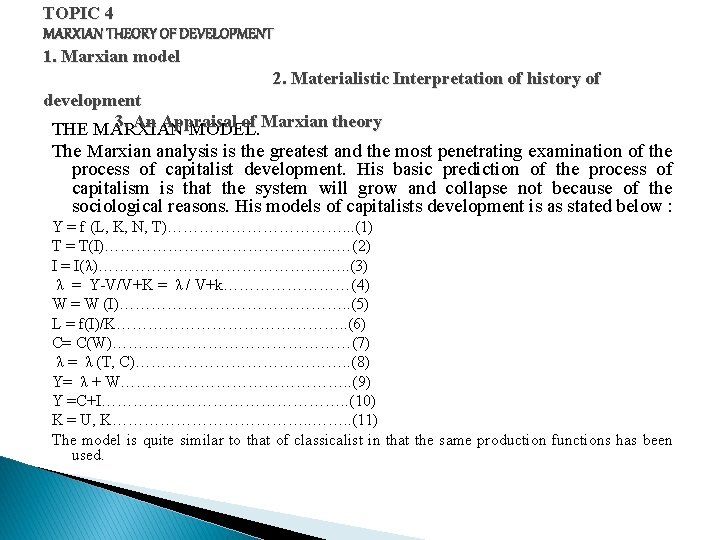
TOPIC 4 MARXIAN THEORY OF DEVELOPMENT 1. Marxian model 2. Materialistic Interpretation of history of development 3. An Appraisal of Marxian theory THE MARXIAN MODEL. The Marxian analysis is the greatest and the most penetrating examination of the process of capitalist development. His basic prediction of the process of capitalism is that the system will grow and collapse not because of the sociological reasons. His models of capitalists development is as stated below : Y = f (L, K, N, T)………………. . . (1) T = T(I)…………………. . …(2) I = I(λ)…………………. …. . (3) λ = Y-V/V+K = λ / V+k…………(4) W = W (I)…………………. . (5) L = f(I)/K…………………. . (6) C= C(W)……………………(7) λ = λ (T, C)…………………. . (8) Y= λ + W…………………. . (9) Y =C+I……………………. . (10) K = U, K………………. . (11) The model is quite similar to that of classicalist in that the same production functions has been used.
2. Materialistic interpretation of history of development. 3. The motivating forces of capitalist development. 4. The alternative path of planned economic development. 5. capitalist Crisis. 6. An appraisal of Marxian theory. 7. Other side of the coins.
TOPIC 5 MODERN THEORIES OF DEVELOPMENT 1. 2. 3. 4. 5. The vicious circle of poverty. The Dualistic Economy. Harrod-Domar theories Balance and unbalanced growth Schumpeterian theories. 6. The Vicious circle of poverty 7. Critical Appraisal of theory of vicious circle of poverty
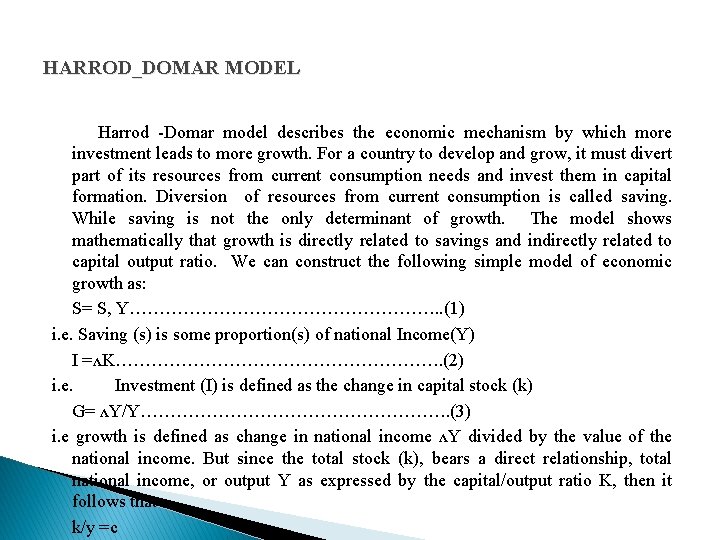
HARROD_DOMAR MODEL Harrod -Domar model describes the economic mechanism by which more investment leads to more growth. For a country to develop and grow, it must divert part of its resources from current consumption needs and invest them in capital formation. Diversion of resources from current consumption is called saving. While saving is not the only determinant of growth. The model shows mathematically that growth is directly related to savings and indirectly related to capital output ratio. We can construct the following simple model of economic growth as: S= S, Y………………………. . (1) i. e. Saving (s) is some proportion(s) of national Income(Y) I =ᴧK………………………. (2) i. e. Investment (I) is defined as the change in capital stock (k) G= ᴧY/Y………………………. (3) i. e growth is defined as change in national income ᴧY divided by the value of the national income. But since the total stock (k), bears a direct relationship, total national income, or output Y as expressed by the capital/output ratio K, then it follows that k/y =c
Topic 5 SHUMPETERIAN THEORY OF DEVELOPMENT In his influential book tilled “ theory of economic development” Joseph Shumpeter explains development in terms of entrepreneurship and innovation. According to him, economic backwardness in many countries may quite legitimately be traced back to relative shortage of inventors and innovators. According to him, innovation can take place in many of four different ways. 1. Introduction of new goods or a new quality of a new source of supply. 2. Discovery of new method pf production 3. The opening of new market and 4. The location of new source of supply. Each of these contains the seeds for increased productivity within the economy and offers a possible expansion path to growth and development.
The practical examples of the different types of innovation Schumpeter mentioned are listed below: 1. 2. 3. 4. 5. New type of goods: New quality of goods: New method of productions: New markets: New source of supply:
THE ROLES OF INNOVATION IN DEVELOPMENT 1. 2. 3. Schumpeter explain that innovation do cause economic growth without involving in due expenditures of capital or interlocking investment plans. Innovation if occurs will reduce the need for skilled labour thereby freeing a scare resource for use in other parts of the economy. Innovation in one area may also indirectly provide external peculiarly or a reduction in the cost of producing it.
TEXT 1. Economic Development: By Michael P. Todaro and Stephen C. Smith. 2. Development Economics, Theories and Application: By Bakare A. S 3. Growth and Development: By A. P. Thiriwal. 4. Theory of Economic Growth: By Lewis, W. Arthure.
ASSINGMENT Vividly discuss the following theories 1. The Lewis theory of economic development. 2. The dualistic economy. 3. Theories of balanced and unbalanced growth.
- Slides: 21