
DEVELOPMENT CRITERIA CURRICULUM AUTHORITY AND YOUR COMMITTEE Brief
DEVELOPMENT CRITERIA, CURRICULUM AUTHORITY, AND YOUR COMMITTEE
Brief Overview - Authority for Curriculum Approvals Responsibility in Curriculum Approvals: Development and Approval Criteria Appropriateness to Mission Need Curriculum Standards Adequate Resources Compliance When Authority and Desire Clash – Discussion on Managing Proposals that Don’t Meet Criteria IN THIS PRESENTATION…
BRIEF OVERVIEW OF APPROVAL AUTHORITY
California Education Code § 70902(b)(7) “The governing board of each district shall establish procedures to ensure. . . the right of academic senates to assume primary responsibility for making recommendations in the areas of curriculum and academic standards. ” CURRICULUM AUTHORITY – ACADEMIC SENATES Title 5 § 53200 lists the following as “academic and professional matters” or “ 10+1”: • curriculum, including establishing prerequisites and placing courses within disciplines; • degree and certificate requirements; • grading policies; • educational program development; • standards or policies regarding student preparation and success;
Title 5 § 55002 : CURRICULUM AUTHORITY – CURRICULUM COMMITTEES The college and/or district curriculum committee recommending the course shall be established by the mutual agreement of the college and/or district administration and the academic senate. The committee shall be either a committee of the academic senate or a committee that includes faculty and is otherwise comprised in a way that is mutually agreeable to the college and/or district administration and the academic senate.

• Curriculum recommended by Curriculum Committees to Governing Boards for approval. CURRICULUM AUTHORITY – LOCAL BOARDS AND CCCCO • CEC § 70902 “The [local] governing board shall establish policies for, and approve, individual courses that are offered in approved educational programs without referral to the board of governors. ” etc. • New rules for local approval, annual certification, and periodic audits. • Curriculum approved by the local governing board submitted to the CO for either chaptering or approval, depending on the type of curriculum.
DEVELOPMENT CRITERIA Looking at the Big Picture in Curriculum Development and Approval
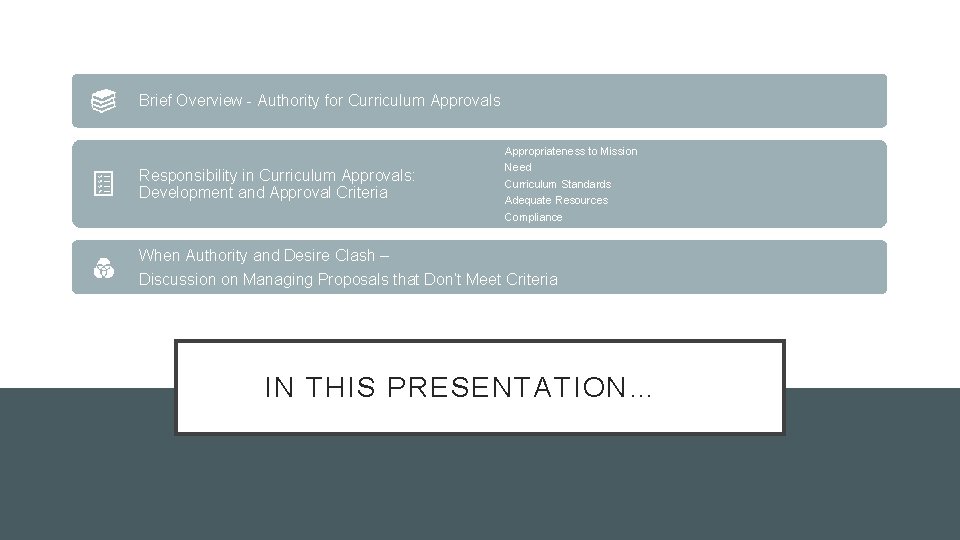
Local curriculum approval assures that each proposal meets five criteria: • Appropriateness to Mission • Need • Curriculum Standards • Adequate Resources • Compliance Fleshes out the “big picture” in approval processes. DEVELOPMENT CRITERIA
“The stated goals and objectives of the proposed program, or the objectives defined in the Course Outline of Record, must be consistent with the mission of the community colleges as established by the Legislature in California Education Code section 66010. 4. ” Basic Considerations for Committee Approval • Must be directed at the appropriate level for community colleges; that is, it must not be directed at a level beyond the associate degree or the first two years of college. • Must address a valid transfer, occupational, basic skills, civic education, or lifelong learning purpose. It must not be primarily avocational or recreational. • Should also be congruent with the mission statement and master plan of the college and district. APPROPRIATENESS TO MISSION
NEED “The proposal must demonstrate a need for a program or course that meets the stated goals and objectives in the region the college proposes to serve with the program. “ Need can be determined by multiple factors, including: • Educational master planning • Needs arising from program review • Documented labor market demand • Student demand for transfer preparation in a specific major or for general education • Student need for college preparation course work leading to collegiate courses. “Furthermore, a proposed new program must not cause harmful competition with an existing program at another college. ”
Title 5 mandates that all credit and noncredit curriculum must be approved by the college curriculum committee and district governing board (pursuant to chapter 6, subchapter 2, beginning with § 55100) as meeting the standards outlined in §§ 55000 et seq. For program approval, documentation required to ensure: • The program is designed so that successful completion of the program requirements will enable students to fulfill the program goals and objectives. • Programs and courses are integrated, with courses designed to effectively meet their objectives and the goals and objectives of the programs for which they are required. • Course outlines of record meet all the requirements of title 5, section 55002 for credit and noncredit course requirements. CURRICULUM STANDARDS
ADEQUATE RESOURCES “The college must demonstrate that it has the resources to realistically maintain the program or course at the level of quality described in the application. “ This includes assurance of sufficient funding for: • Faculty compensation, • Facilities and equipment and library or learning resources and the college must demonstrate that • Offering the course(s) at the level of quality described in the Course Outline(s) of Record Further, the college “must commit to offering all of the required courses for the program at least once every two years, unless the goals and rationale for the particular program justify a longer time frame as being in the best interests of students. ”
“It is also required that the design of the program or the course is not in conflict with any law including state and federal laws, both statutes and regulations. “ PCAH 6 th Edition Some of the title 5 sections to note are: • Open course regulations [Cal Code Regs, tit 5, § 51006] • Course repeatability regulations [Cal. Code Regs. , tit. 5, § 55040 -55046 and 58161] • Regulations regarding tutoring and learning assistance [Cal. Code Regs. , tit. 5, §§ 58168 -58172] • Regulations regarding open-entry open exit courses [Cal. Code Regs. , tit. 5, § 58164] • Statutes and regulations on student fees [Cal. Code Regs. , tit. 5, §§ ? ? ] • Prerequisite and enrollment limitation regulations [Cal. Code Regs. , tit. 5, § 55003] • Particular provisions of the Nursing Practice Act [title 16] COMPLIANCE

WHEN PROPOSALS DON’T MEET CRITERIA
• Local practices vary; not all criteria are evaluated by curriculum committees ABOUT THE DEVELOPMEN T CRITERIA • Some colleges and districts delegate review and endorsement of some criteria to other processes, e. g. departmental administrative Question to consideror during this presentation: how does your college review these review, CIO handle review, techof review, etc. elements? Good practice for the five criteria to be explicitly discussed as part of new curriculum approval process to ensure adequate review and input from faculty and local senates.
QUESTIONS • Does does your curriculum committee evaluate the five criteria in the approval process? • If so, how is this review conducted? Who participates? • Are faculty trained or informed about these criteria prior to developing curriculum or making major revisions? • What are the common disputes managed by your committee? How does your committee handle disputes related to approval and development criteria?
COMMON SCENARIOS Scenario #1 Scenario #3 ”Is this a lower division course? ” “How many hours and units are you proposing for this new AB 705 support course? ” Scenario #2 “Do we have enough faculty to offer this course in the next two years? ” Scenario #4 “What documentation are you presenting that supports the need for this program? ”

THANK YOU!
- Slides: 18