
Development and Young Dual Language Learners What are
- Slides: 43
Development and Young Dual Language Learners: What are Appropriate Outcomes? Linda M. Espinosa, Ph. D Espinosal@missouri. edu. NECTAC October 28, 2012 1 2/24/2021
Definition of DLLs “Dual language learners are children learning two or more languages at the same time, as well as those learning a second language while continuing to develop their first (or home) language. ” (p. 1) Definition includes simultaneous and sequential second language learners Distinctions are usually made in literature Includes English language learners (ELL) and English as a Second Language (ESL) students 2 2/24/2021
Dual Language Learners are “At Risk” for Low Levels Academic Achievement 3 2/24/2021
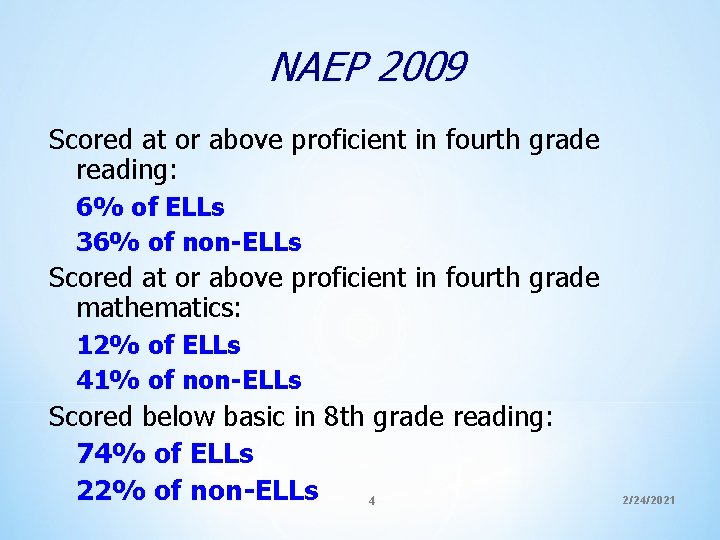
NAEP 2009 Scored at or above proficient in fourth grade reading: 6% of ELLs 36% of non-ELLs Scored at or above proficient in fourth grade mathematics: 12% of ELLs 41% of non-ELLs Scored below basic in 8 th grade reading: 74% of ELLs 22% of non-ELLs 4 2/24/2021
Underserved or Inappropriately Served Population ØAttendance/Participation Rates ØAchievement Patterns: K Entry; Third/Fourth Grade Reading and Math Scores ØHigh School Completion and College Matriculation and Graduation ØAdult Incomes; Percent in Poverty 5 2/24/2021
Recent Quality Improvement Efforts u. RTT: Early Learning Challenge Grants u. Intent: Improve early learning and development outcomes and K readiness for Children with High Needs u. Requires: Comprehensive Assessment System aligned with State EL & D Standards…. . Measuring outcomes and progress key tool to improve quality 6 2/24/2021
Standards>Outcomes>Assessment Ø 49 States Have Published Comprehensive Early Learning Standards (all major domains of learning) 2010 ØUp from 15 in 2001 -2002 Ø 40 States Funded Preschool Education in 20092010 Source: NIEER Yearbook, 2010 RTT ELC: Standards and assessments must be developmentally, linguistically, and culturally appropriate 7 2/24/2021
EL Standards define the desired outcomes and content of ECE *Standards support positive development and learning Only if they emphasize significant, developmentally appropriate content and outcomes. (NAEYC, 2009) *The question today is what are significant and developmentally appropriate outcomes for young DLLs. *What do we know about the development of preschool DLLs? 8 2/24/2021
Needs of Young Dual Language Learners Only “Marginally” Addressed in State Early Learning Standards Few explicitly address learning needs when children speak a language other than English in the home, e. g. , standards are written with assumption children will attain same English benchmarks in same timeframe (Ex: Understands and uses age-appropriate grammar including present, progressive, and regular past tense @48 months) * NCLR, 2010; 2009; Wright & Copeman, 2007 2/24/2021 9
Seven States Recognize Home Language Other Than English ØAcknowledge that some children will be learning through two languages ØAchievement in Home Language evidence of age-appropriate language development ØNo guidance on: ØLanguage benchmarks in English or Home language: How do the two languages interact during Pre. K years? ØLimited guidance on identification and assessment 10 2/24/2021
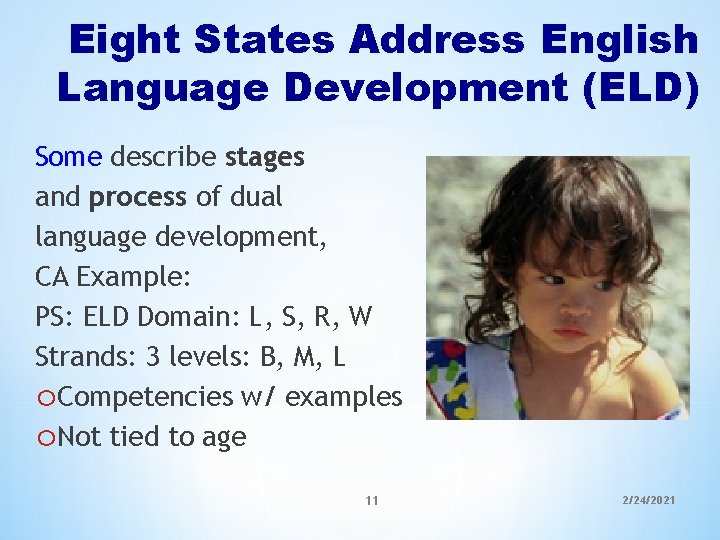
Eight States Address English Language Development (ELD) Some describe stages and process of dual language development, CA Example: PS: ELD Domain: L, S, R, W Strands: 3 levels: B, M, L o. Competencies w/ examples o. Not tied to age 11 2/24/2021
Washington and Alaska Early Learning Guidelines *Linguistic, cultural, and ethnic diversity woven throughout expectations for what and how children learn during Pre. K years Be aware and respectful of cultural differences in valuing independence; WA. Examples: Use vocabulary and phrases in children's home language when introducing new ideas or concepts 12 2/24/2021
Alaska Guidelines include indicators and strategies to support the development of children's home language while acquiring English *Alaska Ex: Goal 74, 36 -60 months: Uses sentences in home language and begins to use single word or telegraphic speech in English *Provider Strategy: 1)Help child develop reasoning skills through use of home language; 2)Devise strategies that home-school 13 collaboration to reinforce home 2/24/2021
State Early Learning Standards and Young DLLs: Summary *Most states do not explicitly address learning needs of DLLs: Assume English is language of learning and instruction *Some states address culture and language in intro principles or generally in each standard, e. g. , honor and respect home culture and language *Few states have explicit learning expectations for home language and English 14 2/24/2021
OHS Child Development and Early Learning Framework, 2010 *Intent: To improve child outcomes and *Serve as a lens for analyzing data in order to understand child progress and *To identify areas that need additional resources and attention. *Programs are to use culturally and linguistically appropriate assessments to capture what children who are DLLs know and can do in all areas of the Framework. 15 2/24/2021
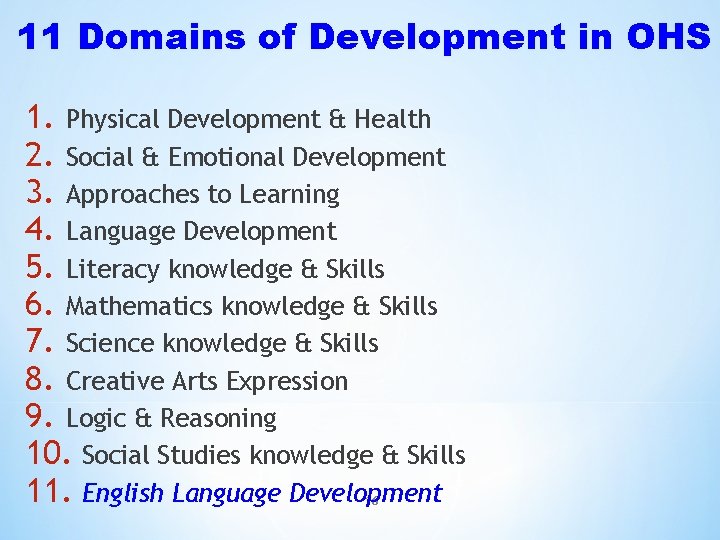
11 Domains of Development in OHS 1. Physical Development & Health 2. Social & Emotional Development 3. Approaches to Learning 4. Language Development 5. Literacy knowledge & Skills 6. Mathematics knowledge & Skills 7. Science knowledge & Skills 8. Creative Arts Expression 9. Logic & Reasoning 10. Social Studies knowledge & Skills 11. English Language Development 16
Language Development: Language and Literacy Uses increasingly complex and varied English vocabulary. OHS: EL Skills: CA: L&L: (60 months) Understands and uses increasingly longer sentences, including sentences that combine 2 -3 phrases or 2 -3 concepts CA: ELD: (Middle) Uses 2 -3 word utterances in English to communicate 17 2/24/2021
What do we know about language/literacy development of young DLLs? *In what ways are typically developing preschool DLLs the same as. . . or different from native English speakers? *How does the child's home language (L 1) influence development of English (L 2)? *Is there a typical developmental trajectory for English language development (ELD) during preschool years? 18 2/24/2021
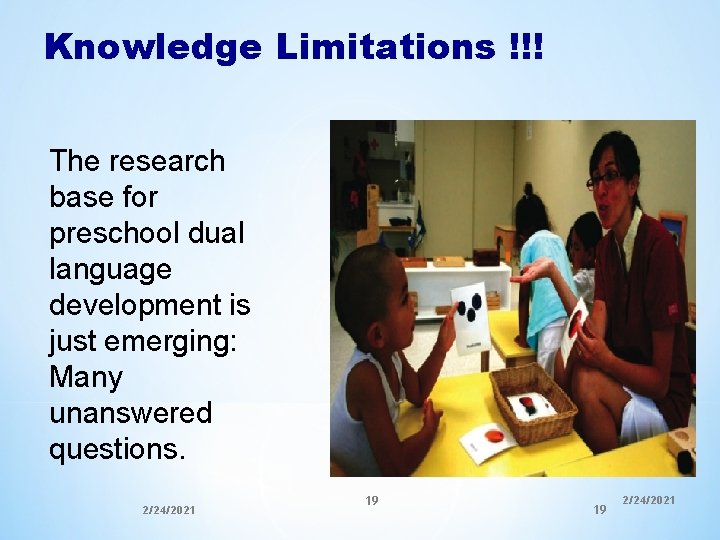
Knowledge Limitations !!! The research base for preschool dual language development is just emerging: Many unanswered questions. 2/24/2021 19 19 2/24/2021
Some Areas with Consensus Ø Babies have capacity for learning multiple languages from first year: linguistic geniuses Ø Balanced early bilingualism is possible with sufficient high quality input in both Ø Cognitive, social, family, economic advantages to bilingualism Ø Home language vulnerable to attrition Ø Proficiency in home language linked to English acquisition: some home language knowledge and skills facilitate English learning 2/24/2021 20 20 2/24/2021
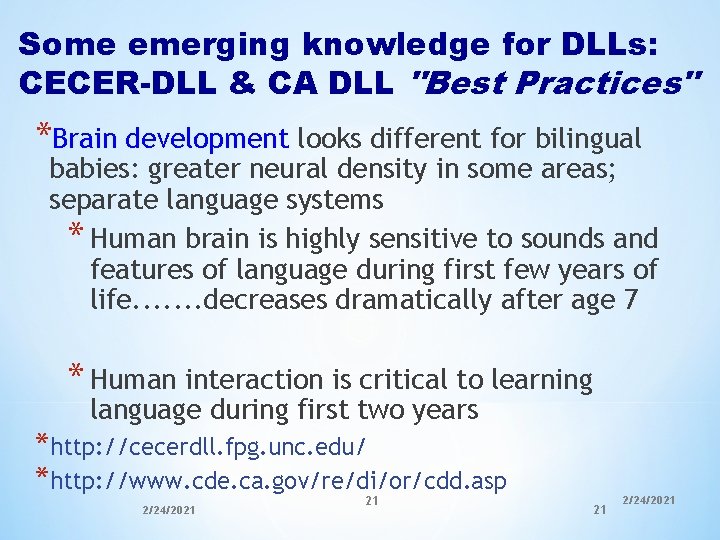
Some emerging knowledge for DLLs: CECER-DLL & CA DLL "Best Practices" *Brain development looks different for bilingual babies: greater neural density in some areas; separate language systems * Human brain is highly sensitive to sounds and features of language during first few years of life. . . . decreases dramatically after age 7 * Human interaction is critical to learning language during first two years *http: //cecerdll. fpg. unc. edu/ *http: //www. cde. ca. gov/re/di/or/cdd. asp 2/24/2021 21 21 2/24/2021
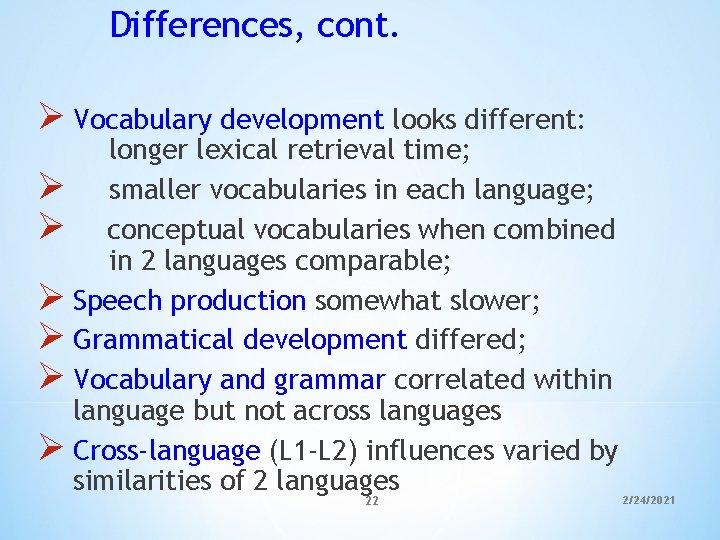
Differences, cont. Ø Vocabulary development looks different: longer lexical retrieval time; Ø smaller vocabularies in each language; Ø conceptual vocabularies when combined in 2 languages comparable; Ø Speech production somewhat slower; Ø Grammatical development differed; Ø Vocabulary and grammar correlated within language but not across languages Ø Cross-language (L 1 -L 2) influences varied by similarities of 2 languages 22 2/24/2021
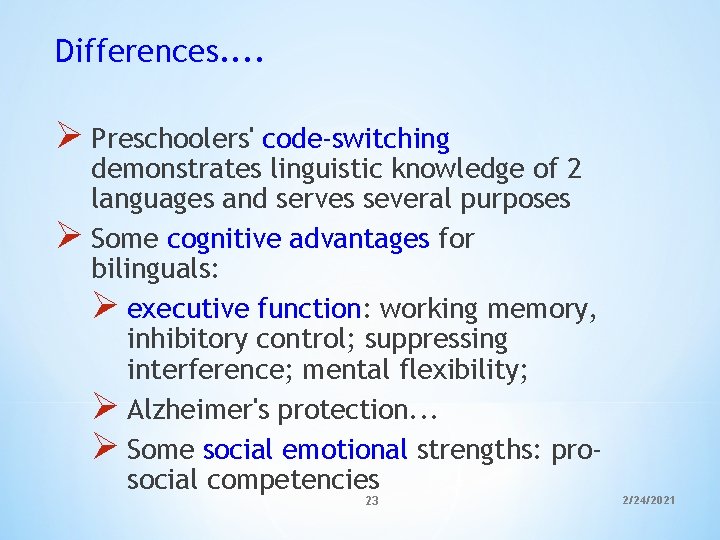
Differences. . Ø Preschoolers' code-switching demonstrates linguistic knowledge of 2 languages and serves several purposes Ø Some cognitive advantages for bilinguals: Ø executive function: working memory, inhibitory control; suppressing interference; mental flexibility; Ø Alzheimer's protection. . . Ø Some social emotional strengths: prosocial competencies 23 2/24/2021
How might expectations/outcomes need to be adjusted based on emerging evidence about developmental trajectories for young dual language learners? 24 2/24/2021
Example of language interaction for a young DLL Four year old in a LAUSD Transitional Kindergarten classroom 25 2/24/2021
Stage of ELD and rate of development depends on many factors 1. Age of first exposure to English 2. Amount and quality of exposure to and opportunity to use new language across contexts 2. Quality of ELD instruction 3. Family background characteristics 26 2/24/2021
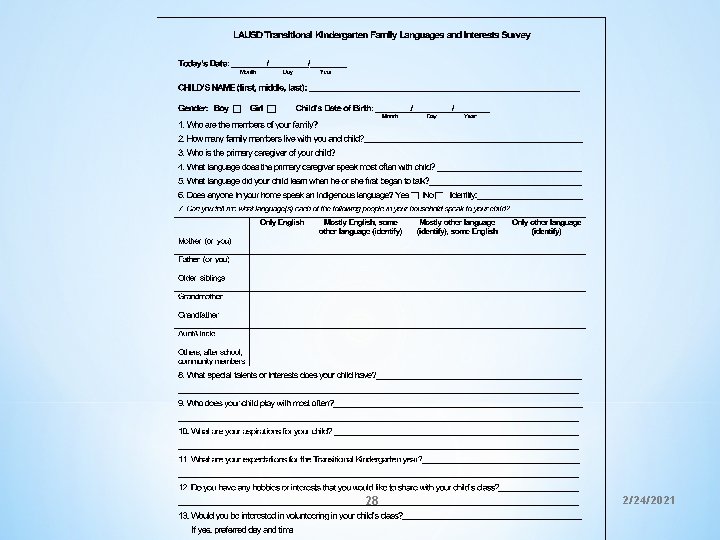
To understand language abilities and progress we must gather information from family 1. Parent family interviews that begin conversation about early language exposure and usage 2. Gain insight about family beliefs/preferences about language. . and child 3. Some available now--CECER-DLL is field testing one this spring 27 2/24/2021
28 2/24/2021
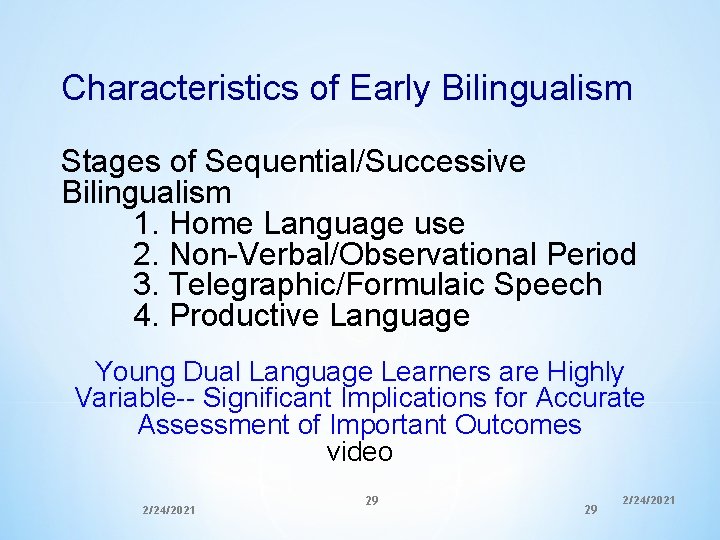
Characteristics of Early Bilingualism Stages of Sequential/Successive Bilingualism 1. Home Language use 2. Non-Verbal/Observational Period 3. Telegraphic/Formulaic Speech 4. Productive Language Young Dual Language Learners are Highly Variable-- Significant Implications for Accurate Assessment of Important Outcomes video 2/24/2021 29 29 2/24/2021
Consequences of Home Language Loss Erasing a child's language or cultural patterns of language use is a great loss for the child. Children's identities and sense of self are inextricably linked to the language they speak and the culture to which they have been socialized. They are, even at an early age, speakers of their languages and members of their cultures. Language and culture are essential to children's identities. Genesee et al. , 2004, p. 33 30 2/24/2021
Language Loss, cont. ØHome Language loss linked to poor long-term academic outcomes (Slavin & Cheung, 2005; Oller & Eilers, 2002; Thomas & Collier, 2002) ØPreschool children quickly can shift language preference to English (Wong-Filmore, 2000) ØLinguistic and cognitive benefits to becoming fully bilingual (Bialystok, 2001, 2011; Winsler, et al. , 1999) 31 2/24/2021
Challenge of Accurate Screening and Assessment “In the early stages of bilingualism, children’s language skills are in flux, so there’s a huge range of proficiency in their secondlanguage performance, which makes it difficult to distinguish between typical second-language differences and genuine language impairment, …. . the result is that children from a linguistically diverse background are often over- or underidentified with a language disorder. ” E. Pena, 2011 32 2/24/2021
Some areas with less clear-cut research *How much exposure to each language during preschool years? *What does “ready for kindergarten” look like for dual language learners? Is it better to have maximum exposure to English or are strong home language skills more important for longterm academic success? (K Entry Assessment) *How do English language benchmarks translate for dual language learners? (Normative info on development for DLLs is lacking; much more complex than monolingual development) 2/24/2021 33 33 2/24/2021
More Research Needed *How to support both home language development and English acquisition with current Early Childhood Workforce; Majority are monolingual and not well prepared for diversity * How to assess progress and development in both languages? 2/24/2021 34 34 2/24/2021
Where to Start? *Review current standards and outcomes for alignment with state goals for first and second language development (diverse team with second language learning expertise), * caveat when aligning with Common Core *Revise/Supplement with most current research on early bilingualism and culturally competent development (need expert advisors) *Extend comprehensive assessment system and outcomes to appropriately include DLLs 2/24/2021 35 35 2/24/2021
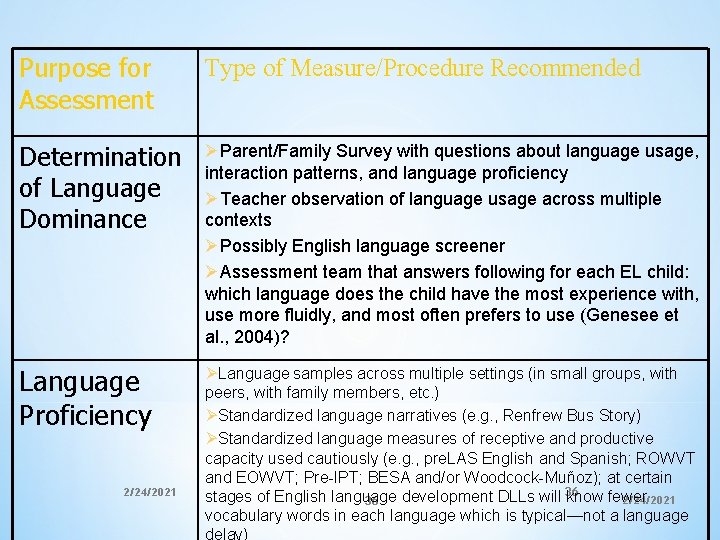
Purpose for Assessment Type of Measure/Procedure Recommended Determination of Language Dominance ØParent/Family Survey with questions about language usage, interaction patterns, and language proficiency ØTeacher observation of language usage across multiple contexts ØPossibly English language screener ØAssessment team that answers following for each EL child: which language does the child have the most experience with, use more fluidly, and most often prefers to use (Genesee et al. , 2004)? Language Proficiency ØLanguage samples across multiple settings (in small groups, with peers, with family members, etc. ) ØStandardized language narratives (e. g. , Renfrew Bus Story) ØStandardized language measures of receptive and productive capacity used cautiously (e. g. , pre. LAS English and Spanish; ROWVT and EOWVT; Pre-IPT; BESA and/or Woodcock-Muñoz); at certain stages of English language development DLLs will 36 know fewer 2/24/2021 36 vocabulary words in each language which is typical—not a language 2/24/2021
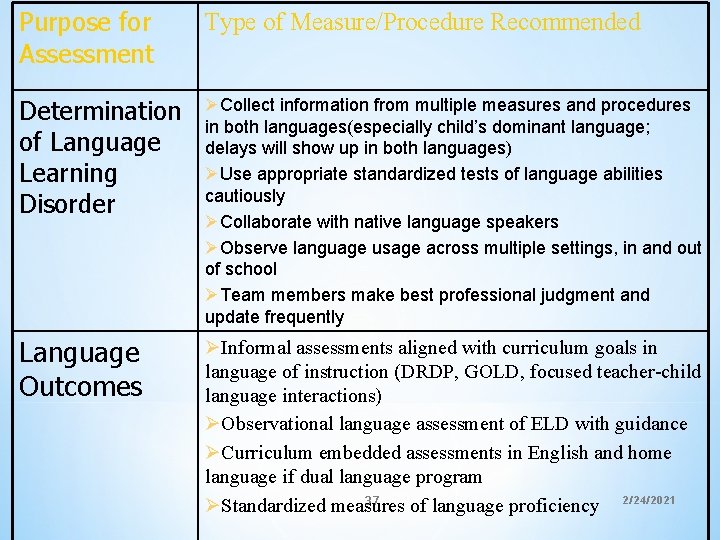
Purpose for Assessment Type of Measure/Procedure Recommended Determination of Language Learning Disorder ØCollect information from multiple measures and procedures in both languages(especially child’s dominant language; delays will show up in both languages) ØUse appropriate standardized tests of language abilities cautiously ØCollaborate with native language speakers ØObserve language usage across multiple settings, in and out of school ØTeam members make best professional judgment and update frequently Language Outcomes ØInformal assessments aligned with curriculum goals in language of instruction (DRDP, GOLD, focused teacher-child language interactions) ØObservational language assessment of ELD with guidance ØCurriculum embedded assessments in English and home language if dual language program 37 ØStandardized measures of language proficiency 2/24/2021
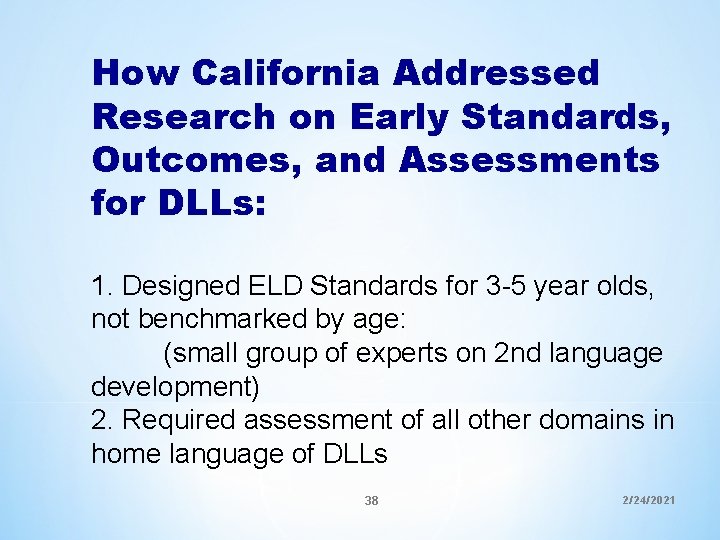
How California Addressed Research on Early Standards, Outcomes, and Assessments for DLLs: 1. Designed ELD Standards for 3 -5 year olds, not benchmarked by age: (small group of experts on 2 nd language development) 2. Required assessment of all other domains in home language of DLLs 38 2/24/2021
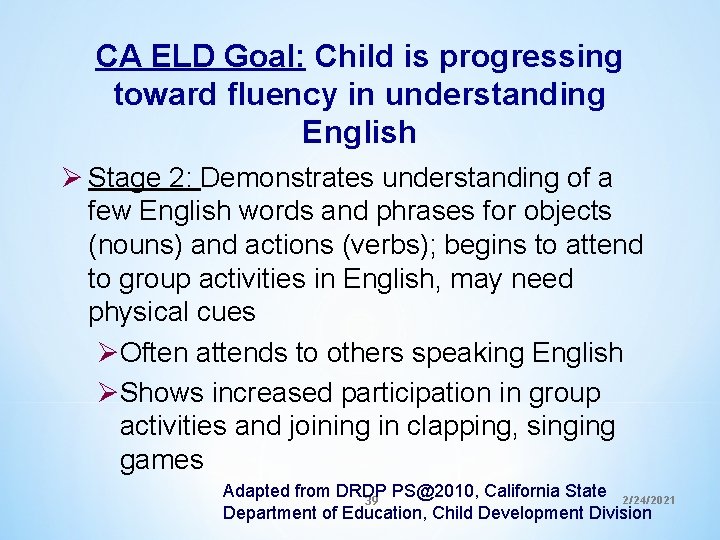
CA ELD Goal: Child is progressing toward fluency in understanding English Ø Stage 2: Demonstrates understanding of a few English words and phrases for objects (nouns) and actions (verbs); begins to attend to group activities in English, may need physical cues ØOften attends to others speaking English ØShows increased participation in group activities and joining in clapping, singing games Adapted from DRDP PS@2010, California State 2/24/2021 39 Department of Education, Child Development Division
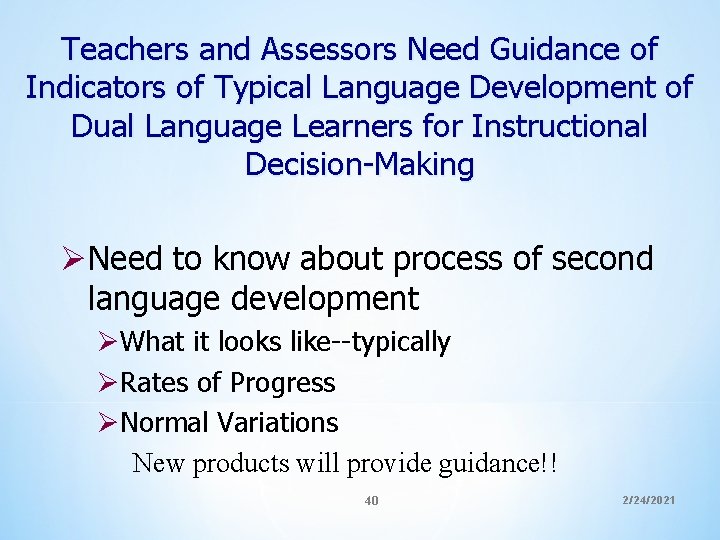
Teachers and Assessors Need Guidance of Indicators of Typical Language Development of Dual Language Learners for Instructional Decision-Making ØNeed to know about process of second language development ØWhat it looks like--typically ØRates of Progress ØNormal Variations New products will provide guidance!! 40 2/24/2021
We Are ALL at the Forefront of Improving Our Standards, Programs, Policies, and Practices to Better Meet the Needs of Young Dual Language Learners and Their Families * Diversity has been written into the DNA of American life; any institution that lacks a rainbow array has come to seem diminished, if not diseased…. Joe Klein 2/24/2021 * Monolingualism is a disease that is easily cured!……Anonymous 2/24/2021 41 41
“When I was little and really wanted something, I prayed to God in two languages, just in case God didn’t know one of them. Knowing two languages opens many doors for children, ensuring that nothing is lost in the translation. ” Rafael Guerra, Executive Director of East Coast Migrant Head Start Project Let’s help ensure Dual Language Learners knowledge, abilities, and strengths are not lost in translation!!! 42 2/24/2021
THANK YOU!!!!! Muchas Gracias Merci Beaucoup �� 43 2/24/2021