
Development and Validation of Assessment Tools for Care
- Slides: 1
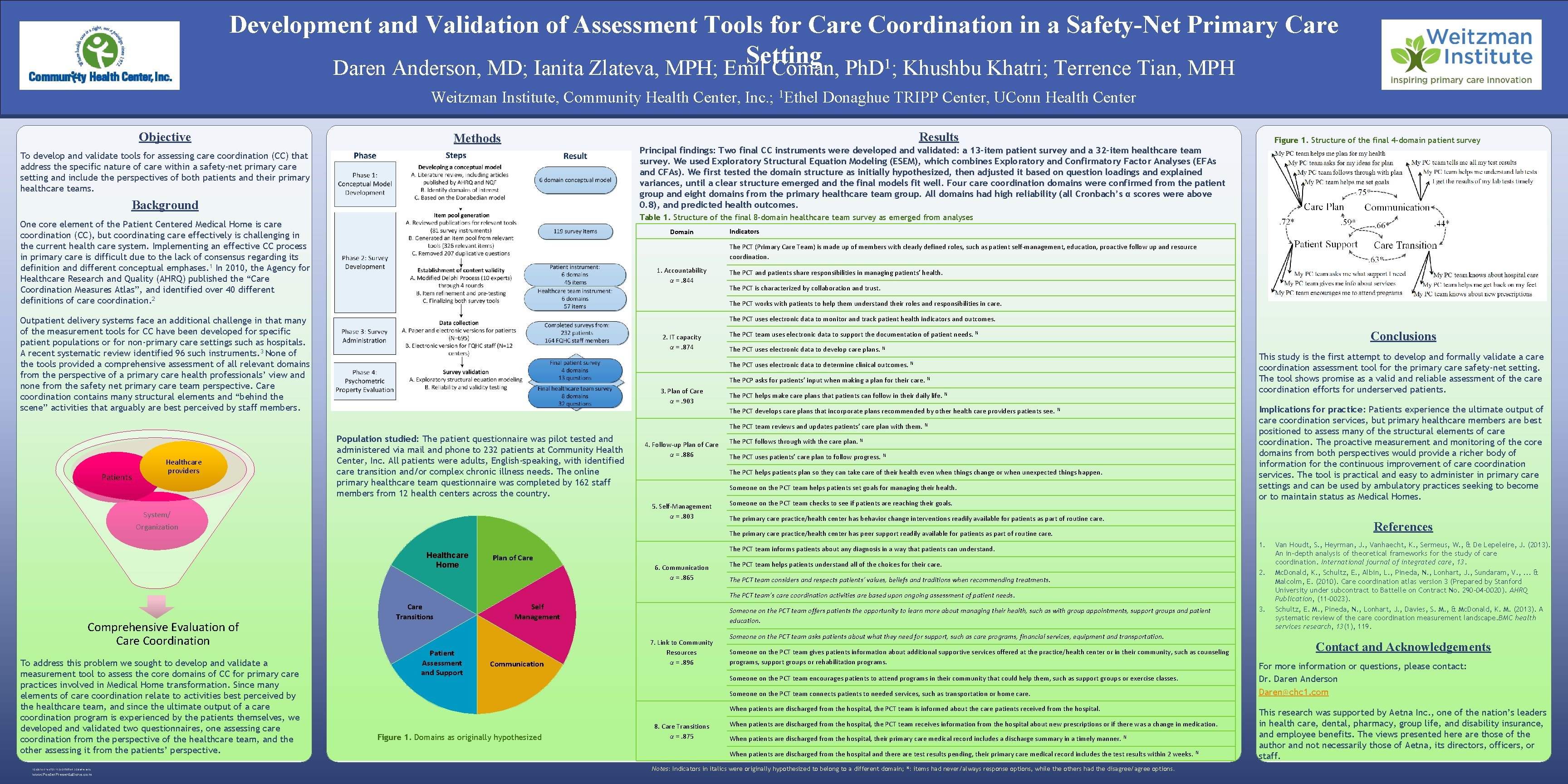
Development and Validation of Assessment Tools for Care Coordination in a Safety-Net Primary Care Setting 1 Daren Anderson, MD; Ianita Zlateva, MPH; Emil Coman, Ph. D ; Khushbu Khatri; Terrence Tian, MPH Weitzman Institute, Community Health Center, Inc. ; 1 Ethel Donaghue TRIPP Center, UConn Health Center Objective Results Methods Principal findings: Two final CC instruments were developed and validated: a 13 -item patient survey and a 32 -item healthcare team survey. We used Exploratory Structural Equation Modeling (ESEM), which combines Exploratory and Confirmatory Factor Analyses (EFAs and CFAs). We first tested the domain structure as initially hypothesized, then adjusted it based on question loadings and explained variances, until a clear structure emerged and the final models fit well. Four care coordination domains were confirmed from the patient group and eight domains from the primary healthcare team group. All domains had high reliability (all Cronbach’s α scores were above 0. 8), and predicted health outcomes. To develop and validate tools for assessing care coordination (CC) that address the specific nature of care within a safety-net primary care setting and include the perspectives of both patients and their primary healthcare teams. Background Table 1. Structure of the final 8 -domain healthcare team survey as emerged from analyses One core element of the Patient Centered Medical Home is care coordination (CC), but coordinating care effectively is challenging in the current health care system. Implementing an effective CC process in primary care is difficult due to the lack of consensus regarding its definition and different conceptual emphases. 1 In 2010, the Agency for Healthcare Research and Quality (AHRQ) published the “Care Coordination Measures Atlas”, and identified over 40 different definitions of care coordination. 2 Domain Indicators The PCT (Primary Care Team) is made up of members with clearly defined roles, such as patient self-management, education, proactive follow up and resource coordination. 1. Accountability α =. 844 The PCT and patients share responsibilities in managing patients’ health. The PCT is characterized by collaboration and trust. The PCT works with patients to help them understand their roles and responsibilities in care. The PCT uses electronic data to monitor and track patient health indicators and outcomes. Outpatient delivery systems face an additional challenge in that many of the measurement tools for CC have been developed for specific patient populations or for non-primary care settings such as hospitals. A recent systematic review identified 96 such instruments. 3 None of the tools provided a comprehensive assessment of all relevant domains from the perspective of a primary care health professionals’ view and none from the safety net primary care team perspective. Care coordination contains many structural elements and “behind the scene” activities that arguably are best perceived by staff members. 2. IT capacity α =. 874 The PCT uses electronic data to develop care plans. N The PCT uses electronic data to determine clinical outcomes. N The PCP asks for patients’ input when making a plan for their care. N 3. Plan of Care α =. 903 The PCT helps make care plans that patients can follow in their daily life. N The PCT develops care plans that incorporate plans recommended by other health care providers patients see. N Patients Population studied: The patient questionnaire was pilot tested and administered via mail and phone to 232 patients at Community Health Center, Inc. All patients were adults, English-speaking, with identified care transition and/or complex chronic illness needs. The online primary healthcare team questionnaire was completed by 162 staff members from 12 health centers across the country. 4. Follow-up Plan of Care α =. 886 System/ Organization The PCT follows through with the care plan. N The PCT uses patients’ care plan to follow progress. N The PCT helps patients plan so they can take care of their health even when things change or when unexpected things happen. Someone on the PCT team helps patients set goals for managing their health. 5. Self-Management α =. 803 Conclusions The PCT team uses electronic data to support the documentation of patient needs. N The PCT team reviews and updates patients’ care plan with them. N Healthcare providers Figure 1. Structure of the final 4 -domain patient survey Someone on the PCT team checks to see if patients are reaching their goals. This study is the first attempt to develop and formally validate a care coordination assessment tool for the primary care safety-net setting. The tool shows promise as a valid and reliable assessment of the care coordination efforts for underserved patients. Implications for practice: Patients experience the ultimate output of care coordination services, but primary healthcare members are best positioned to assess many of the structural elements of care coordination. The proactive measurement and monitoring of the core domains from both perspectives would provide a richer body of information for the continuous improvement of care coordination services. The tool is practical and easy to administer in primary care settings and can be used by ambulatory practices seeking to become or to maintain status as Medical Homes. The primary care practice/health center has behavior change interventions readily available for patients as part of routine care. References The primary care practice/health center has peer support readily available for patients as part of routine care. Healthcare Home The PCT team informs patients about any diagnosis in a way that patients can understand. Plan of Care 6. Communication α =. 865 The PCT team helps patients understand all of the choices for their care. The PCT team considers and respects patients’ values, beliefs and traditions when recommending treatments. 1. 2. The PCT team’s care coordination activities are based upon ongoing assessment of patient needs. Comprehensive Evaluation of Care Coordination To address this problem we sought to develop and validate a measurement tool to assess the core domains of CC for primary care practices involved in Medical Home transformation. Since many elements of care coordination relate to activities best perceived by the healthcare team, and since the ultimate output of a care coordination program is experienced by the patients themselves, we developed and validated two questionnaires, one assessing care coordination from the perspective of the healthcare team, and the other assessing it from the patients’ perspective. RESEARCH POSTER PRESENTATION DESIGN © 2012 www. Poster. Presentations. com Care Transitions Patient Assessment and Support Self Management Communication Someone on the PCT team offers patients the opportunity to learn more about managing their health, such as with group appointments, support groups and patient education. 7. Link to Community Resources α =. 896 Someone on the PCT team asks patients about what they need for support, such as care programs, financial services, equipment and transportation. Someone on the PCT team gives patients information about additional supportive services offered at the practice/health center or in their community, such as counseling programs, support groups or rehabilitation programs. Someone on the PCT team encourages patients to attend programs in their community that could help them, such as support groups or exercise classes. Someone on the PCT team connects patients to needed services, such as transportation or home care. When patients are discharged from the hospital, the PCT team is informed about the care patients received from the hospital. Figure 1. Domains as originally hypothesized 8. Care Transitions α =. 875 When patients are discharged from the hospital, the PCT team receives information from the hospital about new prescriptions or if there was a change in medication. When patients are discharged from the hospital, their primary care medical record includes a discharge summary in a timely manner. N When patients are discharged from the hospital and there are test results pending, their primary care medical record includes the test results within 2 weeks. N Notes: Indicators in italics were originally hypothesized to belong to a different domain; N: items had never/always response options, while the others had the disagree/agree options. 3. Van Houdt, S. , Heyrman, J. , Vanhaecht, K. , Sermeus, W. , & De Lepeleire, J. (2013). An in-depth analysis of theoretical frameworks for the study of care coordination. International journal of integrated care, 13. Mc. Donald, K. , Schultz, E. , Albin, L. , Pineda, N. , Lonhart, J. , Sundaram, V. , . . . & Malcolm, E. (2010). Care coordination atlas version 3 (Prepared by Stanford University under subcontract to Battelle on Contract No. 290 -04 -0020). AHRQ Publication, (11 -0023). Schultz, E. M. , Pineda, N. , Lonhart, J. , Davies, S. M. , & Mc. Donald, K. M. (2013). A systematic review of the care coordination measurement landscape. BMC health services research, 13(1), 119. Contact and Acknowledgements For more information or questions, please contact: Dr. Daren Anderson Daren@chc 1. com This research was supported by Aetna Inc. , one of the nation’s leaders in health care, dental, pharmacy, group life, and disability insurance, and employee benefits. The views presented here are those of the author and not necessarily those of Aetna, its directors, officers, or staff.