
Development and validation of an absolute Frequency Scanning
Development and validation of an absolute Frequency Scanning Interferometry (FSI) network Solomon William KAMUGASA 1 st PACMAN workshop, CERN, Geneva, Switzerland 3 rd February 2015
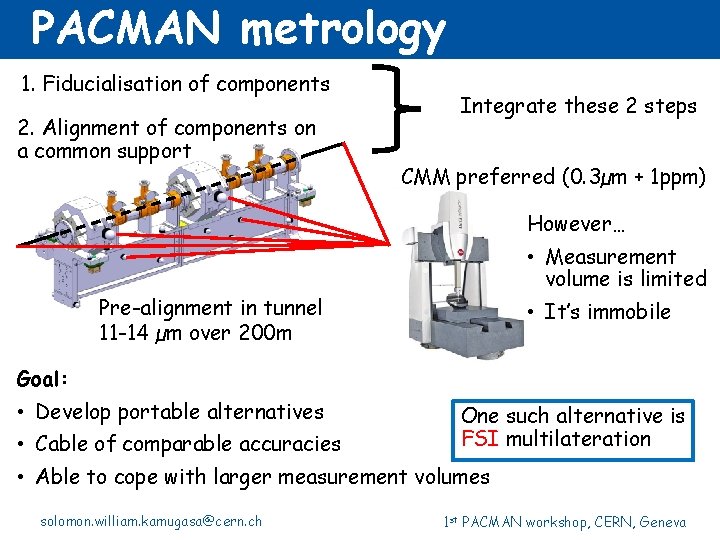
PACMAN metrology 1. Fiducialisation of components 2. Alignment of components on a common support Integrate these 2 steps CMM preferred (0. 3µm + 1 ppm) However… • Measurement volume is limited Pre-alignment in tunnel 11 -14 µm over 200 m • It’s immobile Goal: • Develop portable alternatives • Cable of comparable accuracies One such alternative is FSI multilateration • Able to cope with larger measurement volumes solomon. william. kamugasa@cern. ch 1 st PACMAN workshop, CERN, Geneva

Multilateration • Coordinate determination using distances only • Distance-coordinate relationship is well known Z • Requires distances from at least 3 known points • Self-calibration possible by increasing stations and targets • Coordinate uncertainty dependent on distance uncertainty solomon. william. kamugasa@cern. ch Y X 1 st PACMAN workshop, CERN, Geneva

Distance measurement system Absolute Multiline by Etalon • Absolute distance (FSI) • Uncertainty 0. 5µm/metre • Traceable to SI metre • Up to 100 distance measurements simultaneously solomon. william. kamugasa@cern. ch 1 st PACMAN workshop, CERN, Geneva
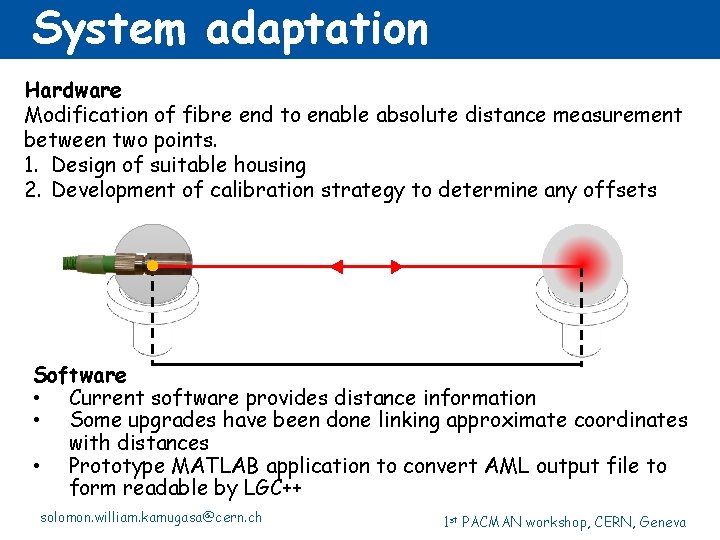
System adaptation Hardware Modification of fibre end to enable absolute distance measurement between two points. 1. Design of suitable housing 2. Development of calibration strategy to determine any offsets Software • Current software provides distance information • Some upgrades have been done linking approximate coordinates with distances • Prototype MATLAB application to convert AML output file to form readable by LGC++ solomon. william. kamugasa@cern. ch 1 st PACMAN workshop, CERN, Geneva
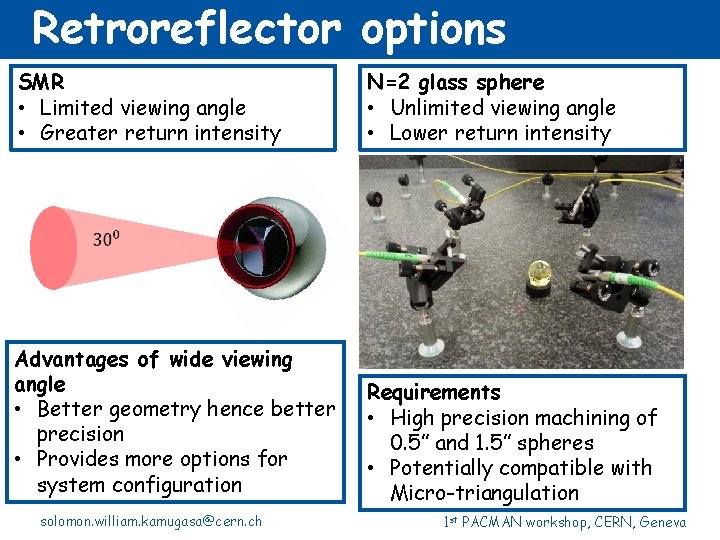
Retroreflector options SMR • Limited viewing angle • Greater return intensity N=2 glass sphere • Unlimited viewing angle • Lower return intensity Advantages of wide viewing angle • Better geometry hence better precision • Provides more options for system configuration Requirements • High precision machining of 0. 5” and 1. 5” spheres • Potentially compatible with Micro-triangulation solomon. william. kamugasa@cern. ch 1 st PACMAN workshop, CERN, Geneva

Lateral tolerance test Why important? • Greater tolerance = easier channel alignment • Ability to continue measuring even with slight misalignment ± 1 mm (3 cm sphere) solomon. william. kamugasa@cern. ch 1 st PACMAN workshop, CERN, Geneva
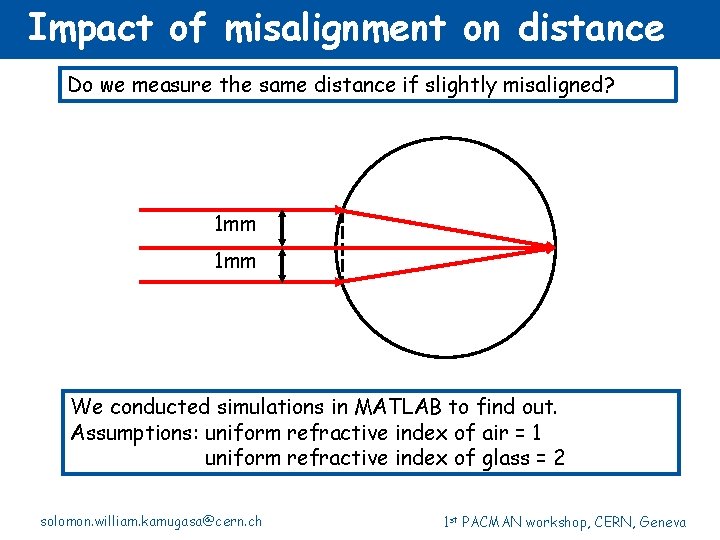
Impact of misalignment on distance Do we measure the same distance if slightly misaligned? 1 mm We conducted simulations in MATLAB to find out. Assumptions: uniform refractive index of air = 1 uniform refractive index of glass = 2 solomon. william. kamugasa@cern. ch 1 st PACMAN workshop, CERN, Geneva
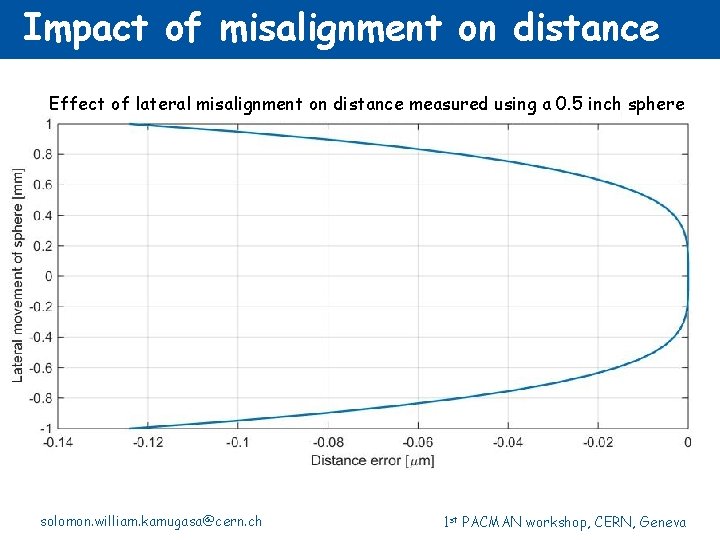
Impact of misalignment on distance Effect of lateral misalignment on distance measured using a 0. 5 inch sphere solomon. william. kamugasa@cern. ch 1 st PACMAN workshop, CERN, Geneva
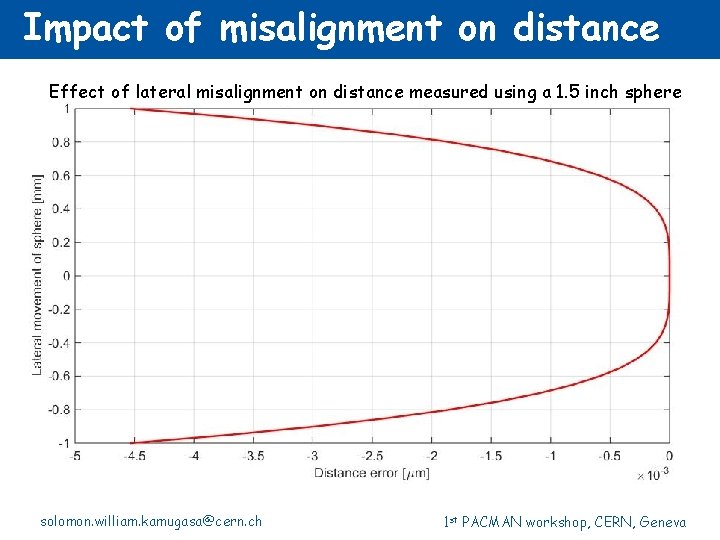
Impact of misalignment on distance Effect of lateral misalignment on distance measured using a 1. 5 inch sphere solomon. william. kamugasa@cern. ch 1 st PACMAN workshop, CERN, Geneva
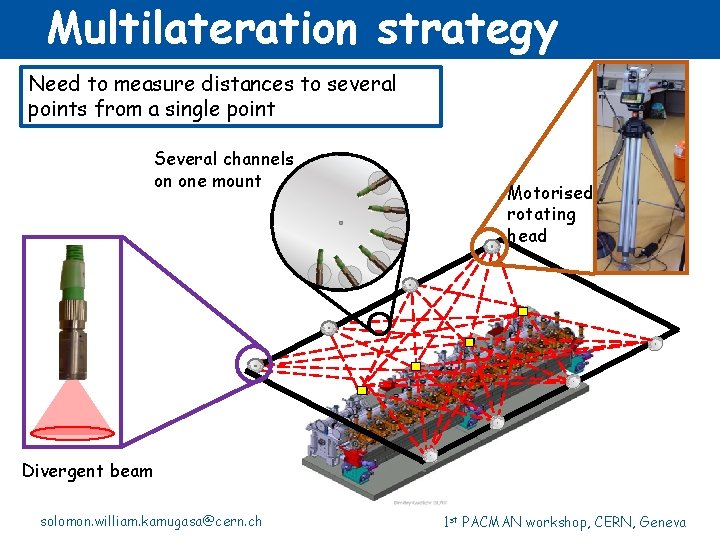
Multilateration strategy Need to measure distances to several points from a single point Several channels on one mount Motorised rotating head Divergent beam solomon. william. kamugasa@cern. ch 1 st PACMAN workshop, CERN, Geneva
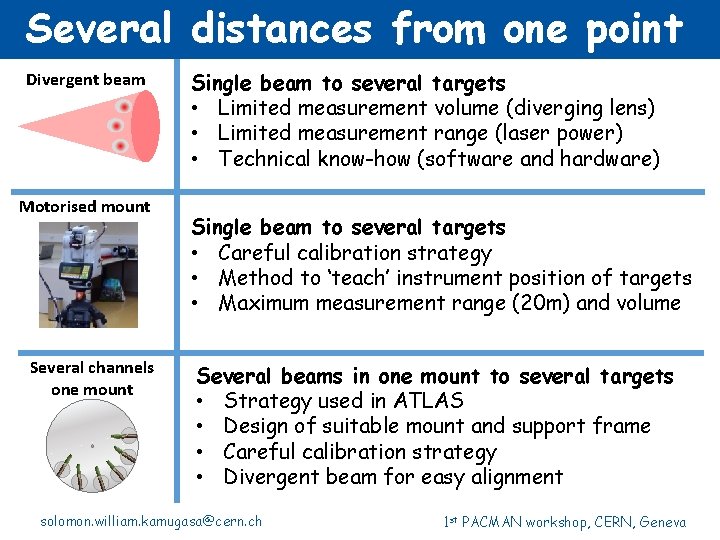
Several distances from one point Divergent beam Motorised mount Several channels one mount Single beam to several targets • Limited measurement volume (diverging lens) • Limited measurement range (laser power) • Technical know-how (software and hardware) Single beam to several targets • Careful calibration strategy • Method to ‘teach’ instrument position of targets • Maximum measurement range (20 m) and volume Several beams in one mount to several targets • Strategy used in ATLAS • Design of suitable mount and support frame • Careful calibration strategy • Divergent beam for easy alignment solomon. william. kamugasa@cern. ch 1 st PACMAN workshop, CERN, Geneva
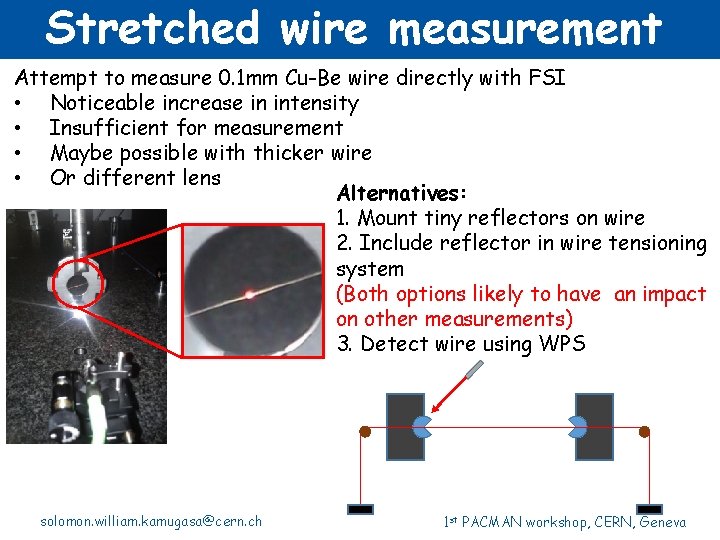
Stretched wire measurement Attempt to measure 0. 1 mm Cu-Be wire directly with FSI • Noticeable increase in intensity • Insufficient for measurement • Maybe possible with thicker wire • Or different lens Alternatives: 1. Mount tiny reflectors on wire 2. Include reflector in wire tensioning system (Both options likely to have an impact on other measurements) 3. Detect wire using WPS solomon. william. kamugasa@cern. ch 1 st PACMAN workshop, CERN, Geneva
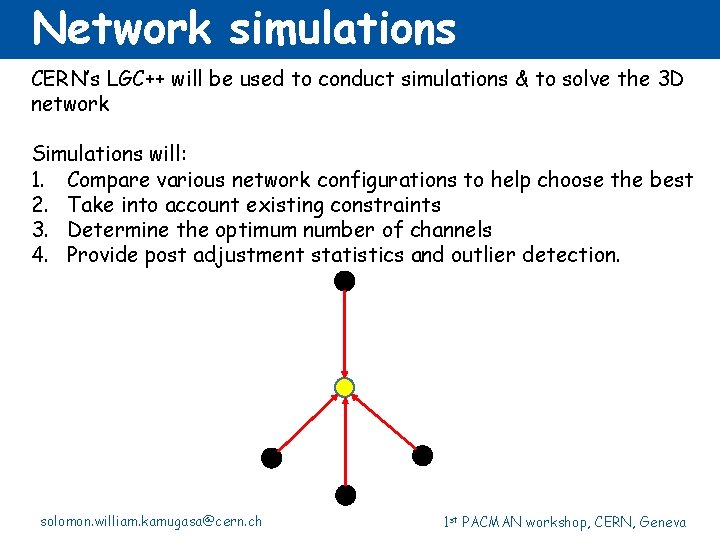
Network simulations CERN’s LGC++ will be used to conduct simulations & to solve the 3 D network Simulations will: 1. Compare various network configurations to help choose the best 2. Take into account existing constraints 3. Determine the optimum number of channels 4. Provide post adjustment statistics and outlier detection. solomon. william. kamugasa@cern. ch 1 st PACMAN workshop, CERN, Geneva
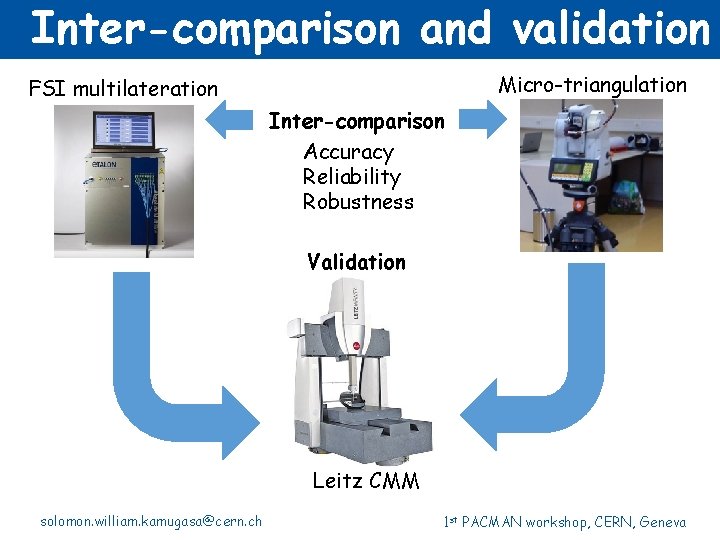
Inter-comparison and validation Micro-triangulation FSI multilateration Inter-comparison Accuracy Reliability Robustness Validation Leitz CMM solomon. william. kamugasa@cern. ch 1 st PACMAN workshop, CERN, Geneva
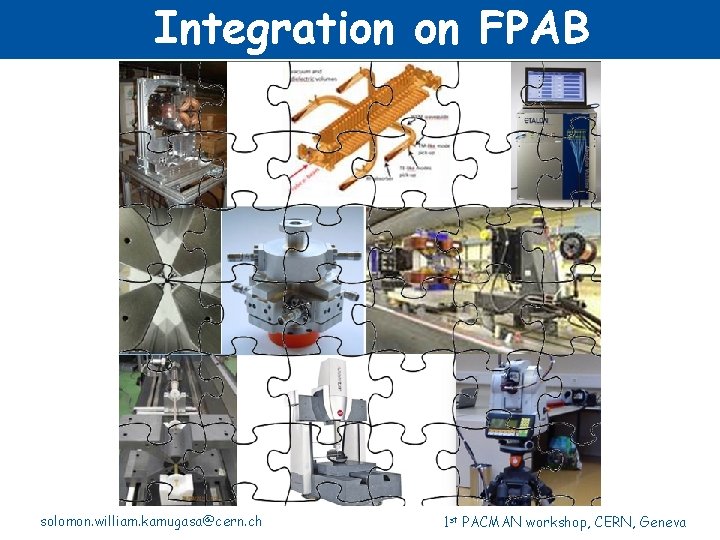
Integration on FPAB solomon. william. kamugasa@cern. ch 1 st PACMAN workshop, CERN, Geneva
Extrapolation & summary Ultimate aim: To develop a portable coordinate measuring system based on FSI multilateration for CLIC that can be extrapolated to other projects Summary: • System modification • Stretched wire measurement • Multilateration strategy • Tests, validation & extrapolation solomon. william. kamugasa@cern. ch 1 st PACMAN workshop, CERN, Geneva
Thank you for your attention!
- Slides: 18