
Development and Validation of a Measure of SelfPresentation
- Slides: 1
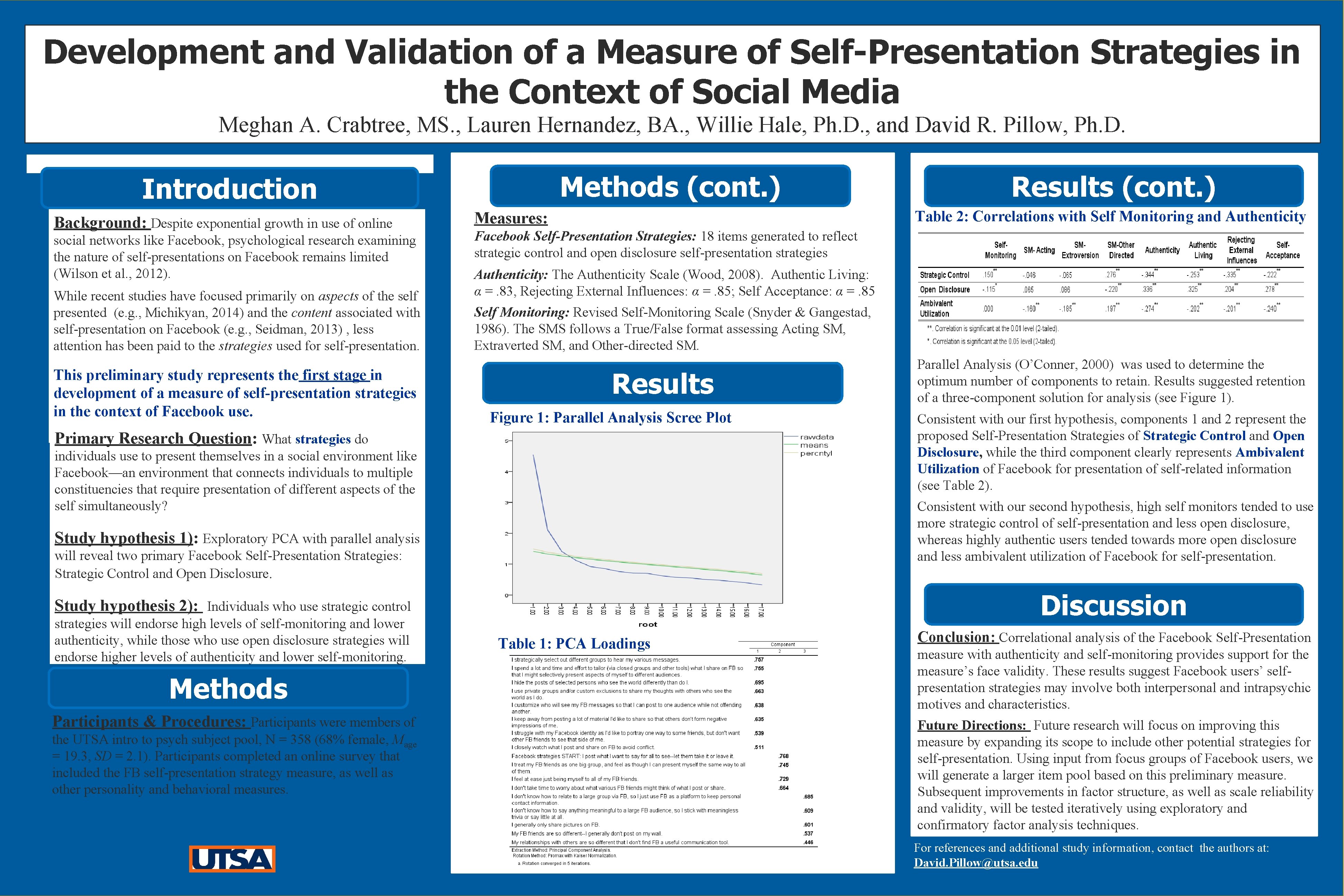
Development and Validation of a Measure of Self-Presentation Strategies in the Context of Social Media Meghan A. Crabtree, MS. , Lauren Hernandez, BA. , Willie Hale, Ph. D. , and David R. Pillow, Ph. D. Methods (cont. ) Introduction Background: Despite exponential growth in use of online social networks like Facebook, psychological research examining the nature of self-presentations on Facebook remains limited (Wilson et al. , 2012). While recent studies have focused primarily on aspects of the self presented (e. g. , Michikyan, 2014) and the content associated with self-presentation on Facebook (e. g. , Seidman, 2013) , less attention has been paid to the strategies used for self-presentation. This preliminary study represents the first stage in development of a measure of self-presentation strategies in the context of Facebook use. Table 2: Correlations with Self Monitoring and Authenticity Measures: Facebook Self-Presentation Strategies: 18 items generated to reflect strategic control and open disclosure self-presentation strategies Authenticity: The Authenticity Scale (Wood, 2008). Authentic Living: α =. 83, Rejecting External Influences: α =. 85; Self Acceptance: α =. 85 Self Monitoring: Revised Self-Monitoring Scale (Snyder & Gangestad, 1986). The SMS follows a True/False format assessing Acting SM, Extraverted SM, and Other-directed SM. Results Figure 1: Parallel Analysis Scree Plot Primary Research Question: What strategies do individuals use to present themselves in a social environment like Facebook—an environment that connects individuals to multiple constituencies that require presentation of different aspects of the self simultaneously? will reveal two primary Facebook Self-Presentation Strategies: Strategic Control and Open Disclosure. G frgfdgfd Participants & Procedures: Participants were members of the UTSA intro to psych subject pool, N = 358 (68% female, Mage = 19. 3, SD = 2. 1). Participants completed an online survey that included the FB self-presentation strategy measure, as well as other personality and behavioral measures. Consistent with our first hypothesis, components 1 and 2 represent the proposed Self-Presentation Strategies of Strategic Control and Open Disclosure, while third component clearly represents Ambivalent Utilization of Facebook for presentation of self-related information (see Table 2). Discussion Study hypothesis 2): Individuals who use strategic control Methods Parallel Analysis (O’Conner, 2000) was used to determine the optimum number of components to retain. Results suggested retention of a three-component solution for analysis (see Figure 1). Consistent with our second hypothesis, high self monitors tended to use more strategic control of self-presentation and less open disclosure, whereas highly authentic users tended towards more open disclosure and less ambivalent utilization of Facebook for self-presentation. Study hypothesis 1): Exploratory PCA with parallel analysis strategies will endorse high levels of self-monitoring and lower authenticity, while those who use open disclosure strategies will endorse higher levels of authenticity and lower self-monitoring. Results (cont. ) Table 1: PCA Loadings Conclusion: Correlational analysis of the Facebook Self-Presentation measure with authenticity and self-monitoring provides support for the measure’s face validity. These results suggest Facebook users’ selfpresentation strategies may involve both interpersonal and intrapsychic motives and characteristics. Future Directions: Future research will focus on improving this measure by expanding its scope to include other potential strategies for self-presentation. Using input from focus groups of Facebook users, we will generate a larger item pool based on this preliminary measure. Subsequent improvements in factor structure, as well as scale reliability and validity, will be tested iteratively using exploratory and confirmatory factor analysis techniques. For references and additional study information, contact the authors at: David. Pillow@utsa. edu