
Development and Reliability of a Revised Behavior Rating
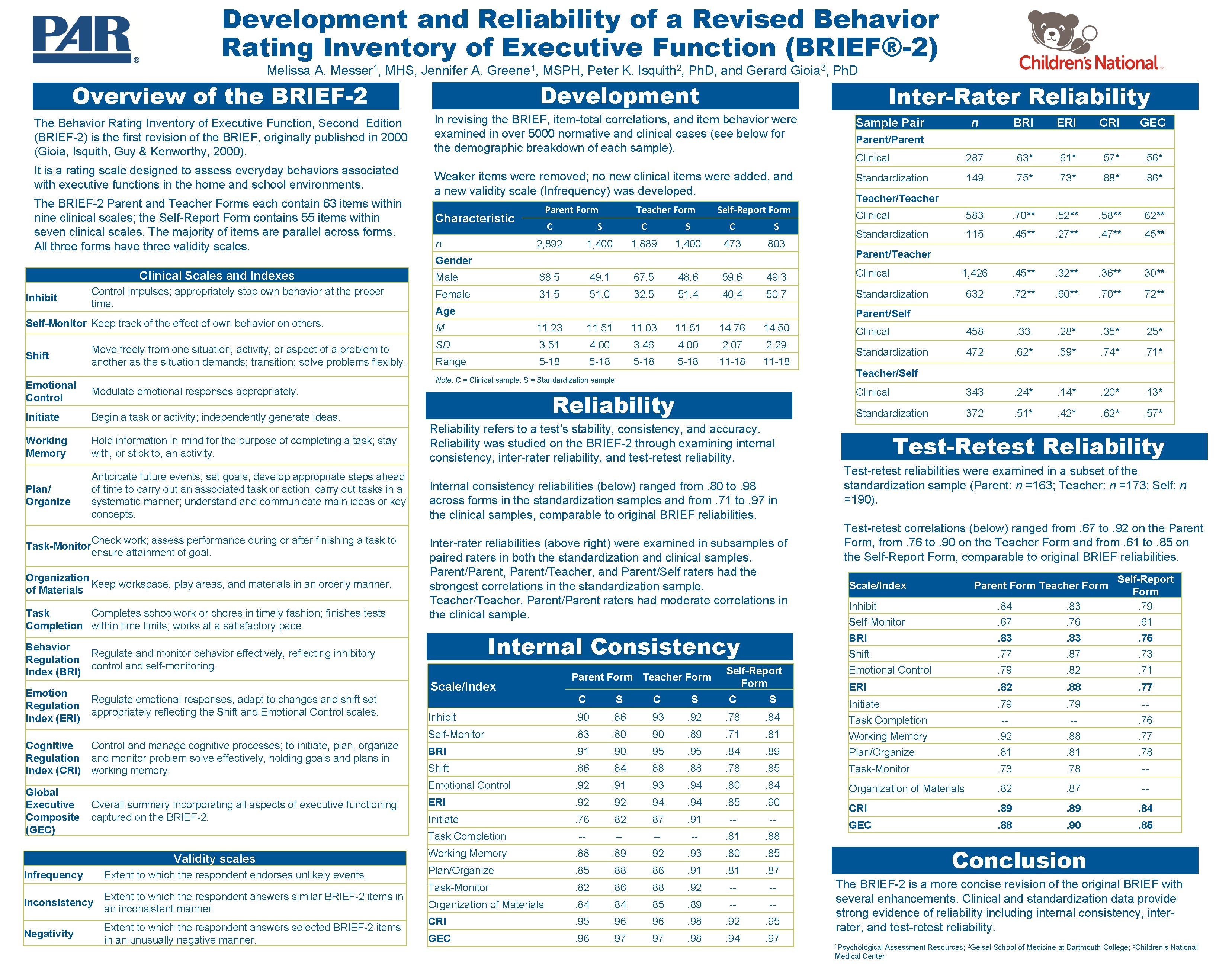
Development and Reliability of a Revised Behavior Rating Inventory of Executive Function (BRIEF®-2) Melissa A. Messer 1, MHS, Jennifer A. Greene 1, MSPH, Peter K. Isquith 2, Ph. D, and Gerard Gioia 3, Ph. D Development Overview of the BRIEF-2 The Behavior Rating Inventory of Executive Function, Second Edition (BRIEF-2) is the first revision of the BRIEF, originally published in 2000 (Gioia, Isquith, Guy & Kenworthy, 2000). It is a rating scale designed to assess everyday behaviors associated with executive functions in the home and school environments. The BRIEF-2 Parent and Teacher Forms each contain 63 items within nine clinical scales; the Self-Report Form contains 55 items within seven clinical scales. The majority of items are parallel across forms. All three forms have three validity scales. Inter-Rater Reliability In revising the BRIEF, item-total correlations, and item behavior were examined in over 5000 normative and clinical cases (see below for the demographic breakdown of each sample). Sample Pair Weaker items were removed; no new clinical items were added, and a new validity scale (Infrequency) was developed. Parent Form Characteristic Teacher Form Self-Report Form Inhibit Control impulses; appropriately stop own behavior at the proper time. Self-Monitor Keep track of the effect of own behavior on others. Shift Move freely from one situation, activity, or aspect of a problem to another as the situation demands; transition; solve problems flexibly. Modulate emotional responses appropriately. Initiate Begin a task or activity; independently generate ideas. Working Memory Hold information in mind for the purpose of completing a task; stay with, or stick to, an activity. Plan/ Organize Anticipate future events; set goals; develop appropriate steps ahead of time to carry out an associated task or action; carry out tasks in a systematic manner; understand communicate main ideas or key concepts. Development Check work; assess performance during or after finishing a task to Task-Monitor ensure attainment of goal. Organization Keep workspace, play areas, and materials in an orderly manner. of Materials Task Completes schoolwork or chores in timely fashion; finishes tests Completion within time limits; works at a satisfactory pace. Behavior Regulation Index (BRI) Emotion Regulation Index (ERI) Cognitive Regulation Index (CRI) Global Executive Composite (GEC) Overall summary incorporating all aspects of executive functioning captured on the BRIEF-2. Validity scales Infrequency Inconsistency Negativity Extent to which the respondent endorses unlikely events. Extent to which the respondent answers similar BRIEF-2 items in an inconsistent manner. Extent to which the respondent answers selected BRIEF-2 items in an unusually negative manner. GEC Clinical 287 . 63* . 61* . 57* . 56* Standardization 149 . 75* . 73* . 88* . 86* Clinical 583 . 70** . 52** . 58** . 62** Standardization 115 . 45** . 27** . 45** 1, 426 . 45** . 32** . 36** . 30** 632 . 72** . 60** . 72** Clinical 458 . 33 . 28* . 35* . 25* Standardization 472 . 62* . 59* . 74* . 71* Clinical 343 . 24* . 14* . 20* . 13* Standardization 372 . 51* . 42* . 62* . 57* Parent/Parent Teacher/Teacher S C S 2, 892 1, 400 1, 889 1, 400 473 803 Male 68. 5 49. 1 67. 5 48. 6 59. 6 49. 3 Clinical Female 31. 5 51. 0 32. 5 51. 4 40. 4 50. 7 Standardization n Age Parent/Teacher Parent/Self M 11. 23 11. 51 11. 03 11. 51 14. 76 14. 50 SD 3. 51 4. 00 3. 46 4. 00 2. 07 2. 29 Range 5 -18 11 -18 Reliability Teacher/Self Reliability refers to a test’s stability, consistency, and accuracy. Reliability was studied on the BRIEF-2 through examining internal consistency, inter-rater reliability, and test-retest reliability. Internal consistency reliabilities (below) ranged from. 80 to. 98 across forms in the standardization samples and from. 71 to. 97 in the clinical samples, comparable to original BRIEF reliabilities. Inter-rater reliabilities (above right) were examined in subsamples of paired raters in both the standardization and clinical samples. Parent/Parent, Parent/Teacher, and Parent/Self raters had the strongest correlations in the standardization sample. Teacher/Teacher, Parent/Parent raters had moderate correlations in the clinical sample. Parent Form Teacher Form Test-Retest Reliability Test-retest reliabilities were examined in a subset of the standardization sample (Parent: n =163; Teacher: n =173; Self: n =190). Test-retest correlations (below) ranged from. 67 to. 92 on the Parent Form, from. 76 to. 90 on the Teacher Form and from. 61 to. 85 on the Self-Report Form, comparable to original BRIEF reliabilities. Self-Report Parent Form Teacher Form. 84. 83. 79 Scale/Index Inhibit Self-Monitor . 67 . 76 . 61 BRI . 83 . 75 Shift . 77 . 87 . 73 Self-Report Form Emotional Control . 79 . 82 . 71 ERI . 82 . 88 . 77 Initiate . 79 -- Internal Consistency Scale/Index Control and manage cognitive processes; to initiate, plan, organize and monitor problem solve effectively, holding goals and plans in working memory. CRI C Regulate and monitor behavior effectively, reflecting inhibitory control and self-monitoring. Regulate emotional responses, adapt to changes and shift set appropriately reflecting the Shift and Emotional Control scales. ERI S Note. C = Clinical sample; S = Standardization sample Emotional Control BRI C Gender Clinical Scales and Indexes n C S C S Inhibit . 90 . 86 . 93 . 92 . 78 . 84 Task Completion -- -- . 76 Self-Monitor . 83 . 80 . 90 . 89 . 71 . 81 Working Memory . 92 . 88 . 77 BRI . 91 . 90 . 95 . 84 . 89 Plan/Organize . 81 . 78 Shift . 86 . 84 . 88 . 78 . 85 Task-Monitor . 73 . 78 -- Emotional Control . 92 . 91 . 93 . 94 . 80 . 84 Organization of Materials . 82 . 87 -- ERI . 92 . 94 . 85 . 90 Initiate . 76 . 82 . 87 . 91 -- -- CRI . 89 . 84 Task Completion -- -- . 81 . 88 GEC . 88 . 90 . 85 Working Memory . 88 . 89 . 92 . 93 . 80 . 85 Plan/Organize . 85 . 88 . 86 . 91 . 87 Task-Monitor . 82 . 86 . 88 . 92 -- -- Organization of Materials . 84 . 85 . 89 -- -- CRI . 95 . 96 . 98 . 92 . 95 GEC . 96 . 97 . 98 . 94 . 97 Conclusion The BRIEF-2 is a more concise revision of the original BRIEF with several enhancements. Clinical and standardization data provide strong evidence of reliability including internal consistency, interrater, and test-retest reliability. 1 Psychological Medical Center Assessment Resources; 2 Geisel School of Medicine at Dartmouth College; 3 Children’s National
- Slides: 1