
Development and Principles of Rocketry Rocket Motors Lecture



- Slides: 30
Development and Principles of Rocketry Rocket Motors Lecture Three
Action and Reaction Remember Newton’s 3 rd Law “TO EVERY ACTION, THERE IS AN EQUAL AND OPPOSITE REACTION” This applies to rocket motors. . .
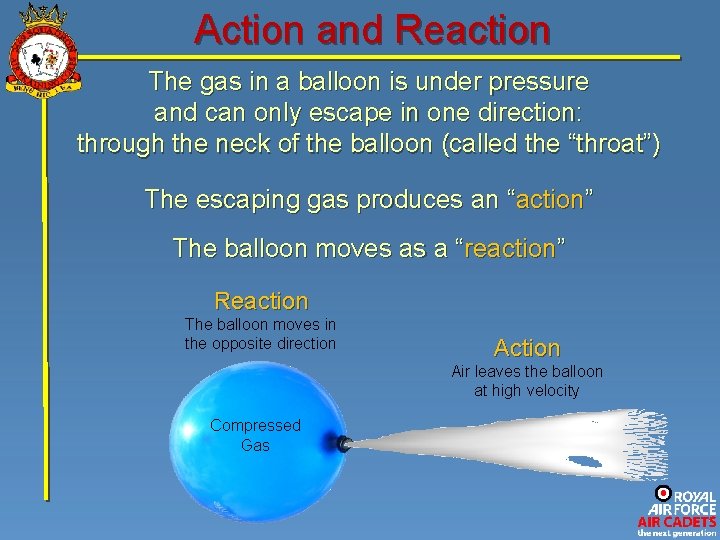
Action and Reaction The gas in a balloon is under pressure and can only escape in one direction: through the neck of the balloon (called the “throat”) The escaping gas produces an “action” The balloon moves as a “reaction” Reaction The balloon moves in the opposite direction Air leaves the balloon at high velocity Compressed Gas
Action and Reaction Balloons are inefficient as rocket motors. They run out of gas very quickly. They don’t provide much “action” (thrust). We can improve performance by: A continuous gas supply to provide thrust for longer. Heating the gas to raise its pressure. Make it leave at higher speeds to increase thrust. All of which are used in rocket motors.
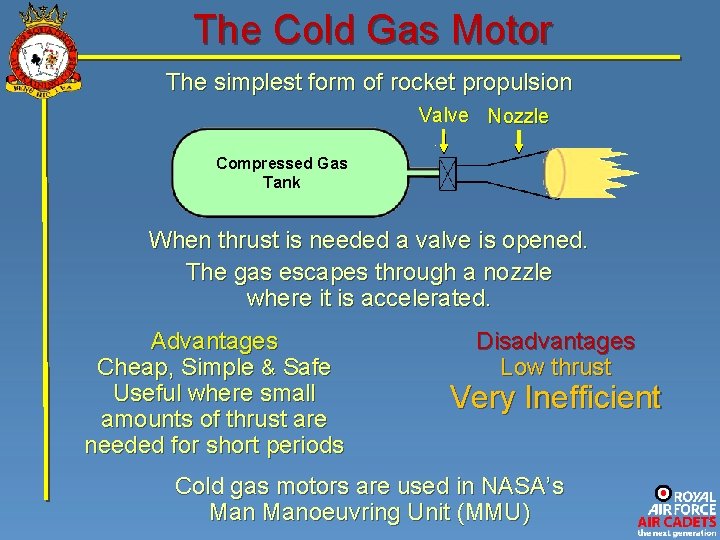
The Cold Gas Motor The simplest form of rocket propulsion Valve Nozzle Compressed Gas Tank When thrust is needed a valve is opened. The gas escapes through a nozzle where it is accelerated. Advantages Cheap, Simple & Safe Useful where small amounts of thrust are needed for short periods Disadvantages Low thrust Very Inefficient Cold gas motors are used in NASA’s Manoeuvring Unit (MMU)
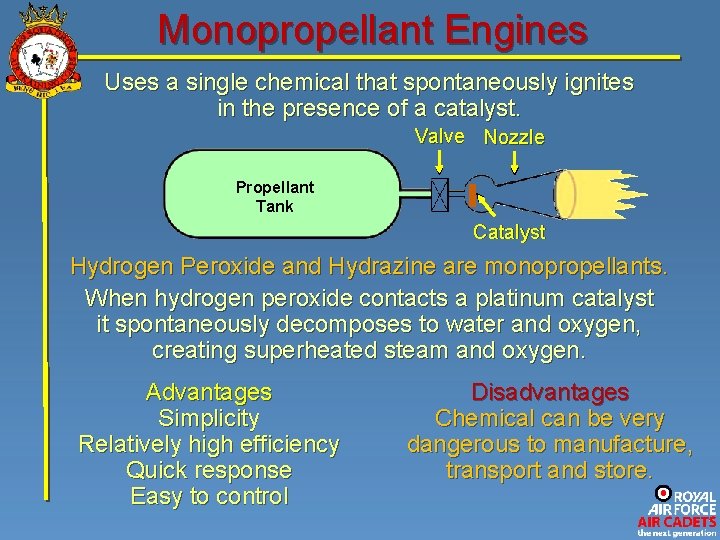
Monopropellant Engines Uses a single chemical that spontaneously ignites in the presence of a catalyst. Valve Nozzle Propellant Tank Catalyst Hydrogen Peroxide and Hydrazine are monopropellants. When hydrogen peroxide contacts a platinum catalyst it spontaneously decomposes to water and oxygen, creating superheated steam and oxygen. Advantages Simplicity Relatively high efficiency Quick response Easy to control Disadvantages Chemical can be very dangerous to manufacture, transport and store.
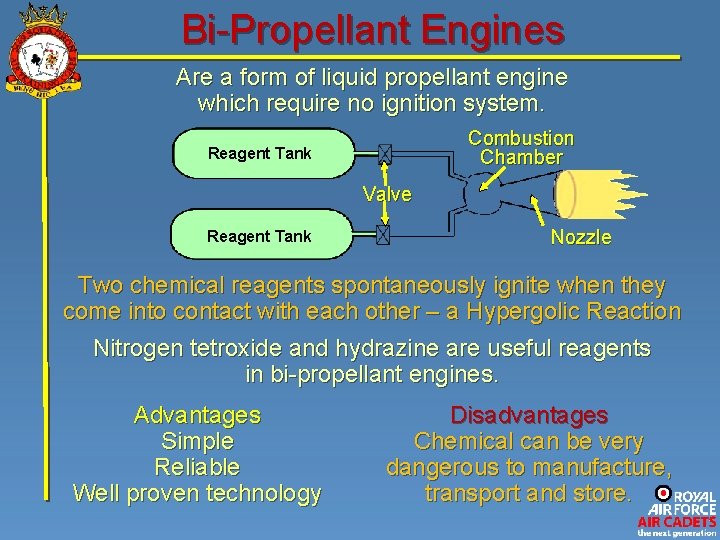
Bi-Propellant Engines Are a form of liquid propellant engine which require no ignition system. Combustion Chamber Reagent Tank Valve Reagent Tank Nozzle Two chemical reagents spontaneously ignite when they come into contact with each other – a Hypergolic Reaction Nitrogen tetroxide and hydrazine are useful reagents in bi-propellant engines. Advantages Simple Reliable Well proven technology Disadvantages Chemical can be very dangerous to manufacture, transport and store.
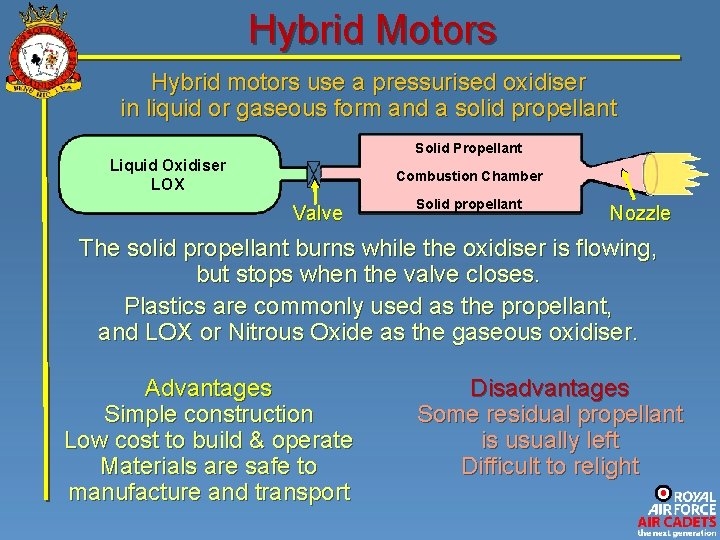
Hybrid Motors Hybrid motors use a pressurised oxidiser in liquid or gaseous form and a solid propellant Solid Propellant Liquid Oxidiser LOX Combustion Chamber Valve Solid propellant Nozzle The solid propellant burns while the oxidiser is flowing, but stops when the valve closes. Plastics are commonly used as the propellant, and LOX or Nitrous Oxide as the gaseous oxidiser. Advantages Simple construction Low cost to build & operate Materials are safe to manufacture and transport Disadvantages Some residual propellant is usually left Difficult to relight
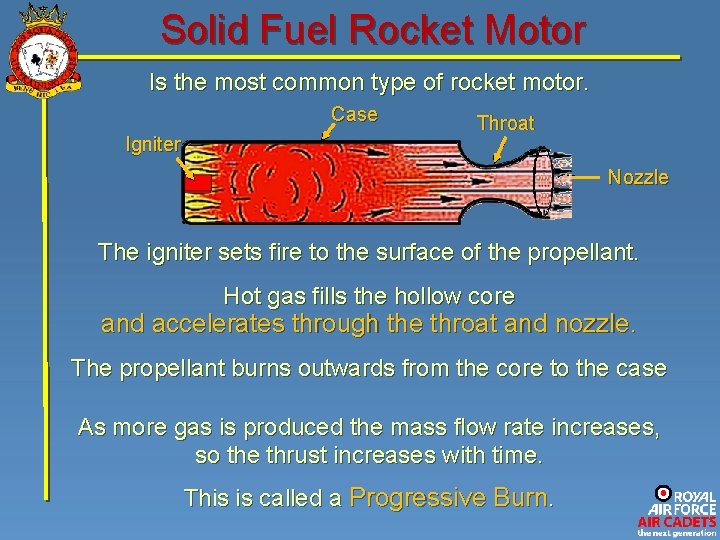
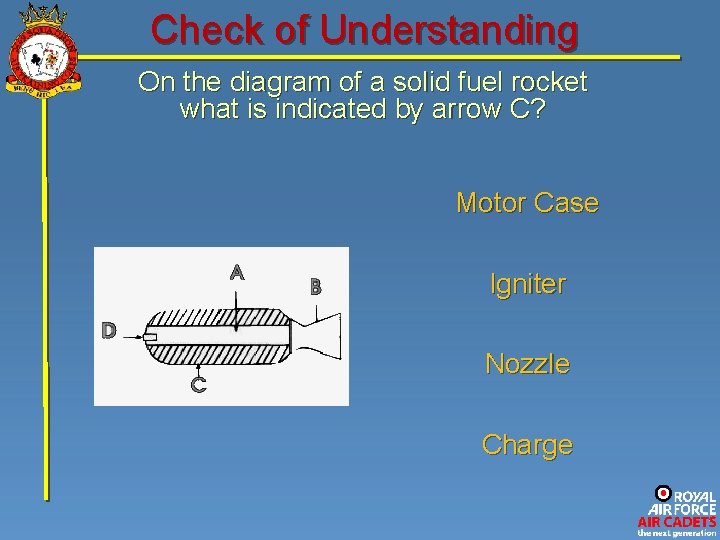
Solid Fuel Rocket Motor Is the most common type of rocket motor. Case Igniter Throat Propellant Grain Nozzle Propellant Grain The igniter sets fire to the surface of the propellant. Hot gas fills the hollow core and accelerates through the throat and nozzle. The propellant burns outwards from the core to the case As more gas is produced the mass flow rate increases, so the thrust increases with time. This is called a Progressive Burn.
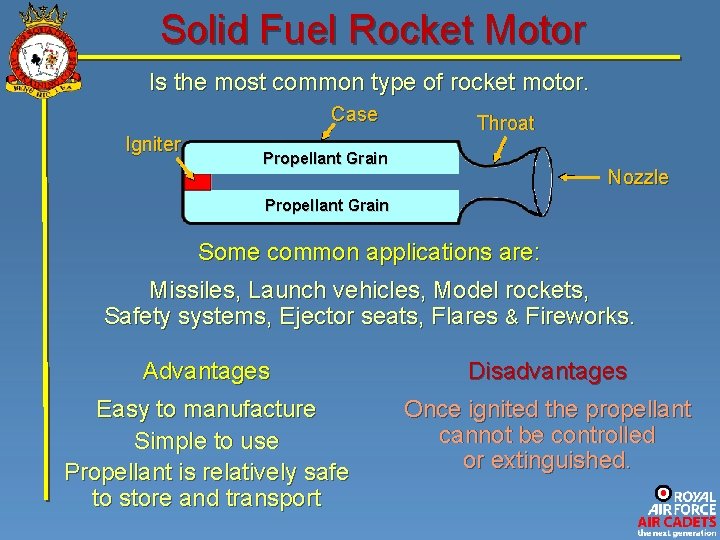
Solid Fuel Rocket Motor Is the most common type of rocket motor. Case Igniter Throat Propellant Grain Nozzle Propellant Grain Some common applications are: Missiles, Launch vehicles, Model rockets, Safety systems, Ejector seats, Flares & Fireworks. Advantages Disadvantages Easy to manufacture Simple to use Propellant is relatively safe to store and transport Once ignited the propellant cannot be controlled or extinguished.
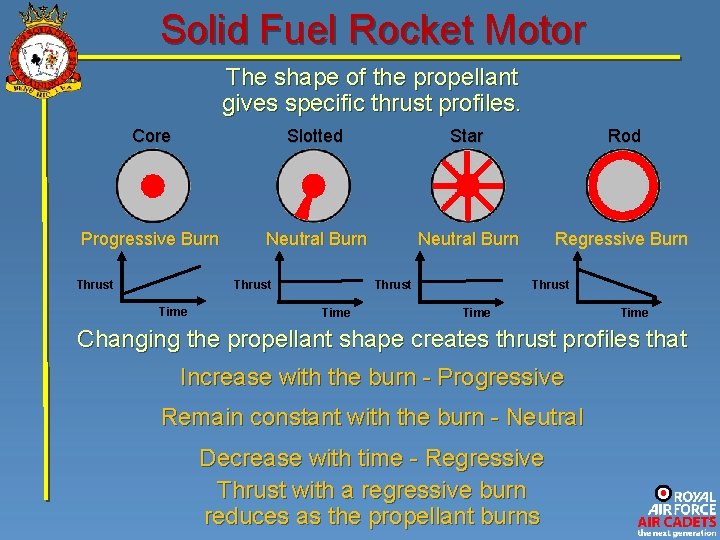
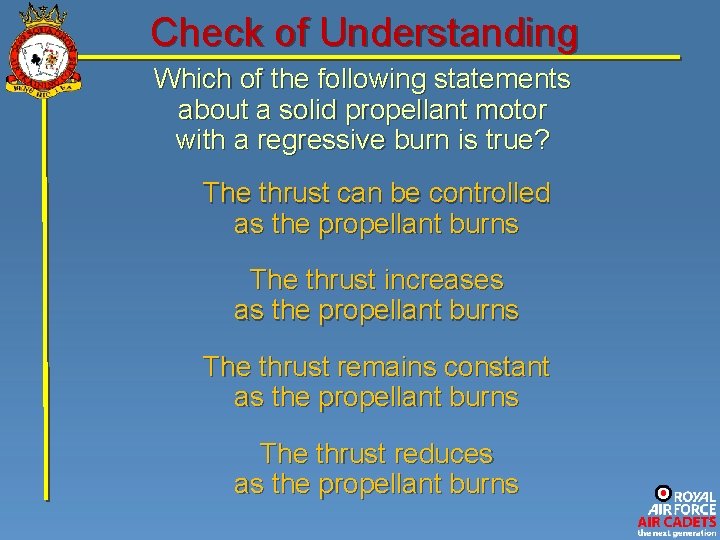
Solid Fuel Rocket Motor The shape of the propellant gives specific thrust profiles. Core Slotted Star Rod Progressive Burn Neutral Burn Regressive Burn Thrust Time Changing the propellant shape creates thrust profiles that Increase with the burn - Progressive Remain constant with the burn - Neutral Decrease with time - Regressive Thrust with a regressive burn reduces as the propellant burns
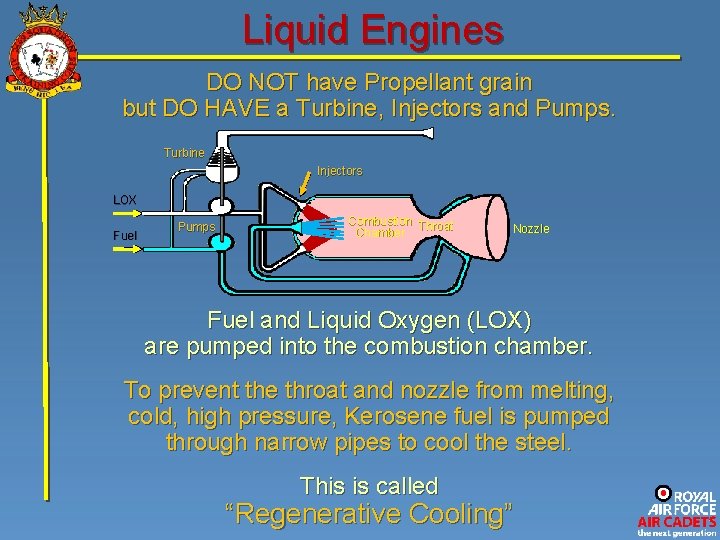
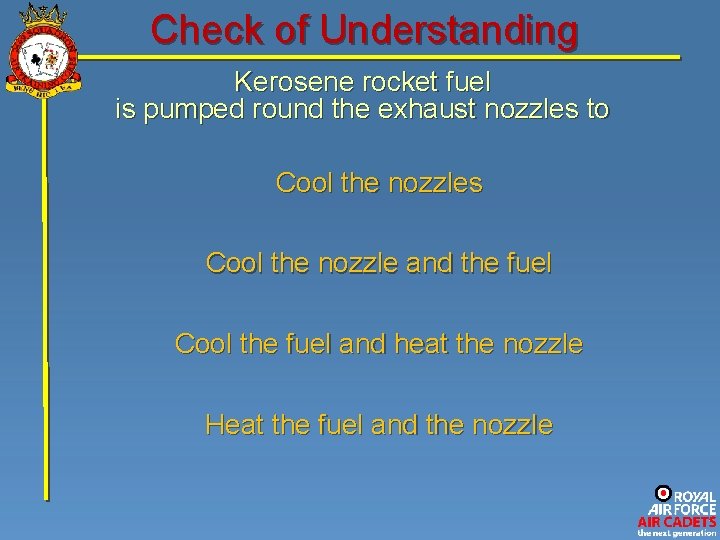
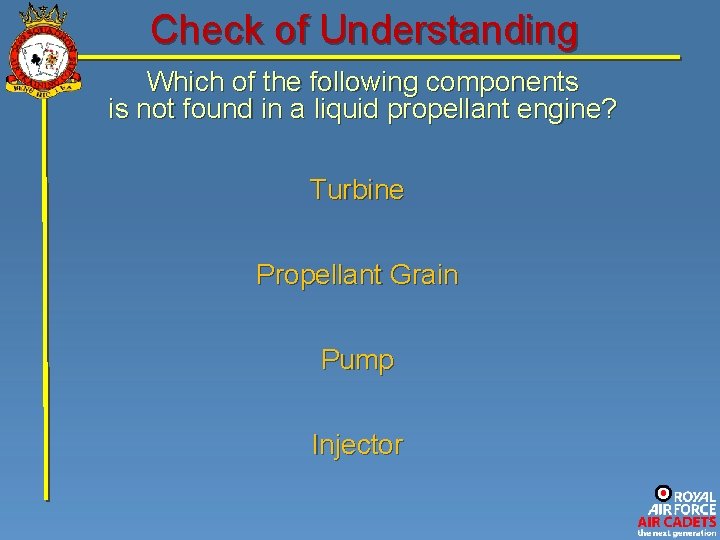
Liquid Engines DO NOT have Propellant grain but DO HAVE a Turbine, Injectors and Pumps. Turbine Injectors LOX Fuel Pumps Combustion Throat Chamber Nozzle Fuel and Liquid Oxygen (LOX) are pumped into the combustion chamber. To prevent the throat and nozzle from melting, cold, high pressure, Kerosene fuel is pumped through narrow pipes to cool the steel. This is called “Regenerative Cooling”
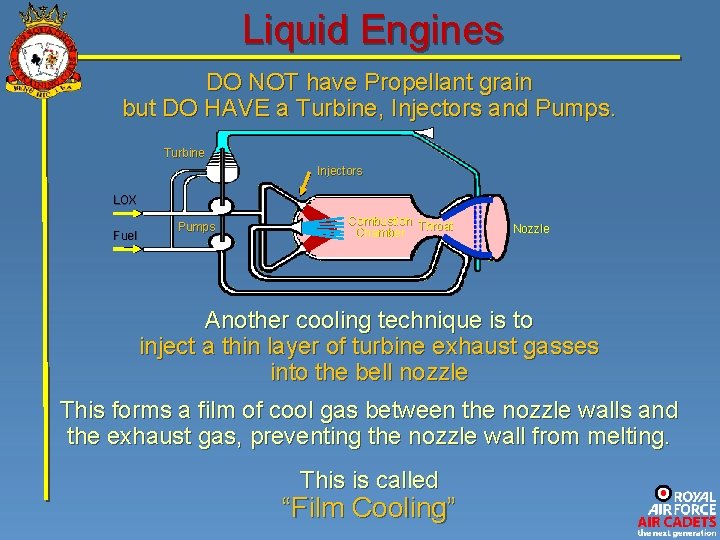
Liquid Engines DO NOT have Propellant grain but DO HAVE a Turbine, Injectors and Pumps. Turbine Injectors LOX Fuel Pumps Combustion Throat Chamber Nozzle Another cooling technique is to inject a thin layer of turbine exhaust gasses into the bell nozzle This forms a film of cool gas between the nozzle walls and the exhaust gas, preventing the nozzle wall from melting. This is called “Film Cooling”
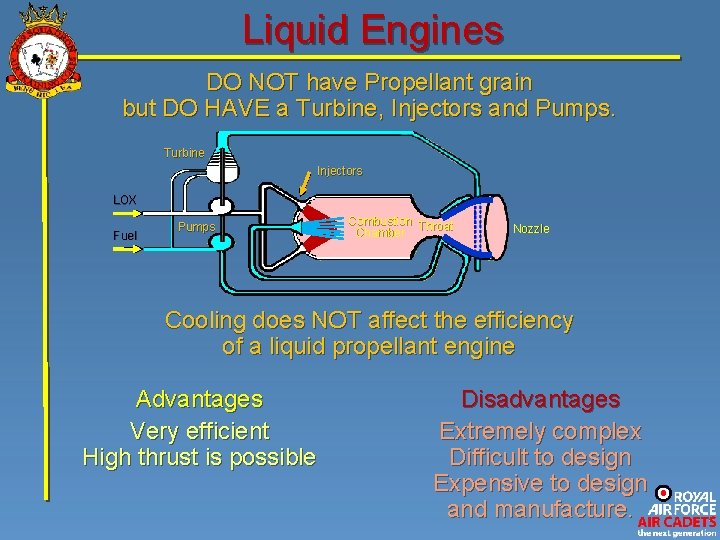
Liquid Engines DO NOT have Propellant grain but DO HAVE a Turbine, Injectors and Pumps. Turbine Injectors LOX Fuel Pumps Combustion Throat Chamber Nozzle Cooling does NOT affect the efficiency of a liquid propellant engine Advantages Very efficient High thrust is possible Disadvantages Extremely complex Difficult to design Expensive to design and manufacture.
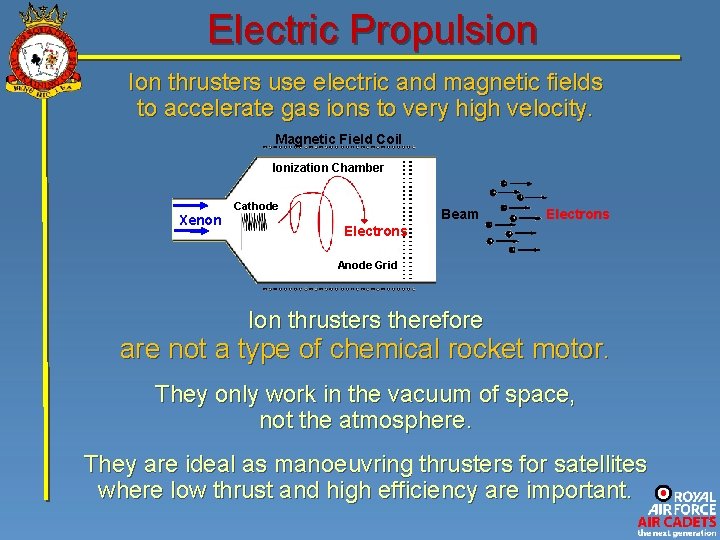
Electric Propulsion Ion thrusters use electric and magnetic fields to accelerate gas ions to very high velocity. Magnetic Field Coil Ionization Chamber Xenon Cathode Beam Electrons Anode Grid Ion thrusters therefore are not a type of chemical rocket motor. They only work in the vacuum of space, not the atmosphere. They are ideal as manoeuvring thrusters for satellites where low thrust and high efficiency are important.
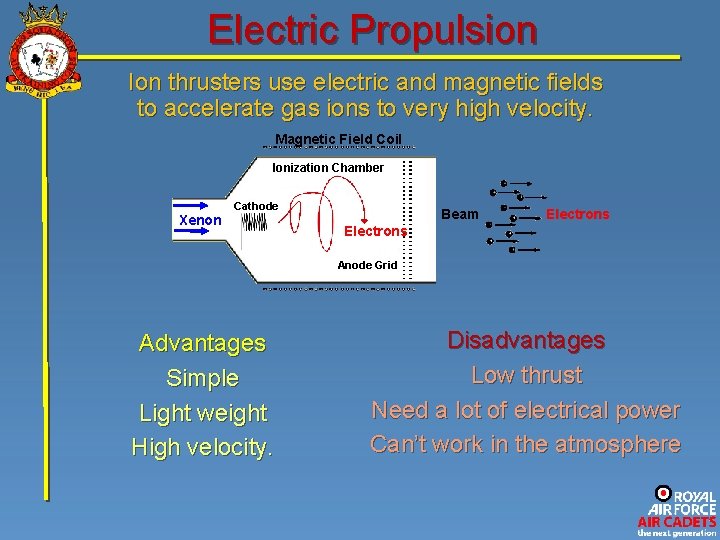
Electric Propulsion Ion thrusters use electric and magnetic fields to accelerate gas ions to very high velocity. Magnetic Field Coil Ionization Chamber Xenon Cathode Beam Electrons Anode Grid Advantages Simple Light weight High velocity. Disadvantages Low thrust Need a lot of electrical power Can’t work in the atmosphere
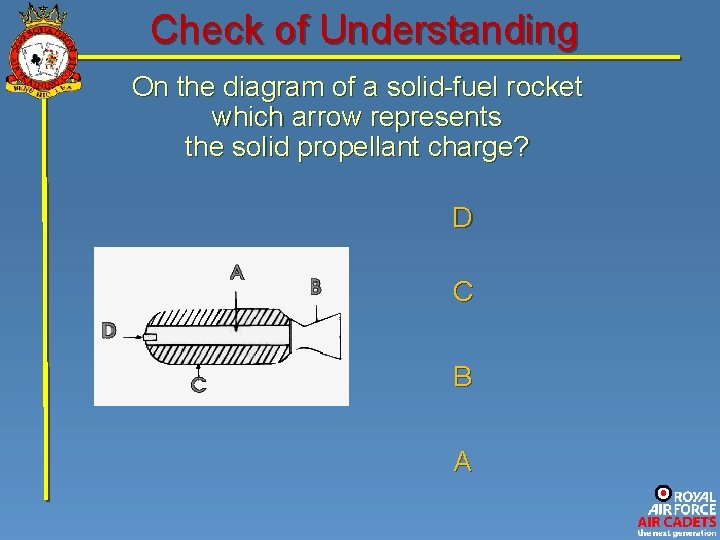
Check of Understanding On the diagram of a solid-fuel rocket which arrow represents the solid propellant charge? D C B A
Check of Understanding What is the burn profile of a core burning solid motor Regressive Neutral Progressive Constant
Check of Understanding Which of the following statements about a solid propellant motor with a regressive burn is true? The thrust can be controlled as the propellant burns The thrust increases as the propellant burns The thrust remains constant as the propellant burns The thrust reduces as the propellant burns
Check of Understanding Kerosene rocket fuel is pumped round the exhaust nozzles to Cool the nozzles Cool the nozzle and the fuel Cool the fuel and heat the nozzle Heat the fuel and the nozzle
Check of Understanding On the diagram of a solid fuel rocket what is indicated by arrow C? Motor Case Igniter Nozzle Charge
Check of Understanding Which of the following components is not found in a liquid propellant engine? Turbine Propellant Grain Pump Injector
Check of Understanding The main disadvantage of monopropellant and bipropellant engines is? They are very inefficient compared to solid rocket motors The engines are very complex to build The chemicals are dangerous to transport and store The motors are very heavy relative to the thrust they produce
Check of Understanding Regenerative cooling is used to: Increase the pressure of the propellant Improve the efficiency of the injectors Prevent the combustion chamber and nozzle from melting Raise the temperature of the LOX
Check of Understanding Which of these statements is NOT true? Cold gas motors are cheap, simple and safe Cold gas motors are very efficient Cold gas motors are used on small satellites Cold gas motors do not provide much thrust and are very inefficient
Check of Understanding Which of the following sentences describes a hybrid motor? It uses a pressurised oxidiser in liquid or gaseous form and a solid propellant It uses pressurised gaseous propellant and oxidser It uses two chemicals which spontaneously react It uses a solid oxidiser and a liquid propellant
Check of Understanding Which of the following does NOT affect the efficiency of a liquid propellant engine: The cooling system The choice of propellant The temperature of combustion How well the propellant and LOX are mixed
Check of Understanding Which of the following is NOT a type of chemical rocket motor? Ion thrusters Cold gas motors Monopropellant engines Solid propellant motors
Check of Understanding In which part(s) of a rocket motor are the exhaust gases accelerated? The nozzle The throat & the nozzle None of the above
Development and Principles of Rocketry End of Presentation