
Development and Principles of Rocketry Model Rockets Lecture

- Slides: 21
Development and Principles of Rocketry Model Rockets Lecture Six
UKRA Model rockets are not toys but are real rockets. They are launched from a launch pad. The pad supports the rocket while it accelerates. The motors are ignited electrically from a distance. The rocket deploys a parachute. Rockets can be flown many times. The specialist body for all model rocketry in the UK is The United Kingdom Rocketry Association (UKRA)
UKRA has established A Safety and Technical Committee. To publish a Safety Code for the launching of rockets, to liaise with government departments on safety and regulatory matters, and appoint Range Safety Officers (RSO) from UKRA’s most experienced rocketeers.
UKRA The RSO’s role is to supervise every launch and ensure that it can proceed safely. This includes the technical assessment of the planned rocket flight, monitoring airspace around the launch site, and ensuring that legal and insurance requirements are met.
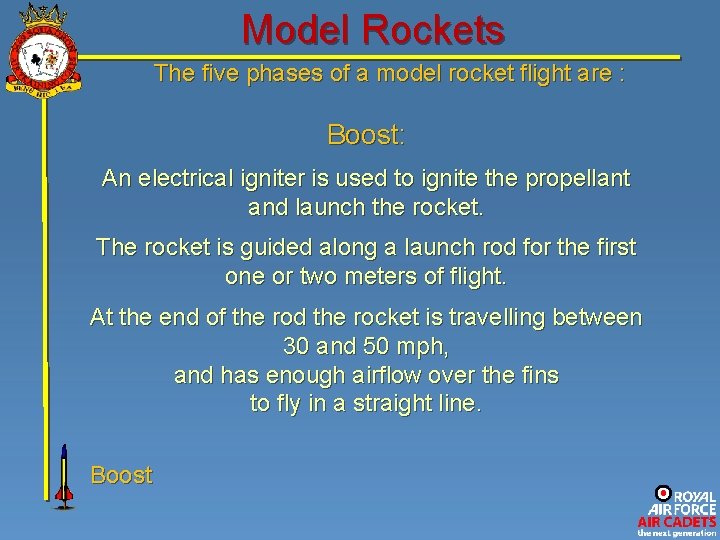
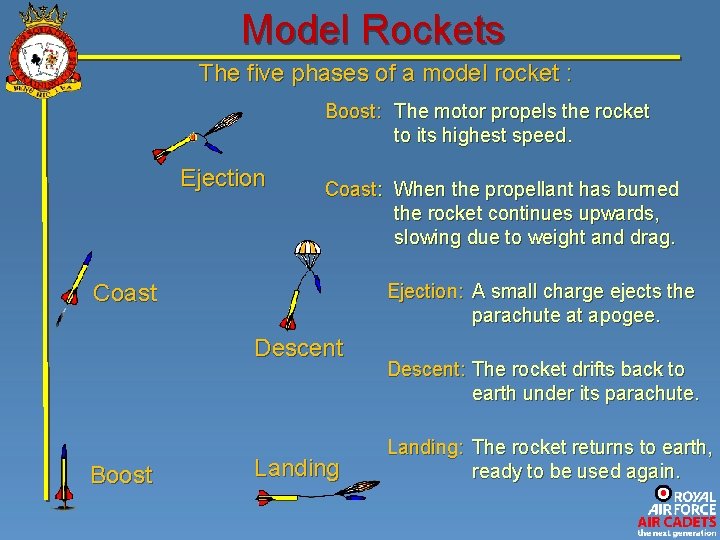
Model Rockets The five phases of a model rocket flight are : Boost: An electrical igniter is used to ignite the propellant and launch the rocket. The rocket is guided along a launch rod for the first one or two meters of flight. At the end of the rod the rocket is travelling between 30 and 50 mph, and has enough airflow over the fins to fly in a straight line. Boost
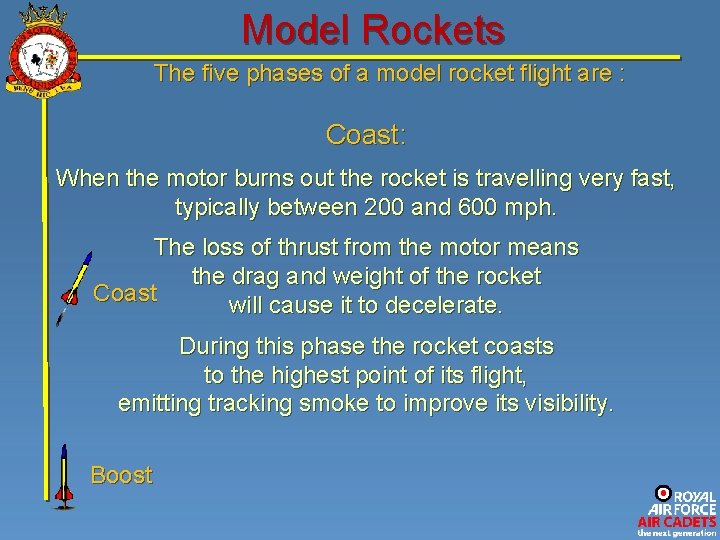
Model Rockets The five phases of a model rocket flight are : Coast: When the motor burns out the rocket is travelling very fast, typically between 200 and 600 mph. The loss of thrust from the motor means the drag and weight of the rocket Coast will cause it to decelerate. During this phase the rocket coasts to the highest point of its flight, emitting tracking smoke to improve its visibility. Boost
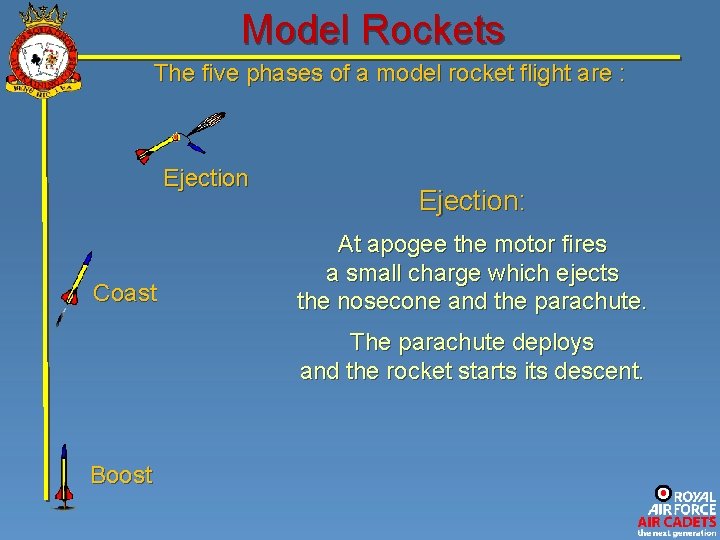
Model Rockets The five phases of a model rocket flight are : Ejection Coast Ejection: At apogee the motor fires a small charge which ejects the nosecone and the parachute. The parachute deploys and the rocket starts its descent. Boost
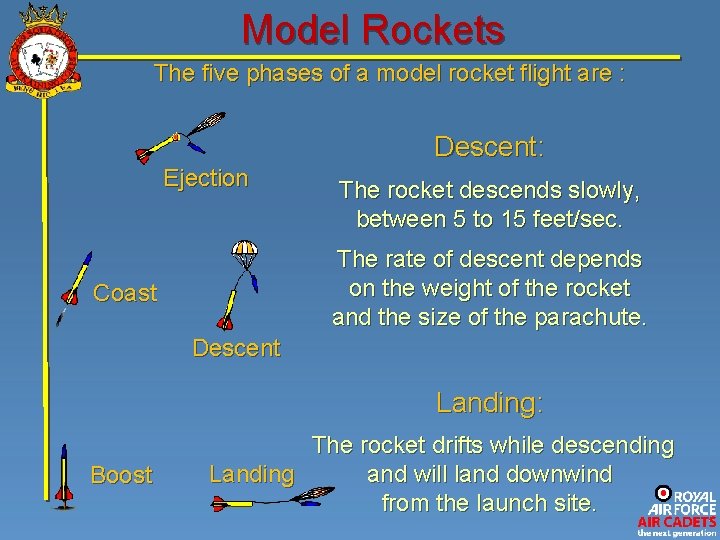
Model Rockets The five phases of a model rocket flight are : Descent: Ejection The rocket descends slowly, between 5 to 15 feet/sec. The rate of descent depends on the weight of the rocket and the size of the parachute. Coast Descent Landing: Boost The rocket drifts while descending Landing and will land downwind from the launch site.
Model Rockets The five phases of a model rocket : Boost: The motor propels the rocket to its highest speed. Ejection Coast: When the propellant has burned the rocket continues upwards, slowing due to weight and drag. Coast Ejection: A small charge ejects the parachute at apogee. Descent Boost Landing Descent: The rocket drifts back to earth under its parachute. Landing: The rocket returns to earth, ready to be used again.
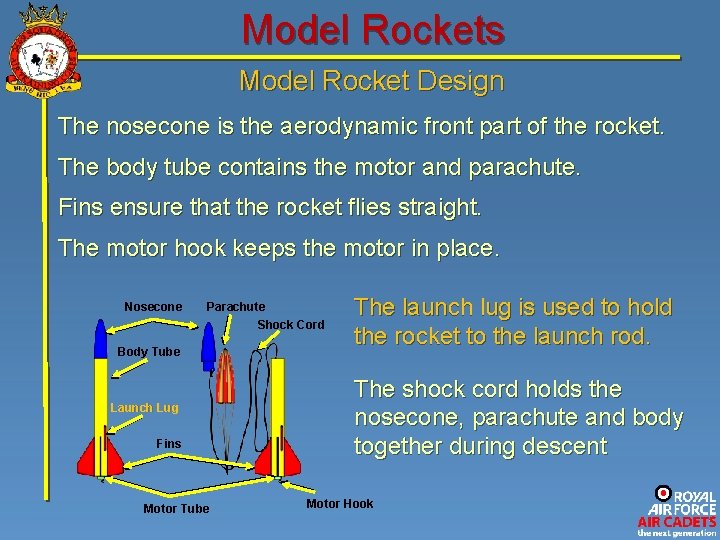
Model Rockets Model Rocket Design The nosecone is the aerodynamic front part of the rocket. The body tube contains the motor and parachute. Fins ensure that the rocket flies straight. The motor hook keeps the motor in place. Nosecone Parachute Shock Cord Body Tube Launch Lug Fins Motor Tube The launch lug is used to hold the rocket to the launch rod. The shock cord holds the nosecone, parachute and body together during descent Motor Hook
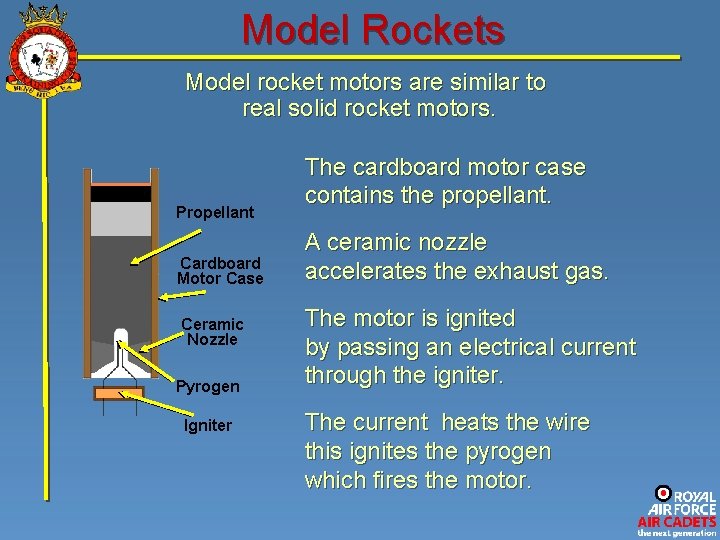
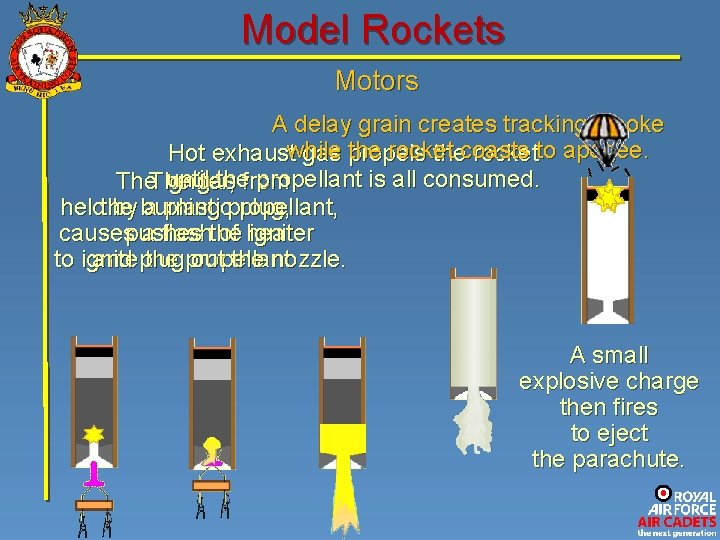
Model Rockets Model rocket motors are similar to real solid rocket motors. Propellant Cardboard Motor Case Ceramic Nozzle Pyrogen Igniter The cardboard motor case contains the propellant. A ceramic nozzle accelerates the exhaust gas. The motor is ignited by passing an electrical current through the igniter. The current heats the wire this ignites the pyrogen which fires the motor.
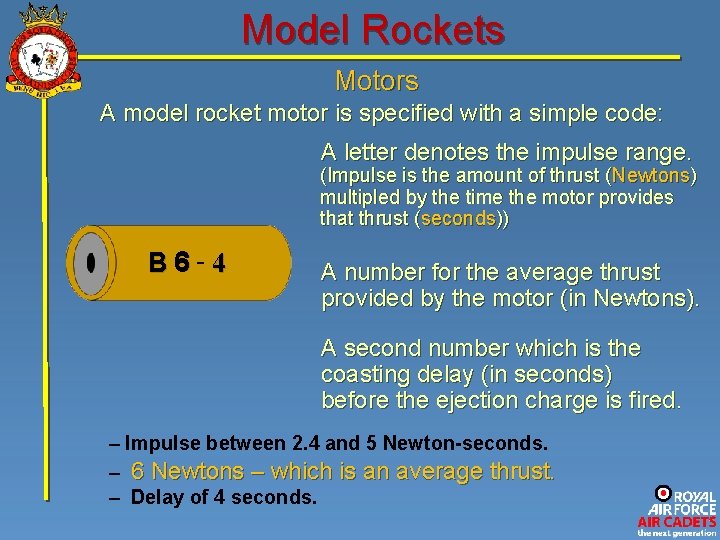
Model Rockets Motors A model rocket motor is specified with a simple code: A letter denotes the impulse range. (Impulse is the amount of thrust (Newtons) multipled by the time the motor provides that thrust (seconds)) B 6 -4 A number for the average thrust provided by the motor (in Newtons). A second number which is the coasting delay (in seconds) before the ejection charge is fired. – Impulse between 2. 4 and 5 Newton-seconds. – 6 Newtons – which is an average thrust. – Delay of 4 seconds.
Model Rockets Motors A delay grain creates tracking smoke the rocket Hot exhaustwhile gas propels thecoasts rocketto apogee. until thefrom propellant is all consumed. The igniter, gas heldthe by burning a plasticpropellant, plug, causespushes a flashthe of heat igniter to ignite and plug the propellant. out the nozzle. propellant A small explosive charge then fires to eject the parachute.
Check of Understanding The specialist body for model rocketry is called? NASA RSO ACPC UKRA
Check of Understanding What is the name of the document which defines safety requirements for model rocketry? Handbook of Model Rocketry UKRA Safety Code The Rocket Safety Manual UKRA Safety Procedures
Check of Understanding What is the role of the RSO in model rocketry? To design rockets so they'll fly safely To prepare rockets for launch To supervise every launch so that it can proceed safely To select the correct motor flight
Check of Understanding The five phases of model rocket flight are called: Boost, Climb, Ejection, Descent, Landing Blast-off, Climb, Ejection, Descent, Landing Boost, Coast, Ejection, Descent, Landing Blast-off, Coast, Ejection, Descent, Landing
Check of Understanding Which part of a model rocket is used to hold it onto the launch rod? Fins Shock cord Motor hook Launch lug
Check of Understanding What does the delay grain do in a model rocket motor? Provides thrust and tracking smoke Delays ejection and provides tracking smoke Electrically ignites the propellant Delays ejection and ejects the parachute
Check of Understanding A rocket motor designated C 6 -5 has an average thrust of: 5 Newtons 6 Newtons 5 Newton seconds 6 Newton seconds
Development and Principles of Rocketry End of Presentation