
Development and Principles of Rocketry Launches and Orbits
Development and Principles of Rocketry Launches and Orbits Lecture Five

Launch Vehicles Staging To produce a higher final velocity, launch vehicles must be multi-staged. This also gets rid of some structure that is no longer needed during the flight. This technique, called Staging, is used in all current launch vehicles.
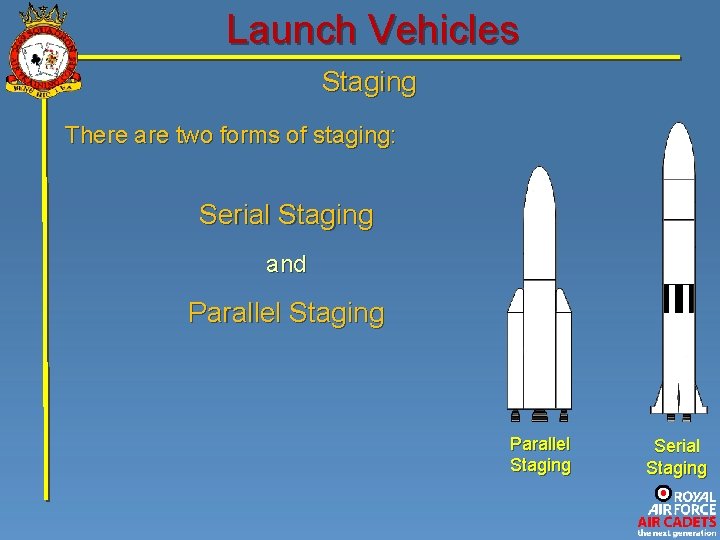
Launch Vehicles Staging There are two forms of staging: Serial Staging and Parallel Staging Serial Staging
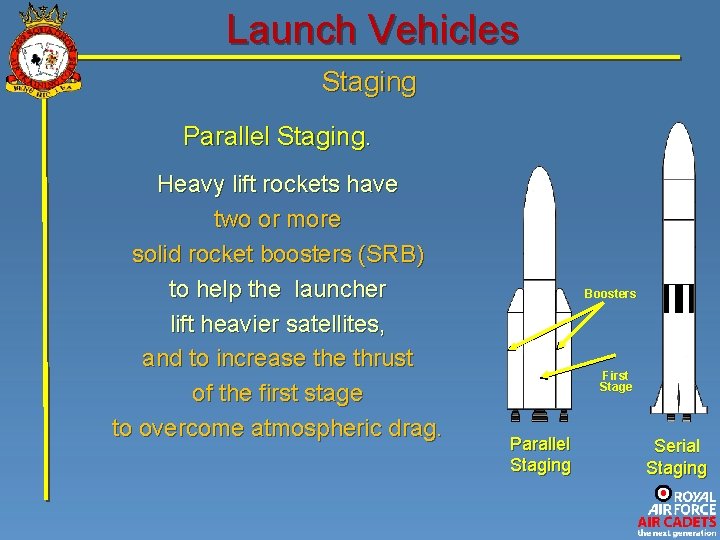
Launch Vehicles Staging Parallel Staging. Heavy lift rockets have two or more solid rocket boosters (SRB) to help the launcher lift heavier satellites, and to increase thrust of the first stage to overcome atmospheric drag. Boosters First Stage Parallel Staging Serial Staging

Launch Vehicles Staging It is normal for launch vehicles like the Ariane 5, to have 3 stages, as well as a payload in the nose. and it is also normal for each stage to be dropped as its propellant is consumed. The first stage uses one powerful engine, Parallel and does Staging the largest portion of the lifting work. Payload Third Stage Second Stage First Stage Serial Staging
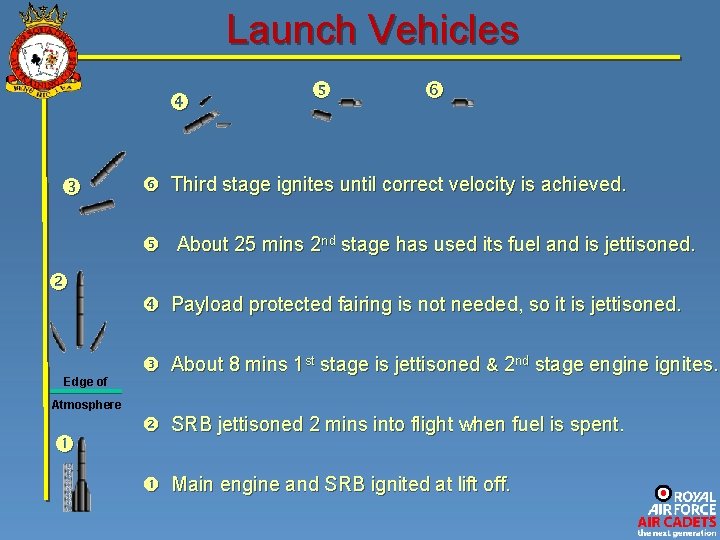
Launch Vehicles Third stage ignites until correct velocity is achieved. About 25 mins 2 nd stage has used its fuel and is jettisoned. Edge of Payload protected fairing is not needed, so it is jettisoned. About 8 mins 1 st stage is jettisoned & 2 nd stage engine ignites. Atmosphere SRB jettisoned 2 mins into flight when fuel is spent. Main engine and SRB ignited at lift off.
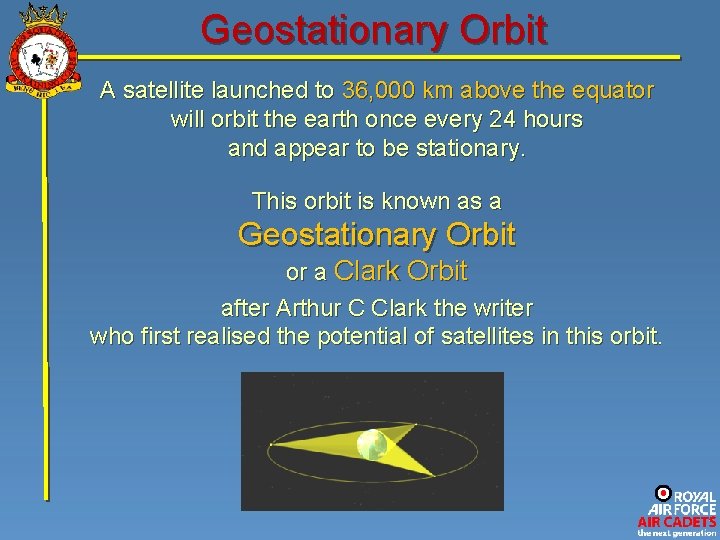
Geostationary Orbit A satellite launched to 36, 000 km above the equator will orbit the earth once every 24 hours and appear to be stationary. This orbit is known as a Geostationary Orbit or a Clark Orbit after Arthur C Clark the writer who first realised the potential of satellites in this orbit.

Geostationary Orbit At a calculated point the rocket is ‘injected‘ into orbit. It needs to reach a velocity of 10. 3 km/s BUT it is only travelling at 9. 5 km/s, so the satellite fires its Apogee Boost Motor (ABM) to accelerate it to the required velocity. GTO 10. 3 km/s This puts the satellite into a Geostationary Transfer Orbit (GTO)
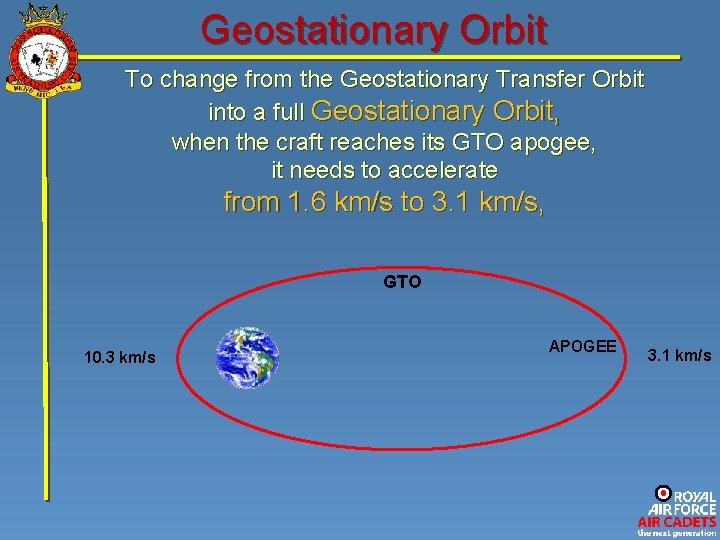
Geostationary Orbit To change from the Geostationary Transfer Orbit into a full Geostationary Orbit, when the craft reaches its GTO apogee, it needs to accelerate from 1. 6 km/s to 3. 1 km/s, GTO 10. 3 km/s APOGEE 3. 1 km/s
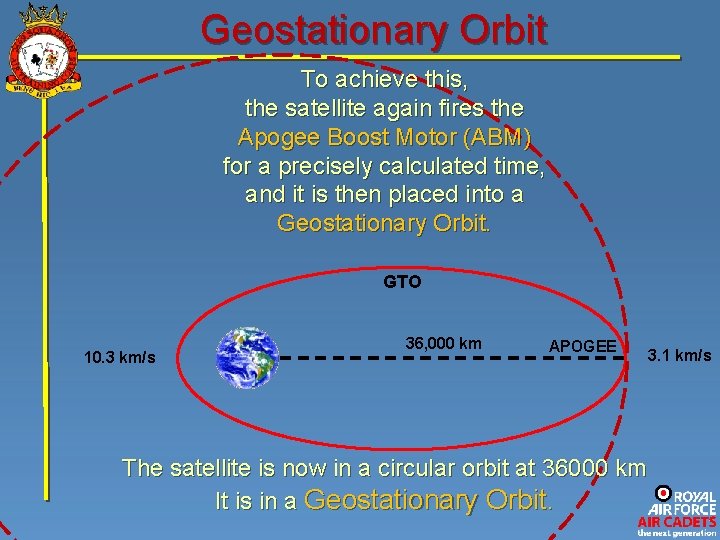
Geostationary Orbit To achieve this, the satellite again fires the Apogee Boost Motor (ABM) for a precisely calculated time, and it is then placed into a Geostationary Orbit. GTO 10. 3 km/s 36, 000 km APOGEE The satellite is now in a circular orbit at 36000 km It is in a Geostationary Orbit. 3. 1 km/s
Check of Understanding Additional rockets fixed to the outside of the first-stage of a multiple-stage rocket are called? Orbiter motors External tanks Afterburners Boosters

Check of Understanding The problem of lifting large rockets and their payloads into space is overcome by the use of? Thruster motors Multi-stage rockets Booster engines Re-usable vehicles
Check of Understanding In an Ariane 5 launch vehicle how many stages are there? One Two Three Four
Check of Understanding If a launch vehicle has staging strapped alongside each other and fired simultaneously what type of staging is this? Serial Flat Parrallel Inline
Check of Understanding In a multi-stage rocket, which stage does the largest portion of the lifting work? Second & Third Second First
Check of Understanding What is the main advantage of multi-staging a launch vehicle? It uses more efficient engines It produces a higher final velocity It allows more fuel to be carried It reduces the mass ratio
Check of Understanding What is the altitude of the Clark orbit ? 36, 000 metres 36, 000 kilometres 36, 000 feet 36, 000 miles
Check of Understanding Injection is the process of altering a rocket's trajectory from vertical to horizontal in order to put it into? A dive Space Orbit Its final velocity
Check of Understanding What is the velocity of a satellite at apogee in GTO 1. 3 km per sec 1. 6 km per sec 3. 1 km per sec 6. 1 km per sec
Check of Understanding Final acceleration into GTO is performed by: Burning the apogee boost motor Jettisoning the SRB’s Burning the booster motors Jettisoning the second stage
Development and Principles of Rocketry End of Presentation
- Slides: 21