
Development and Impact of Bilingualism LCD 323 Fall
Development and Impact of Bilingualism LCD 323 Fall 2014
On Bilingual Language Acquisition Language acquisition is similar to the process children use in getting first and second languages. It requires meaningful interaction in the target language and natural communication. (Brown and Hanlon, 1970; Brown, Cazden, and Bellugi, 1973)
Some Definitions First Language Acquisition: Studies infants’ acquisition of their native language. Native Language: A first language (also native language, mother tongue, arterial language, or L 1) is the language(s) a person has learned from birth or within the critical period, or that a person speaks the best and so is often the basis for sociolinguistic identity. Second Language acquisition, or L 2 acquisition, generally refers to the acquisition of a Second Language by someone who has already acquired a First Language. Bilingual Language acquisition Refers to the simultaneous acquisition of two languages beginning in infancy, or before the age of three years.
“Bilingualism Is & Likely Will Be Intriguing” People wonder how it´s possible for a child to acquire two or more languages at the same time…. Doesn´t the child confuse the two languages? Are bilingual children brighter? Does acquiring two languages negatively affect the child´s cognitive development in some way?
Reflecting on Language Acquisition The ability of children to form complex rules and construct grammars of the languages used around them in a short time IS phenomenal. Beginning from birth, babies everywhere follow a similar pattern to acquire their first language according to their individual biological timetable- from crying, cooing, babbling to one-word utterances, two word phrases, full sentences, and eventually, to complex grammar.
Stages Different in a Child’s Second Language acquisition? Individuals learning a Second Language use the same innate processes that are used to acquire their first language from the first days of exposure to the new language in spite of their age. They reach similar development stages to those in first language acquisition, making some of the same type of errors in grammatical markers that young children make, picking up chunks of language without knowing precisely what each word means (Collier, 1998).
Phenomena of Second Language Acquisition Interference: e. g. “this house is more bigger”; “Take a seat”. Interlanguage: e. g. “ What Pat doing now? (neither L 1 nor L 2) Silent Period: e. g. when learner listens but rarely speaks in the new language. Code Switching: Changing languages over phrases or sentences e. g. : “Me gustaría manejar- I´ll take the car” Language Loss: e. g. : when a child´s first language diminishes. Bilingual Code Mixing: Use of patterns from two languages in the same utterance. e. g. : I´m going with her to la esquina. (Roseberry-Mc. Kibbin(2002)

Children´s Second Language Acquisition Stages and Related Linguistic Patterns STAGE 1. PRE-PRODUCTION (Silent Period): • Minimal comprehension; No verbal production. Up to 500 words in their receptive vocabulary. • They need repetition. STAGE 2. EARLY PRODUCTION: • Limited comprehension one/two- word response. Vocabulary of 1000 words. STAGE 3. SPEECH EMERGENCE: • Increased comprehension; Simple sentences; Some errors in speech. Vocabulary of 3, 000 words.
Children´s Second Language Acquisition Stages STAGE 4. INTERMEDIATE FLUENCY: Very good comprehension; More complex sentences and concepts; Complex errors in speech. Able to synthesize and make inferences. Vocabulary of 6, 000 active words. STAGE 5 ADVANCED FLUENCY: Near- native in their ability; From 4 -10 years to achieve cognitive academic language proficiency. (Stephen Krashen and Tracy Terrell, 1983)
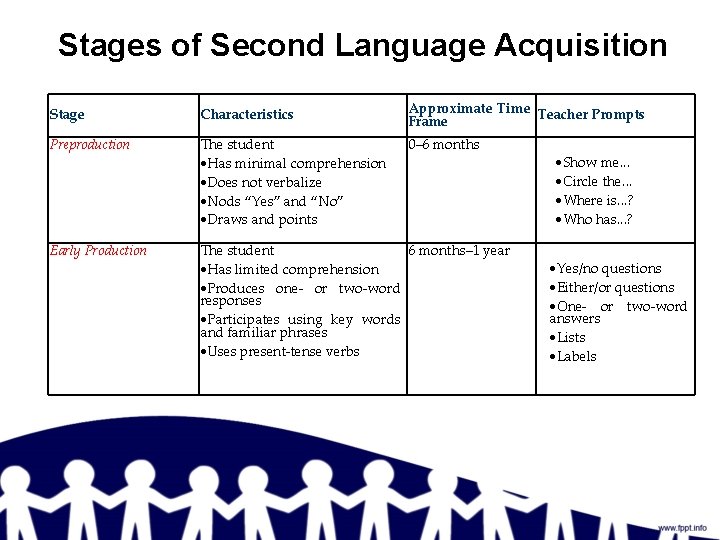
Stages of Second Language Acquisition Stage Characteristics Approximate Time Teacher Prompts Frame Preproduction The student Has minimal comprehension Does not verbalize Nods “Yes” and “No” Draws and points 0– 6 months Early Production The student 6 months– 1 year Has limited comprehension Produces one- or two-word responses Participates using key words and familiar phrases Uses present-tense verbs Show me. . . Circle the. . . Where is. . . ? Who has. . . ? Yes/no questions Either/or questions One- or two-word answers Lists Labels
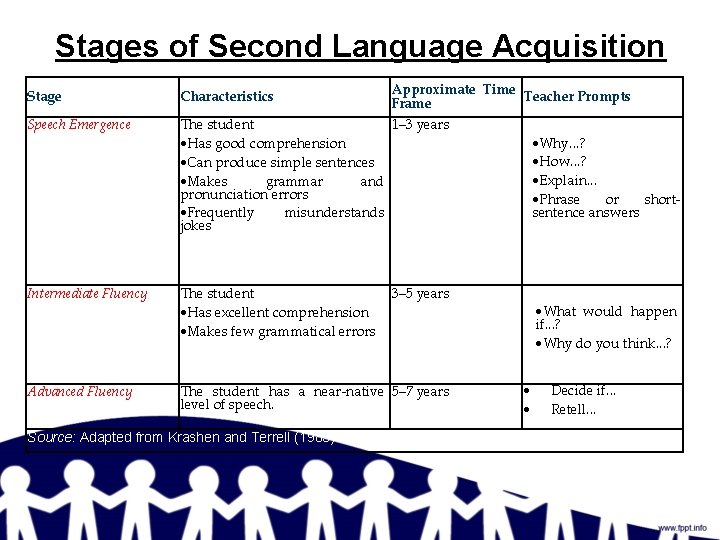
Stages of Second Language Acquisition Approximate Time Teacher Prompts Frame Stage Characteristics Speech Emergence The student 1– 3 years Has good comprehension Can produce simple sentences Makes grammar and pronunciation errors Frequently misunderstands jokes Intermediate Fluency The student 3– 5 years Has excellent comprehension Makes few grammatical errors Advanced Fluency The student has a near-native 5– 7 years level of speech. Source: Adapted from Krashen and Terrell (1983). Why. . . ? How. . . ? Explain. . . Phrase or shortsentence answers What would happen if. . . ? Why do you think. . . ? Decide if. . . Retell. . .
EARLY RESEARCH -Two languages were learned independently and the knowledge of learning one did not transfer into the other. -As more was learned in one language, less could be learned in the other. This gave the idea of having an “amount of” or “limit to” language acquisition.
Recent Research - Two languages influence each other. For Example : *Concept of adding *Recognition of spoken language which is represented in writing. -- Meaning of words: When children are fluent in two languages, they know more than one word for the same concept, this can add cognitive flexibility in the children which allows them to build a more complex understanding of the word at a younger age.

More On Cognitive Benefits Ellen Bialystok and Kenji Hakuta – “the benefits for being bilingual go much further than simply knowing two languages. Because the structures and ideas of the two languages are so different it forces the child to think in more complicated ways than if they learning only one language” • Other benefits of language acquisition is a greater sensitivity to language in general and greater awareness of meaning and structure in language. • Children receive more linguistic input, requiring a greater amount of language analysis.
OTHER AWARENESSES Cummins suggested that if L 1 has not reached a certain competence, the child may develop “semi-linguistic” or “limited bilingualism”, a situation of lower competence in the various languages acquired, in comparison to monolingual children.
OTHER AWARENESSES - Dr. Janet Werner of the University of British Columbus carried out a phonological study because she considers that every aspect of language including sound system is essential for getting the full message from the speaker. In her study Dr. Werner proposed the following question : Can early bilinguals achieve native competence in phonetic perception in both languages or is there language dominance even in infancy? To address this question she used a prior research conducted by Dr. Tracey Burns. In this research a bilingual mother was exposed to 2 languages prenatally over five year period. - After that period, she concluded that both languages are equally dominant at birth in the infants. Newborn of bilingual mother keep both familiar languages active
Childhood Bilingualism Families’ definition Having a language plan Raising bilingual children
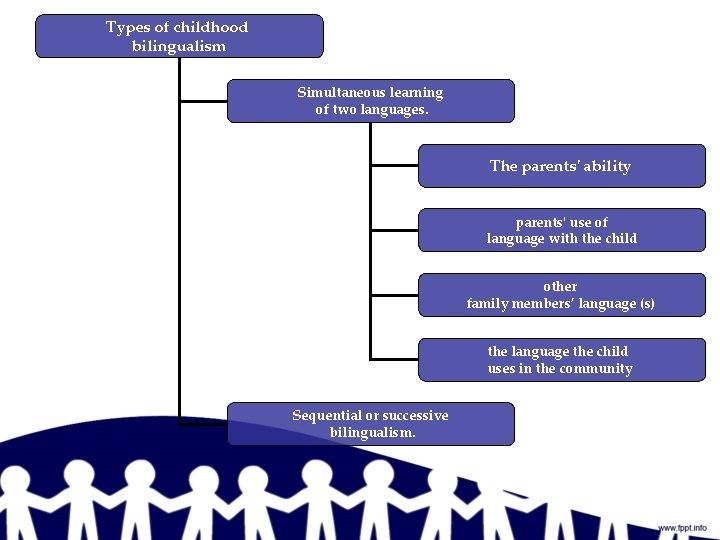
Types of childhood bilingualism Simultaneous learning of two languages. The parents' ability parents' use of language with the child other family members’ language (s) the language the child uses in the community Sequential or successive bilingualism.
Simultaneous Learning Of Two Languages. Strategies: One parent, one language. Both parents speak one language in the home and a second language is used at school.
Simultaneous Learning of Two Languages Strategies: One language is used in the home and at school and the second language is used in the community. Both parents speak both languages to the child but separate the languages according to speaking situations or alternate days.
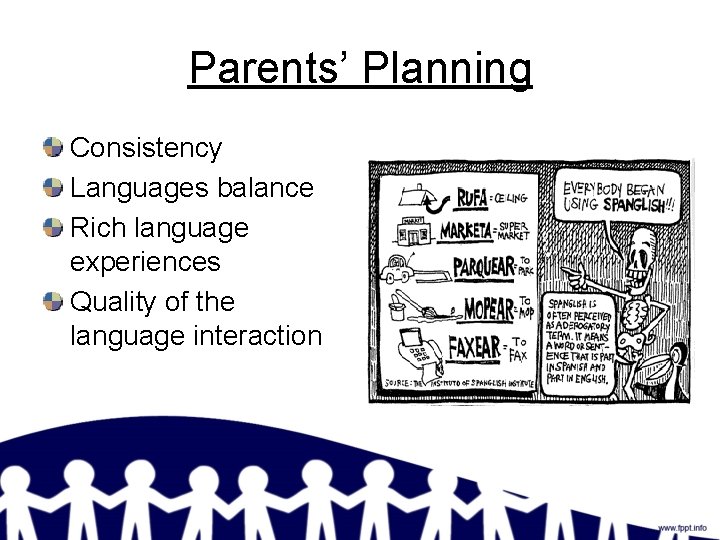
Parents’ Planning Consistency Languages balance Rich language experiences Quality of the language interaction
Individual Differences Stability and mobility. Relationships within the family affect bilingual language development. Attitudes toward each language
Advantages of Bilingualism COGNITIVE Creativity Problem Solving, Analytical Skills, Logical Reasoning, Cognitive Flexibility
Advantages of Bilingualism Child's self identity Self-esteem Schooling options Socio-Cultural: visual-social abilities, interpersonal skills, Social sensitivity
Importance of Bilingualism Research into bilingualism is crucial today. Although it plays out differently in other parts of the world, research on bilingualism does serve to elucidate an understanding of the human mind and an understanding of social possibilities of other cultures, and how these can be used to educate children to prepare them to be citizens of the world.
ASHA ON BILINGUALISM Bilingual Service Delivery http: //www. asha. org/PRPSpecific. Topic. aspx? folderid=8589935225§ion=Key_Issues
Other Information on Bilingualism How can a speech-language pathologist help? A speech-language pathologist (SLP) can provide elective services for individuals who are learning English as a second language. These services are not covered by insurance. The Preferred Practice Patterns for the Profession of Speech-Language Pathology outline the common practices followed by SLPs when engaging in various aspects of the profession. The Preferred Practice Patterns for elective communication modifications are outlined in sections 31, 32, and 33. What other organizations have information about second language acquisition? í Colorín Colorado! National Association of Bilingual Education National Clearinghouse for English language acquisition Talk to your baby in your own language See also: Learning Two Languages Acquiring English as a Second Language: What's Normal and What's Not The Advantages of Being Bilingual
Sources on Bilingualism Dr. Fred H. Genesee. Early childhood bilingualism: Perils and possibilities Vol. 2, Special Issue, Article 2, April 2009 Journal of Applied Research on Learning 1 Rose Li and Associates, Inc. January 2005. Childhood Bilingualism Current Status and Future Directions 2004 Workshop Summary. Marsha Rosenberg. “Raising Bilingual Children”. Reprinted from: The Ambassador, The American School in Japan Alumni & Community Magazine. Spring 1996 The Internet TESL Journal, Vol. II, No. 6, June 1996 ARTICLE TAKEN FROM: The Internet TESL Journal http: //iteslj. org/ Link: http: //iteslj. org/Articles/Rosenberg-Bilingual. html

More Sources
- Slides: 29