
Development and evolution of 3 GPP Core Network
- Slides: 8
Development and evolution of 3 GPP Core Network Hannu Hietalahti, CT chairman 1
CT officials • Chairman – Hannu Hietalahti / Nokia (ETSI) • Vice Chairs – Gary Jones / T-Mobile (ATIS) – Steve Mecrow / O 2 (ETSI) – Akishige Noda / Fujitsu (TTC) • MCC Support – Kimmo Kymalainen (MCC) 2
CT To. R • At discontinuation of TSG-T and TSG-CN the new TSG-CT became the “core network and terminal” group • Technical tasks – – – – Cellular and IMS protocols CS and PS domain UE L 3 protocols (CT 1) Interworking with external networks (CT 3) Network interfaces (CT 4) Open Service Architecture, OSA (CT 5) Smart card applications (CT 6) 3
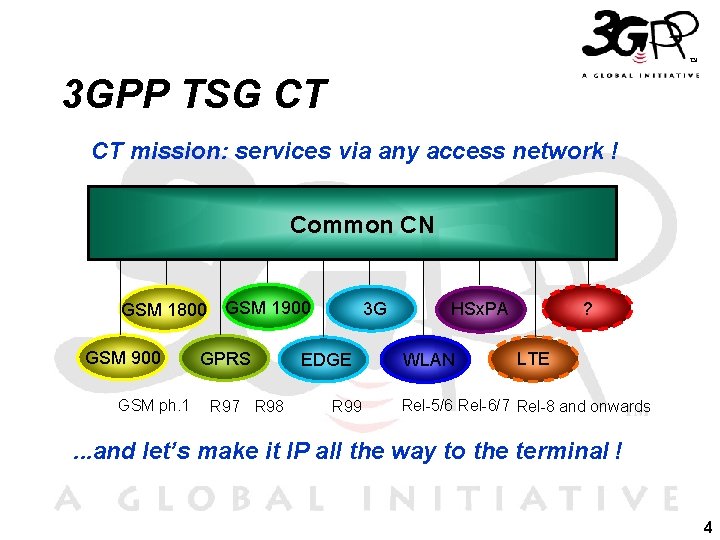
3 GPP TSG CT CT mission: services via any access network ! Common CN GSM 1800 GSM 1900 GSM ph. 1 GPRS R 97 R 98 3 G EDGE R 99 ? HSx. PA WLAN LTE Rel-5/6 Rel-6/7 Rel-8 and onwards . . . and let’s make it IP all the way to the terminal ! 4
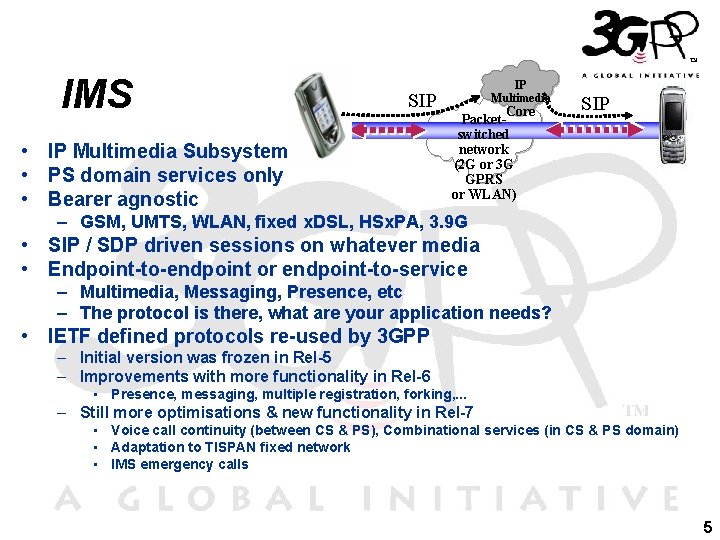
IMS SIP • IP Multimedia Subsystem • PS domain services only • Bearer agnostic IP Multimedia Core Packetswitched network (2 G or 3 G GPRS or WLAN) SIP – GSM, UMTS, WLAN, fixed x. DSL, HSx. PA, 3. 9 G • SIP / SDP driven sessions on whatever media • Endpoint-to-endpoint or endpoint-to-service – Multimedia, Messaging, Presence, etc – The protocol is there, what are your application needs? • IETF defined protocols re-used by 3 GPP – Initial version was frozen in Rel-5 – Improvements with more functionality in Rel-6 • Presence, messaging, multiple registration, forking, . . . – Still more optimisations & new functionality in Rel-7 • Voice call continuity (between CS & PS), Combinational services (in CS & PS domain) • Adaptation to TISPAN fixed network • IMS emergency calls 5
WLAN interworking • • Currently specified for IEEE 802. 11, but not restricted to that version Re-use of IEEE WLAN specifications Definition of the architecture Functionality – – – – Detection of the AP’s Associating with AP Detection of HPLMN connection Authentication Establishment of tunnel to HPLMN packet gateway Voice call continuity in Rel-7 WLAN VPN access in Rel-7 6
Some of the main Rel-7 work items • CSI (CS and IMS combinational service) – Requires both CS and PS connectivity at the same time – CS domain voice call with additional information e. g. video clip via IMS • VCC (Voice Call Continuity) – Voice call continuity between CS domain and PS domain – Transition between CS and PS cells without losing the call • IMS evolution – – NGN, IMS over fixed access IMS emergency calls based on SIP emergency sessions IMS multimedia telephony Conferencing and messaging enhancements (DM and BFCP) • . . . and several WLAN and traditional cellular protocol evolution work items 7
What’s next. . . Stabilising Rel-7 Rel-8 Long Term Evolution network architecture adapted via SAE to LTE radio Migration from CS domain voice services to PS domain IMS multimedia services 8