
DEVELOPMENT AND ASSESSMENT OF DEVELOPMENT IAP UG Teaching


- Slides: 38
DEVELOPMENT AND ASSESSMENT OF DEVELOPMENT IAP UG Teaching slides 2015 -16 1
DEVELOPMENTAL RULES • Development is a continuous process beginning in utero and progressing till maturity. • Sequence of attainment of milestones is essentially the same in all children. (Variation only in time and manner of attainment) • Development proceeds in a cephalo caudal direction -head control precedes trunk control which precedes limb control IAP UG Teaching slides 2015 -16 2
DEVELOPMENTAL RULES • Control of limbs in a proximo distal fashion where hand use is learnt before finger control. • Certain primitive reflexes have to be lost before appropriate milestone is achieved. • Initial disorganized mass activity is gradually replaced by more specific activity e. g. when shown a bright toy a 3 month old will excitedly move all 4 limbs and squeal loudly while a 3 -4 year old will smile and ask for it. IAP UG Teaching slides 2015 -16 3
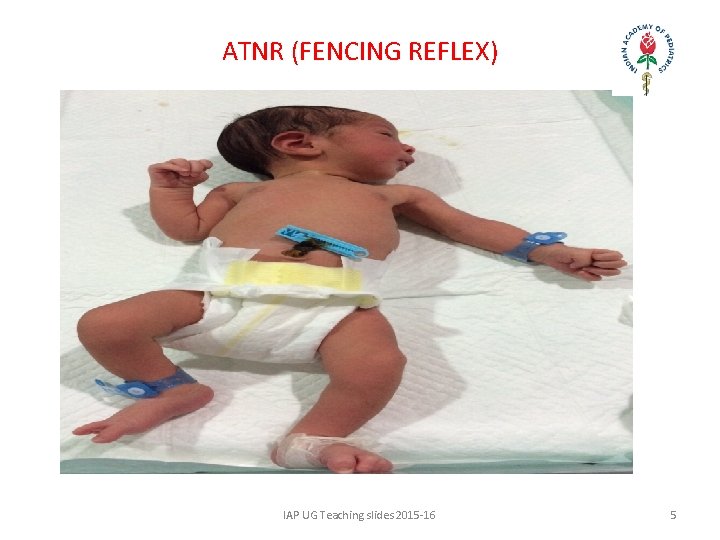
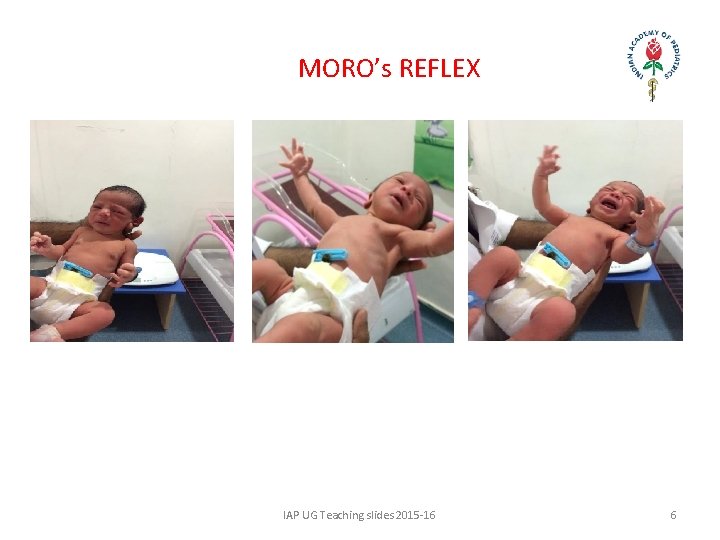
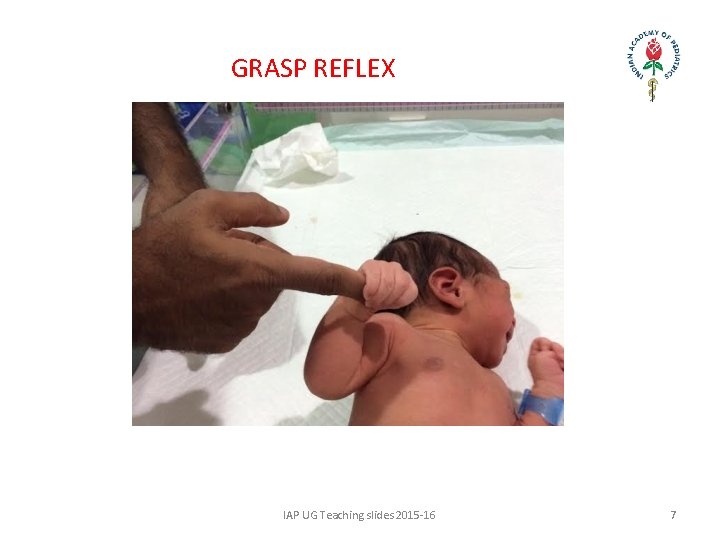
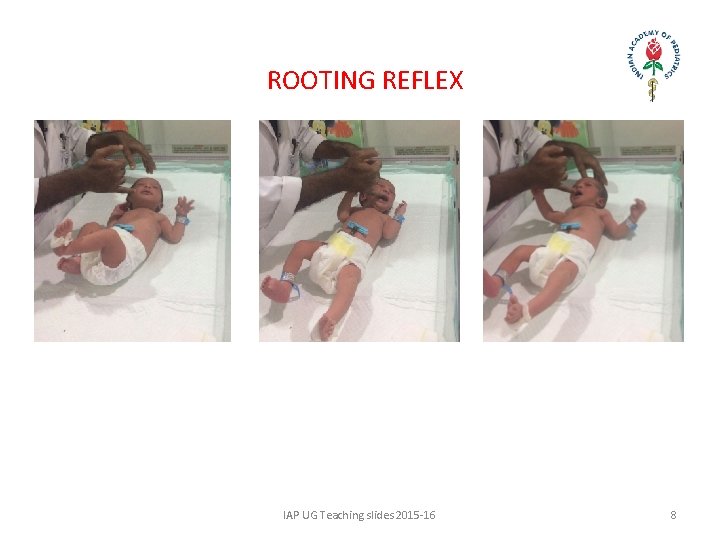
• • • REFLEXES Palmar grasp - appears 28 weeks, disappears 2 -3 months Rooting - appears 32 weeks, less prominent after 1 month Moro - appears 28 -32 weeks, disappears 5 -6 months Asymmetric Tonic neck reflex (ATNR) - appears 35 weeks, disappears 2 -3 months Landau-appears 3 months, disappears around 1 year Parachute - appears 6 -9 months remains throughout life. IAP UG Teaching slides 2015 -16 4
ATNR (FENCING REFLEX) IAP UG Teaching slides 2015 -16 5
MORO’s REFLEX IAP UG Teaching slides 2015 -16 6
GRASP REFLEX IAP UG Teaching slides 2015 -16 7
ROOTING REFLEX IAP UG Teaching slides 2015 -16 8
DEVELOPMENTAL DOMAINS 1. Gross Motor 2. Fine motor 3. Personal and social development and general understanding 4. Language 5. Vision and hearing IAP UG Teaching slides 2015 -16 9
DEVELOPMENT FROM NEWBORN TO 6 WEEKS Pull to sit • Newborn complete head lag, back rounded • 6 weeks - head control begins Ventral suspension • Newborn head flops down • 6 weeks momentarily holds in horizontal plane IAP UG Teaching slides 2015 -16 10
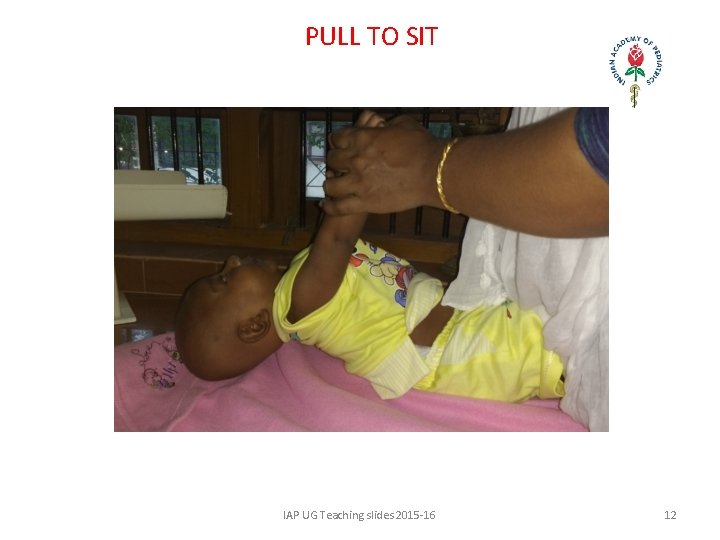
HEAD LAG • Infant gently pulled to sitting position. • In newborns, head completely lags behind. IAP UG Teaching slides 2015 -16 11
PULL TO SIT IAP UG Teaching slides 2015 -16 12
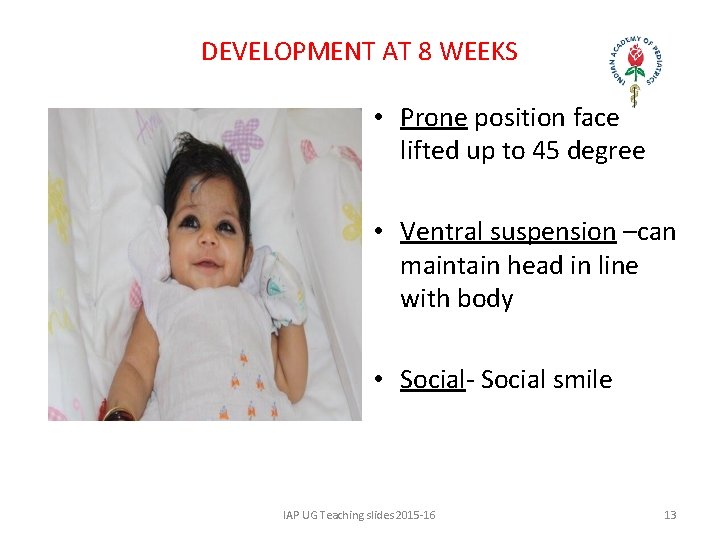
DEVELOPMENT AT 8 WEEKS • Prone position face lifted up to 45 degree • Ventral suspension –can maintain head in line with body • Social- Social smile IAP UG Teaching slides 2015 -16 13
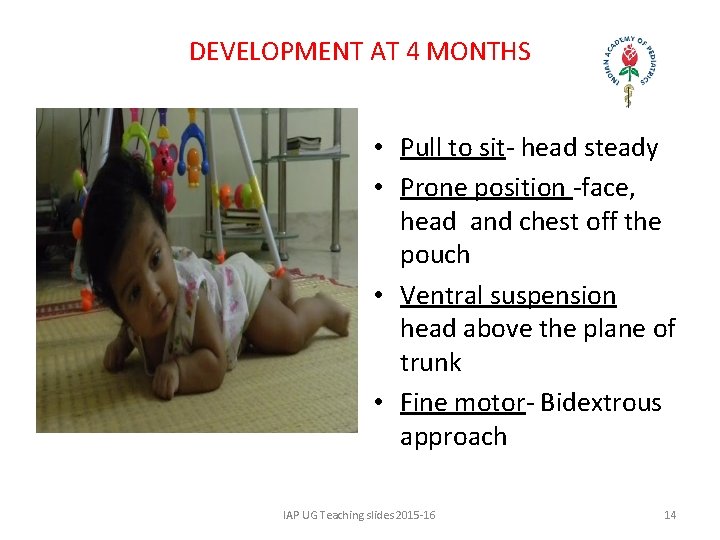
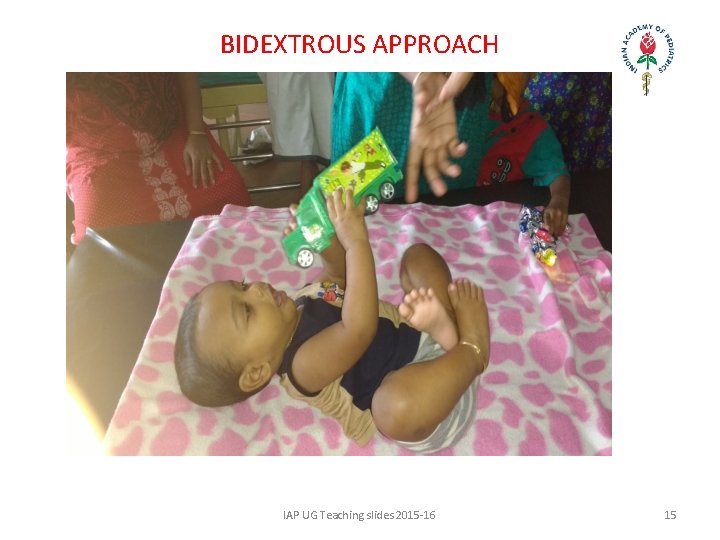
DEVELOPMENT AT 4 MONTHS • Pull to sit- head steady • Prone position -face, head and chest off the pouch • Ventral suspension head above the plane of trunk • Fine motor- Bidextrous approach IAP UG Teaching slides 2015 -16 14
BIDEXTROUS APPROACH IAP UG Teaching slides 2015 -16 15
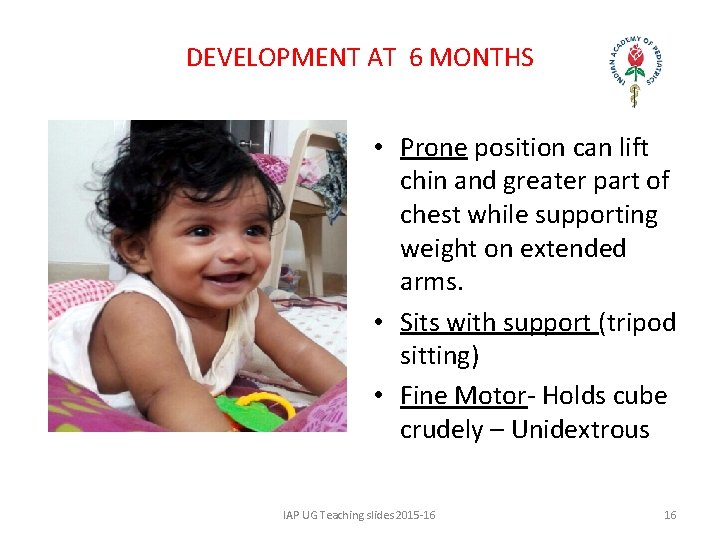
DEVELOPMENT AT 6 MONTHS • Prone position can lift chin and greater part of chest while supporting weight on extended arms. • Sits with support (tripod sitting) • Fine Motor- Holds cube crudely – Unidextrous IAP UG Teaching slides 2015 -16 16
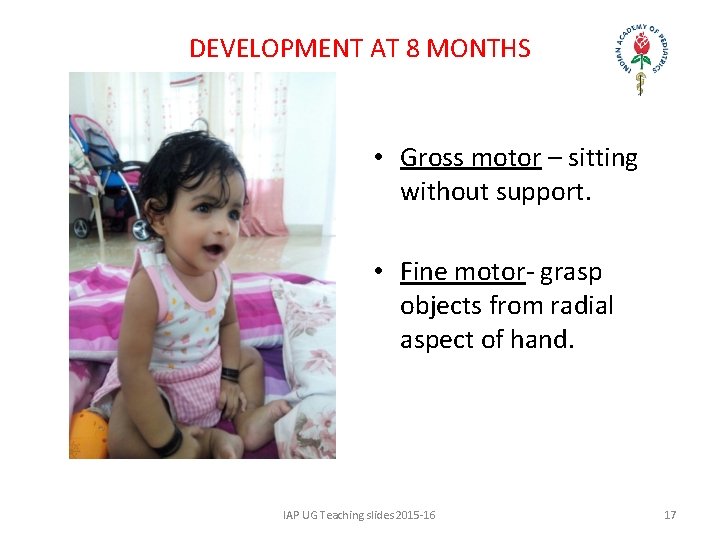
DEVELOPMENT AT 8 MONTHS • Gross motor – sitting without support. • Fine motor- grasp objects from radial aspect of hand. IAP UG Teaching slides 2015 -16 17
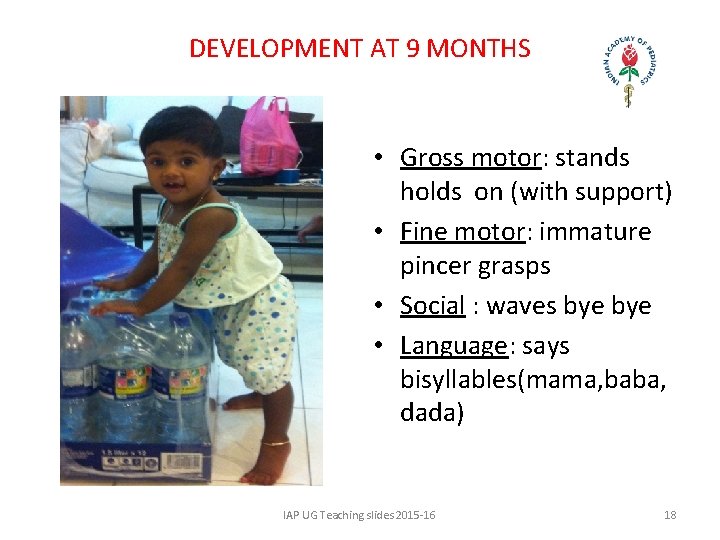
DEVELOPMENT AT 9 MONTHS • Gross motor: stands holds on (with support) • Fine motor: immature pincer grasps • Social : waves bye • Language: says bisyllables(mama, baba, dada) IAP UG Teaching slides 2015 -16 18
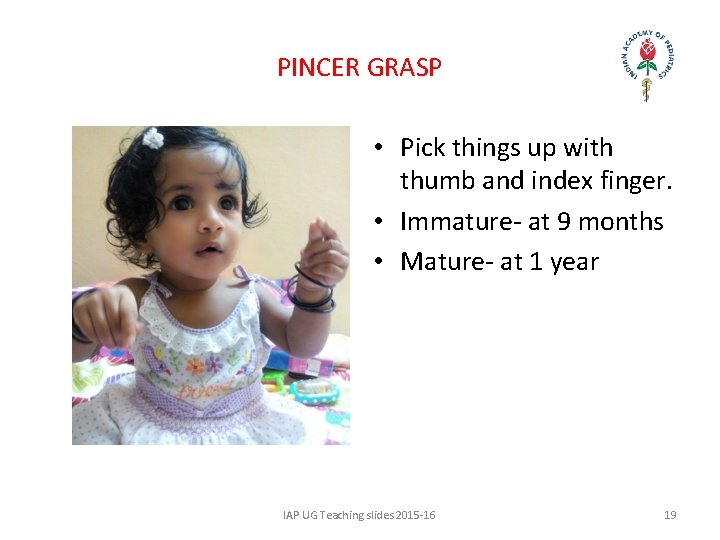
PINCER GRASP • Pick things up with thumb and index finger. • Immature- at 9 months • Mature- at 1 year IAP UG Teaching slides 2015 -16 19
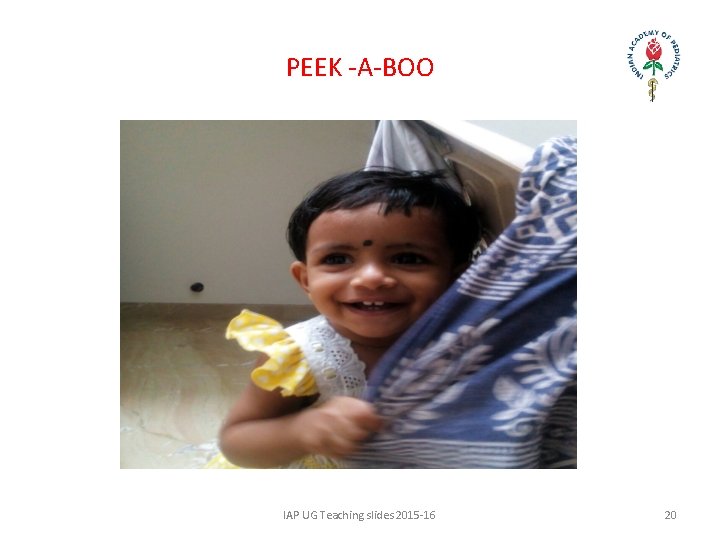
PEEK -A-BOO IAP UG Teaching slides 2015 -16 20
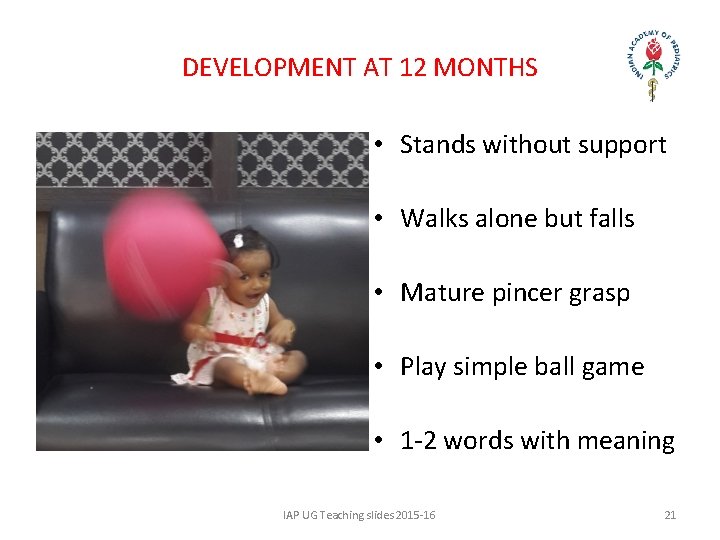
DEVELOPMENT AT 12 MONTHS • Stands without support • Walks alone but falls • Mature pincer grasp • Play simple ball game • 1 -2 words with meaning IAP UG Teaching slides 2015 -16 21
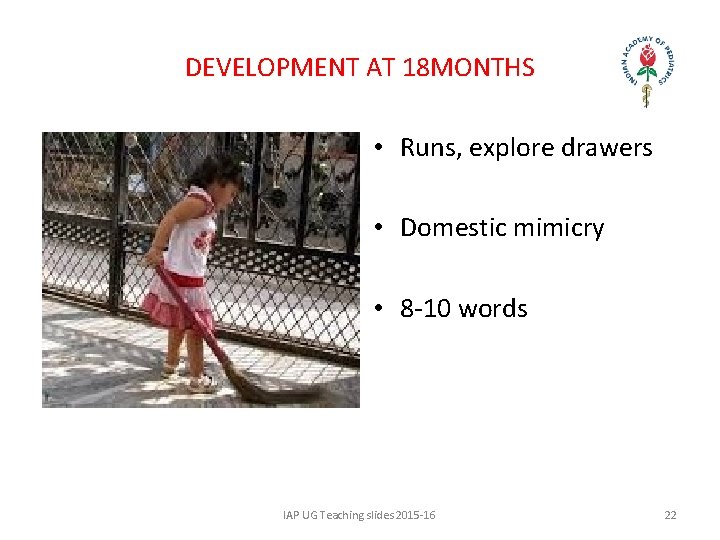
DEVELOPMENT AT 18 MONTHS • Runs, explore drawers • Domestic mimicry • 8 -10 words IAP UG Teaching slides 2015 -16 22
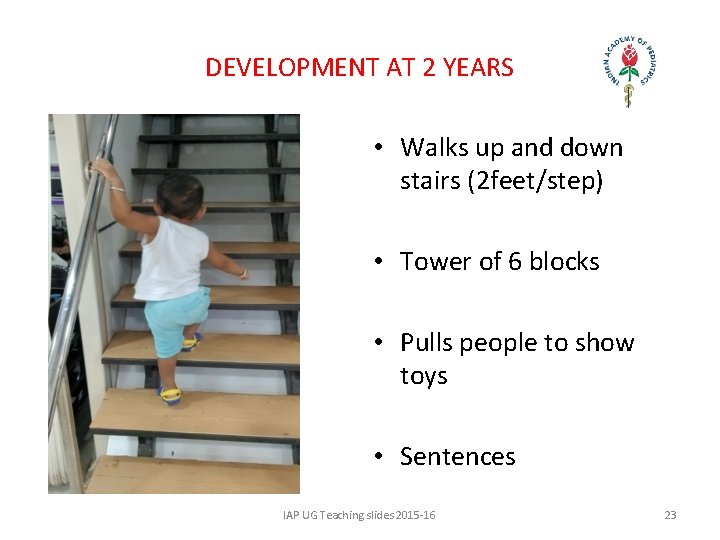
DEVELOPMENT AT 2 YEARS • Walks up and down stairs (2 feet/step) • Tower of 6 blocks • Pulls people to show toys • Sentences IAP UG Teaching slides 2015 -16 23
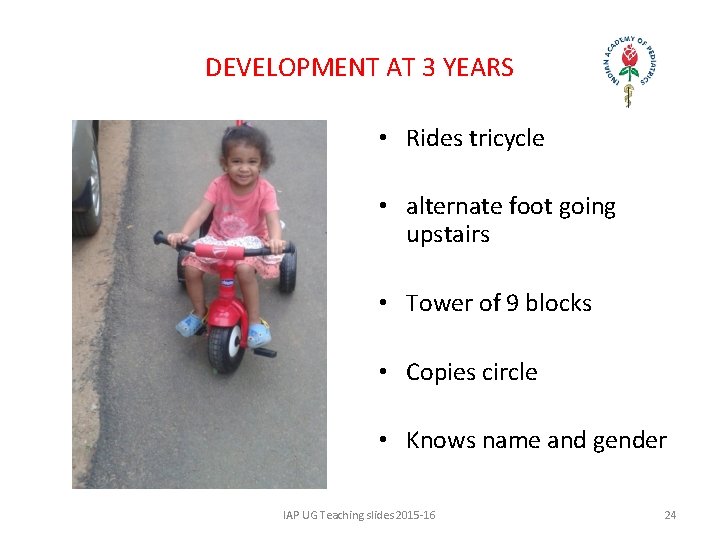
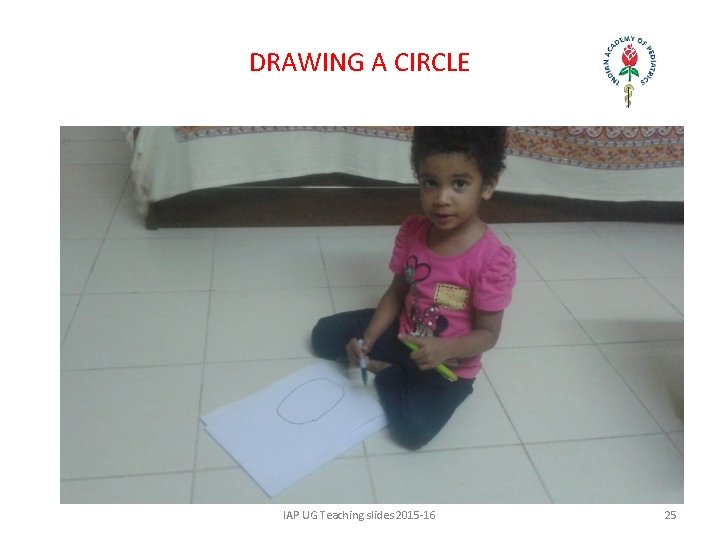
DEVELOPMENT AT 3 YEARS • Rides tricycle • alternate foot going upstairs • Tower of 9 blocks • Copies circle • Knows name and gender IAP UG Teaching slides 2015 -16 24
DRAWING A CIRCLE IAP UG Teaching slides 2015 -16 25
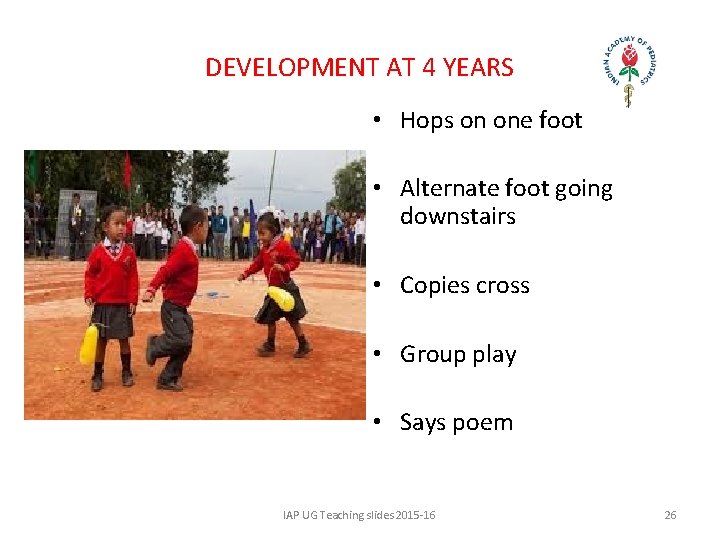
DEVELOPMENT AT 4 YEARS • Hops on one foot • Alternate foot going downstairs • Copies cross • Group play • Says poem IAP UG Teaching slides 2015 -16 26
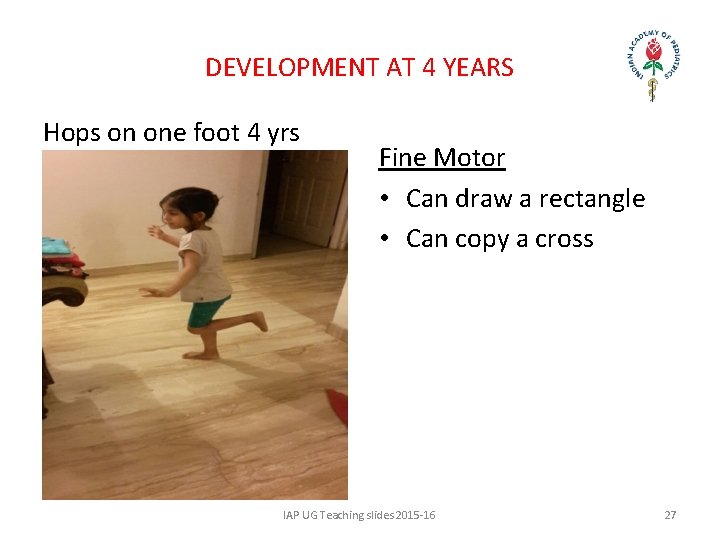
DEVELOPMENT AT 4 YEARS Hops on one foot 4 yrs Fine Motor • Can draw a rectangle • Can copy a cross IAP UG Teaching slides 2015 -16 27
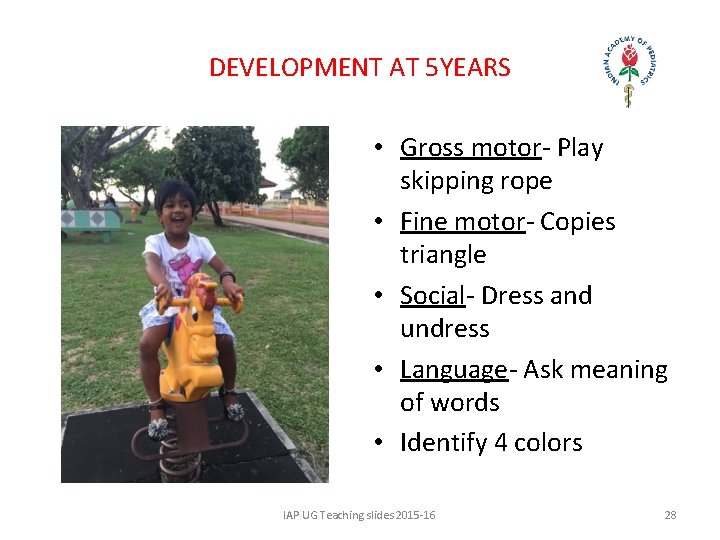
DEVELOPMENT AT 5 YEARS • Gross motor- Play skipping rope • Fine motor- Copies triangle • Social- Dress and undress • Language- Ask meaning of words • Identify 4 colors IAP UG Teaching slides 2015 -16 28
DEVELOPMENTAL EVALUATION DETAILED HISTORY A) Ask for risk factors affecting development B) Attainment of milestones. Differentiate between delay and regression C) Form a gross estimation of developmental age: Ask for attained milestones and ascertain if development age matches with chronological age. IAP UG Teaching slides 2015 -16 29
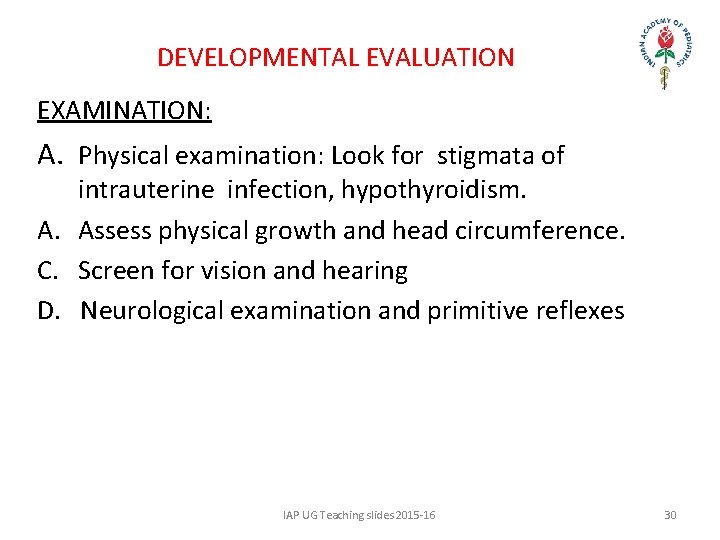
DEVELOPMENTAL EVALUATION EXAMINATION: A. Physical examination: Look for stigmata of intrauterine infection, hypothyroidism. A. Assess physical growth and head circumference. C. Screen for vision and hearing D. Neurological examination and primitive reflexes IAP UG Teaching slides 2015 -16 30
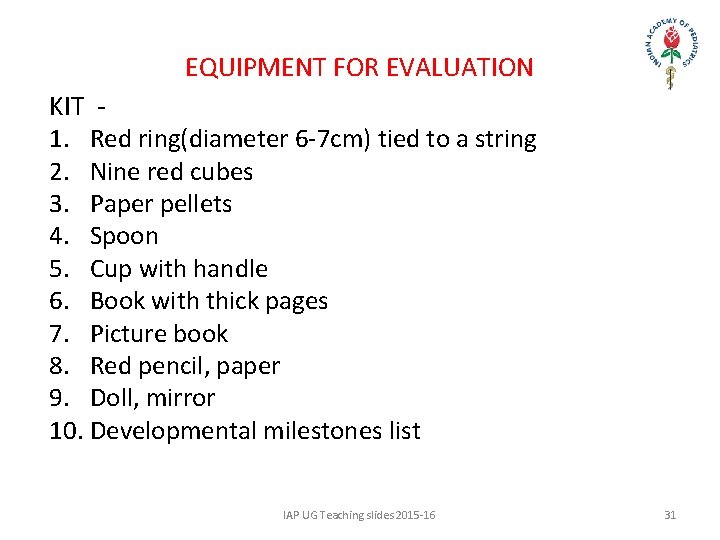
EQUIPMENT FOR EVALUATION KIT 1. Red ring(diameter 6 -7 cm) tied to a string 2. Nine red cubes 3. Paper pellets 4. Spoon 5. Cup with handle 6. Book with thick pages 7. Picture book 8. Red pencil, paper 9. Doll, mirror 10. Developmental milestones list IAP UG Teaching slides 2015 -16 31
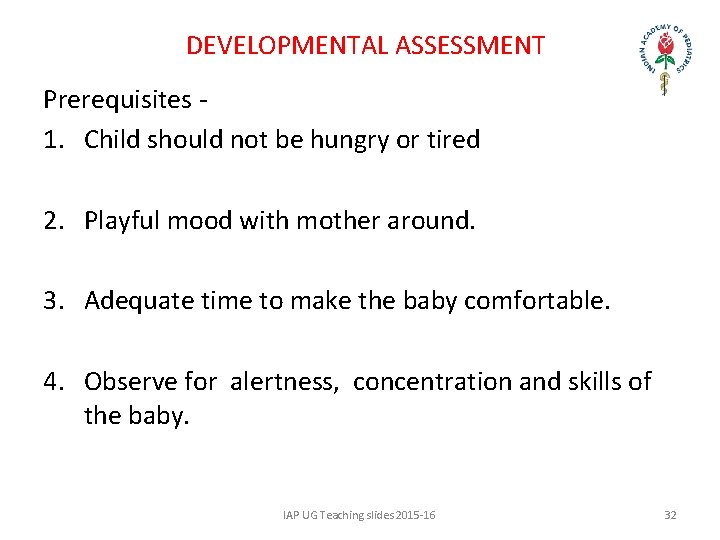
DEVELOPMENTAL ASSESSMENT Prerequisites 1. Child should not be hungry or tired 2. Playful mood with mother around. 3. Adequate time to make the baby comfortable. 4. Observe for alertness, concentration and skills of the baby. IAP UG Teaching slides 2015 -16 32
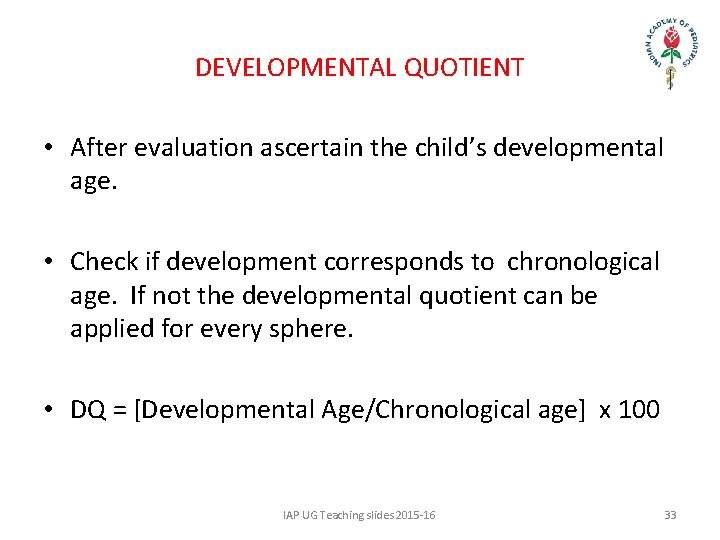
DEVELOPMENTAL QUOTIENT • After evaluation ascertain the child’s developmental age. • Check if development corresponds to chronological age. If not the developmental quotient can be applied for every sphere. • DQ = [Developmental Age/Chronological age] x 100 IAP UG Teaching slides 2015 -16 33
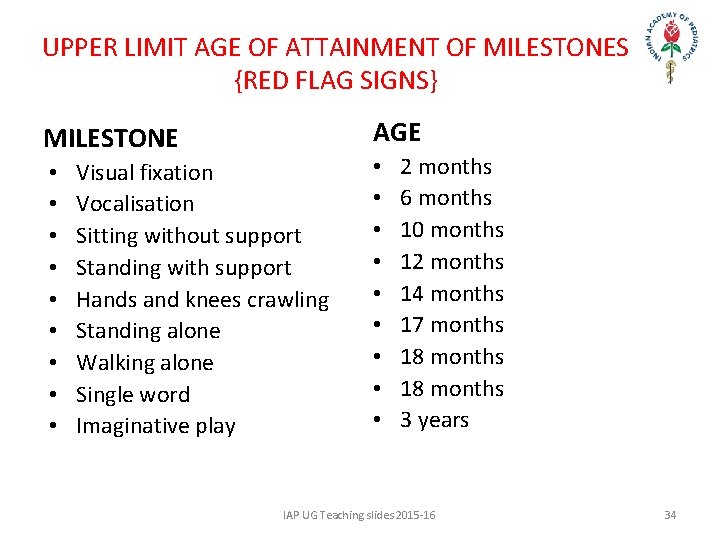
UPPER LIMIT AGE OF ATTAINMENT OF MILESTONES {RED FLAG SIGNS} AGE MILESTONE • • • Visual fixation Vocalisation Sitting without support Standing with support Hands and knees crawling Standing alone Walking alone Single word Imaginative play • • • 2 months 6 months 10 months 12 months 14 months 17 months 18 months 3 years IAP UG Teaching slides 2015 -16 34
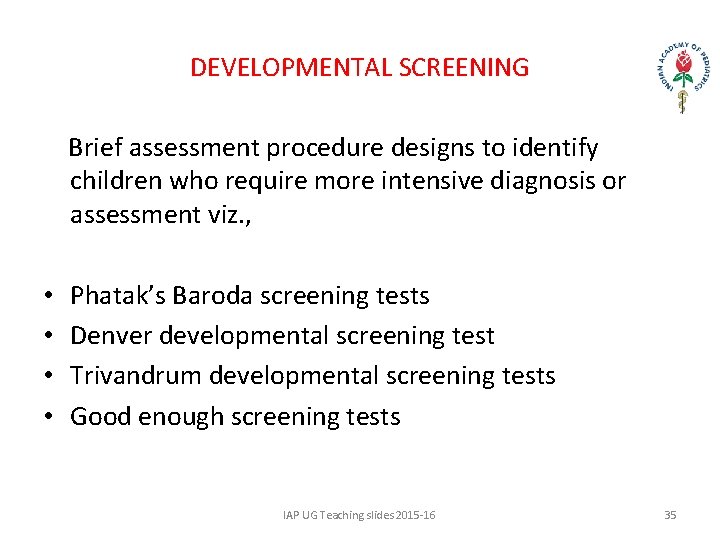
DEVELOPMENTAL SCREENING Brief assessment procedure designs to identify children who require more intensive diagnosis or assessment viz. , • • Phatak’s Baroda screening tests Denver developmental screening test Trivandrum developmental screening tests Good enough screening tests IAP UG Teaching slides 2015 -16 35
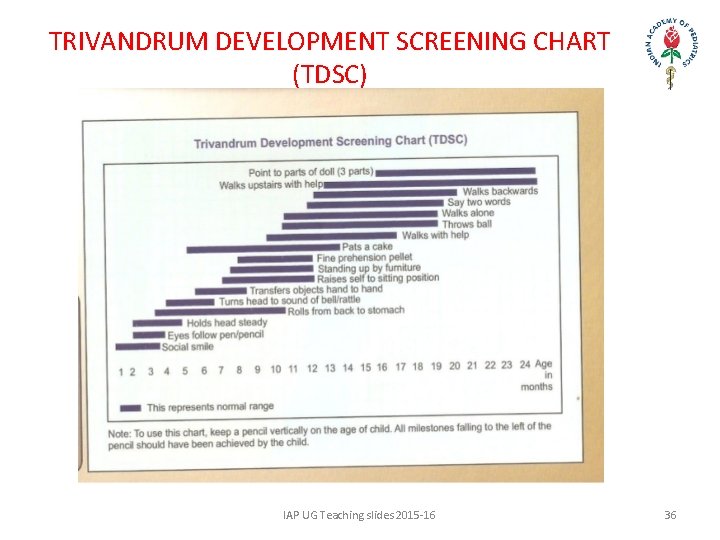
TRIVANDRUM DEVELOPMENT SCREENING CHART (TDSC) IAP UG Teaching slides 2015 -16 36
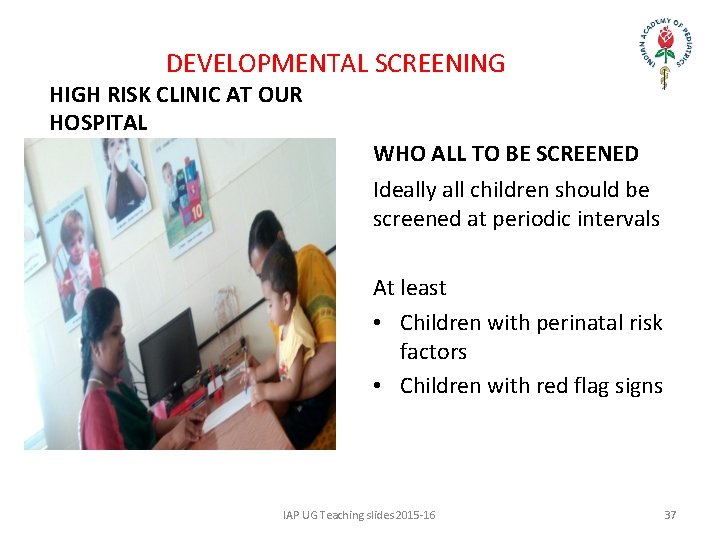
DEVELOPMENTAL SCREENING HIGH RISK CLINIC AT OUR HOSPITAL WHO ALL TO BE SCREENED Ideally all children should be screened at periodic intervals At least • Children with perinatal risk factors • Children with red flag signs IAP UG Teaching slides 2015 -16 37
Thank You IAP UG Teaching slides 2015 -16 38