
Developing Your Thesis Statement AICE English General Paper
- Slides: 21
Developing Your Thesis Statement AICE English General Paper Review Session
The Thesis The thesis is called many other names, such as the “main claim” and the “roadmap to your essay. ” When you are writing an argument, whether discursive or argumentative, your main idea/ thesis transforms into an opinion you want others to believe. TIP: It can be helpful to pose your main claim/thesis in the form of a “because” statement. For example, “X is beneficial/harmful because…”
Thesis Review Key words from the prompt (or synonyms of those keywords) should be used, but DO NOT use the prompt itself as your thesis. DO NOT use a rhetorical question as your thesis. This is WEAK, and you want to write a STRONG argument. (“Are video games truly detrimental to teenagers? ”) The thesis is the LAST sentence in your introduction, NOT the first. The thesis should be ONE clear, concise sentence, and NOT take up the entire introduction.
Thesis Review One common error I have noticed in student essays is a lack of focus in thesis statement and essay. Make SURE you examine the prompt carefully and your thesis and essay answer ALL parts of it, not just one. I have seen excellent essays that would, unfortunately, fail the exam because of this. Example: How far do you agree that a college education is essential to today’s society? Thesis: A college education is important because it can help you become successful in life. Several students wrote essays like this that detailed all the benefits of going to college, but never dealt with the idea of how essential it was. Remember to USE KEYWORDS to FOCUS your essay AND your thesis! For this prompt, you would HAVE to discuss not only the benefits of an education, but HOW ESSENTIAL it is in TODAY’S SOCIETY.
Thesis Review Remember, thesis is a one-sentence summary that expresses the main idea of your essay. It makes your intentions clear to the audience and sets the tone for your approach to the issue (discursive or argumentative). It also gives your essay a clear focus. EVERYTHING you write in your essay WILL relate back to this claim, which makes it the MOST ESSENTIAL COMPONENT of any introduction. We have also discussed a common error many students make, which is crafting long lists in thesis. AVOID THIS. Having too many ideas listed makes a thesis sound awkward, too long, and disjointed. It is more useful to start with a broader thesis.
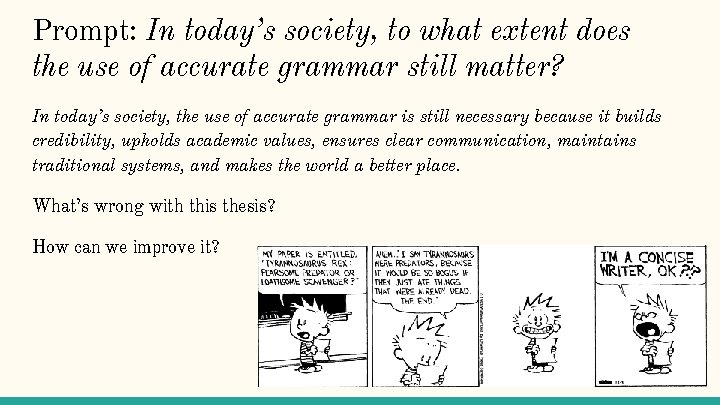
Prompt: In today’s society, to what extent does the use of accurate grammar still matter? In today’s society, the use of accurate grammar is still necessary because it builds credibility, upholds academic values, ensures clear communication, maintains traditional systems, and makes the world a better place. What’s wrong with this thesis? How can we improve it?
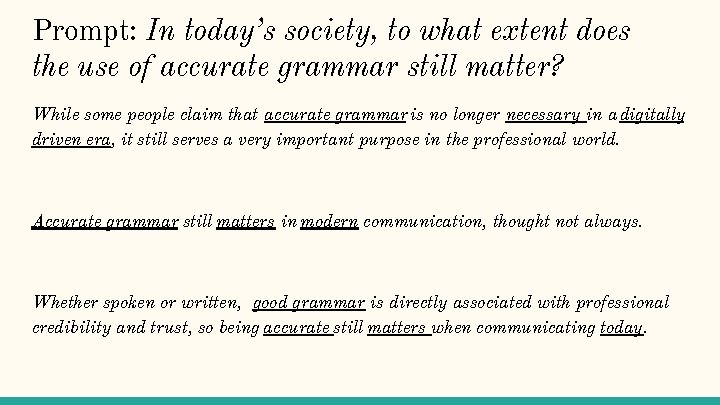
Prompt: In today’s society, to what extent does the use of accurate grammar still matter? While some people claim that accurate grammar is no longer necessary in a digitally driven era, it still serves a very important purpose in the professional world. Accurate grammar still matters in modern communication, thought not always. Whether spoken or written, good grammar is directly associated with professional credibility and trust, so being accurate still matters when communicating today.
The Argumentative Thesis The purpose of argumentative writing is to argue. (Duh. )Your main claim, or thesis, should therefore: ● Be debatable ● Support one point of view It should also: ● Focus on the key words of the question ● Introduce the perspectives that you will argue
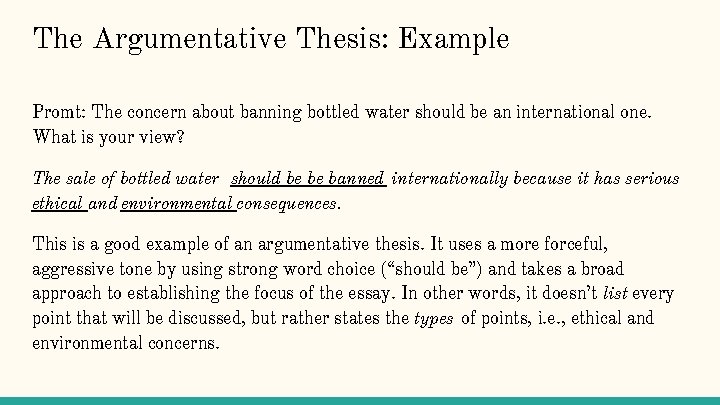
The Argumentative Thesis: Example Promt: The concern about banning bottled water should be an international one. What is your view? The sale of bottled water should be be banned internationally because it has serious ethical and environmental consequences. This is a good example of an argumentative thesis. It uses a more forceful, aggressive tone by using strong word choice (“should be”) and takes a broad approach to establishing the focus of the essay. In other words, it doesn’t list every point that will be discussed, but rather states the types of points, i. e. , ethical and environmental concerns.
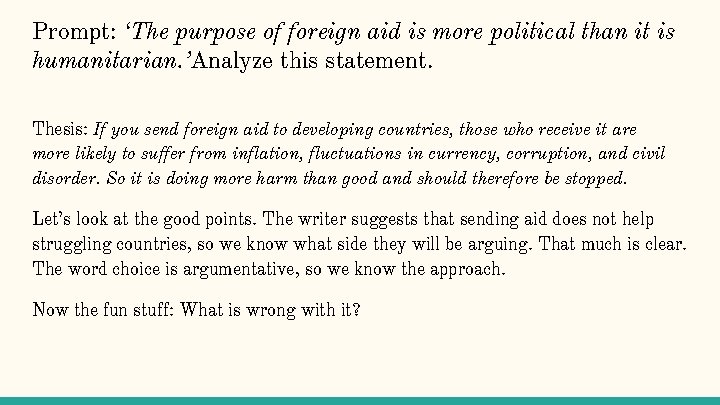
Prompt: ‘The purpose of foreign aid is more political than it is humanitarian. ’Analyze this statement. Thesis: If you send foreign aid to developing countries, those who receive it are more likely to suffer from inflation, fluctuations in currency, corruption, and civil disorder. So it is doing more harm than good and should therefore be stopped. Let’s look at the good points. The writer suggests that sending aid does not help struggling countries, so we know what side they will be arguing. That much is clear. The word choice is argumentative, so we know the approach. Now the fun stuff: What is wrong with it?
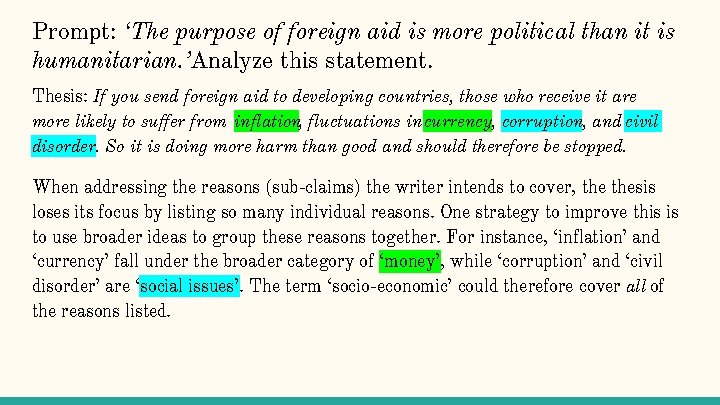
Prompt: ‘The purpose of foreign aid is more political than it is humanitarian. ’Analyze this statement. Thesis: If you send foreign aid to developing countries, those who receive it are more likely to suffer from inflation, fluctuations in currency, corruption, and civil disorder. So it is doing more harm than good and should therefore be stopped. When addressing the reasons (sub-claims) the writer intends to cover, thesis loses its focus by listing so many individual reasons. One strategy to improve this is to use broader ideas to group these reasons together. For instance, ‘inflation’ and ‘currency’ fall under the broader category of ‘money’, while ‘corruption’ and ‘civil disorder’ are ‘social issues’. The term ‘socio-economic’ could therefore cover all of the reasons listed.
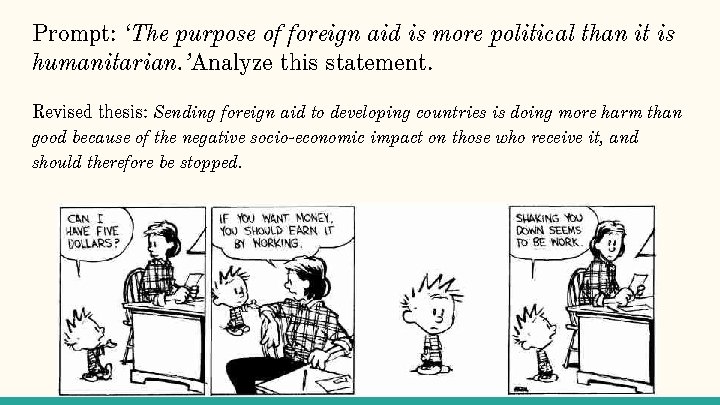
Prompt: ‘The purpose of foreign aid is more political than it is humanitarian. ’Analyze this statement. Revised thesis: Sending foreign aid to developing countries is doing more harm than good because of the negative socio-economic impact on those who receive it, and should therefore be stopped.
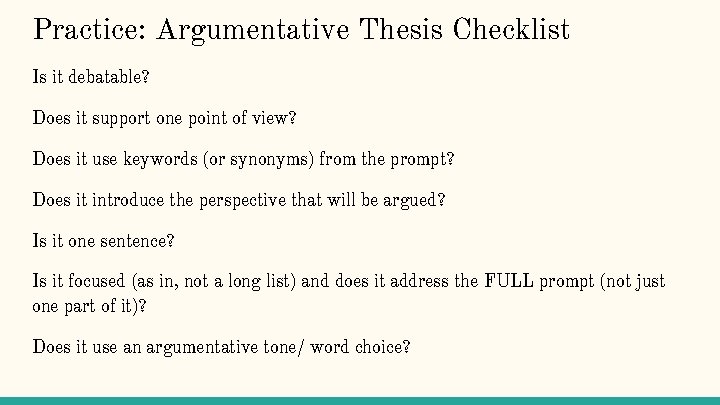
Practice: Argumentative Thesis Checklist Is it debatable? Does it support one point of view? Does it use keywords (or synonyms) from the prompt? Does it introduce the perspective that will be argued? Is it one sentence? Is it focused (as in, not a long list) and does it address the FULL prompt (not just one part of it)? Does it use an argumentative tone/ word choice?
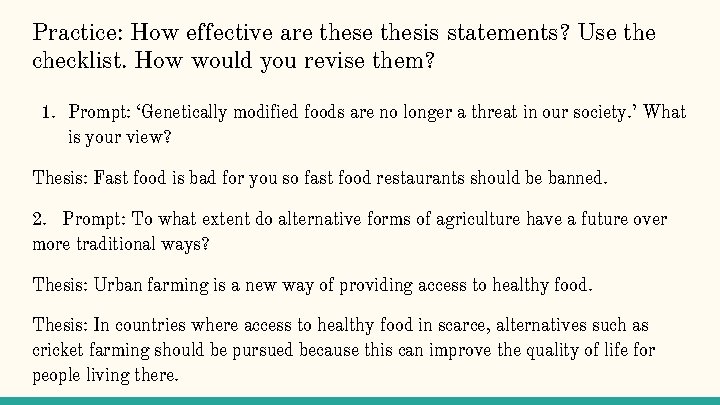
Practice: How effective are thesis statements? Use the checklist. How would you revise them? 1. Prompt: ‘Genetically modified foods are no longer a threat in our society. ’ What is your view? Thesis: Fast food is bad for you so fast food restaurants should be banned. 2. Prompt: To what extent do alternative forms of agriculture have a future over more traditional ways? Thesis: Urban farming is a new way of providing access to healthy food. Thesis: In countries where access to healthy food in scarce, alternatives such as cricket farming should be pursued because this can improve the quality of life for people living there.
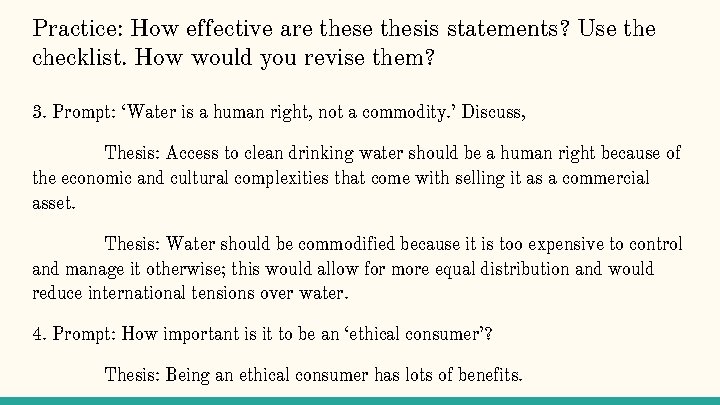
Practice: How effective are thesis statements? Use the checklist. How would you revise them? 3. Prompt: ‘Water is a human right, not a commodity. ’ Discuss, Thesis: Access to clean drinking water should be a human right because of the economic and cultural complexities that come with selling it as a commercial asset. Thesis: Water should be commodified because it is too expensive to control and manage it otherwise; this would allow for more equal distribution and would reduce international tensions over water. 4. Prompt: How important is it to be an ‘ethical consumer’? Thesis: Being an ethical consumer has lots of benefits.
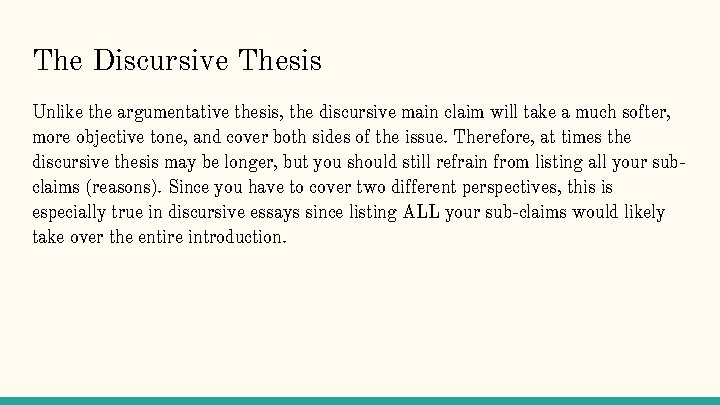
The Discursive Thesis Unlike the argumentative thesis, the discursive main claim will take a much softer, more objective tone, and cover both sides of the issue. Therefore, at times the discursive thesis may be longer, but you should still refrain from listing all your subclaims (reasons). Since you have to cover two different perspectives, this is especially true in discursive essays since listing ALL your sub-claims would likely take over the entire introduction.
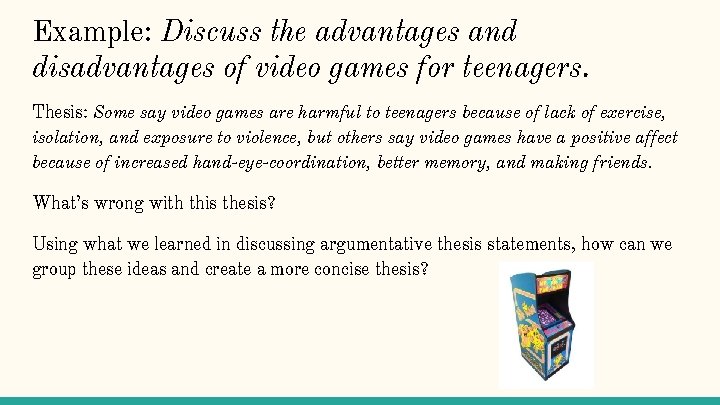
Example: Discuss the advantages and disadvantages of video games for teenagers. Thesis: Some say video games are harmful to teenagers because of lack of exercise, isolation, and exposure to violence, but others say video games have a positive affect because of increased hand-eye-coordination, better memory, and making friends. What’s wrong with this thesis? Using what we learned in discussing argumentative thesis statements, how can we group these ideas and create a more concise thesis?
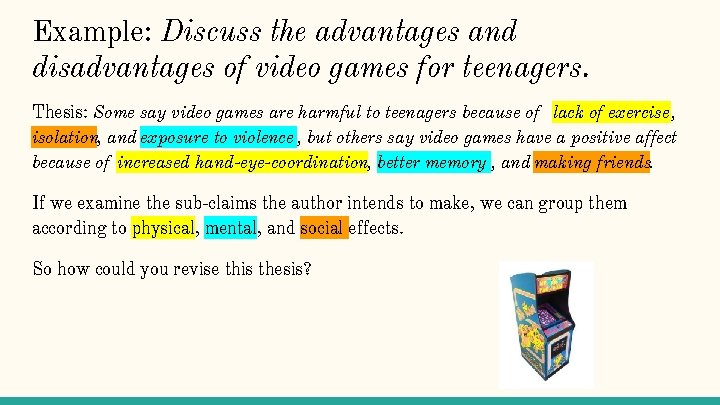
Example: Discuss the advantages and disadvantages of video games for teenagers. Thesis: Some say video games are harmful to teenagers because of lack of exercise, isolation, and exposure to violence , but others say video games have a positive affect because of increased hand-eye-coordination, better memory , and making friends. If we examine the sub-claims the author intends to make, we can group them according to physical, mental, and social effects. So how could you revise this thesis?
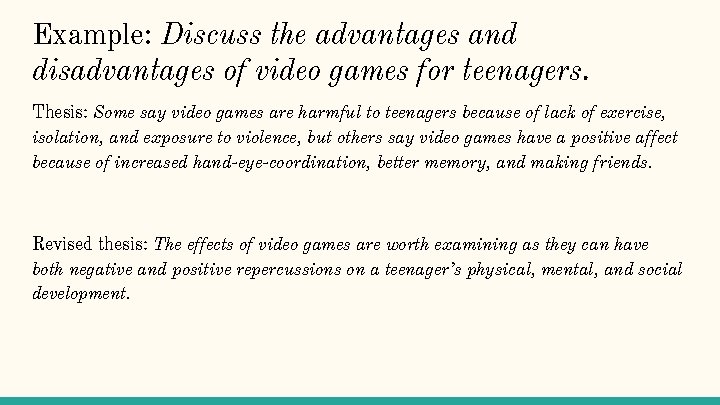
Example: Discuss the advantages and disadvantages of video games for teenagers. Thesis: Some say video games are harmful to teenagers because of lack of exercise, isolation, and exposure to violence, but others say video games have a positive affect because of increased hand-eye-coordination, better memory, and making friends. Revised thesis: The effects of video games are worth examining as they can have both negative and positive repercussions on a teenager’s physical, mental, and social development.
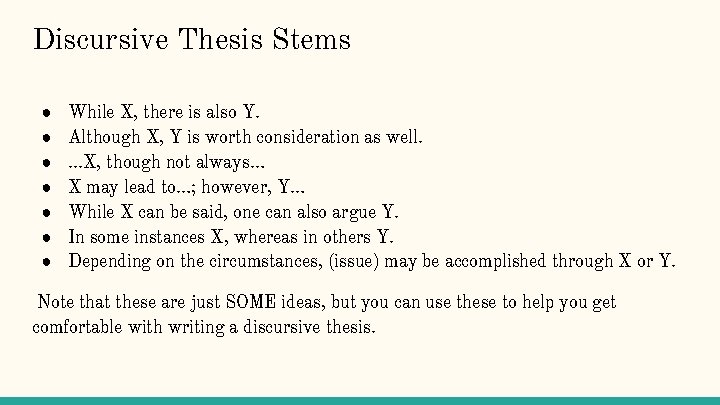
Discursive Thesis Stems ● ● ● ● While X, there is also Y. Although X, Y is worth consideration as well. . X, though not always… X may lead to…; however, Y… While X can be said, one can also argue Y. In some instances X, whereas in others Y. Depending on the circumstances, (issue) may be accomplished through X or Y. Note that these are just SOME ideas, but you can use these to help you get comfortable with writing a discursive thesis.
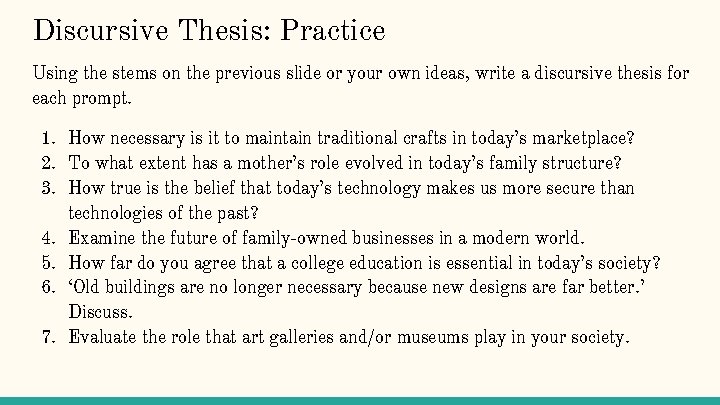
Discursive Thesis: Practice Using the stems on the previous slide or your own ideas, write a discursive thesis for each prompt. 1. How necessary is it to maintain traditional crafts in today’s marketplace? 2. To what extent has a mother’s role evolved in today’s family structure? 3. How true is the belief that today’s technology makes us more secure than technologies of the past? 4. Examine the future of family-owned businesses in a modern world. 5. How far do you agree that a college education is essential in today’s society? 6. ‘Old buildings are no longer necessary because new designs are far better. ’ Discuss. 7. Evaluate the role that art galleries and/or museums play in your society.