
Developing Undergraduate and Graduate Mathematics Courses and Materials





![A Polynomial Subtlety The polynomial x 2+5 x+3 in R[x] induces the function f:](https://slidetodoc.com/presentation_image_h/0a6bf0ff66f2ff9b4af1348a15408528/image-22.jpg "A Polynomial Subtlety The polynomial x 2+5 x+3 in R[x] induces the function f:")
- Slides: 23
Developing Undergraduate and Graduate Mathematics Courses and Materials for Mathematics Education Majors as Part of Two National Science Foundation Projects Four undergraduate mathematics courses and materials were developed for pre-service middle grade teachers as part of this NSF project. 2001 -2006 2004 -2009 We will briefly discuss the mission of the CSMC Center and highlight a graduate level mathematics course developed for Mathematics Education doctoral students as part of this project.
Catalysts for Change • Principles and standards for school mathematics (NCTM, 2000) • Before It’s Too Late: Glenn Commission Report, (DOE, 2000) • Mathematics Education of Teachers Report (CBMS/MAA, 2001)
Before It’s Too Late: Glenn Commission Report Primary message: “America’s students must improve their performance in mathematics and science if they are to succeed in today’s world and if the United States is to stay competitive in an integrated global economy. ” Second message: “The most direct route to improving mathematics and science achievement for all students is better mathematics and science teaching. ”
CBMS Mathematical Education of Teachers Report: General Recommendations o Teachers need a deep understanding of the mathematics they will teach. o Teachers need to learn how fundamental mathematical principles underlie classroom practice. o Teachers need to develop a mastery of the mathematics in several grades beyond (and below) the grade level they expect to teach.
CBMS Mathematical Education of Teachers Report: General Recommendations o Courses for teachers should involve: + foundational mathematics + careful reasoning + connections of principles / practice + mathematical ‘common sense’ + habits of mind / inquiry + utility, power and elegance + multiple ways to engage students + technology-computation /exploration
CBMS Mathematical Education of Teachers Report: General Recommendations o Teacher education must be recognized as an important part of mathematics departments’ mission at institutions that educate teachers. o Mathematics departments should devote commensurate resources to designing and offering courses for teachers. o They should value and properly reward the faculty members that are heavily involved in teacher education. o The mathematical education of teachers should be seen as a partnership between mathematics faculty and mathematics education faculty.
Project Outcomes Developed 4 mathematics courses with accompanying text books for pre-service / inservice middle grade mathematics teachers Developed recruitment models for attracting middle grade mathematics teachers Developed options for post-bac certification (middle / high school mathematics)
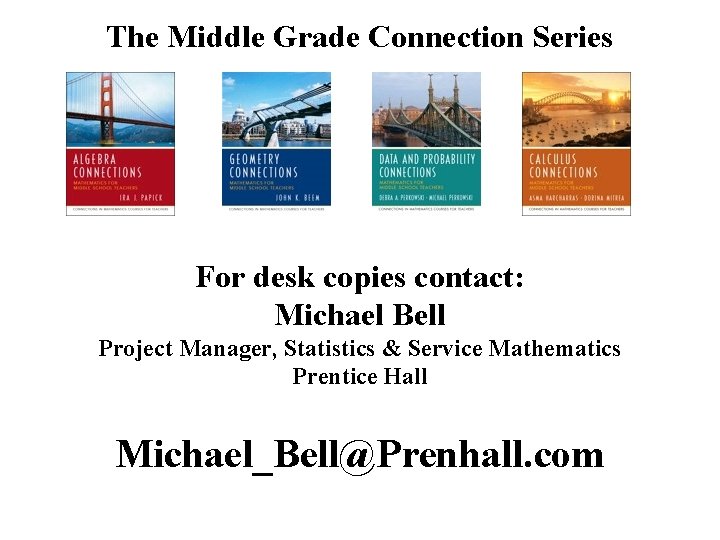
The Curriculum: Making the Connections • Algebra Connections • Geometry Connections • Data Analysis and Probability Connections • Calculus Connections
The text books utilize middle school curricular materials in multiple ways ∑ As a springboard to college level mathematics ∑ To expose future (or present) teachers to current middle grade curricular materials ∑ To provide strong motivation to learn more and better mathematics ∑ To support curriculum dissection—critically analyzing middle school curriculum content —developing improved middle grade lessons through lesson study approach ∑ To use college content to gain new perspectives on middle grade content and vice versa ∑ To apply middle grade instructional strategies and multiple forms of assessment to the college classroom
Instructional Components: Classroom Connections, Classroom Discussions, and Classroom Problems. Classroom Connections: middle grade investigations that serve as launch pads to the college level Classroom Discussions, Classroom Problems, and other related collegiate mathematics. Classroom Discussions: detailed mathematical conversations between college teacher and pre-service middle grade teachers, and are used to introduce and explore a variety of important concepts during class periods. Classroom Problems: a collection of problems with complete or partially complete solutions and are meant to illustrate and engage preservice teachers in various problem solving techniques and strategies.
The Middle Grade Connection Series For desk copies contact: Michael Bell Project Manager, Statistics & Service Mathematics Prentice Hall Michael_Bell@Prenhall. com
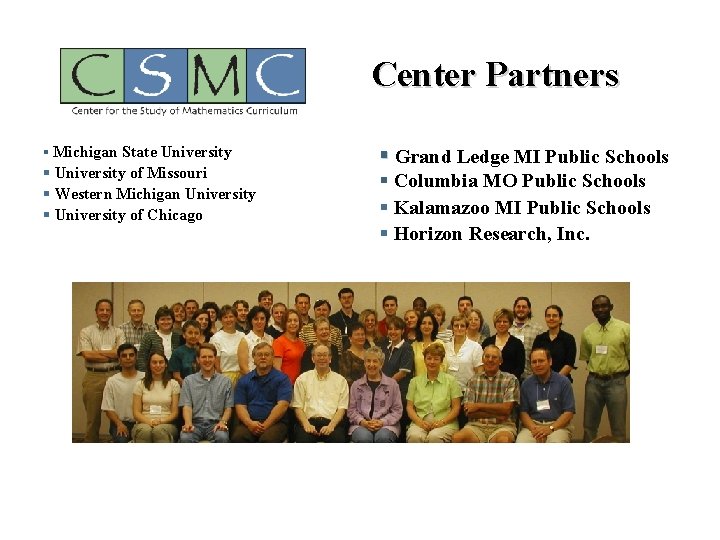
Center Partners § Michigan State University § University of Missouri § Western Michigan University § University of Chicago § Grand Ledge MI Public Schools § Columbia MO Public Schools § Kalamazoo MI Public Schools § Horizon Research, Inc.
Mission To advance the research base and leadership capacity supporting K-12 mathematics curriculum design, analysis, implementation, and evaluation.
Doctoral Program Goals: § Increase the number and diversity of professionals prepared in doctoral programs in mathematics education at CSMC institutions. § Strengthen the quality of doctoral programs through collaboration and program enhancement. § Prepare doctoral graduates to assume leadership roles in scholarly work related to mathematics curriculum.
Conference Announcement DOCTORAL PROGRAMS IN MATHEMATICS EDUCATION: A DECADE OF PROGRESS Marriott Country Club Plaza Kansas City, Missouri September 23 -26, 2007 Register at: mathcurriculumcenter. org Deadline: March 31, 2007
New Doctoral Courses § Mathematics Curriculum Issues and Trends § Mathematics Curriculum Design and Analysis § Mathematics Curriculum Research and Evaluation § Courses analyzing mathematics content in curriculum materials
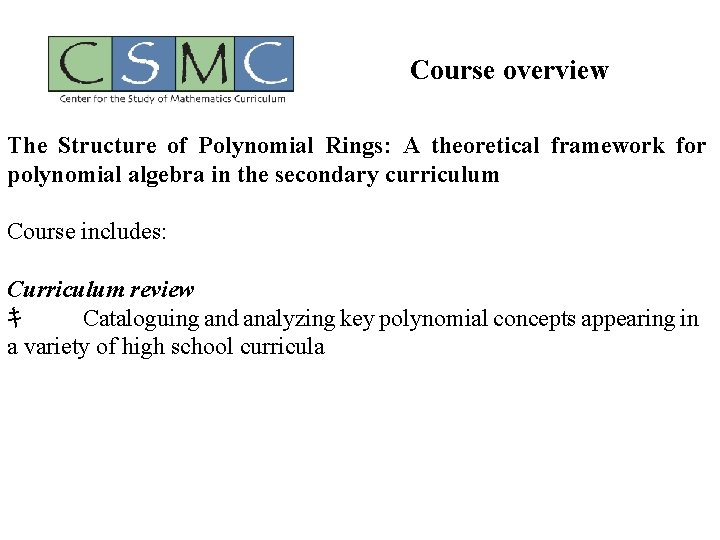
Course overview The Structure of Polynomial Rings: A theoretical framework for polynomial algebra in the secondary curriculum Course includes: Curriculum review キ Cataloguing and analyzing key polynomial concepts appearing in a variety of high school curricula
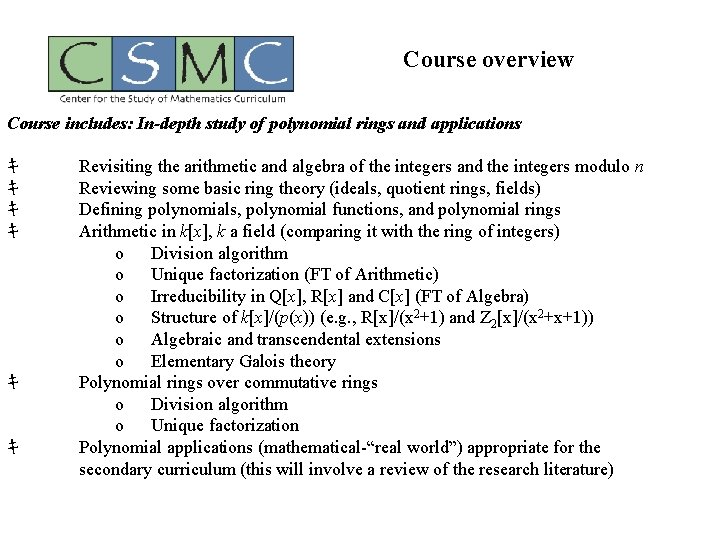
Course overview Course includes: In-depth study of polynomial rings and applications キ キ キ Revisiting the arithmetic and algebra of the integers and the integers modulo n Reviewing some basic ring theory (ideals, quotient rings, fields) Defining polynomials, polynomial functions, and polynomial rings Arithmetic in k[x], k a field (comparing it with the ring of integers) o Division algorithm o Unique factorization (FT of Arithmetic) o Irreducibility in Q[x], R[x] and C[x] (FT of Algebra) o Structure of k[x]/(p(x)) (e. g. , R[x]/(x 2+1) and Z 2[x]/(x 2+x+1)) o Algebraic and transcendental extensions o Elementary Galois theory Polynomial rings over commutative rings o Division algorithm o Unique factorization Polynomial applications (mathematical-“real world”) appropriate for the secondary curriculum (this will involve a review of the research literature)
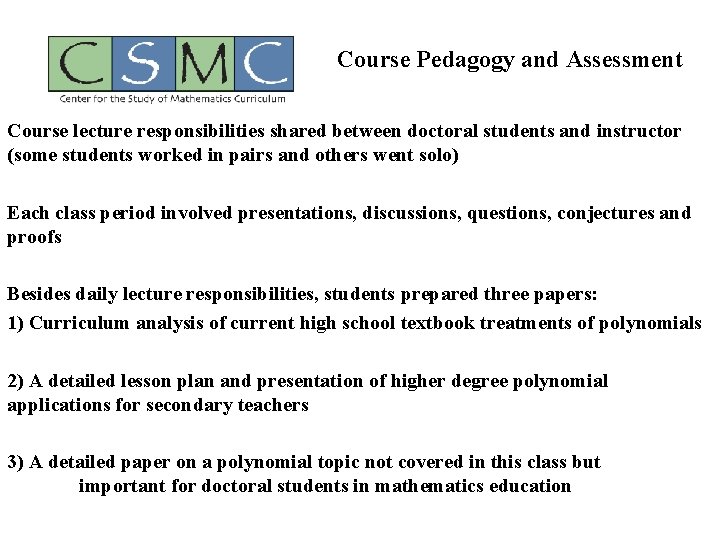
Course Pedagogy and Assessment Course lecture responsibilities shared between doctoral students and instructor (some students worked in pairs and others went solo) Each class period involved presentations, discussions, questions, conjectures and proofs Besides daily lecture responsibilities, students prepared three papers: 1) Curriculum analysis of current high school textbook treatments of polynomials 2) A detailed lesson plan and presentation of higher degree polynomial applications for secondary teachers 3) A detailed paper on a polynomial topic not covered in this class but important for doctoral students in mathematics education
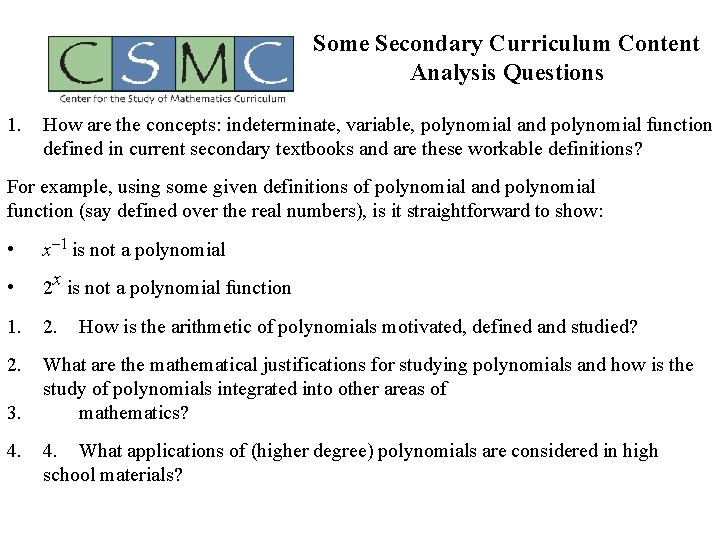
Some Secondary Curriculum Content Analysis Questions 1. How are the concepts: indeterminate, variable, polynomial and polynomial function defined in current secondary textbooks and are these workable definitions? For example, using some given definitions of polynomial and polynomial function (say defined over the real numbers), is it straightforward to show: • x– 1 is not a polynomial 2 x is not a polynomial function 1. 2. What are the mathematical justifications for studying polynomials and how is the study of polynomials integrated into other areas of mathematics? • 3. 4. How is the arithmetic of polynomials motivated, defined and studied? 4. What applications of (higher degree) polynomials are considered in high school materials?
A Polynomial Subtlety The polynomial x 2+5 x+3 in R[x] induces the function f: R R defined by the rule: f(a) = a 2+5 a+3 for each a in R. This assignment defines an surjective ring homomorphism R[x] R[a] = ring of polynomials in the variable a. Remark: There is a distinction between polynomials and polynomial functions (these rings are not isomorphic in general). Example: Consider the unequal polynomials x 4+x+1 and x 3+x 2+1 in Z 3[x] and the induced functions f: Z 3 , f(a)= a 4+a+1 for each a in Z 3 g: Z 3, g(a)=a 3+a 2+1 for each a in Z 3 f(0)=1=g(0); f(1)=3=0, g(1)=3=0; f(2)=19=1, g(2)=13=1 Therefore, f=g, but the polynomials that induced these functions are not equal, (i. e. , the above homomorphism is not always injective). Note: The existence of such an example is clear, since the polynomial ring Z 3[x] is infinite, but there are only a finite number of functions f: Z 3. Question: Is there a similar example if the coefficient field is infinite? Answer: NO!!! R[x] isomorphic to R[a] iff R is infinite.
QED