
DEVELOPING THE WHOLE PERSON Prepared by Mary Krystine
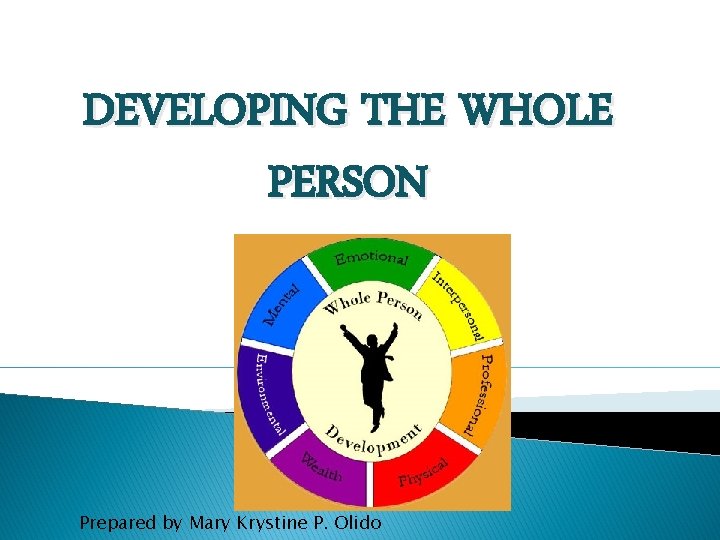
DEVELOPING THE WHOLE PERSON Prepared by Mary Krystine P. Olido
Mind and Body Dualism of Descartes �Duality – understanding the nature of things in a simple, dual mode. �Dual character separation �Examples: ◦ body and spirit ◦ mind and body ◦ Yin and yang ◦ Good-bad ◦ Life-death
Holism and Gestalt �Gen. Jan C. Smuts (1926) – wrote Holism and Evolution ◦ Introduced the academic terminology for holism as ◦ “ the tendency in nature to form wholes which are greater than the sum of the parts through creative evolution”
Holism and Gestalt �Christian von Ehrehfels – introduced the concept of gestalt �Merriam-Webster Dictionary definition: “something that is made of many parts and yet is somehow more than or different from the combination of its parts; broadly, the general quality or character of something. ”

The Various Aspects of Holistic Development of Persons �Physiological – physical attributes, 5 senses �Cognitive – intellectual functions �Psychological – thinking, feeling, behaving �Social – manner of interaction with others �Spiritual – attribute of a person’s consciousness, beliefs, and values
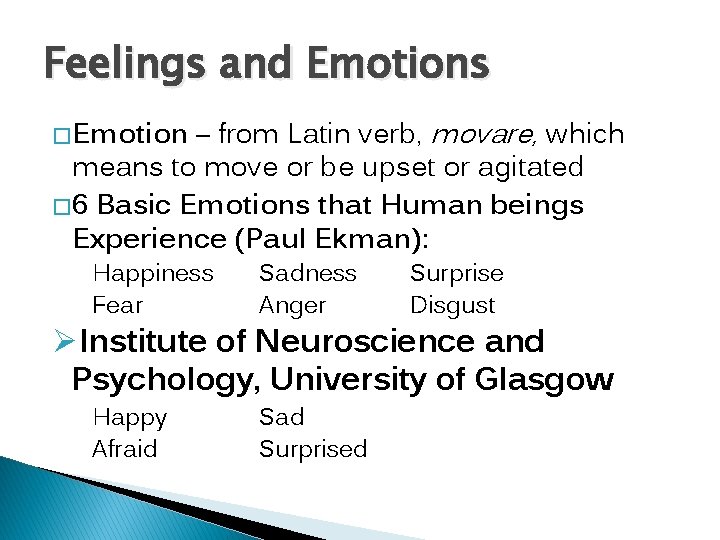
Feelings and Emotions – from Latin verb, movare, which means to move or be upset or agitated � 6 Basic Emotions that Human beings Experience (Paul Ekman): � Emotion Happiness Fear Sadness Anger Happy Afraid Sad Surprise Disgust ØInstitute of Neuroscience and Psychology, University of Glasgow
Dr. Antonio R. Damasio (2005) �Feelings arise from the brain as it interprets an emotion, which is usually caused by physical sensations experienced by the body as a reaction to certain external stimulus. �Example: Emotion of being afraid produces a feeling of fear
Attitudes and Behavior �Attitudes – a person’s thoughts, feelings, and emotions about another person, object, idea, behavior, or situation. ◦ Result of a person’s evaluation of an experience with another person, object, idea, behavior, or situation based on his/her values and belief systems �Behavior – a manifestation or acting out of the attitudes an individual has
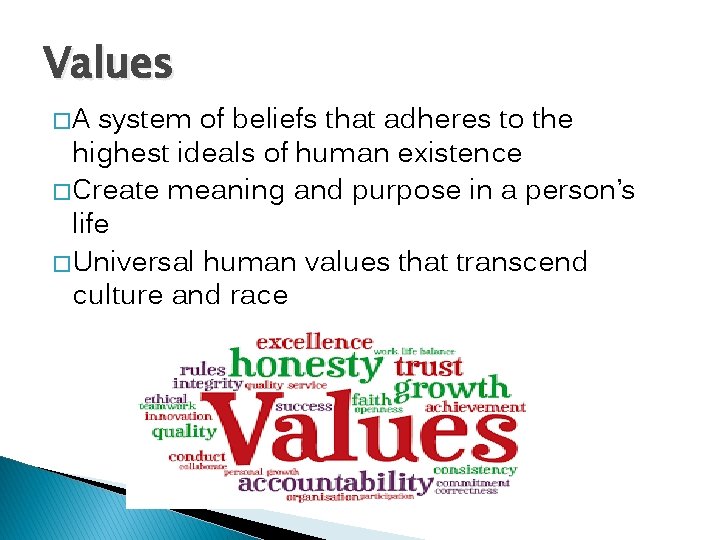
Values �A system of beliefs that adheres to the highest ideals of human existence � Create meaning and purpose in a person’s life � Universal human values that transcend culture and race
Five Core Values for the Workplace by Robert L. Dilenschneider �Integrity �Accountability �Diligence �Perseverance �Discipline
10 Common Values People Have by Shalom H. Schwartz 1. 2. 3. 4. 5. 6. 7. 8. 9. 10. Self-direction Stimulation Hedonism Achievement Power Security Conformity Tradition Benevolence Universalism
Motivational goals that characterize the 10 values 1. 2. 3. 4. Openness to change Self-transcendence Self-enhancement conservation
Some questions to help clarify your Values: 1. 2. What things are important to you? Are these things worthy enough for you to risk your future, your relationships, your career, or even your own life? What are things that are important to you that when taken away from you, or were not honored by other people, will make you angry or feel hurt?
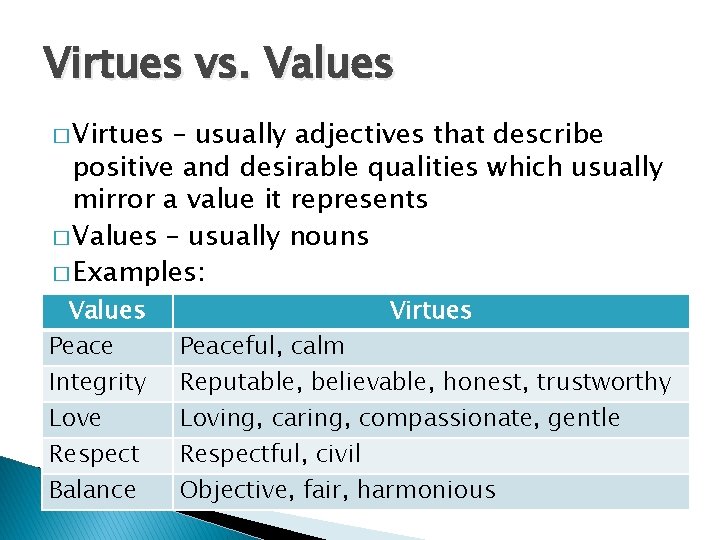
Virtues vs. Values � Virtues – usually adjectives that describe positive and desirable qualities which usually mirror a value it represents � Values – usually nouns � Examples: Values Peace Integrity Love Respect Balance Virtues Peaceful, calm Reputable, believable, honest, trustworthy Loving, caring, compassionate, gentle Respectful, civil Objective, fair, harmonious
Source: � Personal Santos Development by Ricardo Rubio
- Slides: 15