
Developing the Security Program Objectives Upon completion of
Developing the Security Program
Objectives • Upon completion of this material you should be able to: – Explain the organizational approaches to information security – List and describe the functional components of an information security program – Determine how to plan and staff an organization’s information security program based on its size
Objectives (cont’d. ) • Upon completion of this material you should be able to: (cont’d. ) – Evaluate the internal and external factors that influence the activities and organization of an information security program – List and describe the typical job titles and functions performed in the information security program http: //www. flickr. com/photos/pstainthorp/5471415240/
Objectives (cont’d. ) • Upon completion of this material you should be able to: (cont’d. ) – Describe the components of a security education, training, and awareness program and explain how organizations create and manage these programs
Introduction • Some organizations use security program to describe the entire set of personnel, plans, policies, and initiatives related to information security – The term “information security program” is used here to describe the structure and organization of the effort that contains risks to the information assets of the organization
Organizing for Security • Variables involved in structuring an information security program – Organizational culture – Size – Security personnel budget – Security capital budget • As organizations increase in size: – Their security departments are not keeping up with increasingly complex organizational infrastructures
Organizing for Security (cont’d. ) • Information security departments tend to form internal groups – To meet long-term challenges and handle day-to-day security operations • Functions are likely to be split into groups • Smaller organizations typically create fewer groups – Perhaps having only one general group of specialists
Organizing for Security (cont’d. ) • Very large organizations – More than 10, 000 computers – Security budgets often grow faster than IT budgets – Even with large budgets, the average amount spent on security per user is still smaller than any other type of organization • Small organizations spend more than $5, 000 per user on security; very large organizations spend about 1/18 th of that, roughly $300 per user
Organizing for Security (cont’d. ) • Very large organizations (cont’d. ) – Do a better job in the policy and resource management areas – Only 1/3 of organizations handled incidents according to an IR plan • Large organizations – Have 1, 000 to 10, 000 computers – Security approach has often matured, integrating planning and policy into the organization’s culture
Organizing for Security (cont’d. ) • Large organizations (cont’d. ) – Do not always put large amounts of resources into security • Considering the vast numbers of computers and users often involved – They tend to spend proportionally less on security
Security in Large Organizations • One approach separates functions into four areas: – Functions performed by nontechnology business units outside of IT – Functions performed by IT groups outside of information security area – Functions performed within information security department as customer service – Functions performed within the information security department as compliance
Security in Large Organizations (cont’d. ) • The CISO has responsibility for information security functions – Should be adequately performed somewhere within the organization • The deployment of full-time security personnel depends on: – Sensitivity of the information to be protected – Industry regulations – General profitability
Security in Large Organizations (cont’d. ) • The more money the company can dedicate to its personnel budget – The more likely it is to maintain a large information security staff
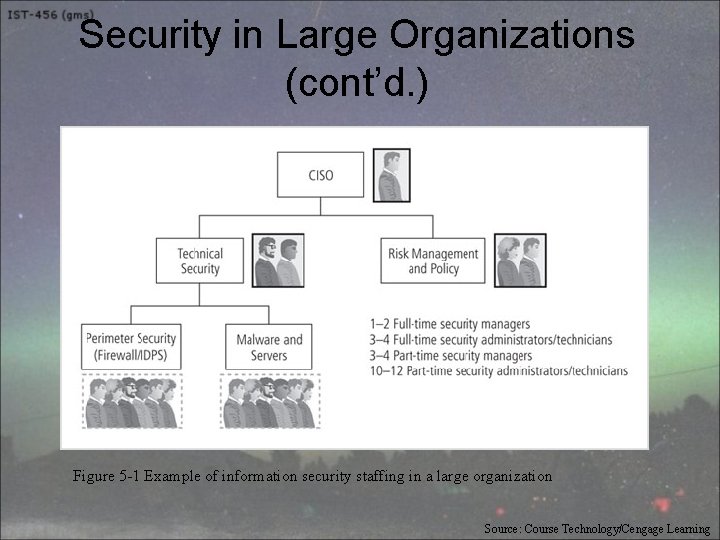
Security in Large Organizations (cont’d. ) Figure 5 -1 Example of information security staffing in a large organization Source: Course Technology/Cengage Learning
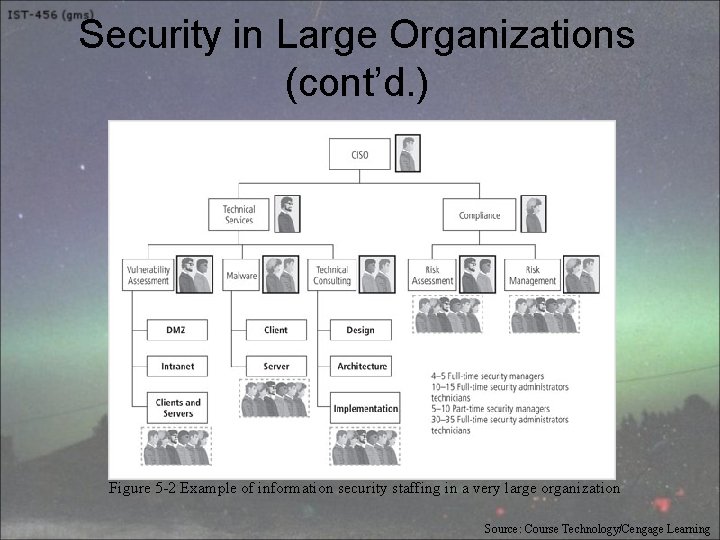
Security in Large Organizations (cont’d. ) Figure 5 -2 Example of information security staffing in a very large organization Source: Course Technology/Cengage Learning
Security in Medium-Sized Organizations • Medium-sized organizations – Have between 100 and 1000 computers – Have a smaller total budget – Have same sized security staff as the small organization, but a larger need – Must rely on help from IT staff for plans and practices – Ability to set policy, handle incidents, and effectively allocate resources is worse than any other size
Security in Medium-Sized Organizations (cont’d. ) • Medium-sized organizations (cont’d. ) – May be large enough to implement a multi-tiered approach to security • With fewer dedicated groups and more functions assigned to each group – Tend to ignore some security functions
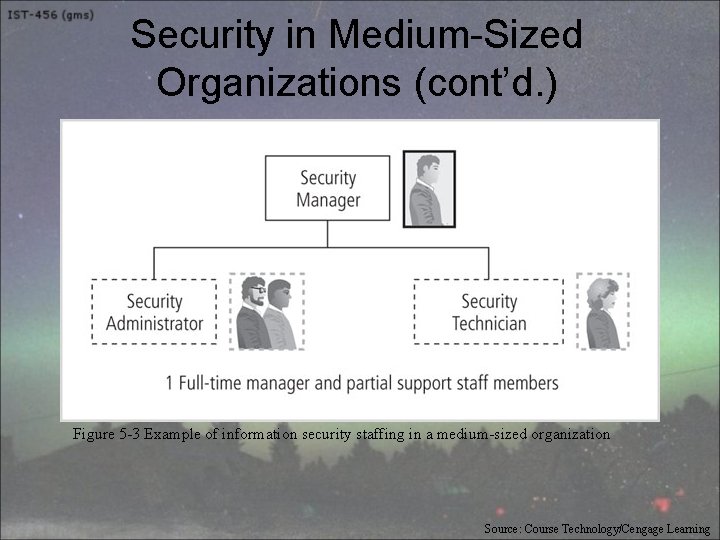
Security in Medium-Sized Organizations (cont’d. ) Figure 5 -3 Example of information security staffing in a medium-sized organization Source: Course Technology/Cengage Learning
Security in Small Organizations • Small organizations – Have between 10 and 100 computers – Have a simple, centralized IT organizational model – Spend disproportionately more on security – Information security is often the responsibility of a single security administrator – Have little in the way of formal policy, planning, or security measures
Security in Small Organizations (cont’d. ) • Small organizations (cont’d. ) – Commonly outsource their Web presence or electronic commerce operations – Security training and awareness is commonly conducted on a 1 -on-1 basis – Policies (when they exist) are often issue-specific – Formal planning is often part of IT planning – Threats from insiders are less likely • Every employee knows every other employee
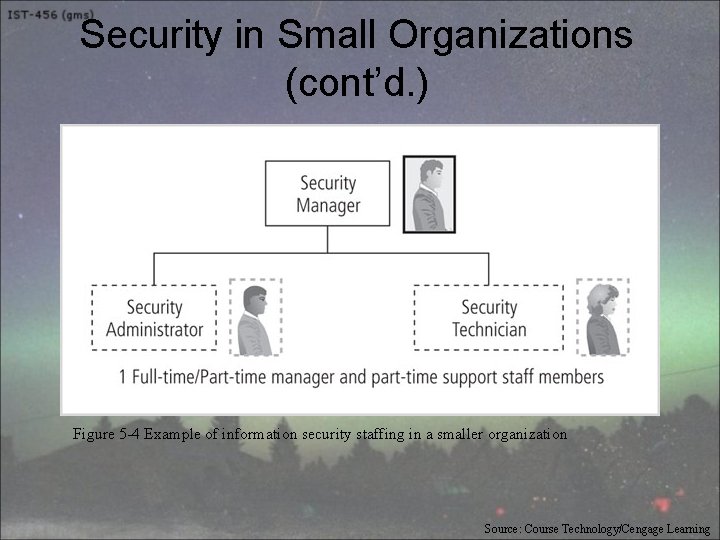
Security in Small Organizations (cont’d. ) Figure 5 -4 Example of information security staffing in a smaller organization Source: Course Technology/Cengage Learning
Placing Information Security Within An Organization • In large organizations – Info. Sec is often located within the information technology department • Headed by the CISO who reports directly to the top computing executive, or CIO • An Info. Sec program is sometimes at odds with the goals and objectives of the IT department as a whole
Placing Information Security Within An Organization (cont’d. ) • Because the goals and objectives of the CIO and the CISO may come in conflict – It is not difficult to understand the current movement to separate information security from the IT division – The challenge is to design a reporting structure for the Info. Sec program that balances the needs of each of the communities of interest
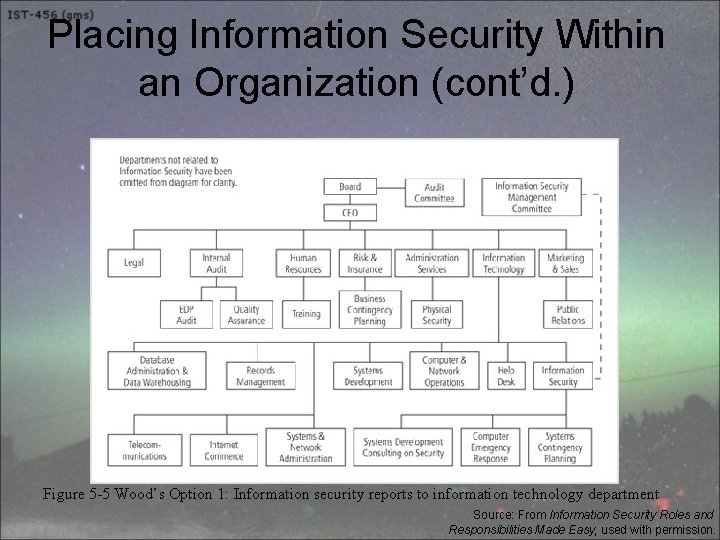
Placing Information Security Within an Organization (cont’d. ) Figure 5 -5 Wood’s Option 1: Information security reports to information technology department Source: From Information Security Roles and Responsibilities Made Easy, used with permission.
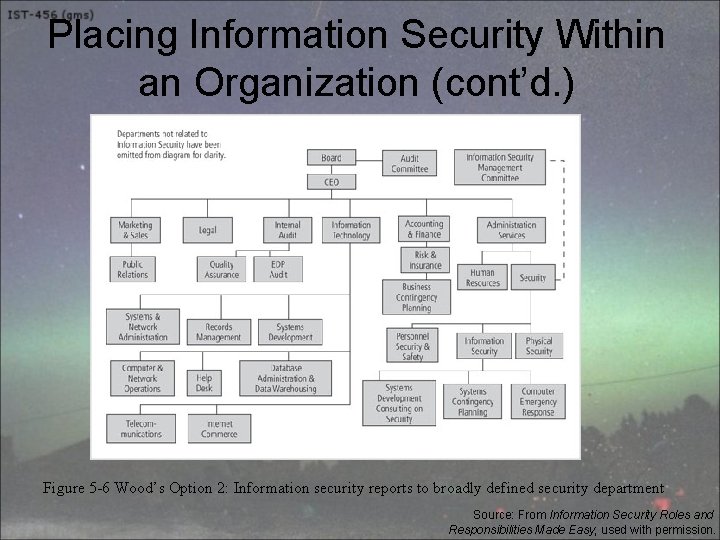
Placing Information Security Within an Organization (cont’d. ) Figure 5 -6 Wood’s Option 2: Information security reports to broadly defined security department Source: From Information Security Roles and Responsibilities Made Easy, used with permission.
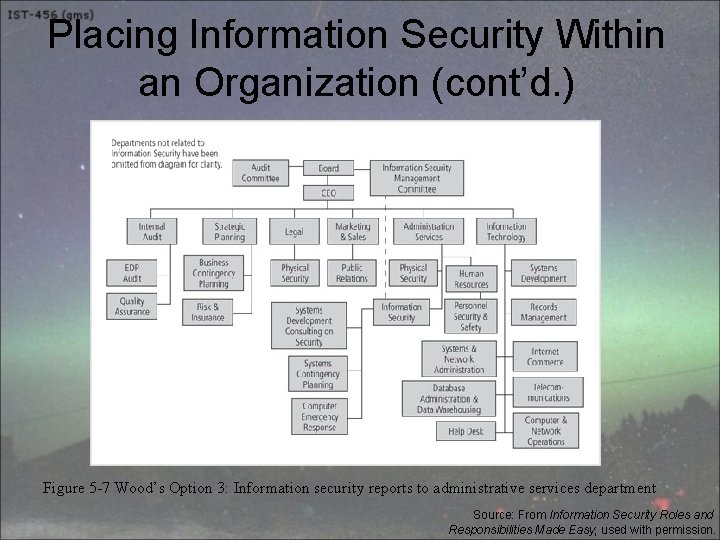
Placing Information Security Within an Organization (cont’d. ) Figure 5 -7 Wood’s Option 3: Information security reports to administrative services department Source: From Information Security Roles and Responsibilities Made Easy, used with permission.
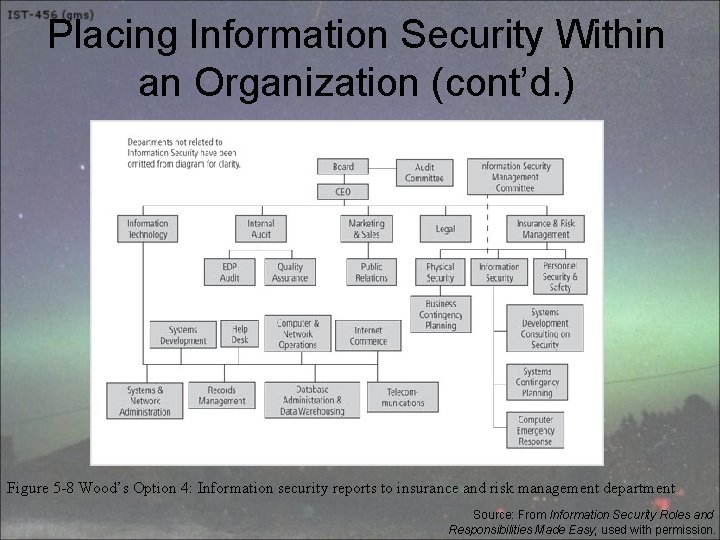
Placing Information Security Within an Organization (cont’d. ) Figure 5 -8 Wood’s Option 4: Information security reports to insurance and risk management department Source: From Information Security Roles and Responsibilities Made Easy, used with permission.
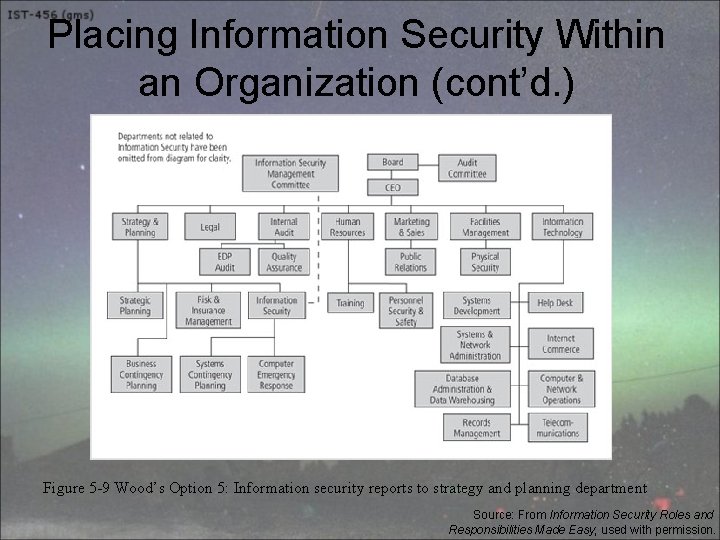
Placing Information Security Within an Organization (cont’d. ) Figure 5 -9 Wood’s Option 5: Information security reports to strategy and planning department Source: From Information Security Roles and Responsibilities Made Easy, used with permission.
Placing Information Security Within an Organization (cont’d. ) • Other options – – Option 6: Legal Option 7: Internal audit Option 8: Help desk Option 9: Accounting and finance through IT – Option 10: Human resources – Option 11: Facilities management – Option 12: Operations
Components of the Security Program • Organization’s information security needs – Unique to the culture, size, and budget of the organization – Determining what level the information security program operates on depends on the organization’s strategic plan • Also the plan’s vision and mission statements • The CIO and CISO should use these two documents to formulate the mission statement for the information security program
Information Security Roles and Titles • Types of information security positions – Those that define • Provide the policies, guidelines, and standards • Do the consulting and the risk assessment • Develop the product and technical architectures • Senior people with a lot of broad knowledge, but often not a lot of depth – Those that build • The real “techies” who create and install security solutions
Information Security Roles and Titles (cont’d. ) • Types of information security positions (cont’d. ) – Those that administer • Operate and administer the security tools and the security monitoring function • Continuously improve the processes • A typical organization has a number of individuals with information security responsibilities
Information Security Roles and Titles (cont’d. ) • While the titles used may be different, most of the job functions fit into one of the following: – Chief Information Security Officer (CISO) or Chief Security Officer (CSO) – Security managers – Security administrators and analysts – Security technicians – Security staff
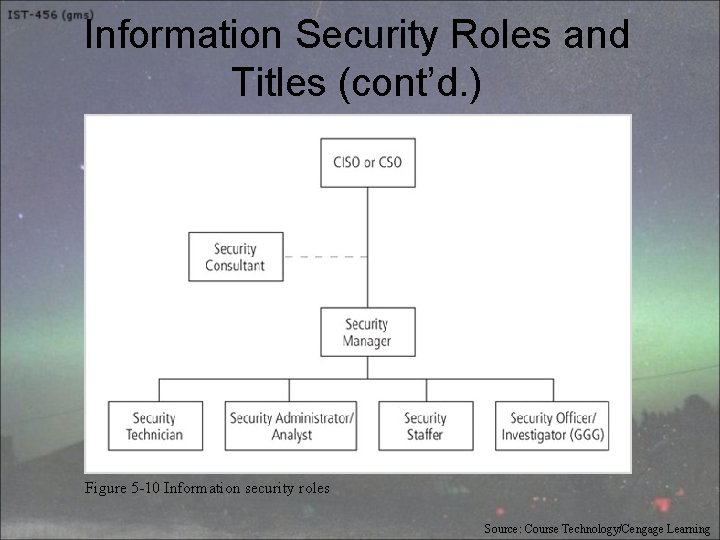
Information Security Roles and Titles (cont’d. ) Figure 5 -10 Information security roles Source: Course Technology/Cengage Learning
Help Desk Personnel • Help desk – An important part of the information security team – Enhances the security team’s ability to identify potential problems – When a user calls the help desk with a complaint , the user’s problem may turn out to be related to a bigger problem, such as a hacker, denial-of-service attack, or a virus
Help Desk Personnel (cont’d. ) • Help desk (cont’d. ) – Because help desk technicians perform a specialized role in information security, they have a need for specialized training
Implementing Security Education, Training, and Awareness Programs • SETA program – Designed to reduce accidental security breaches – Consists of three elements: security education, security training, and security awareness • Awareness, training, and education programs offer two major benefits: – Improving employee behavior – Enabling the organization to hold employees accountable for their actions
Implementing SETA Programs (cont’d. ) • Purpose of SETA is to enhance security: – By building in-depth knowledge, to design, implement, or operate security programs for organizations and systems – By developing skills and knowledge so that computer users can perform their jobs while using IT systems more securely – By improving awareness of the need to protect system resources
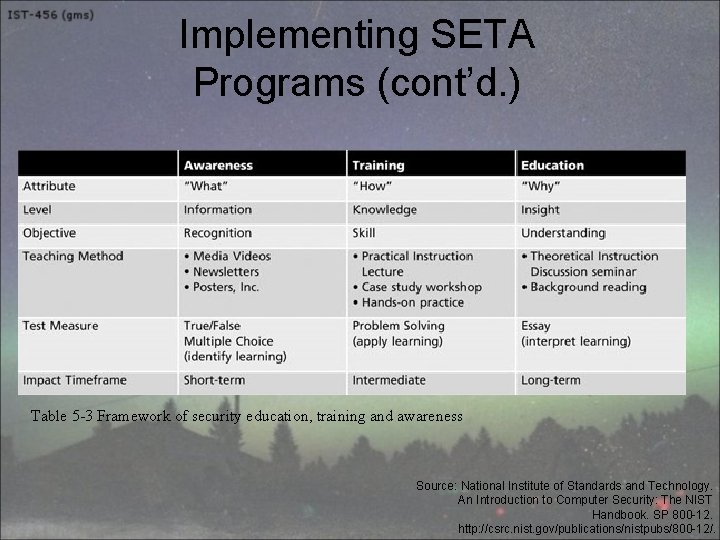
Implementing SETA Programs (cont’d. ) Table 5 -3 Framework of security education, training and awareness Source: National Institute of Standards and Technology. An Introduction to Computer Security: The NIST Handbook. SP 800 -12. http: //csrc. nist. gov/publications/nistpubs/800 -12/.
Security Education • Employees within information security may be encouraged to seek a formal education – If not prepared by their background or experience – A number of institutions of higher learning, including colleges and universities, provide formal coursework in information security
Security Education (cont’d. ) • A knowledge map – Can help potential students assess information security programs – Identifies the skills and knowledge clusters obtained by the program’s graduates – Creating the map can be difficult because many academics are unaware of the numerous subdisciplines within the field of information security • Each of which may have different knowledge requirements
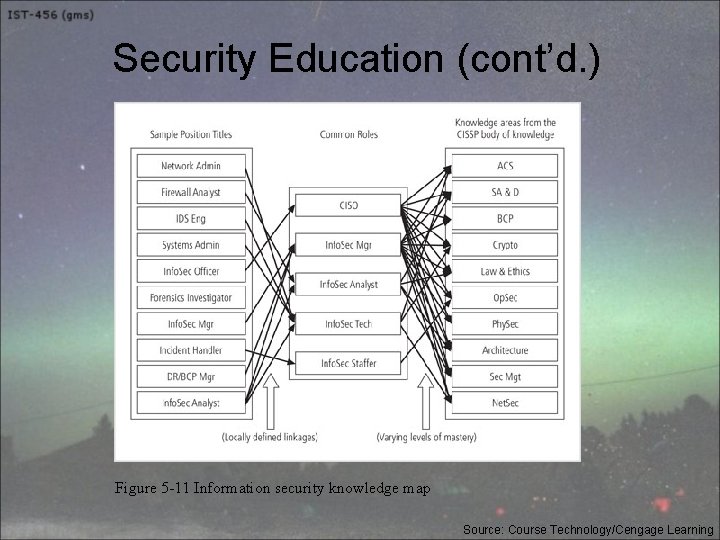
Security Education (cont’d. ) Figure 5 -11 Information security knowledge map Source: Course Technology/Cengage Learning
Security Education (cont’d. ) • Depth of knowledge – Indicated by a level of mastery using an established taxonomy of learning objectives or a simple scale such as “understanding → accomplishment → proficiency → mastery. ” • Because many institutions have no frame of reference for which skills and knowledge are required for a particular job area – They may refer to the certifications offered in that field
Security Education (cont’d. ) • Once the knowledge areas are identified, common knowledge areas are aggregated into teaching domains – From which individual courses can be created • Course design – Should enable a student to obtain the required knowledge and skills upon completion of the program – Identify the prerequisite knowledge for each class
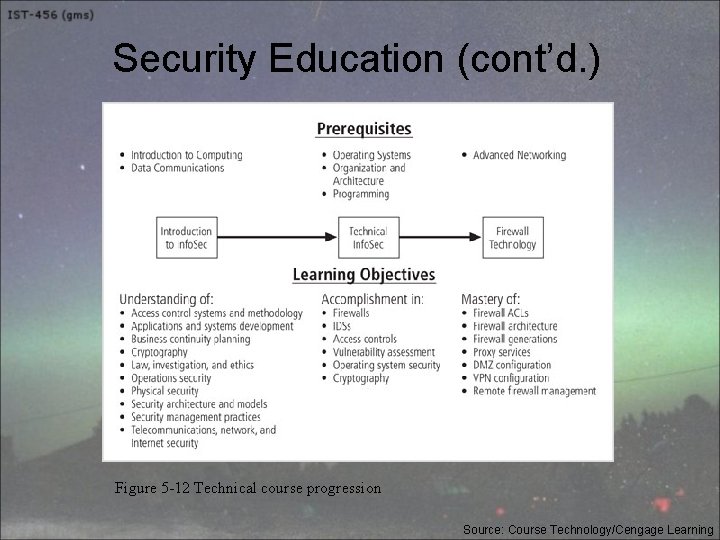
Security Education (cont’d. ) Figure 5 -12 Technical course progression Source: Course Technology/Cengage Learning
Security Training • Involves providing detailed information and hands-on instruction – To develop user skills to perform their duties securely • Management can either develop customized training or outsource
Security Training (cont’d. ) • Customizing training for users – By functional background • General user • Managerial user • Technical user – By skill level • Novice • Intermediate • Advanced
Training Techniques • Using the wrong method – Can hinder the transfer of knowledge • Leading to unnecessary expense and frustrated, poorly trained employees • Good training programs – Take advantage of the latest learning technologies and best practices
Training Techniques (cont’d. ) • Recent developments – Less use of centralized public courses and more on-site training • Training is often for one or a few individuals – Waiting until there is a largeenough group for a class can cost companies lost productivity • Other best practices – Increased use of short, taskoriented modules • Available during the normal work week
Training Techniques (cont’d. ) • Selection of the training delivery method – Not always based on the best outcome for the trainee • Often overriden by budget, scheduling, and needs of the organization • Types of delivery methods – One-on-one – Formal class – Computer-based training (CBT)
Training Techniques (cont’d. ) • Types of delivery methods (cont’d. ) – Distance learning/web seminars – User support group – On-the-job training – Self-study (non-computerized)
Training Techniques (cont’d. ) • Training methods – Use a local training program – Use a continuing education department – Use another external training agency – Hire a professional trainer, a consultant, or someone from an accredited institution to conduct on-site training – Organize and conduct training inhouse using organization’s own employees
Implementing Training • Seven-step methodology generally applies: – Step 1: Identify program scope, goals, and objectives – Step 2: Identify training staff – Step 3: Identify target audiences – Step 4: Motivate management and employees – Step 5: Administer the program – Step 6: Maintain the program – Step 7: Evaluate the program
Security Awareness • One of the least frequently implemented, but most effective security methods is the security awareness program • Security awareness programs: – Set the stage for training by changing organizational attitudes to realize the importance of security and the adverse consequences of its failure – Remind users of the procedures to be followed
Security Awareness (cont’d. ) • Best practices – Focus on people – Refrain from using technical jargon – Use every available venue – Define learning objectives, state them clearly, and provide sufficient detail and coverage – Keep things light – Don’t overload the users – Help users understand their roles in Info. Sec
Security Awareness (cont’d. ) • Best practices (cont’d. ) – Take advantage of in-house communications media – Make the awareness program formal • Plan and document all actions – Provide good information early, rather than perfect information late
Security Awareness (cont’d. ) • The ten commandments of information security awareness training – Information security is a people, rather than a technical, issue – If you want them to understand, speak their language – If they cannot see it, they will not learn it – Make your point so that you can identify it and so can they. – Never lose your sense of humor
Security Awareness (cont’d. ) • The ten commandments of information security awareness training (cont’d. ) – Make your point, support it, and conclude it – Always let the recipients know how the behavior that you request will affect them – Ride the tame horses – Formalize your training methodology – Always be timely, even if it means slipping schedules to include urgent information
Security Awareness (cont’d. ) • Security awareness and security training are designed to modify any employee behavior that endangers the security of the organization’s information – Security training and awareness activities can be undermined if management does not set a good example
Security Awareness (cont’d. ) • Effective training and awareness programs make employees accountable for their actions • Dissemination and enforcement of policy become easier when training and awareness programs are in place • Demonstrating due care and due diligence can help indemnify the institution against lawsuits
Security Awareness (cont’d. ) • Awareness can take on different forms for particular audiences • A security awareness program can use many methods to deliver its message • Recognize that people tend to practice a tuning out process (acclimation) – Awareness techniques should be creative and frequently changed
Security Awareness (cont’d. ) • Many security awareness components are available at little or no cost – Others can be very expensive • Examples of security awareness components – Videos – Posters and banners – Lectures and conferences – Computer-based training
Security Awareness (cont’d. ) • Examples of security awareness components (cont’d. ) – Newsletters – Brochures and flyers – Trinkets (coffee cups, pencils, T-shirts) – Bulletin boards
Security Awareness (cont’d. ) • Security newsletter – A cost-effective way to disseminate security information – Newsletters can be in the form of hard copy, e-mail, or intranet – Topics can include threats to the organization’s information assets, schedules for upcoming security classes, and the addition of new security personnel
Security Awareness (cont’d. ) • Security newsletter (cont’d. ) – The goal is to keep the idea of information security uppermost in users’ minds and to stimulate them to care about security – Newsletters might include: • Summaries of key policies • Summaries of key news articles • A calendar of security events, including training sessions, presentations, and other activities • Announcements relevant to information security • How-to’s
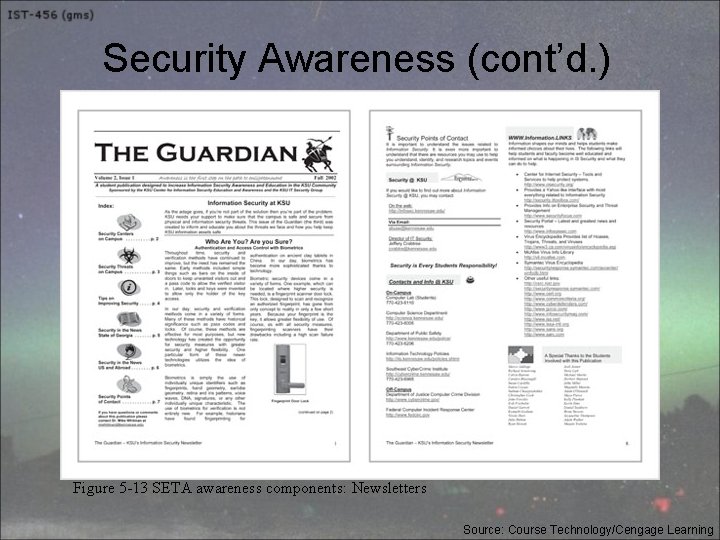
Security Awareness (cont’d. ) Figure 5 -13 SETA awareness components: Newsletters Source: Course Technology/Cengage Learning
Security Awareness (cont’d. ) http: //www. flickr. com/photos/salfordpgrs/4710790787/ • Security poster series – A simple and inexpensive way to keep security on people’s minds – Professional posters can be quite expensive, so in-house development may be the best solution – Keys to a good poster series: • Varying the content and keeping posters updated • Keeping them simple, but visually interesting • Making the message clear • Providing information on reporting violations
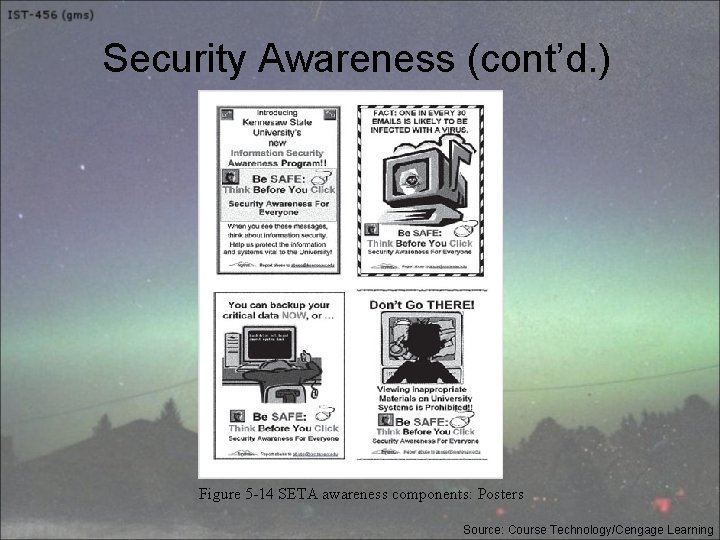
Security Awareness (cont’d. ) Figure 5 -14 SETA awareness components: Posters Source: Course Technology/Cengage Learning
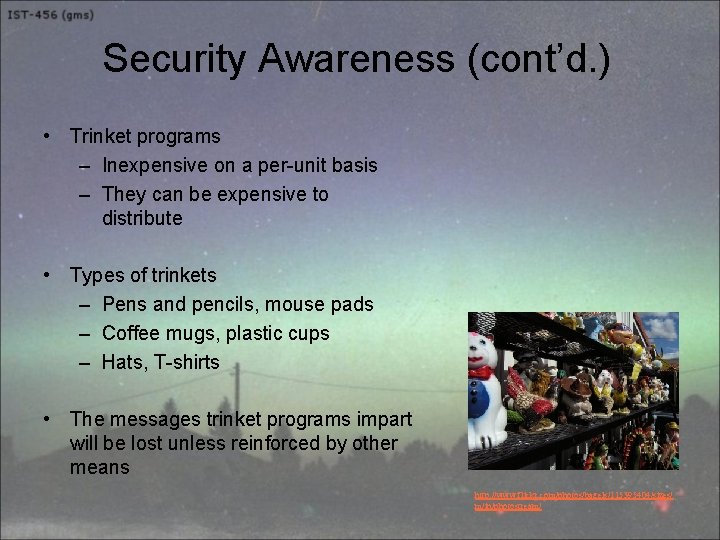
Security Awareness (cont’d. ) • Trinket programs – Inexpensive on a per-unit basis – They can be expensive to distribute • Types of trinkets – Pens and pencils, mouse pads – Coffee mugs, plastic cups – Hats, T-shirts • The messages trinket programs impart will be lost unless reinforced by other means http: //www. flickr. com/photos/bagels/115395404/sizes/ m/in/photostream/
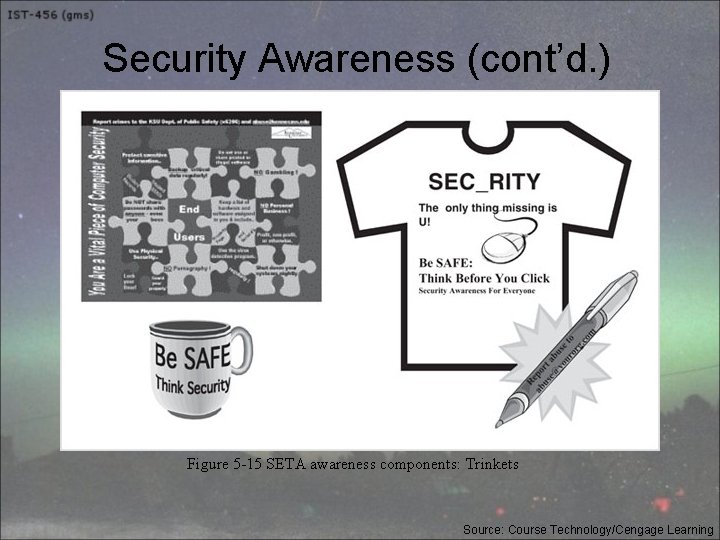
Security Awareness (cont’d. ) Figure 5 -15 SETA awareness components: Trinkets Source: Course Technology/Cengage Learning
Security Awareness (cont’d. ) • Organizations can establish Web pages or sites dedicated to promoting information security awareness – The challenge lies in updating the messages frequently enough to keep them fresh • Tips on creating and maintaining an educational Web site – See what’s already out there – Plan ahead
Security Awareness (cont’d. ) • Tips on creating and maintaining an educational Web site (cont’d. ) – Keep page loading time to a minimum – Seek feedback – Assume nothing and check everything – Spend time promoting your site
Security Awareness (cont’d. ) • Security awareness conference – Have a guest speaker or even a mini-conference dedicated to the topic • Perhaps in association with the semi-annual National Computer Security Days: October 31 and April 4 http: //www. openclipart. org/detail/140461/hal 9000 -by-marauder
- Slides: 73