
Developing the Media Planning A series of decisions
- Slides: 32
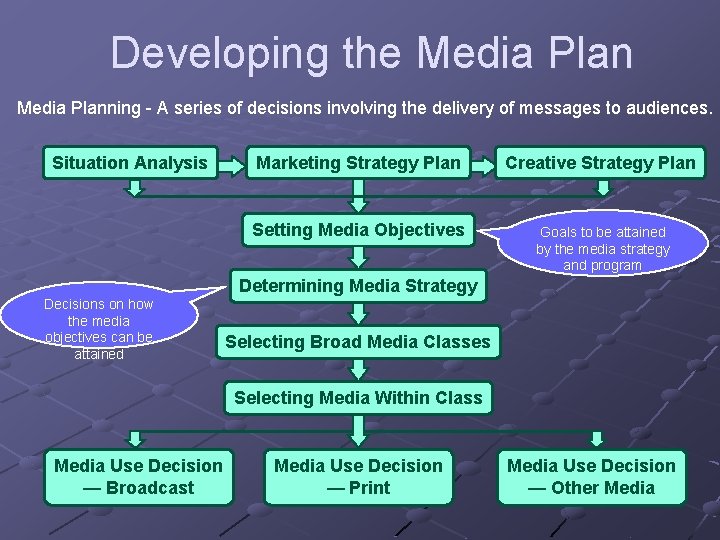
Developing the Media Planning - A series of decisions involving the delivery of messages to audiences. Situation Analysis Marketing Strategy Plan Creative Strategy Plan Setting Media Objectives Goals to be attained by the media strategy and program Determining Media Strategy Decisions on how the media objectives can be attained Selecting Broad Media Classes Selecting Media Within Class Media Use Decision — Broadcast Media Use Decision — Print Media Use Decision — Other Media
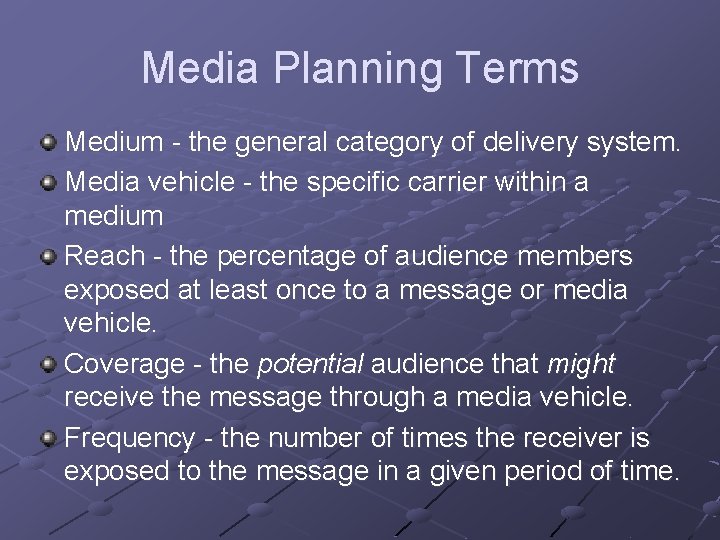
Media Planning Terms Medium - the general category of delivery system. Media vehicle - the specific carrier within a medium Reach - the percentage of audience members exposed at least once to a message or media vehicle. Coverage - the potential audience that might receive the message through a media vehicle. Frequency - the number of times the receiver is exposed to the message in a given period of time.
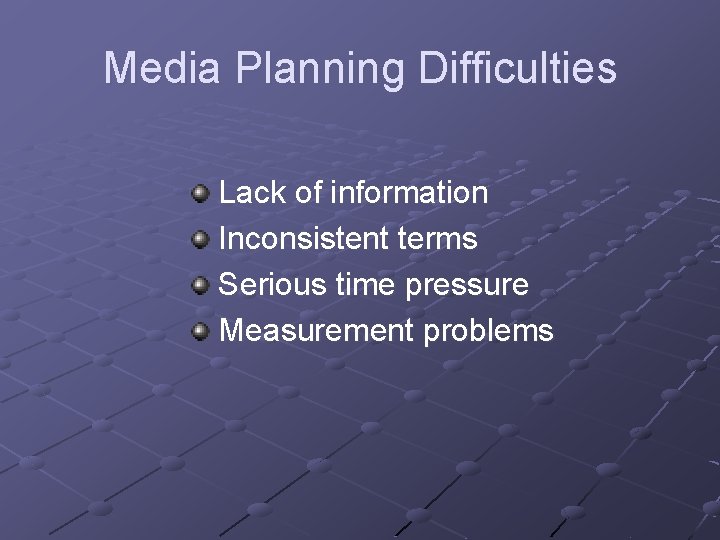
Media Planning Difficulties Lack of information Inconsistent terms Serious time pressure Measurement problems
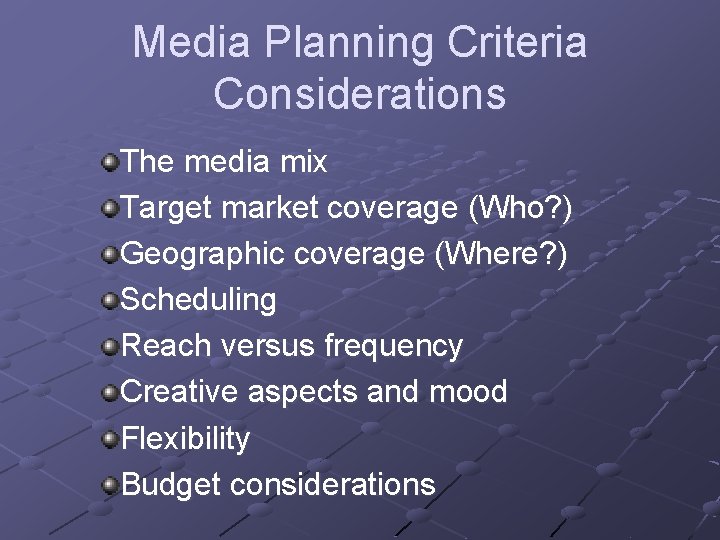
Media Planning Criteria Considerations The media mix Target market coverage (Who? ) Geographic coverage (Where? ) Scheduling Reach versus frequency Creative aspects and mood Flexibility Budget considerations
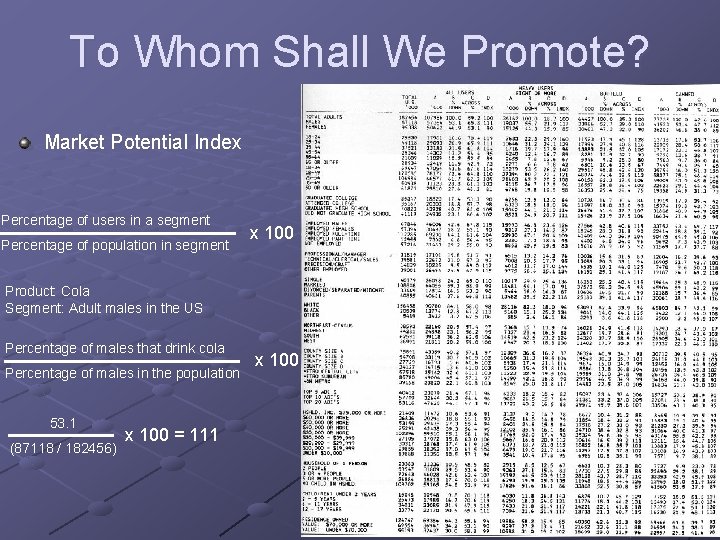
To Whom Shall We Promote? Market Potential Index Percentage of users in a segment Percentage of population in segment x 100 Product: Cola Segment: Adult males in the US Percentage of males that drink cola Percentage of males in the population 53. 1 (87118 / 182456) x 100 = 111 x 100
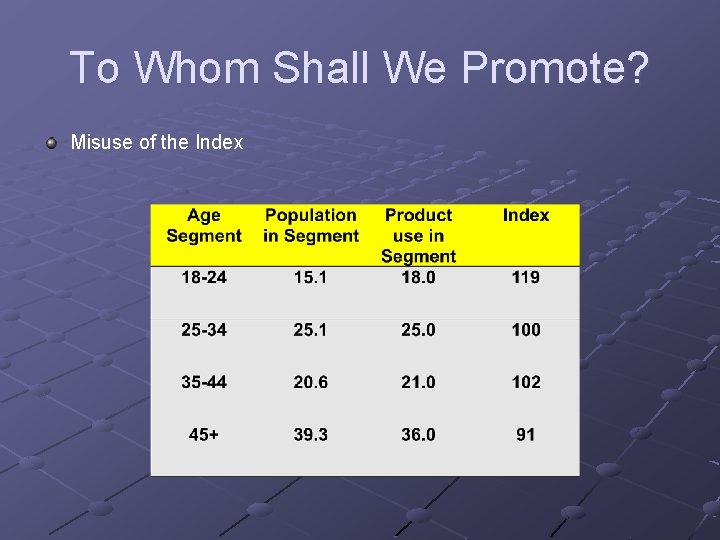
To Whom Shall We Promote? Misuse of the Index
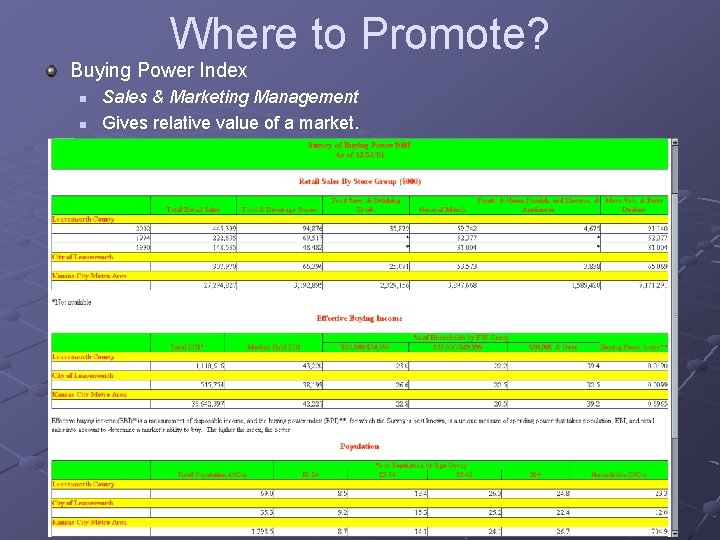
Where to Promote? Buying Power Index n n Sales & Marketing Management Gives relative value of a market.
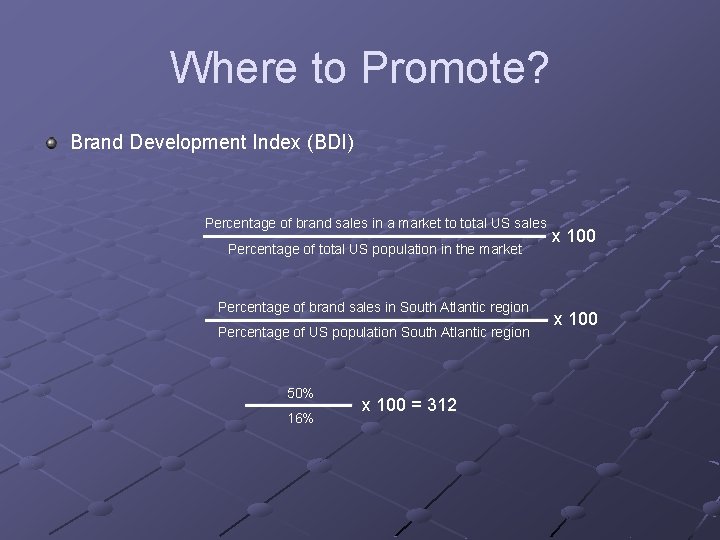
Where to Promote? Brand Development Index (BDI) Percentage of brand sales in a market to total US sales Percentage of total US population in the market Percentage of brand sales in South Atlantic region Percentage of US population South Atlantic region 50% 16% x 100 = 312 x 100
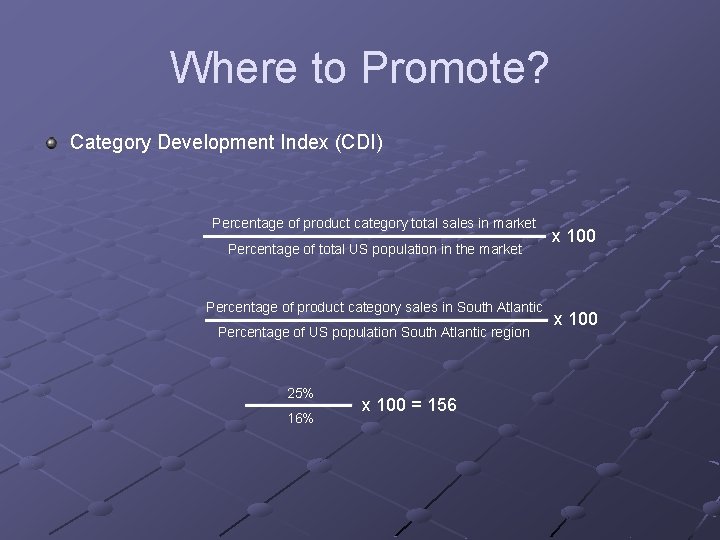
Where to Promote? Category Development Index (CDI) Percentage of product category total sales in market Percentage of total US population in the market Percentage of product category sales in South Atlantic Percentage of US population South Atlantic region 25% 16% x 100 = 156 x 100
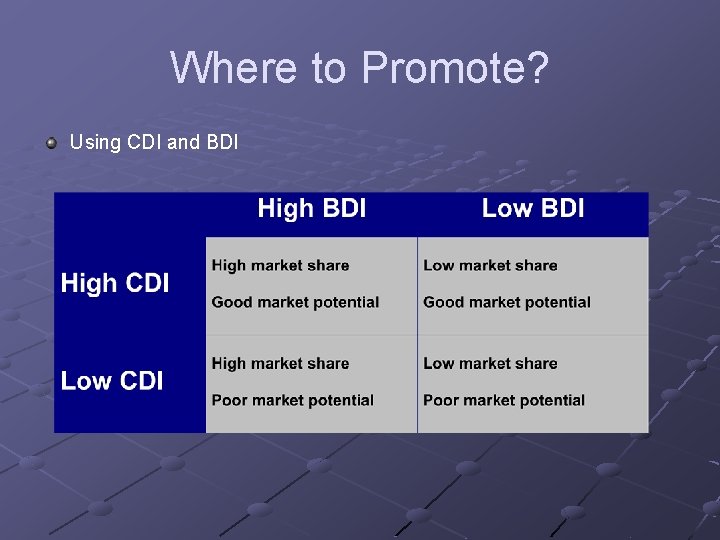
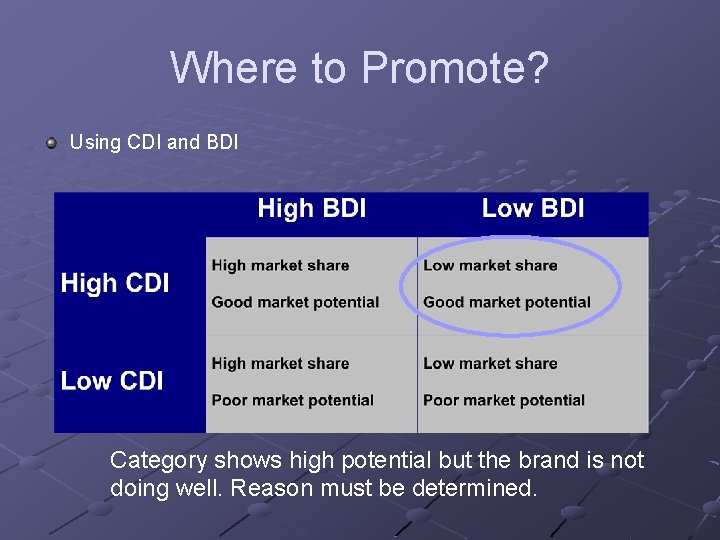
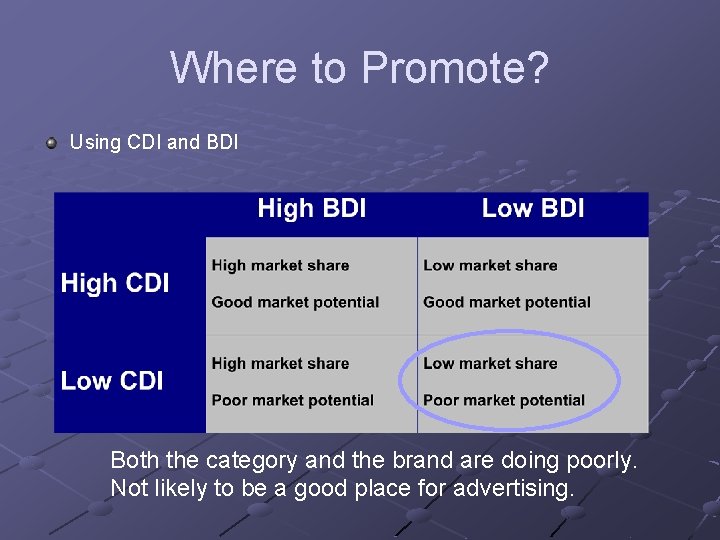
Where to Promote? Using CDI and BDI
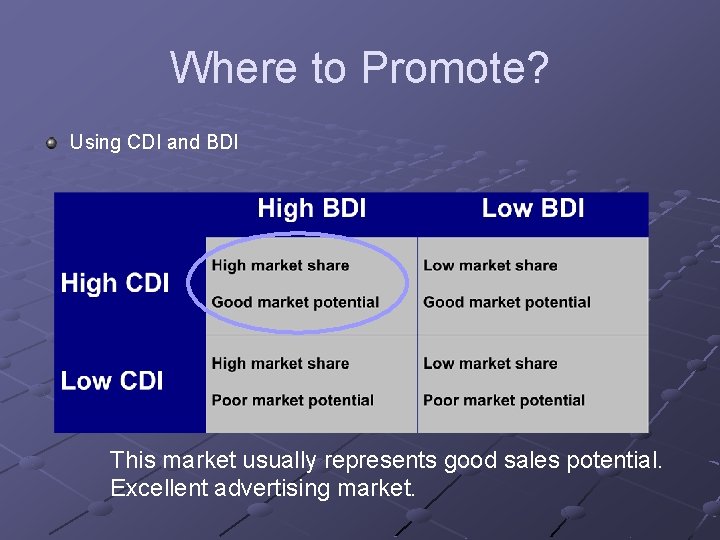
Where to Promote? Using CDI and BDI This market usually represents good sales potential. Excellent advertising market.
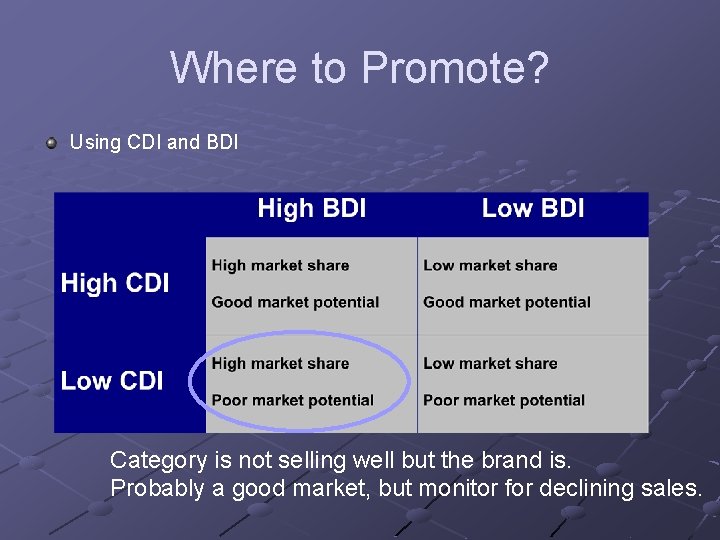
Where to Promote? Using CDI and BDI Category is not selling well but the brand is. Probably a good market, but monitor for declining sales.
Where to Promote? Using CDI and BDI Category shows high potential but the brand is not doing well. Reason must be determined.
Where to Promote? Using CDI and BDI Both the category and the brand are doing poorly. Not likely to be a good place for advertising.
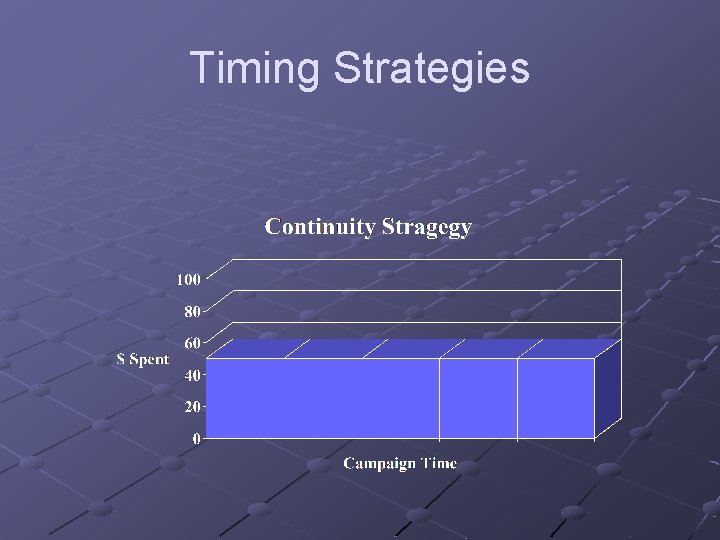
Timing Strategies
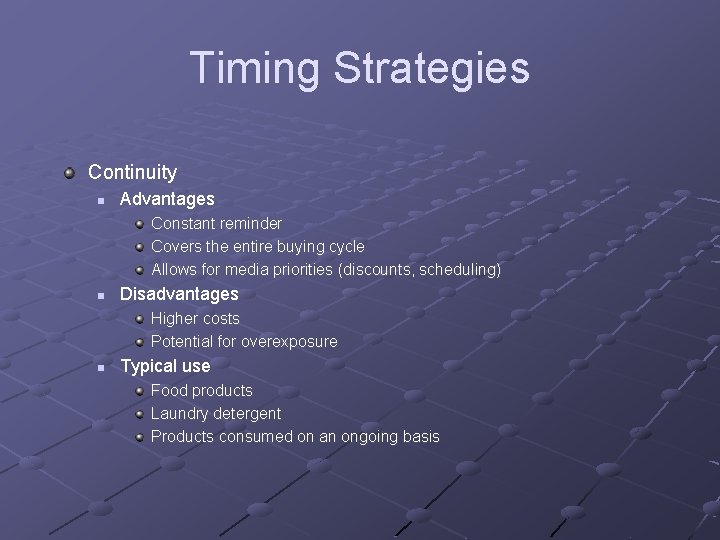
Timing Strategies Continuity n Advantages Constant reminder Covers the entire buying cycle Allows for media priorities (discounts, scheduling) n Disadvantages Higher costs Potential for overexposure n Typical use Food products Laundry detergent Products consumed on an ongoing basis
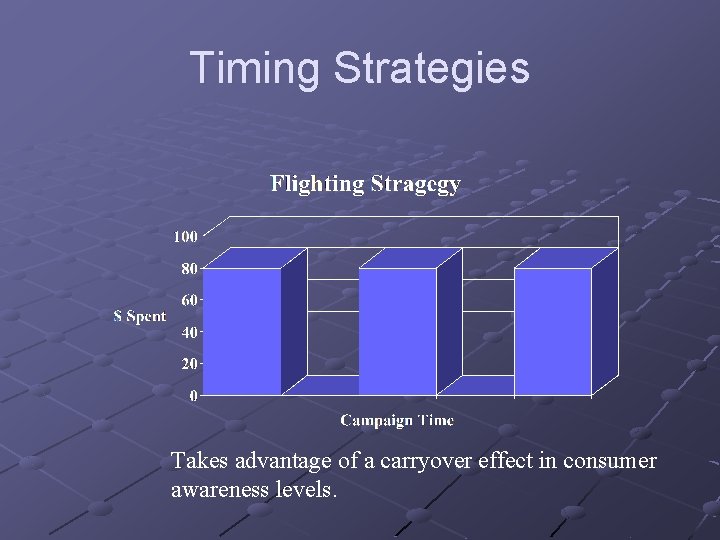
Timing Strategies Takes advantage of a carryover effect in consumer awareness levels.
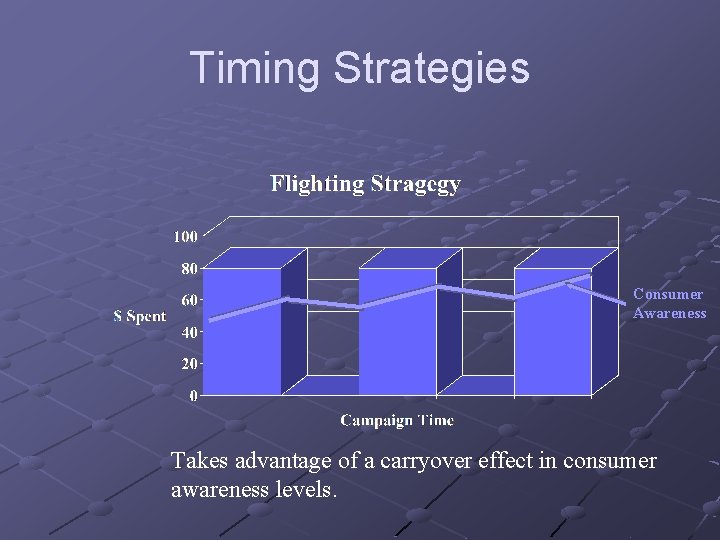
Timing Strategies Consumer Awareness Takes advantage of a carryover effect in consumer awareness levels.
Timing Strategies Flighting n Advantages Cost efficiency May allow multiple media or vehicles with limited budget Weighting may offer more exposure and competitive advantage during scheduled times n Disadvantages Lack of awareness/interest/retention during unscheduled times Vulnerable to competitive efforts during unscheduled times n Typical use Products with limited budgets Products for which highest potential buying times can be identified Seasonal products
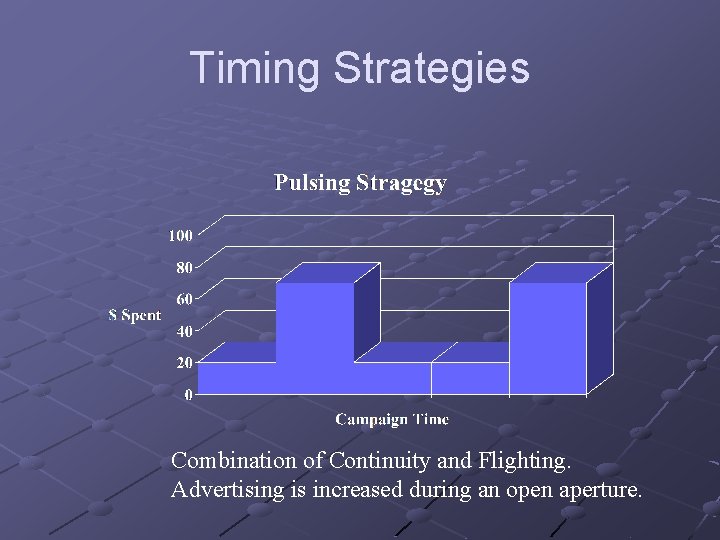
Timing Strategies Combination of Continuity and Flighting. Advertising is increased during an open aperture.
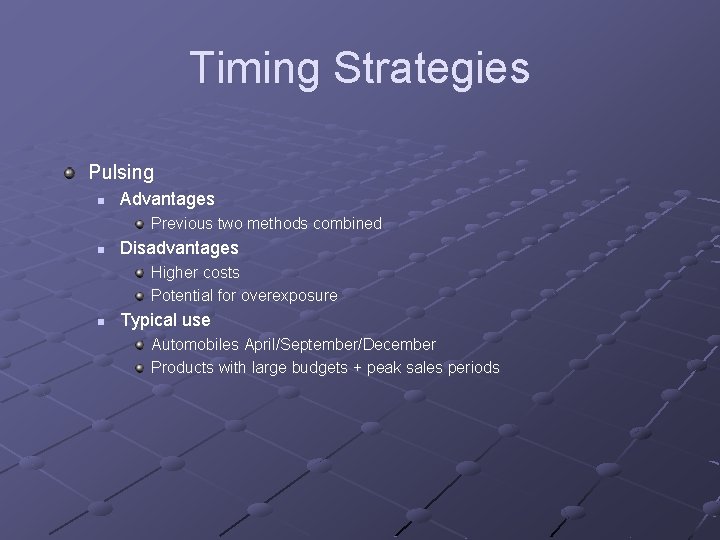
Timing Strategies Pulsing n Advantages Previous two methods combined n Disadvantages Higher costs Potential for overexposure n Typical use Automobiles April/September/December Products with large budgets + peak sales periods
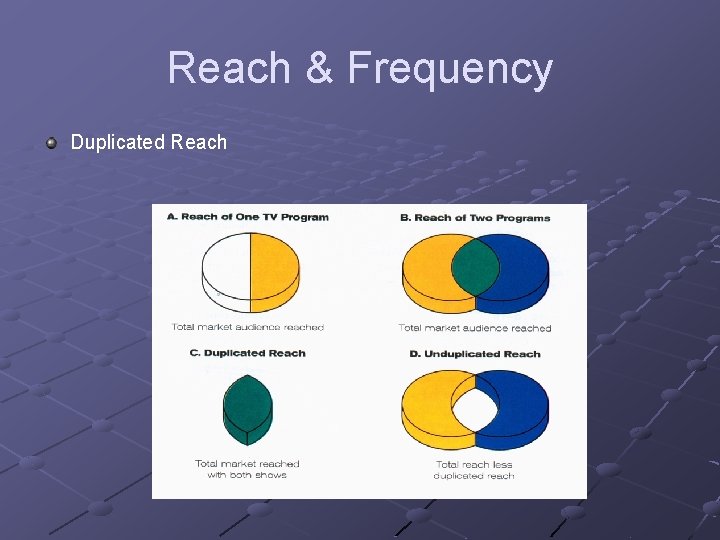
Reach & Frequency Duplicated Reach
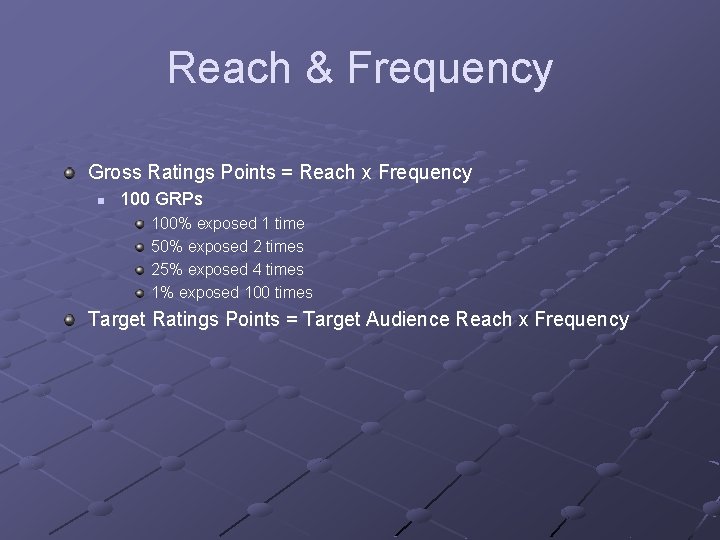
Reach & Frequency Gross Ratings Points = Reach x Frequency n 100 GRPs 100% exposed 1 time 50% exposed 2 times 25% exposed 4 times 1% exposed 100 times Target Ratings Points = Target Audience Reach x Frequency
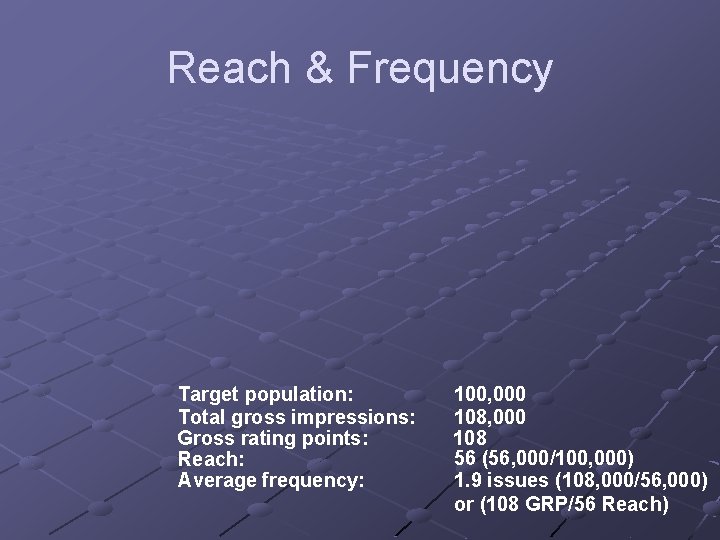
Reach & Frequency Target population: Total gross impressions: Gross rating points: Reach: Average frequency: 100, 000 108 56 (56, 000/100, 000) 1. 9 issues (108, 000/56, 000) or (108 GRP/56 Reach)
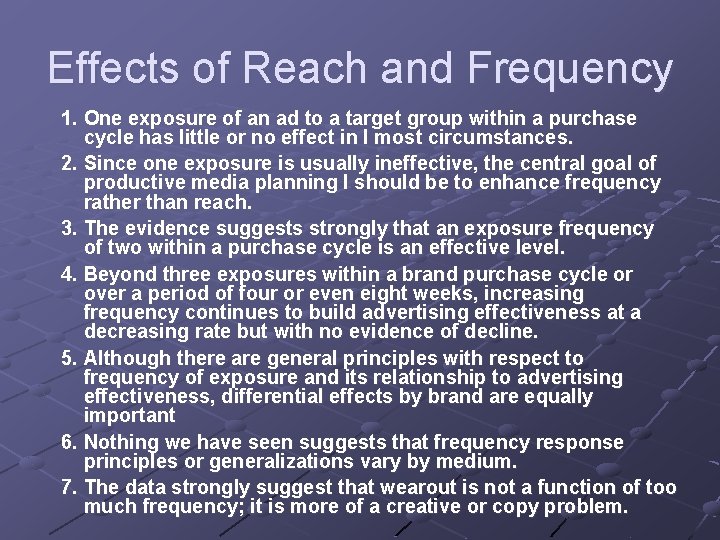
Effects of Reach and Frequency 1. One exposure of an ad to a target group within a purchase cycle has little or no effect in I most circumstances. 2. Since one exposure is usually ineffective, the central goal of productive media planning I should be to enhance frequency rather than reach. 3. The evidence suggests strongly that an exposure frequency of two within a purchase cycle is an effective level. 4. Beyond three exposures within a brand purchase cycle or over a period of four or even eight weeks, increasing frequency continues to build advertising effectiveness at a decreasing rate but with no evidence of decline. 5. Although there are general principles with respect to frequency of exposure and its relationship to advertising effectiveness, differential effects by brand are equally important 6. Nothing we have seen suggests that frequency response principles or generalizations vary by medium. 7. The data strongly suggest that wearout is not a function of too much frequency; it is more of a creative or copy problem.
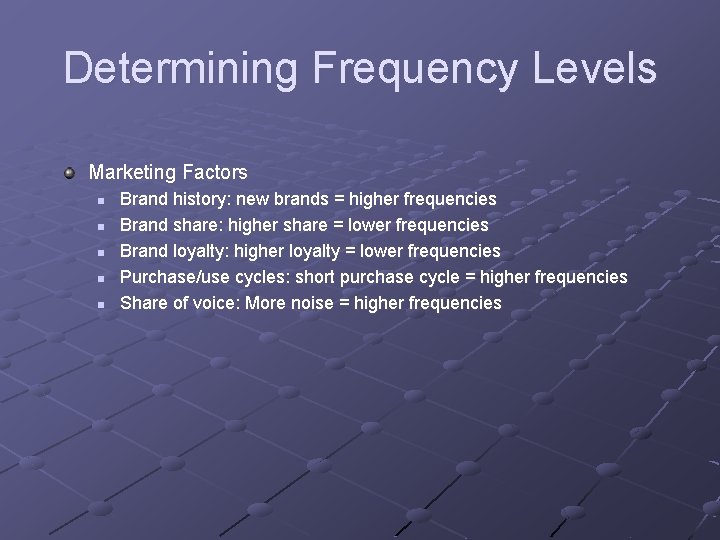
Determining Frequency Levels Marketing Factors n n n Brand history: new brands = higher frequencies Brand share: higher share = lower frequencies Brand loyalty: higher loyalty = lower frequencies Purchase/use cycles: short purchase cycle = higher frequencies Share of voice: More noise = higher frequencies
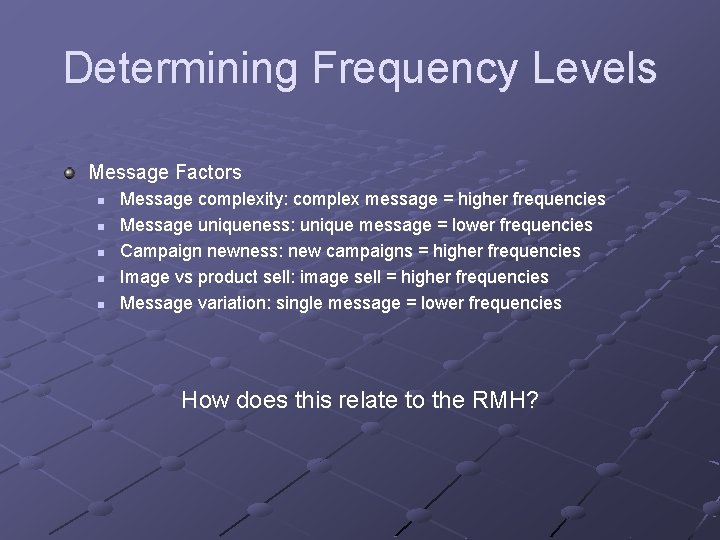
Determining Frequency Levels Message Factors n n n Message complexity: complex message = higher frequencies Message uniqueness: unique message = lower frequencies Campaign newness: new campaigns = higher frequencies Image vs product sell: image sell = higher frequencies Message variation: single message = lower frequencies How does this relate to the RMH?
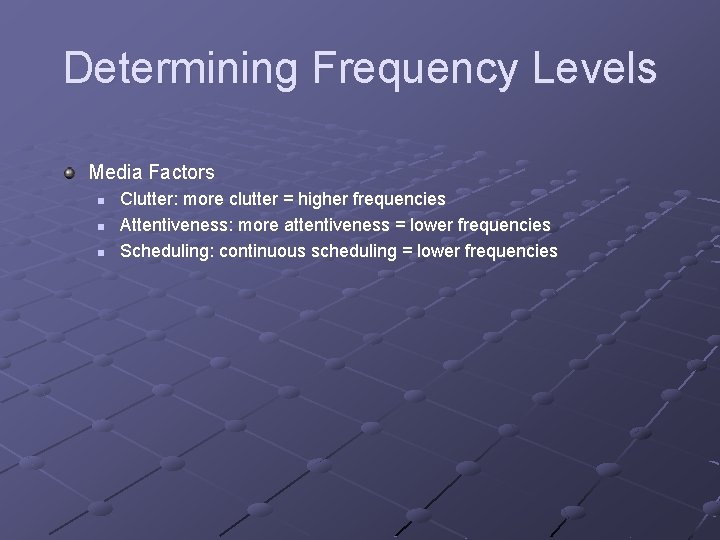
Determining Frequency Levels Media Factors n n n Clutter: more clutter = higher frequencies Attentiveness: more attentiveness = lower frequencies Scheduling: continuous scheduling = lower frequencies
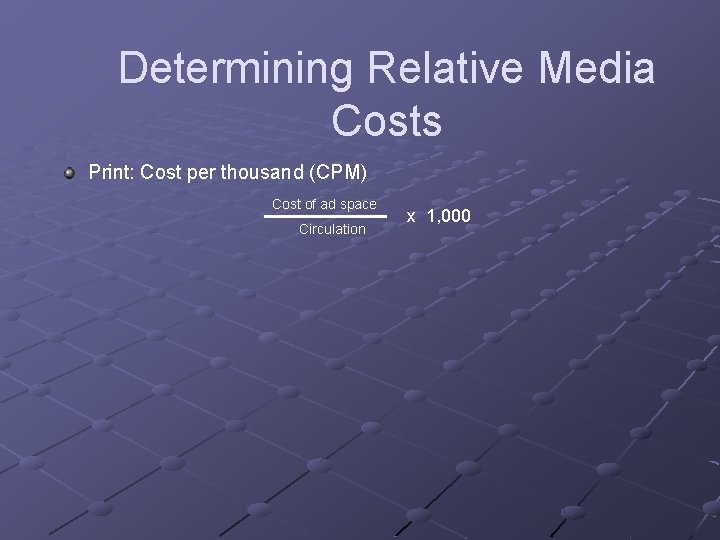
Determining Relative Media Costs Print: Cost per thousand (CPM) Cost of ad space Circulation x 1, 000
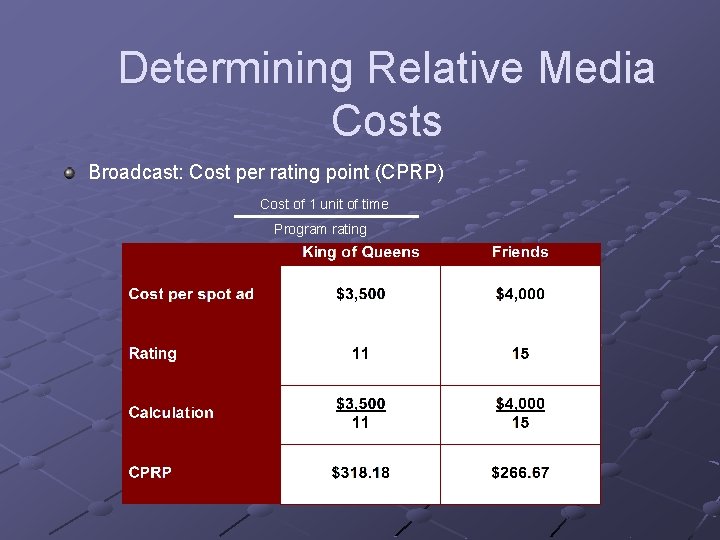
Determining Relative Media Costs Broadcast: Cost per rating point (CPRP) Cost of 1 unit of time Program rating
Cautions Scenario A: Overestimation of Efficiency
Cautions Scenario B: Underestimation of Efficiency