
DEVELOPING THE LABEL AVOIDANCE MEASURE OF STIGMA A
DEVELOPING THE LABEL AVOIDANCE MEASURE OF STIGMA: A PSYCHOMETRIC PRELIMINARY REVIEW JULIA CAMERON, B. A. UNIVERSITY OF MONTANA DEPARTMENT OF CLINICAL PSYCHOLOGY
WHY STUDY STIGMA? Large gap between those who require mental health treatment and those who actually receive it Approximately 44 million American adults experience a mental illness, and it is estimated that more than half of these adults do not receive treatment for their conditions (MHA, 2019). Stigma is a commonly reported barrier Individuals fear that seeking treatment will lead to negative evaluation (Vogel, Wester, Larson, 2007)

Public • Stereotypes and negative societal messages Stigma Self. Stigma Label Avoidance • Internalization of broader societal messages • Lead to feelings of demoralization and lower selfesteem • Assumes specific stigma attached to mental illness label • Results in less treatment seeking behavior and lower treatment engagement (Owen, Le. Keldric, & Rodolfa, 2013; Corrigan, 2004; Link, 1987)
![Label avoidance [is when individuals] opt to avoid the stigma all together by denying](http://slidetodoc.com/presentation_image_h2/0334756bc62bf5a95b18bc316023ddb4/image-4.jpg "Label avoidance [is when individuals] opt to avoid the stigma all together by denying")
Label avoidance [is when individuals] opt to avoid the stigma all together by denying their group status and by not seeking the institutions that mark them (i. e. , mental health care) (Corrigan 2004)

CURRENT POTENTIAL LABEL AVOIDANCE MEASURES Self Identification as Having a Mental Illness Scale (SELF-I) A measure of symptom appraisal “Current issues I am facing could be the first signs of mental illness” Stolzenburg et al. , 2017
Measure Rational. Creation Test Construction q Consider Corrigan’s (2004) definition of label avoidance q Brainstorm relevant items q Focus specifically on institution avoidance
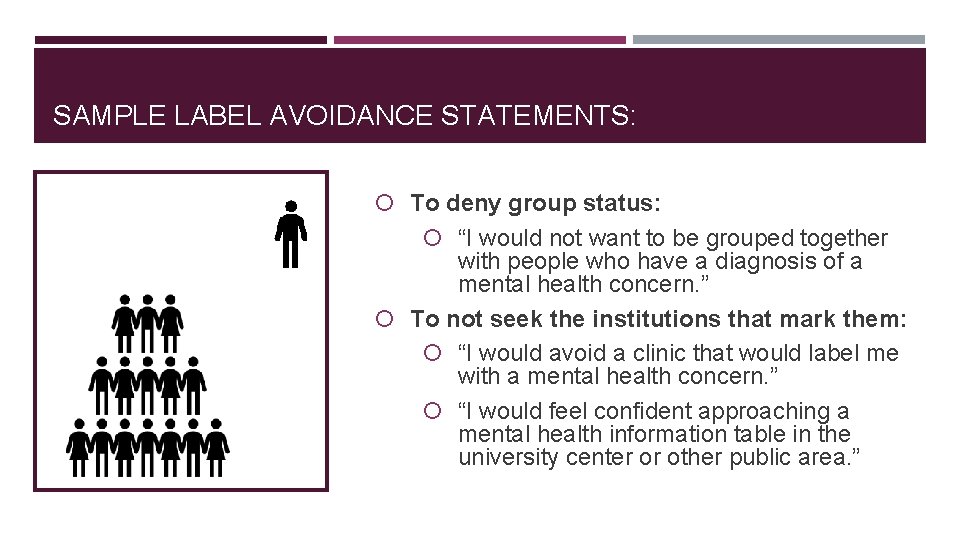
SAMPLE LABEL AVOIDANCE STATEMENTS: To deny group status: “I would not want to be grouped together with people who have a diagnosis of a mental health concern. ” To not seek the institutions that mark them: “I would avoid a clinic that would label me with a mental health concern. ” “I would feel confident approaching a mental health information table in the university center or other public area. ”
MEASURE REFINEMENT Participants: 41 undergraduates recruited through SONA Recommended that target population is involved in item selection (Fox et al. , 2018) Tasks: Consider if each statement is indicative of label avoidance Suggest an original statement
METHODS: STAGE 1 Participants: 641 MTurk participants responded; 232 included in analysis for accurately responding to attention checks Tasks: Participants complete public and self stigma measures, a measure of social desirability, the SELF-I, and the Label Avoidance Measure (LAM) created for this study
RESULTS AND DISCUSSION Exploratory principal components factor analysis on the LAM One factor solution Eliminated three statements Good reliability Preliminary validity evidence LAM significantly and strongly correlated with self-stigma (r=. 744**, p<. 01) and public-stigma (r=. 619**, p<. 01) measures LAM not correlated with SELF-I (r= -. 043, p<. 01)
LIMITATIONS Difficult to estimate potential future behaviors Preliminary evidence that we are capturing label avoidance Participants not reflective of the demographic composition of the US
ACKNOWLEDGEMENTS Lab Committee Duncan Campbell, Ph. D. Bryan Cochran, Ph. D. Annie Belcourt, Ph. D. Mates Kali Strickland, M. A. Ivie English, M. A. Jenny Lippold, B. A. Jennifer Villa, B. A. Ashton Smith, B. A. Hannah De. Bellis Brittany Stewart Matthew Sorensen

WHAT QUESTIONS DO YOU HAVE? JULIA. CAMERON@UMONTANA. EDU
REFERENCES Campbell, D. G. , Bonner, L. M. , Bolkan, C. R. , Lanto, A. B. , Zivin, K. , Waltz, T. J…Chaney, E. F. (2016). Stigma predicts treatment preferences and care engagement among veterans affairs primary care patients with depression. Annals of Behavioral Medicine, 50(4), 533 -544. doi: 10. 1007/s 12160 -0169780 -1 Corrigan, P. (2004). How stigma interferes with mental health care. American Psychologist, 59(7), 614 -625. doi: 10. 1037/0003 -066 X. 59. 7. 614 Difallah, D. , Filatova, E. , & Iperirotis, P. (2018). Demographics and dynamics of mechanical turk workers. Proceedings of WSDM 2018: The Eleventh ACM International Conference on Web Search and Data Mining, Marina Del Ray, CA, USA, February 5 -9, 2018. doi: 10. 1145/3159652. 3159661 Downs, A. , Boucher, L. , Campbell, D. , & Dasse, M. (2013). Development and Initial Validation of the Symptoms and Assets Screening Scale. Journal of American College Health, 61(3), 164 -174. doi: 10. 1080/07448481. 2013. 773902 Fox, A. B. , Earnshaw, V. A. , Taverna, E. C. , & Vogt, D. (2018). Conceptualizing and Measuring Mental Illness Stigma: The Mental Illness Stigma Framework and Critical Review of Measures. Stigma and Health, 3(4), 348 -376. doi: 10. 1037/sah 0000104 Link, B. G. (1987). Understanding labeling effects in the area of mental disorders: an assessment of the effects of expectations of rejection. American Sociological Review, 52(1), 96 -112. Retrieved from: https: //www. jstor. org/stable/2095395 Mental Health America (MHA). (2019). Mental Health in America – Adult Data. Retrieved from: https: //www. mhanational. org/issues/mental-healthamerica-adult-data#six Meyer, W. (2017). Testing the effects of depression label avoidance and descriptions of depression etiology on treatment intention. Dissertation Abstracts International: Section B: The Sciences and Engineering, 78(12 -B(E)). Owen, J. , Le. Keldric, T. & Rodolfa, E. (2013). Stigma for seeking therapy: Self-stigma, social stigma, and therapeutic process. The Counseling Psychologist, 41(6), 857 -880. doi: 10. 1177/0011000012459365 Snyder, C. R. , Harris, C. , Anderson, J. R. , Holleran, S. A. , Irving, L. M. , Sigmon, S. T. , et al. (1991). The will and the ways: Development and validation of an individualdifferences measure of hope. Journal of Personality and Social Psychology, 60, 570 -585. Stolzenburg, S. , Freitag, S. , Evans-Lacko, S. , Muehlan, H. , Schmidt, S. , & Schomerus, G. (2017). The stigma of mental illness as a barrier to selflabeling as having a mental illness. Journal of Nervous and Mental Disease, 205(12), 903 -909. doi: 10. 1097/NMD. 0000000756 Vogel, D. L. , Wade, N. G. , & Haake, S. (2006). Measuring the self-stigma associated with seeking psychological help. Journal of Counseling Psychology, 53, 325– 337. doi: 10. 1037/0022 -0167. 53. 3. 325 Vogel, D. L. , Wade, N. G. & Ascheman, P. (2009). Measuring perceptions of stigmatization by others for seeking psychological help: Reliability and validity of a new stigma scale with college students. Journal of Counseling Psychology, 56(2), 301 -308. doi: 10. 1037/a 0014903 Vogel, D. , Wester, S. , & Larson, L. (2007). Avoidance of counseling: psychological factors that inhibit seeking help. Journal of Counseling and
- Slides: 14