
Developing Technology for NASA Earth Science Technology Strategy
- Slides: 16
Developing Technology for NASA Earth Science Technology Strategy Panel, 50 th Goddard Memorial Symposium Robert Bauer March 28, 2012 Deputy Director Earth Science Technology Office
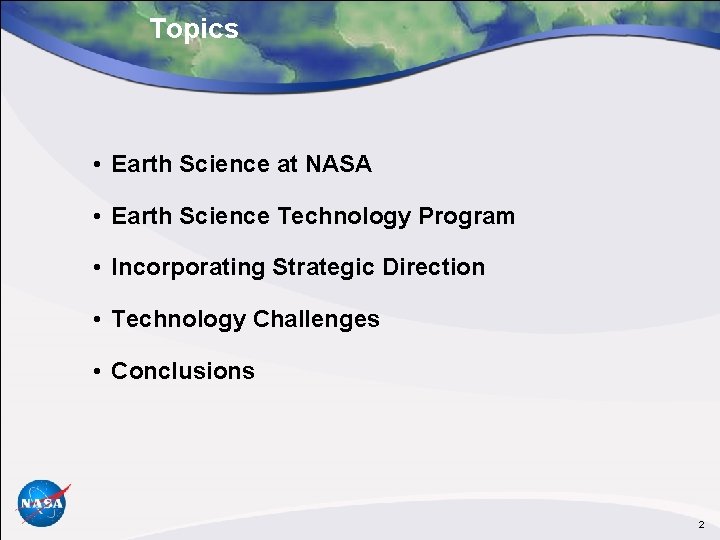
Topics • Earth Science at NASA • Earth Science Technology Program • Incorporating Strategic Direction • Technology Challenges • Conclusions 2
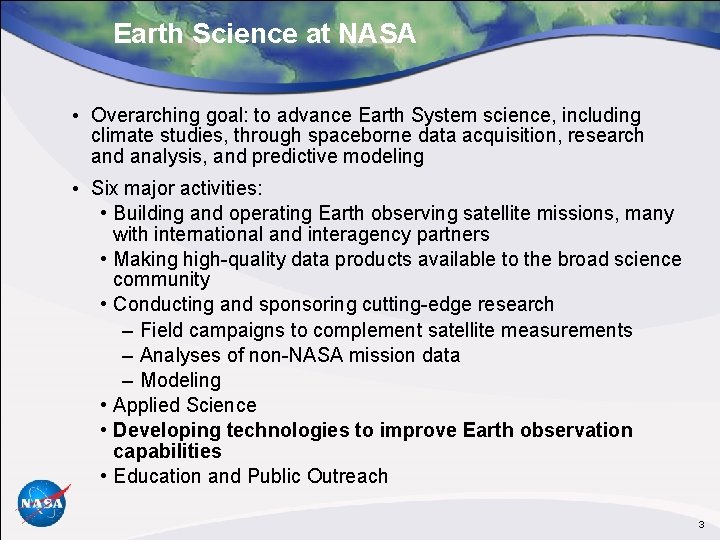
Earth Science at NASA • Overarching goal: to advance Earth System science, including climate studies, through spaceborne data acquisition, research and analysis, and predictive modeling • Six major activities: • Building and operating Earth observing satellite missions, many with international and interagency partners • Making high-quality data products available to the broad science community • Conducting and sponsoring cutting-edge research – Field campaigns to complement satellite measurements – Analyses of non-NASA mission data – Modeling • Applied Science • Developing technologies to improve Earth observation capabilities • Education and Public Outreach 3
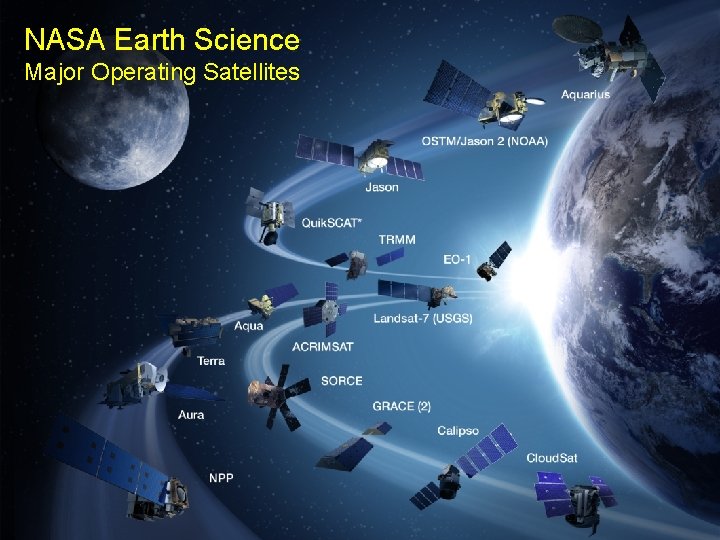
NASA Earth Science Major Operating Satellites
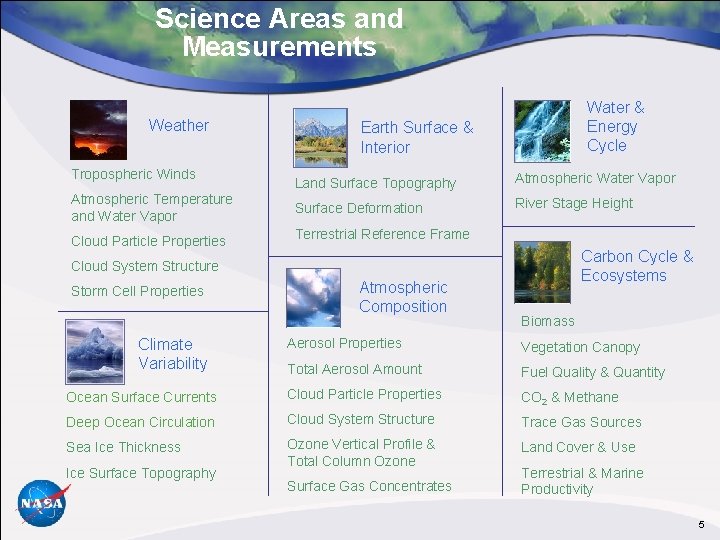
Science Areas and Measurements Weather Tropospheric Winds Atmospheric Temperature and Water Vapor Cloud Particle Properties Water & Energy Cycle Earth Surface & Interior Land Surface Topography Atmospheric Water Vapor Surface Deformation River Stage Height Terrestrial Reference Frame Carbon Cycle & Ecosystems Cloud System Structure Storm Cell Properties Climate Variability Atmospheric Composition Biomass Aerosol Properties Vegetation Canopy Total Aerosol Amount Fuel Quality & Quantity Ocean Surface Currents Cloud Particle Properties CO 2 & Methane Deep Ocean Circulation Cloud System Structure Trace Gas Sources Sea Ice Thickness Ozone Vertical Profile & Total Column Ozone Land Cover & Use Ice Surface Topography Surface Gas Concentrates Terrestrial & Marine Productivity 5
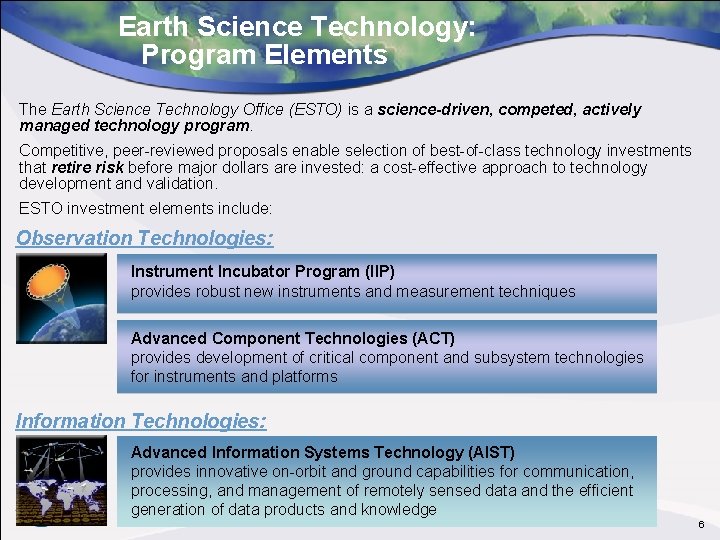
Earth Science Technology: Program Elements The Earth Science Technology Office (ESTO) is a science-driven, competed, actively managed technology program. Competitive, peer-reviewed proposals enable selection of best-of-class technology investments that retire risk before major dollars are invested: a cost-effective approach to technology development and validation. ESTO investment elements include: Observation Technologies: Instrument Incubator Program (IIP) provides robust new instruments and measurement techniques Advanced Component Technologies (ACT) provides development of critical component and subsystem technologies for instruments and platforms Information Technologies: Advanced Information Systems Technology (AIST) provides innovative on-orbit and ground capabilities for communication, processing, and management of remotely sensed data and the efficient generation of data products and knowledge 6
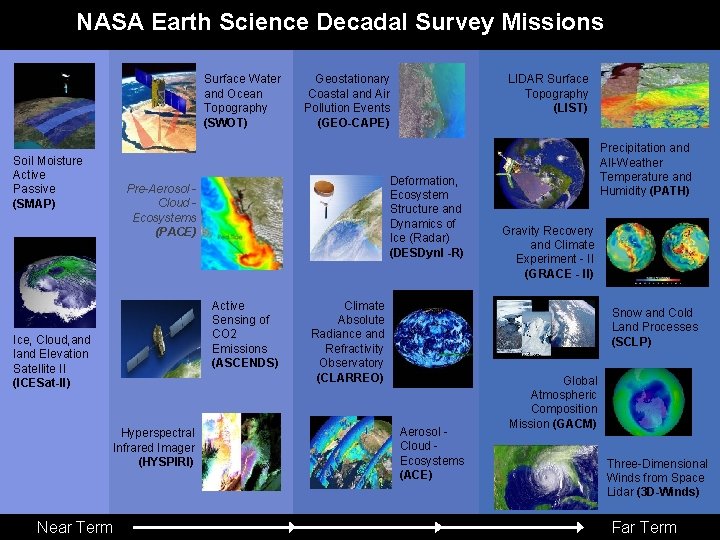
NASA Earth Science Decadal Survey Missions Surface Water and Ocean Topography (SWOT) Soil Moisture Active Passive (SMAP) Deformation, Ecosystem Structure and Dynamics of Ice (Radar) (DESDyn. I -R) Pre-Aerosol Cloud Ecosystems (PACE) Active Sensing of CO 2 Emissions (ASCENDS) Ice, Cloud, and land Elevation Satellite II (ICESat-II) Hyperspectral Infrared Imager (HYSPIRI) Near Term LIDAR Surface Topography (LIST) Geostationary Coastal and Air Pollution Events (GEO-CAPE) Climate Absolute Radiance and Refractivity Observatory (CLARREO) Precipitation and All-Weather Temperature and Humidity (PATH) Gravity Recovery and Climate Experiment - II (GRACE - II) Snow and Cold Land Processes (SCLP) Aerosol Cloud Ecosystems (ACE) Global Atmospheric Composition Mission (GACM) Three-Dimensional Winds from Space Lidar (3 D-Winds) Far Term
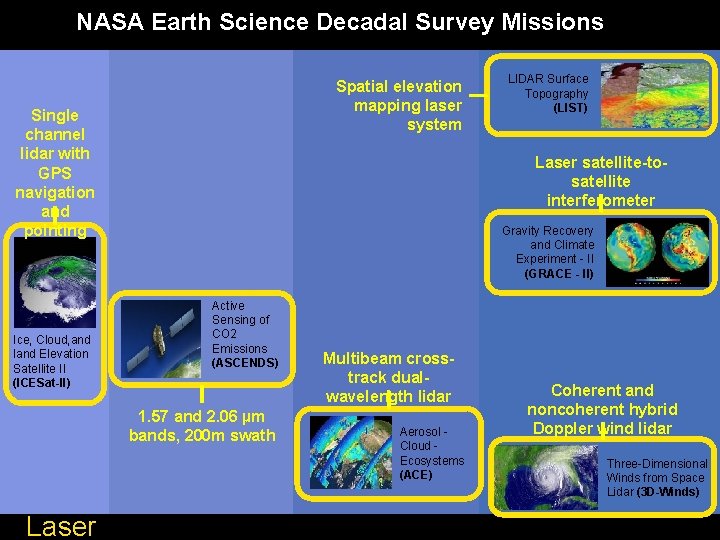
NASA Earth Science Decadal Survey Missions Spatial elevation mapping laser system Single channel lidar with GPS navigation and pointing Ice, Cloud, and land Elevation Satellite II (ICESat-II) Laser satellite-tosatellite interferometer Gravity Recovery and Climate Experiment - II (GRACE - II) Active Sensing of CO 2 Emissions (ASCENDS) 1. 57 and 2. 06 µm bands, 200 m swath Laser LIDAR Surface Topography (LIST) Multibeam crosstrack dualwavelength lidar Aerosol Cloud Ecosystems (ACE) Coherent and noncoherent hybrid Doppler wind lidar Three-Dimensional Winds from Space Lidar (3 D-Winds)
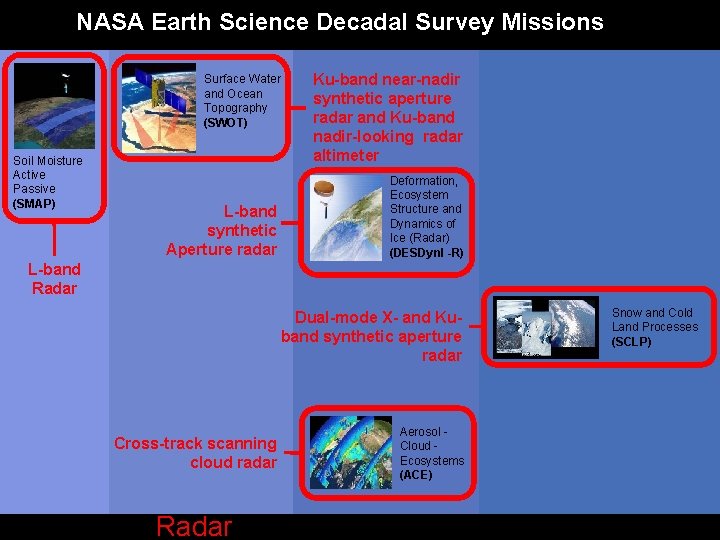
NASA Earth Science Decadal Survey Missions Surface Water and Ocean Topography (SWOT) Soil Moisture Active Passive (SMAP) L-band synthetic Aperture radar Ku-band near-nadir synthetic aperture radar and Ku-band nadir-looking radar altimeter Deformation, Ecosystem Structure and Dynamics of Ice (Radar) (DESDyn. I -R) L-band Radar Dual-mode X- and Kuband synthetic aperture radar Cross-track scanning cloud radar Radar Aerosol Cloud Ecosystems (ACE) Snow and Cold Land Processes (SCLP)
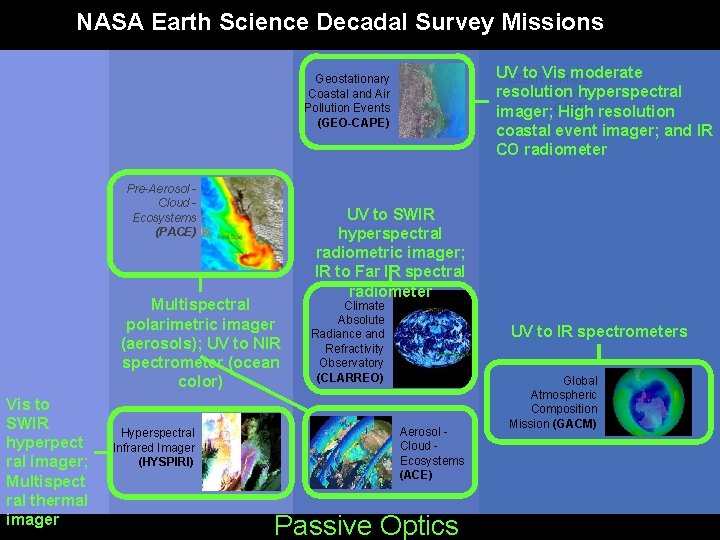
NASA Earth Science Decadal Survey Missions UV to Vis moderate LIDAR Surface resolution hyperspectral Topography imager; (LIST) High resolution coastal event imager; and IR CO radiometer Geostationary Coastal and Air Pollution Events (GEO-CAPE) Pre-Aerosol Cloud Ecosystems (PACE) Multispectral polarimetric imager (aerosols); UV to NIR spectrometer (ocean color) Vis to SWIR hyperpect ral imager; Multispect ral thermal imager Hyperspectral Infrared Imager (HYSPIRI) UV to SWIR hyperspectral radiometric imager; IR to Far IR spectral radiometer Climate Absolute Radiance and Refractivity Observatory (CLARREO) UV to IR spectrometers Aerosol Cloud Ecosystems (ACE) Passive Optics Global Atmospheric Composition Mission (GACM)
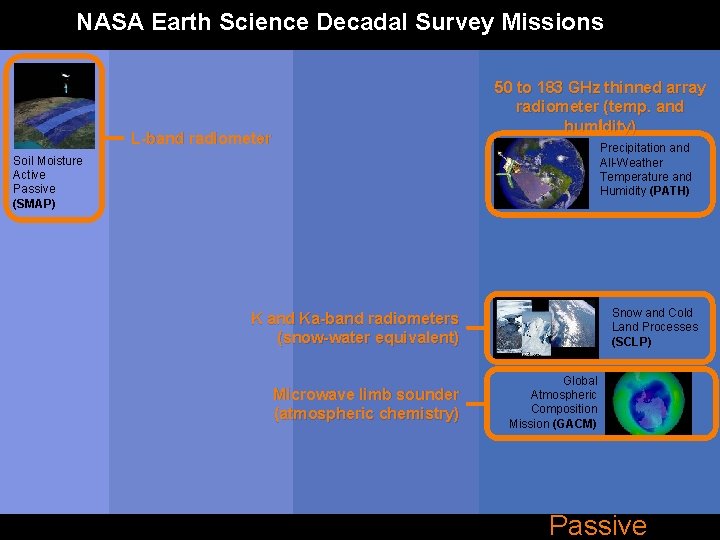
NASA Earth Science Decadal Survey Missions 50 to 183 GHz thinned array radiometer (temp. and humidity) L-band radiometer Precipitation and All-Weather Temperature and Humidity (PATH) Soil Moisture Active Passive (SMAP) Snow and Cold Land Processes (SCLP) K and Ka-band radiometers (snow-water equivalent) Microwave limb sounder (atmospheric chemistry) Global Atmospheric Composition Mission (GACM) Passive
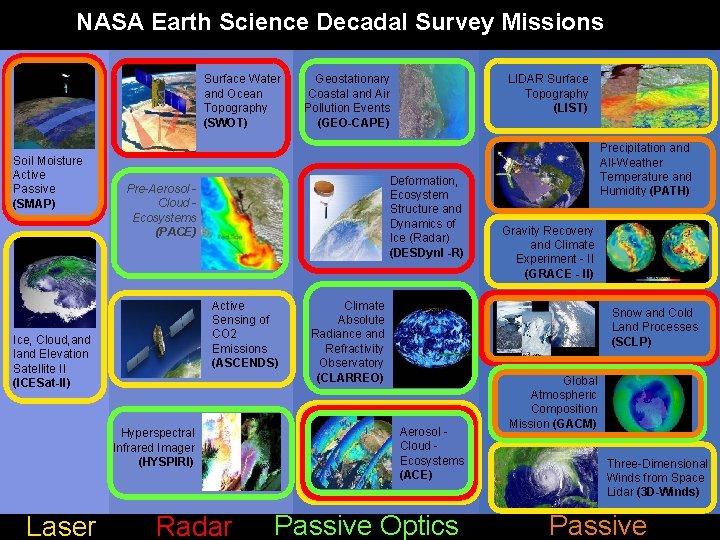
NASA Earth Science Decadal Survey Missions Surface Water and Ocean Topography (SWOT) Soil Moisture Active Passive (SMAP) Deformation, Ecosystem Structure and Dynamics of Ice (Radar) (DESDyn. I -R) Pre-Aerosol Cloud Ecosystems (PACE) Active Sensing of CO 2 Emissions (ASCENDS) Ice, Cloud, and land Elevation Satellite II (ICESat-II) Hyperspectral Infrared Imager (HYSPIRI) Laser LIDAR Surface Topography (LIST) Geostationary Coastal and Air Pollution Events (GEO-CAPE) Radar Climate Absolute Radiance and Refractivity Observatory (CLARREO) Precipitation and All-Weather Temperature and Humidity (PATH) Gravity Recovery and Climate Experiment - II (GRACE - II) Snow and Cold Land Processes (SCLP) Aerosol Cloud Ecosystems (ACE) Passive Optics Global Atmospheric Composition Mission (GACM) Three-Dimensional Winds from Space Lidar (3 D-Winds) Passive
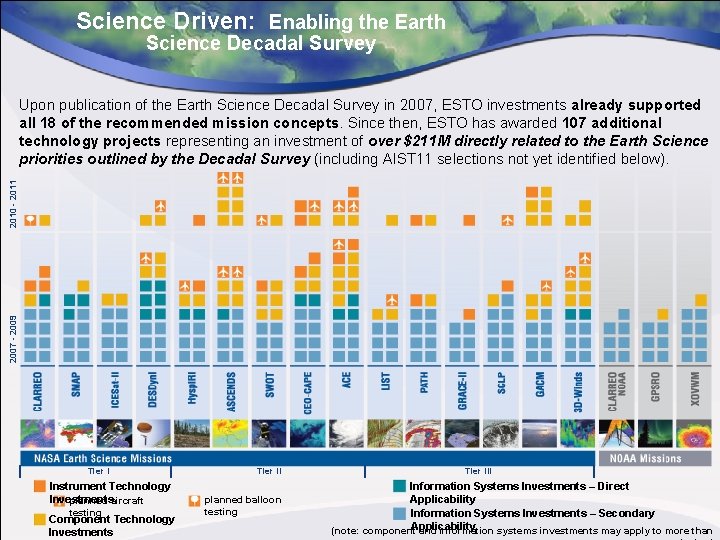
Science Driven: Enabling the Earth Science Decadal Survey 2007 - 2009 2010 - 2011 Upon publication of the Earth Science Decadal Survey in 2007, ESTO investments already supported all 18 of the recommended mission concepts. Since then, ESTO has awarded 107 additional technology projects representing an investment of over $211 M directly related to the Earth Science priorities outlined by the Decadal Survey (including AIST 11 selections not yet identified below). Tier I Instrument Technology Investments planned aircraft testing Component Technology Investments Tier II planned balloon testing Tier III Information Systems Investments – Direct Applicability Information Systems Investments – Secondary Applicability (note: component and information systems investments may apply to more than
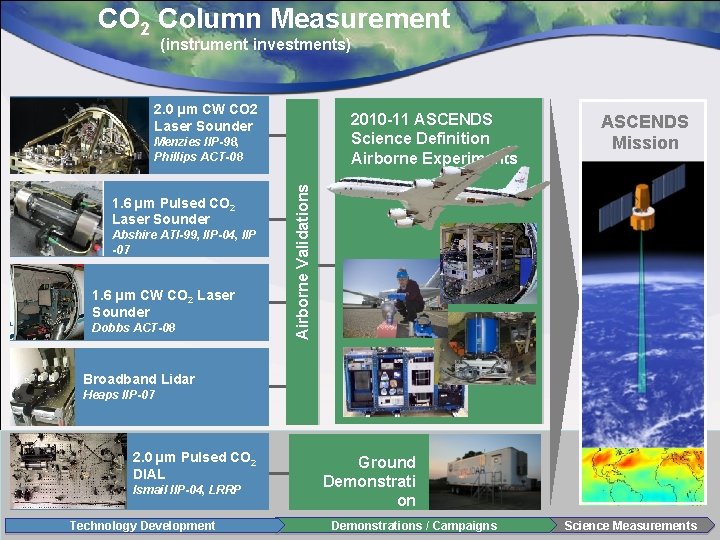
CO 2 Column Measurement (instrument investments) 2. 0 µm CW CO 2 Laser Sounder 2010 -11 ASCENDS Science Definition Airborne Experiments 1. 6 µm Pulsed CO 2 Laser Sounder Abshire ATI-99, IIP-04, IIP -07 1. 6 µm CW CO 2 Laser Sounder Dobbs ACT-08 Airborne Validations Menzies IIP-98, Phillips ACT-08 ASCENDS Mission Broadband Lidar Heaps IIP-07 2. 0 µm Pulsed CO 2 DIAL Ismail IIP-04, LRRP Technology Development Ground Demonstrati on Demonstrations / Campaigns Science Measurements
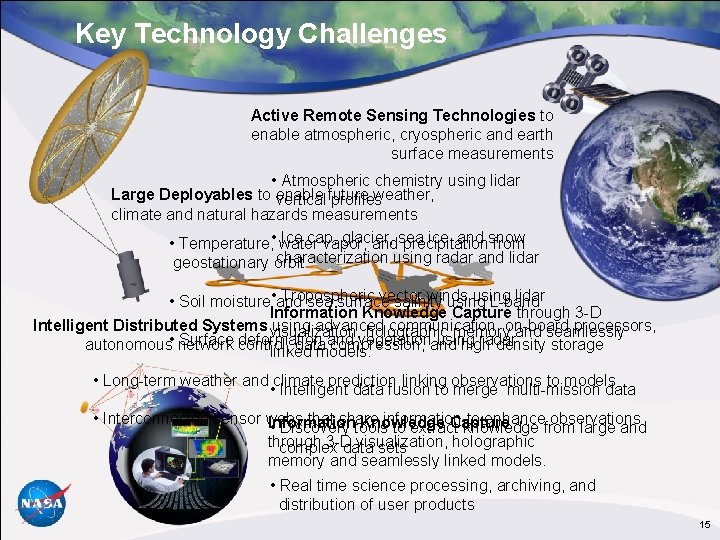
Key Technology Challenges Active Remote Sensing Technologies to enable atmospheric, cryospheric and earth surface measurements • Atmospheric chemistry using lidar Large Deployables to enable weather, vertical future profiles climate and natural hazards measurements Ice cap, glacier, ice, and snow • Temperature, • water vapor, andsea precipitation from characterization using radar and lidar geostationary orbit Tropospheric vector winds using lidar • Soil moisture • and sea surface salinity using L-band Information Knowledge Capture through 3 -D Intelligent Distributed Systems visualization, using advanced communication, on-board processors, holographic memory and seamlessly Surface control, deformation and vegetationand using radar autonomous • network data compression, high density storage linked models. • Long-term weather and climate prediction linking observations to models • Intelligent data fusion to merge multi-mission data • Interconnected sensor webs that share information to enhance observations Information Knowledge Capture • Discovery tools to extract knowledge from large and through 3 -D visualization, holographic complex data sets memory and seamlessly linked models. • Real time science processing, archiving, and distribution of user products 15
Conclusions The technology strategy for Earth science is driven by scientific guidance. Technology investments are specifically targeted toward Decadal Survey mission and measurement concepts. A portfolio of competitively selected awards is reducing risk and improving measurement concepts. 16