
Developing Teachers Understanding of Statistics Tim Jacobbe University
Developing Teachers’ Understanding of Statistics Tim Jacobbe University of Florida jacobbe@coe. ufl. edu DRL-1118168
Overview of Today’s Session • Overview of the LOCUS Assessments • Teachers’ Performance on LOCUS • Some Materials for Teacher Development

LOCUS Assessment Project • Principal Investigator: Tim Jacobbe, University of Florida • Co-Principal Investigators – Bob del. Mas, University of Minnesota – Jeff Haberstroh, Educational Testing Service (ETS) – Brad Hartlaub, Kenyon College • External Evaluator: Jim Hammerman, TERC • Research Fellows: Catherine Case, Steven Foti, Douglas Whitaker, University of Florida
An Amazing Team • Advisory Board: David Miller, Dick Scheaffer, Mike Shaughnessy, Jane Watson • Beginning/Intermediate Items (Grades 6 -9): Chris Franklin, Brad Hartlaub, Gary Kader, Mary Lindquist, and Jerry Moreno • Intermediate/Advanced Items (Grades 1012): Bob del. Mas, Roxy Peck, Mike Perry, and Josh Tabor
LOCUS: Three Broad Goals • Develop instruments to assess levels of statistical understanding as initially defined in the CCSS and the Guidelines for Assessment & Instruction in Statistics Education (GAISE) framework (Change the way statistics is assessed) • Provide a characterization of the level of understanding of statistical topics • Provide a tool for researchers and teachers to assess growth in statistical understanding
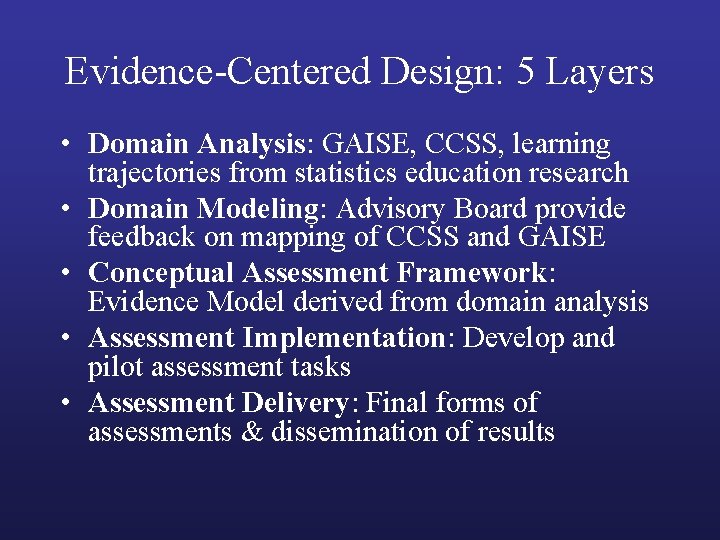
Evidence-Centered Design: 5 Layers • Domain Analysis: GAISE, CCSS, learning trajectories from statistics education research • Domain Modeling: Advisory Board provide feedback on mapping of CCSS and GAISE • Conceptual Assessment Framework: Evidence Model derived from domain analysis • Assessment Implementation: Develop and pilot assessment tasks • Assessment Delivery: Final forms of assessments & dissemination of results
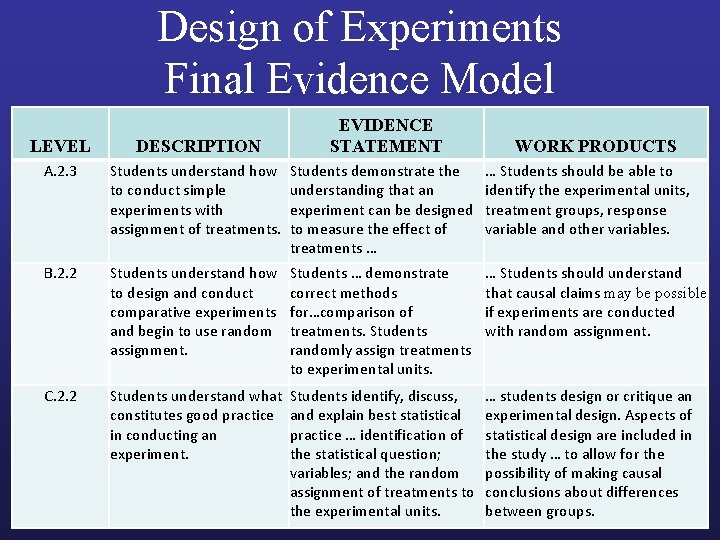
Design of Experiments Final Evidence Model EVIDENCE STATEMENT LEVEL DESCRIPTION WORK PRODUCTS A. 2. 3 Students understand how to conduct simple experiments with assignment of treatments. Students demonstrate the understanding that an experiment can be designed to measure the effect of treatments … … Students should be able to identify the experimental units, treatment groups, response variable and other variables. B. 2. 2 Students understand how to design and conduct comparative experiments and begin to use random assignment. Students … demonstrate correct methods for…comparison of treatments. Students randomly assign treatments to experimental units. … Students should understand that causal claims may be possible if experiments are conducted with random assignment. C. 2. 2 Students understand what constitutes good practice in conducting an experiment. Students identify, discuss, and explain best statistical practice … identification of the statistical question; variables; and the random assignment of treatments to the experimental units. … students design or critique an experimental design. Aspects of statistical design are included in the study … to allow for the possibility of making causal conclusions about differences between groups.
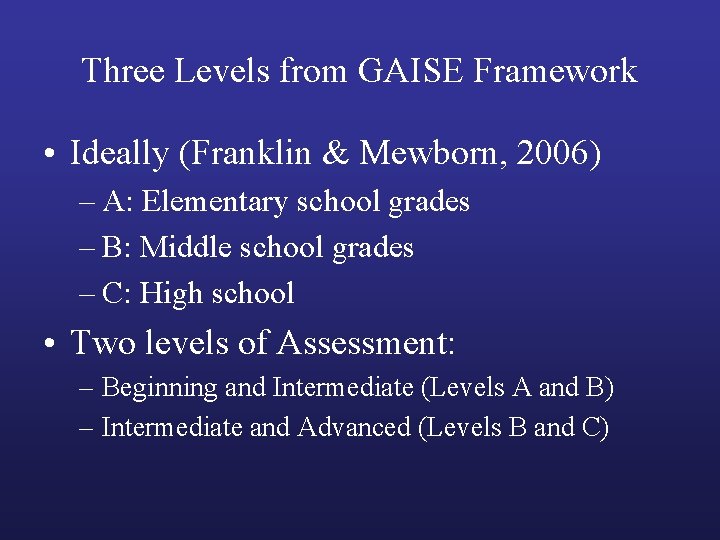
Three Levels from GAISE Framework • Ideally (Franklin & Mewborn, 2006) – A: Elementary school grades – B: Middle school grades – C: High school • Two levels of Assessment: – Beginning and Intermediate (Levels A and B) – Intermediate and Advanced (Levels B and C)
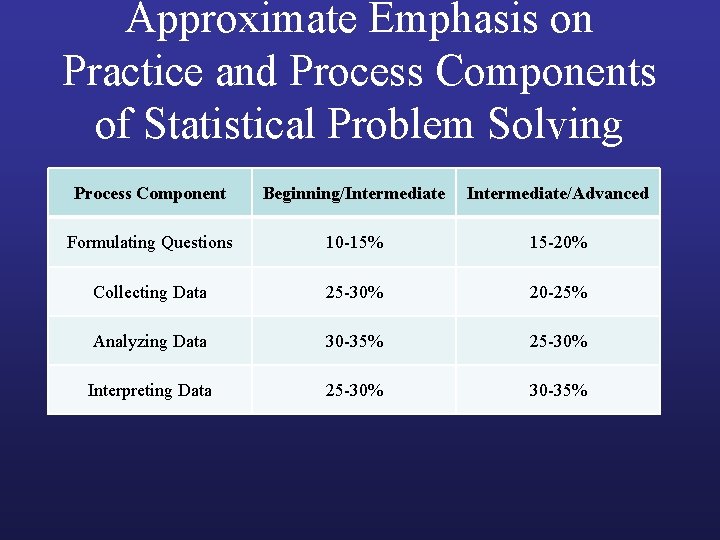
Approximate Emphasis on Practice and Process Components of Statistical Problem Solving Process Component Beginning/Intermediate/Advanced Formulating Questions 10 -15% 15 -20% Collecting Data 25 -30% 20 -25% Analyzing Data 30 -35% 25 -30% Interpreting Data 25 -30% 30 -35%
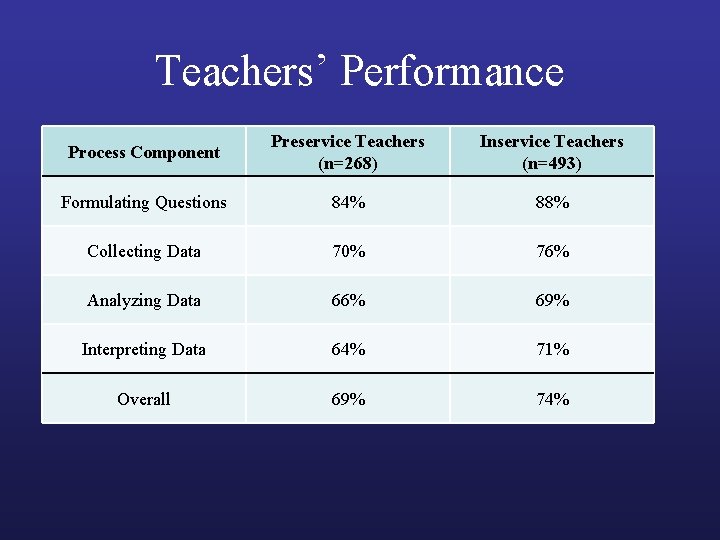
Teachers’ Performance Process Component Preservice Teachers (n=268) Inservice Teachers (n=493) Formulating Questions 84% 88% Collecting Data 70% 76% Analyzing Data 66% 69% Interpreting Data 64% 71% Overall 69% 74%
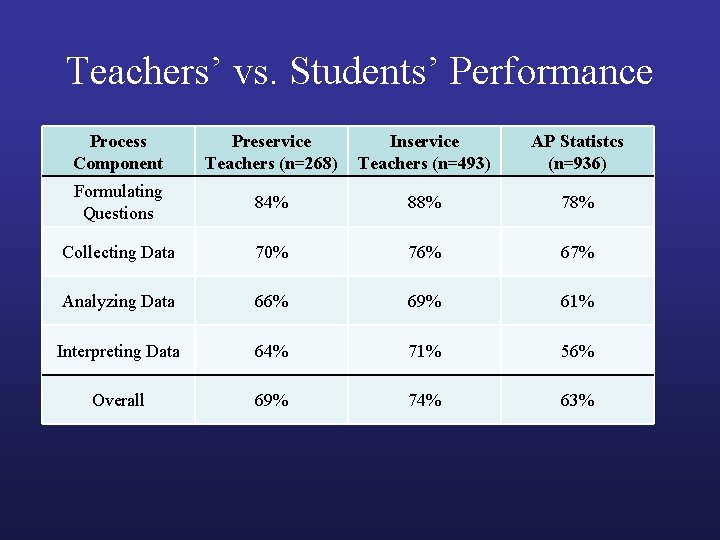
Teachers’ vs. Students’ Performance Process Component Preservice Teachers (n=268) Inservice Teachers (n=493) AP Statistcs (n=936) Formulating Questions 84% 88% 78% Collecting Data 70% 76% 67% Analyzing Data 66% 69% 61% Interpreting Data 64% 71% 56% Overall 69% 74% 63%
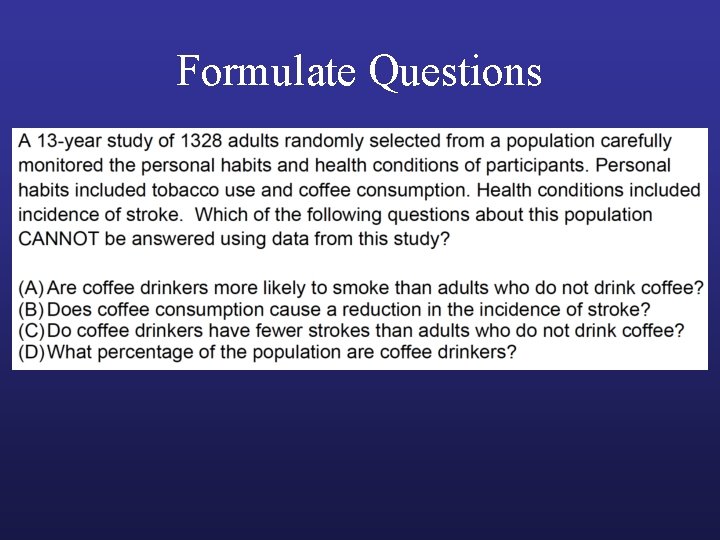
Formulate Questions
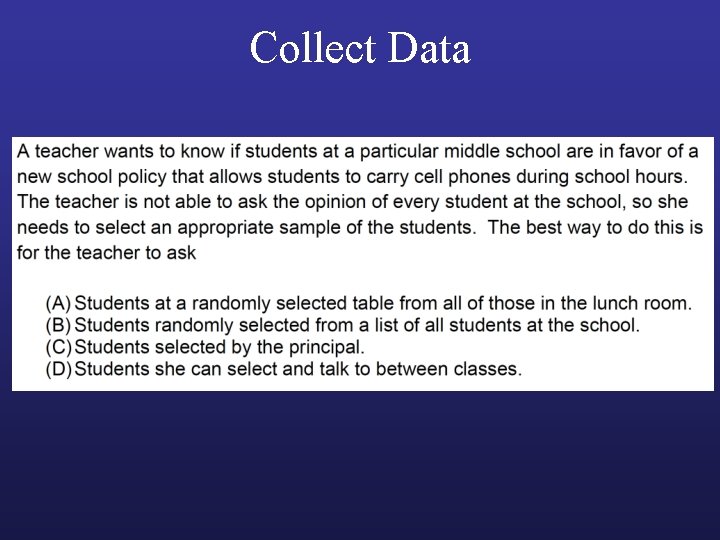
Collect Data
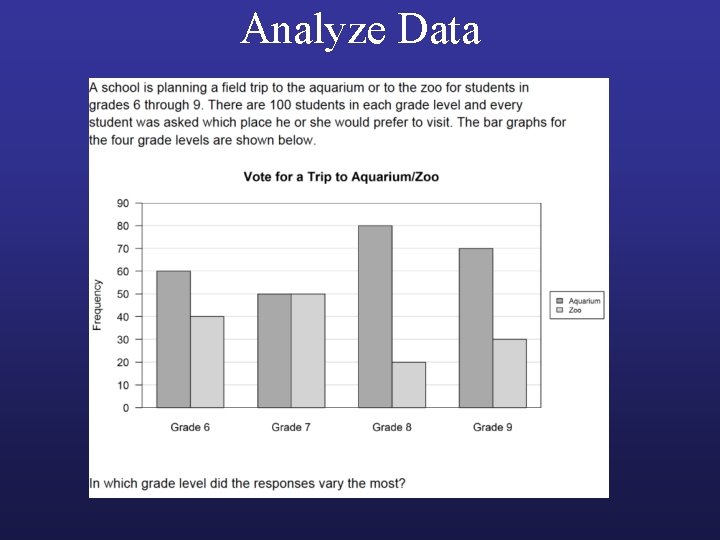
Analyze Data
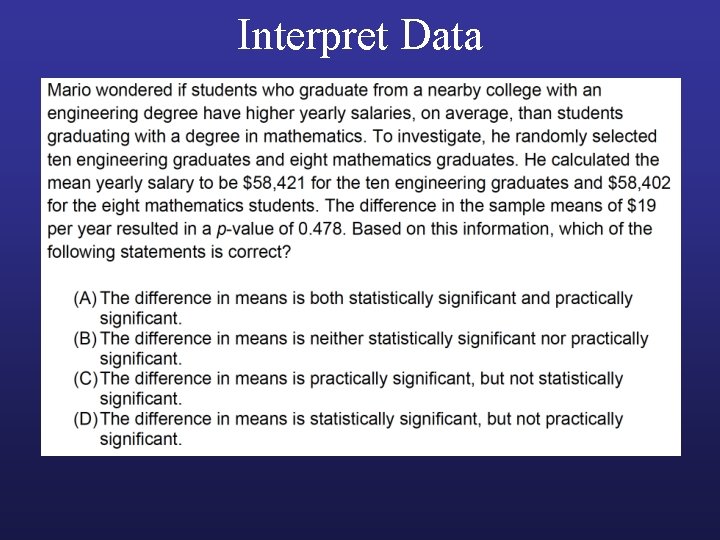
Interpret Data
What Should We Do? • Teacher performance is encouraging considering there has been limited training • LOCUS Measures Statistical Understanding Expected of STUDENTS in grades 6 -12
ASA’s Statistics Education of Teachers
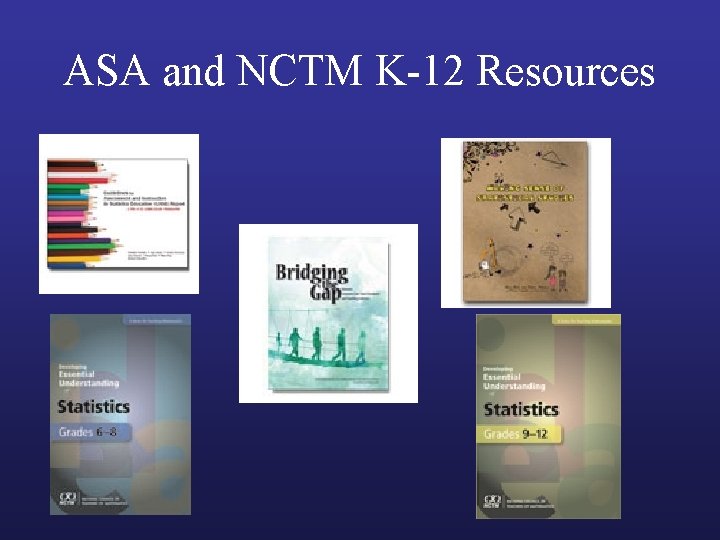
ASA and NCTM K-12 Resources
ASA K-12 Resources
Some Ongoing Projects • NSF-Funded CAREER: Investigating Middle and Secondary Mathematics Teachers” Transformative Learning of Statistics within Professional Development (PI: Sue Peters, University of Louisville) • MOOC-Ed Teaching Statistics Through Data Investigations http: //mooc-ed. org/tsdi (PI: Hollylynne S. Lee) • Project-SET: Statistics Education for Teachers (PI: Anna Bargagliotti)
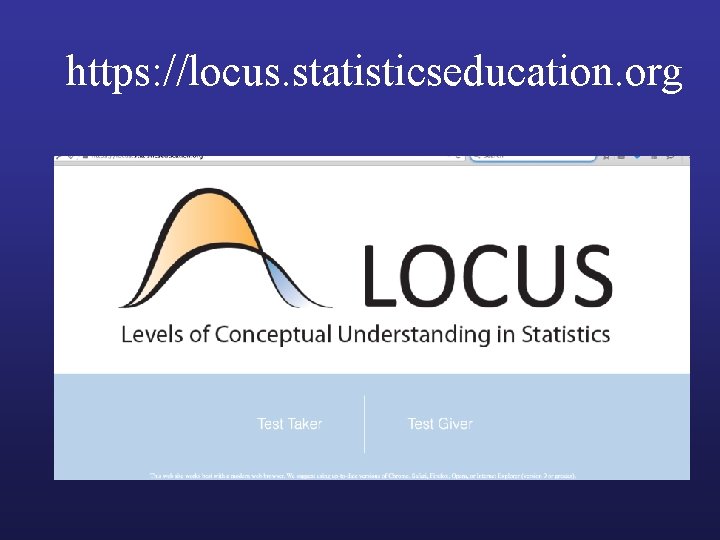
https: //locus. statisticseducation. org
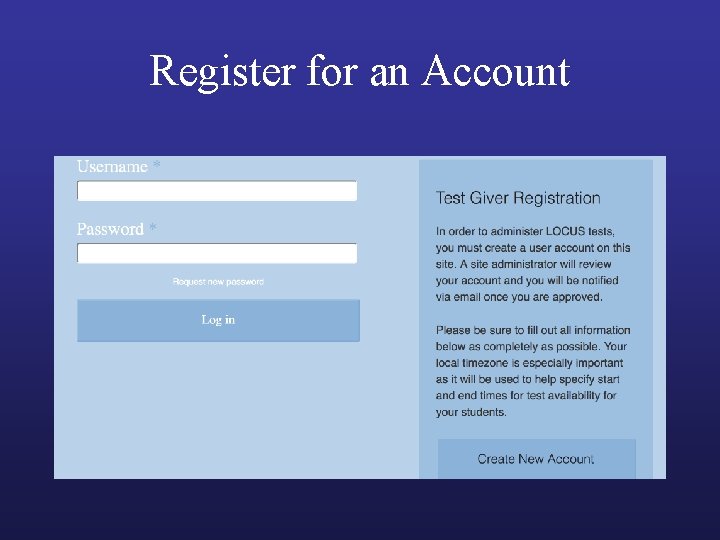
Register for an Account
Next Step for LOCUS • Website aimed at professional development of teachers – Commentaries – Sample items – Evidence Model • Continue to influence statistics items on high-stakes assessments
Thank You for Participating (or Watching) Tim Jacobbe, jacobbe@coe. ufl. edu DRL-1118168
- Slides: 24