
Developing teachers mathematics subject knowledge in primary schools

Developing teachers’ mathematics subject knowledge in primary schools to improve the attainment of all pupils Liz Woodham, NRICH Project & Michael Hall, Open University 2014 - 2015 London Schools Excellence Fund
In between face-to-face days … Don’t forget https: //nrich. maths. org/haringey London Schools Excellence Fund
Day 9 – 20 May 2015 9. 15 -9. 30 Welcome 9. 30 -10. 45 Working on mathematical tasks together Tackling tasks and reflecting on them in terms of subject knowledge and pedagogy 10. 45 -11. 00 Break 11. 00 -12. 00 Working on more mathematical tasks together Tackling one or more tasks and reflecting on them in terms of subject knowledge and pedagogy 12. 00 -12. 15 Sharing classroom experiences since last time 12. 15 -1. 00 Lunch 1. 00 -1. 20 Update on various project strands 1. 20 -2. 20 Curriculum development work In pairs, planning for at least one task back at school 2. 20 -3. 10 Working on more mathematical tasks together – reasoning follow-up 3. 10 -3. 15 Reflection London Schools Excellence Fund
Common themes from mathematical needs identified on day 1 The following were flagged up by at least two schools: • Fractions/decimals/percentages • Problem solving • Place value • Time • Algebra • Word problems • Application of calculation strategies • Subtraction London Schools Excellence Fund
Common mathematical needs identified on day 7 In order of preference: • mental maths • assessment (planning and progression) • problem solving • challenging SEN children • challenging the gifted • division (not chunking) • word problems (especially money) • ratio • subtraction • multiplication • place value London Schools Excellence Fund
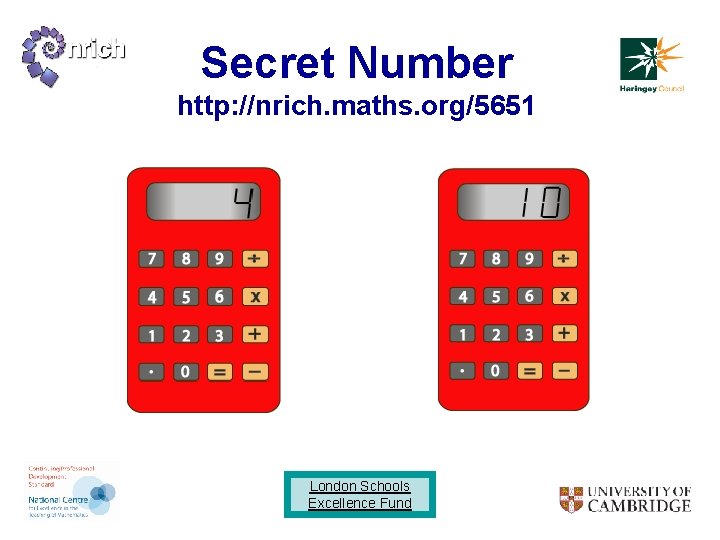
Secret Number http: //nrich. maths. org/5651 London Schools Excellence Fund
• How could you use ‘Secret Number’ in the classroom? • How could you adapt it to suit your learners? • What mathematical knowledge is needed to have a go at this task? • How does it help to meet the aims of the National Curriculum (problem solving, reasoning and fluency)? London Schools Excellence Fund
Forgot the Numbers http: //nrich. maths. org/1015 On my calculator I divided one whole number by another whole number and got the answer 3. 125. I know that both numbers were less than 50, but can't remember what they were. Can you work out what they were? London Schools Excellence Fund
• Take each starting point and work it up into a solution. • What are the advantages and disadvantages of each method? • Which would you choose if you were presented with a similar task at a future date? London Schools Excellence Fund
• How could you use ‘Forgot the Numbers’ in the classroom? • How could you adapt it to suit your learners? • What mathematical knowledge is needed to have a go at this task? • How does it help to meet the aims of the National Curriculum (problem solving, reasoning and fluency)? London Schools Excellence Fund
Reverse Trick http: //nrich. maths. org/1982 Tell your friends that you have a strange calculator that turns numbers backwards. Secretly enter 9+ then enter 12 and show a friend. Press = and up comes 21. Try another one: Secretly enter 36+ then enter 15 and show a friend. Press = and up comes 51. What secret number do you have to enter to make this large number turn around: 141 414? London Schools Excellence Fund
• How could you use ‘Reverse Trick’ in the classroom? • How could you adapt it to suit your learners? • What mathematical knowledge is needed to have a go at this task? • How does it help to meet the aims of the National Curriculum (problem solving, reasoning and fluency)? London Schools Excellence Fund
Before we meet again … • Continue to try out rich tasks with your learners and colleagues • Lead a staff meeting/follow-up staff meeting • Revisit the calculator-based tasks we have tried today • Collect data about the attainment of children in your class London Schools Excellence Fund
Liz Woodham emp 1001@cam. ac. uk Michael Hall wichaelhall@gmail. com London Schools Excellence Fund
- Slides: 14