
DEVELOPING SECURE DATA PROTOCOLS FOR LGBTI RESEARCH Presented
DEVELOPING SECURE DATA PROTOCOLS FOR LGBTI RESEARCH Presented by Kristen Daskilewicz On behalf of the Southern and East African Research Collective on Health (SEARCH)
Project background ■ Collaboration with civil society organization (CSO) project partners ■ A cross-sectional survey with LGBTI people to investigate violence, mental health and health-seeking behavior in 9 countries ■ Same-sex is criminalized in most of the study countries ■ We wanted data protocols that would help partners get the most out of data while also ensuring security
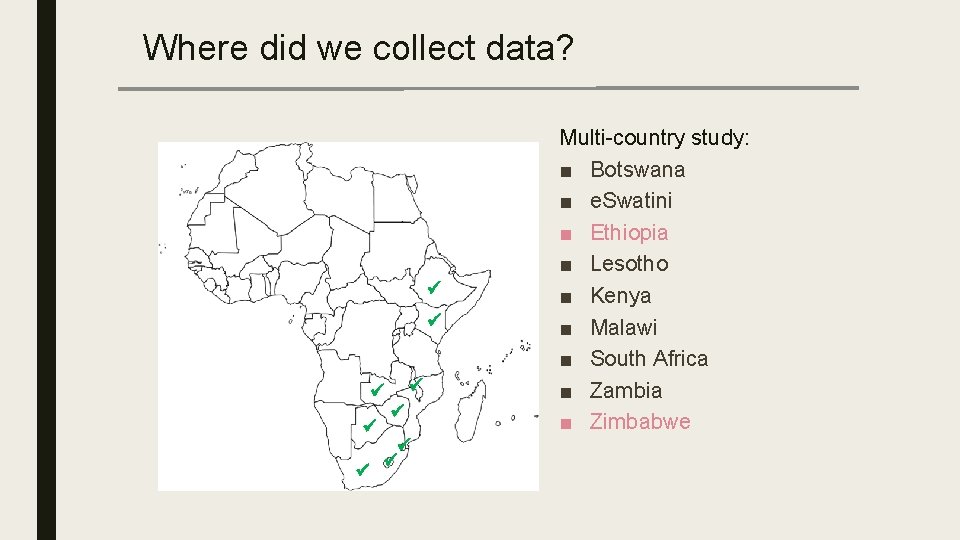
Where did we collect data? Multi-country study: ■ Botswana ■ e. Swatini ■ Ethiopia ■ Lesotho ■ Kenya ■ Malawi ■ South Africa ■ Zambia ■ Zimbabwe
Southern and East African Research Collective on Health (SEARCH) ■ Academic partners: – – – ■ Civil society partners: – – – – – ■ Lead: Prof Alex Muller & Kristen Daskilewicz, Gender Health and Justice Research Unit, University of Cape Town Botswana: Dr Chelsea Morroni, University of Botswana e. Swatini: Sindy Matse, Ministry of Health Malawi: Prof Adamson Muula, College of Medicine, University of Malawi Zimbabwe: Dr Nelson Muparamoto, University of Zimbabwe & Martha Tholanah Botswana: Bonela, Le. Ga. Bi. Bo, RIA Ethiopia: community based organisations Kenya: Ishtar-MSM, Jinsiangu, Maaygo, Minority Women in Action, National Gay and Lesbian Human Rights Commission, PEMA Lesotho: People’s Matrix Association Malawi: Centre for the Development of People South Africa: Durban Lesbian and Gay Centre, Gender Dynamix, OUT LGBT Well-Being, Triangle Project Swaziland: Rock of Hope Zambia: Friends of Rainka, Lotus Identity, Trans. Bantu Zambia Zimbabwe: GALZ, Sexual Rights Centre Funder & coordinator: COC Netherlands
Data collection & management Took place December 2016 – December 2018 (phased approach) ■ Considerations – Protection of participants and data collectors in-country – Differing needs between organisations based on capacity and preferred data collection methods ■ Used REDCap for data collection and management – Comfortable with level of security – Online survey – Database for paper-based survey
Considerations for open data ■ SEARCH met to discuss in person in November 2018 ■ We discussed risks and benefits of open data with partners: – Concerns about safety and security ■ – – ■ In particular: manipulation of data for homophobic efforts How to acknowledge all partners Data storage Implications for publication Future research We also engaged with the Digital Library Services at UCT Libraries
Final decision: Mostly closed ■ We made a data agreement among all members of SEARCH to: – Store data on Zivahub, with access managed by GHJRU ■ We opted to use “unpublished” storage of data for extra security – Not share datasets outside of SEARCH, unless agreed upon with all partners – Store datasets in secure ways while in use – Respect privacy constraints of partners
Recommendations ■ Research with LGBTI communities should engage with local CSOs throughout the process – Seek to understand context: laws, stigma, resilience, resources – Involve CSOs in data decisions that will impact their well-being – As needed, work with CSOs to build capacity in data management ■ Open data is an excellent opportunity, but security and sensitivity must also be considered

Questions? SEARCH: Southern and East African Research Collective on Health Kristen Daskilewicz, Project data manager: ka. daskilewicz@uct. ac. za Alex Müller, Principal investigator: alexandra. muller@uct. ac. za
- Slides: 9