
Developing Safety Behaviour Prediction A Pathway Towards Farm
Developing Safety Behaviour Prediction: A Pathway Towards Farm Safety Culture in Ireland Dr Mohammadrezaei & Dr David Meredith
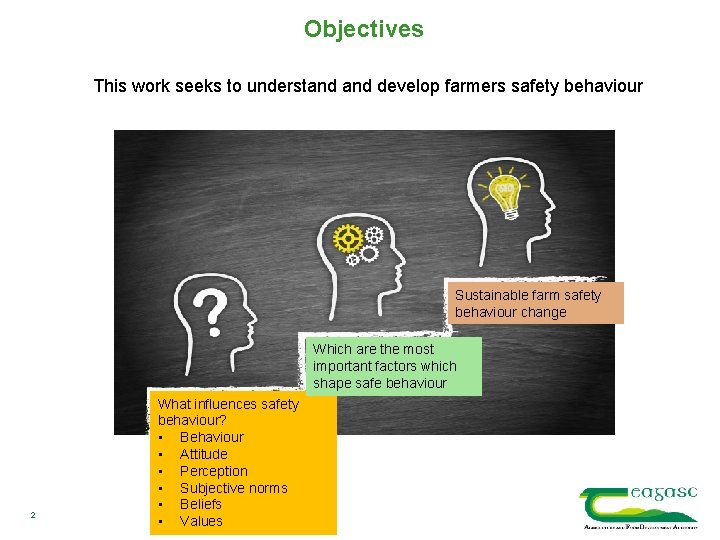
Objectives This work seeks to understand develop farmers safety behaviour Sustainable farm safety behaviour change Which are the most important factors which shape safe behaviour 2 What influences safety behaviour? • Behaviour • Attitude • Perception • Subjective norms • Beliefs • Values
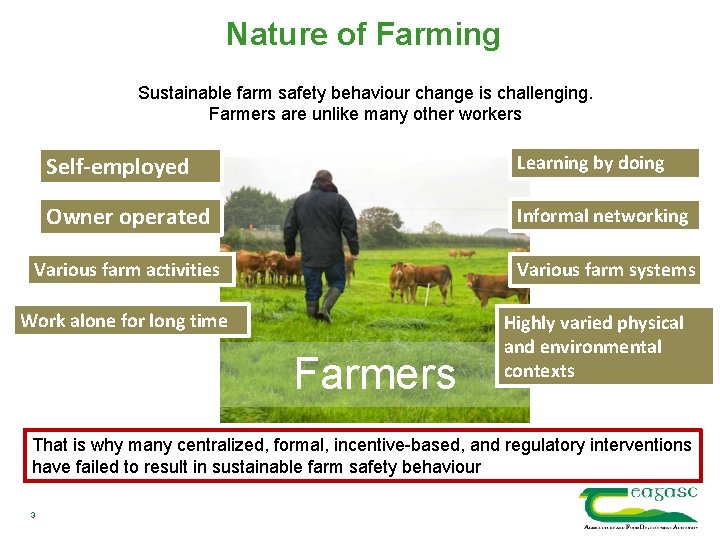
Nature of Farming Sustainable farm safety behaviour change is challenging. Farmers are unlike many other workers Self-employed Learning by doing Owner operated Informal networking Various farm activities Various farm systems Work alone for long time Farmers Highly varied physical and environmental contexts That is why many centralized, formal, incentive-based, and regulatory interventions have failed to result in sustainable farm safety behaviour 3

How to affect farmers behaviour There have been many attempts to make consistent behavioural change But Farms are still unsafe and function within a complex socio-ecological contexts that are slow / hard to change Environment s on ati ory eg ula t R fs At titu lie e de B Farmer tion Ho ho sy s tem s lds rm No Awaren ess s ga nis n u Age Or scale Behaviour e us Farm n Farm community e ns c en dge Knowle I nte nti o Percep Interventio ri pe Ex Ed ca tio g in ra in T icy Pol Farmers groups 4 Environment Behaviour Safety Culture ‘How things are done’ Subjective norms
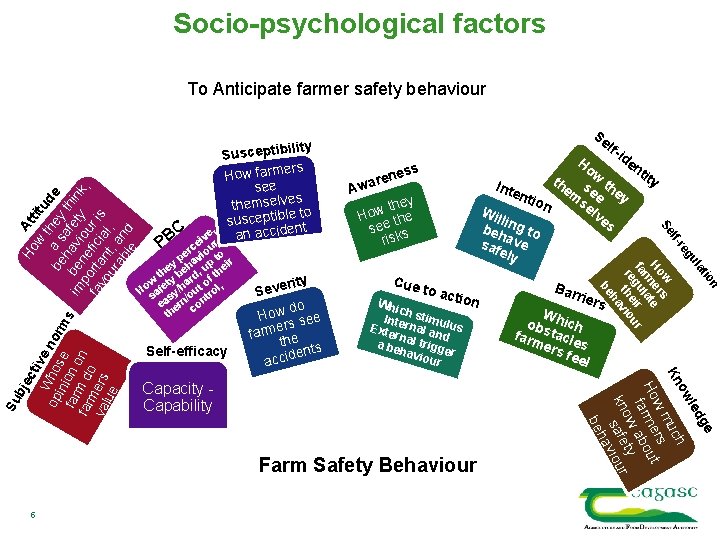
Socio-psychological factors they w o H the see s risk W obs hich farm tacle ers s fee l n s ge Farm Safety Behaviour 5 rier led Capacity Capability Bar tio to ac tion Whi ch s timu Int Exte ernal a lus nd rn a be al trigg e havi our r la bje cti Wh ve n op ini ose orm s far on o m n far m do va ers lue Awa gu en tit w t y t h Inte em see he ntio y se n l Wil ve ling s beh to saf ave ely ss rene Cue id ow h Kn uc w m rs Ho me ut far abo ow ty kn afe iour s v ha be Su Ho re Self-efficacy rity Seve do How see ers farm he t ents accid lf- w s Ho mer te r a fa gul ir r re the viou ha pe vi to y ha up eir e th be rd, f th w ty a o , Ho safe sy/h out trol / ea em con h t Se lf. Se ity Susceptibil rs How farme see s themselve to susceptible t C ive, an acciden B P rce our be Ho At w titu t d be a s hey e h a t im ben avi fety hink p e o , fa orta fici ur is vo n al ur t, a , ab n le d To Anticipate farmer safety behaviour
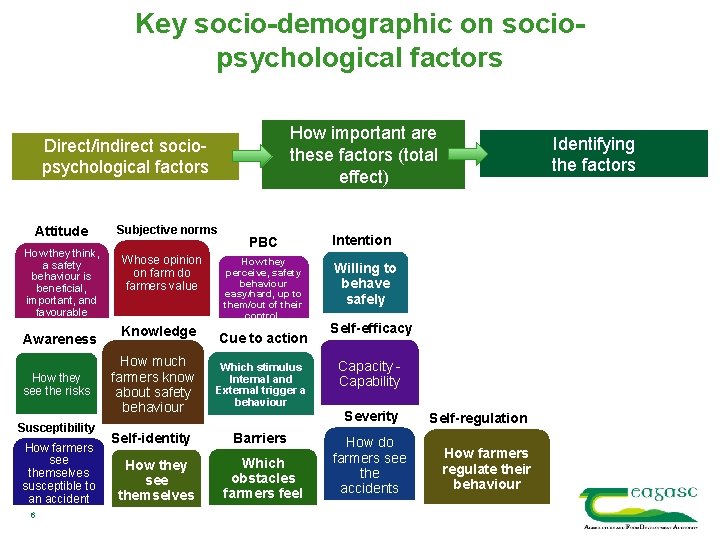
Key socio-demographic on sociopsychological factors How important are these factors (total effect) Direct/indirect sociopsychological factors Attitude How they think, a safety behaviour is beneficial, important, and favourable Awareness How they see the risks Susceptibility How farmers see themselves susceptible to an accident 6 Subjective norms Whose opinion on farm do farmers value Knowledge PBC How they perceive, safety behaviour easy/hard, up to them/out of their control, Cue to action How much farmers know about safety behaviour Which stimulus Internal and External trigger a behaviour Self-identity Barriers How they see themselves Which obstacles farmers feel Identifying the factors Intention Willing to behave safely Self-efficacy Capacity Capability Severity How do farmers see the accidents Self-regulation How farmers regulate their behaviour
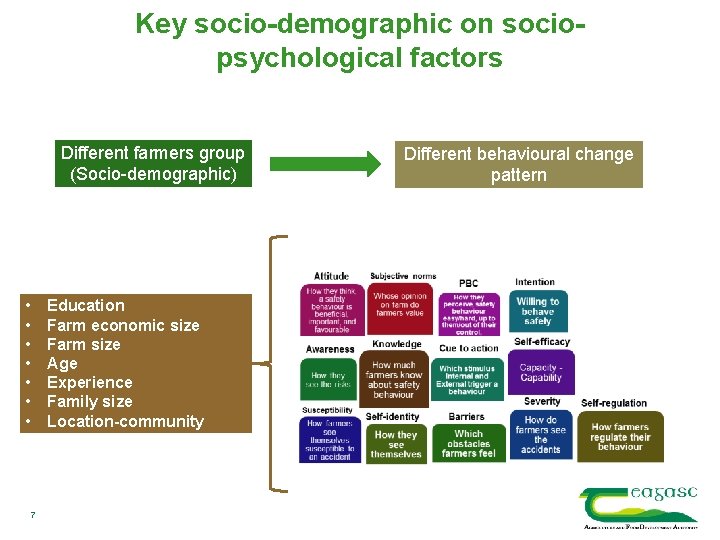
Key socio-demographic on sociopsychological factors Different farmers group (Socio-demographic) • • Education Farm economic size Farm size Age Experience Family size Location-community 7 Different behavioural change pattern
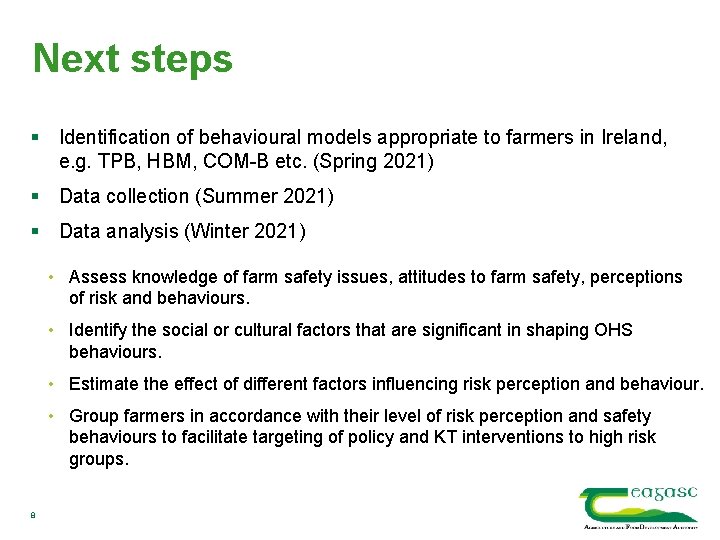
Next steps § Identification of behavioural models appropriate to farmers in Ireland, e. g. TPB, HBM, COM-B etc. (Spring 2021) § Data collection (Summer 2021) § Data analysis (Winter 2021) • Assess knowledge of farm safety issues, attitudes to farm safety, perceptions of risk and behaviours. • Identify the social or cultural factors that are significant in shaping OHS behaviours. • Estimate the effect of different factors influencing risk perception and behaviour. • Group farmers in accordance with their level of risk perception and safety behaviours to facilitate targeting of policy and KT interventions to high risk groups. 8
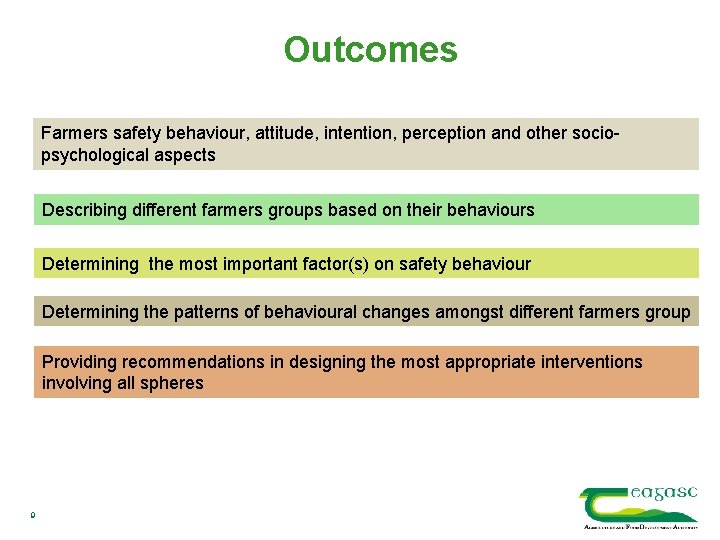
Outcomes Farmers safety behaviour, attitude, intention, perception and other sociopsychological aspects Describing different farmers groups based on their behaviours Determining the most important factor(s) on safety behaviour Determining the patterns of behavioural changes amongst different farmers group Providing recommendations in designing the most appropriate interventions involving all spheres 9
Thank you for your attention! 10 Teagasc Presentation Footer
- Slides: 10