
Developing Recording Vocabulary Getting started Vocabulary learning It
Developing & Recording Vocabulary Getting started
Vocabulary learning It takes time and effort to learn vocabulary. On your course you’ll come across a lot of new terms. To help you to prepare, follow this powerpoint and do the small tasks. Task 1: Think about this question: What does ‘I know this word/phrase’ mean? Discuss this with a partner and then look at the next slide. You will see that ‘knowing a word’ is quite complex.
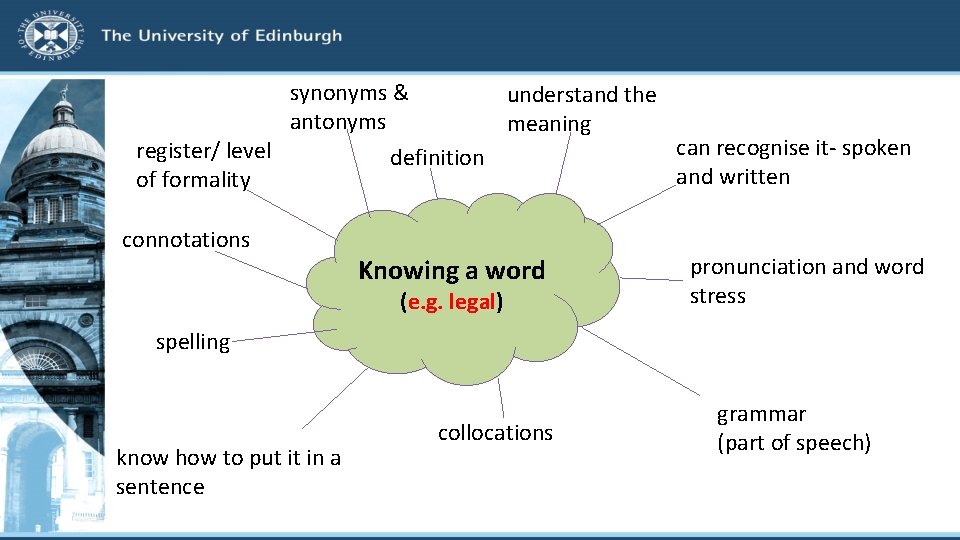
synonyms & antonyms register/ level of formality connotations understand the meaning definition Knowing a word (e. g. legal) can recognise it- spoken and written pronunciation and word stress spelling know how to put it in a sentence collocations grammar (part of speech)
Collocations A collocation is two or more words that often go together. These combinations just sound "right" to native English speakers, who use them all the time. Examples: a fast train to issue a warning heavy rain make a mistake go to the beach (NOT a quick train) (NOT tell a warning) (NOT strong rain) (NOT do a mistake) (NOT go beach) Task: Which words do you think can be used in the gaps? We drank some delicious. . . . wine. (red/pink/rosé/white/dry/heavy) The police are. . . . the murder. (investigating/exploring/campaigning)
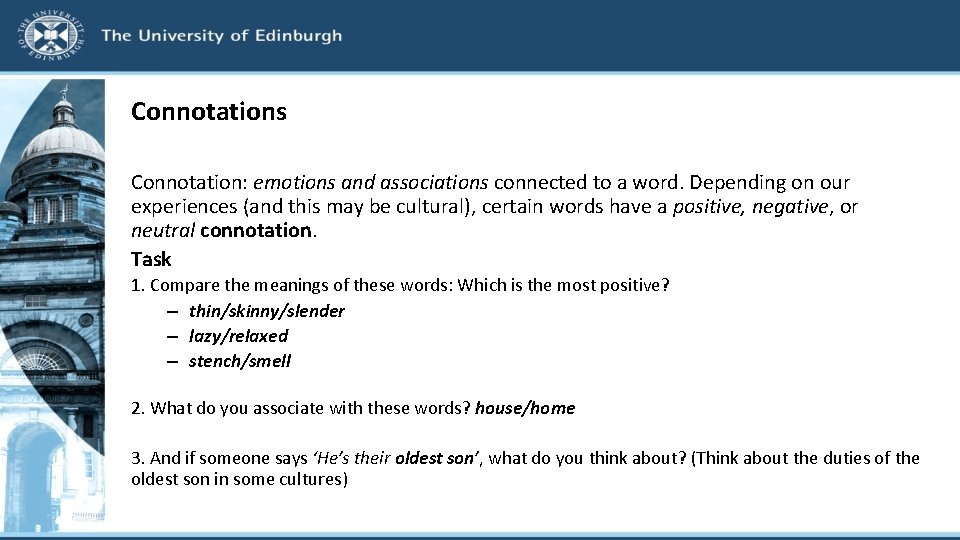
Connotations Connotation: emotions and associations connected to a word. Depending on our experiences (and this may be cultural), certain words have a positive, negative, or neutral connotation. Task 1. Compare the meanings of these words: Which is the most positive? – thin/skinny/slender – lazy/relaxed – stench/smell 2. What do you associate with these words? house/home 3. And if someone says ‘He’s their oldest son’, what do you think about? (Think about the duties of the oldest son in some cultures)
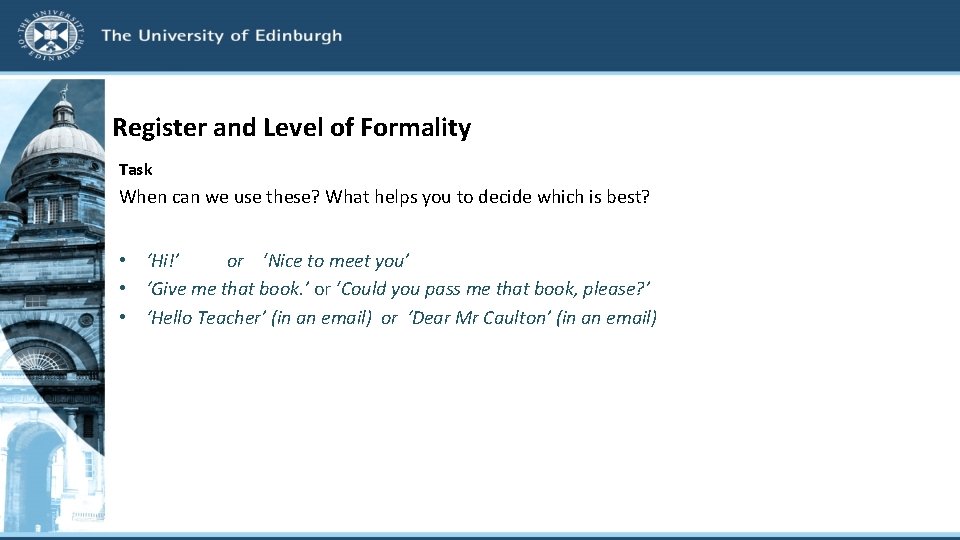
Register and Level of Formality Task When can we use these? What helps you to decide which is best? • ‘Hi!’ or ‘Nice to meet you’ • ‘Give me that book. ’ or ‘Could you pass me that book, please? ’ • ‘Hello Teacher’ (in an email) or ‘Dear Mr Caulton’ (in an email)
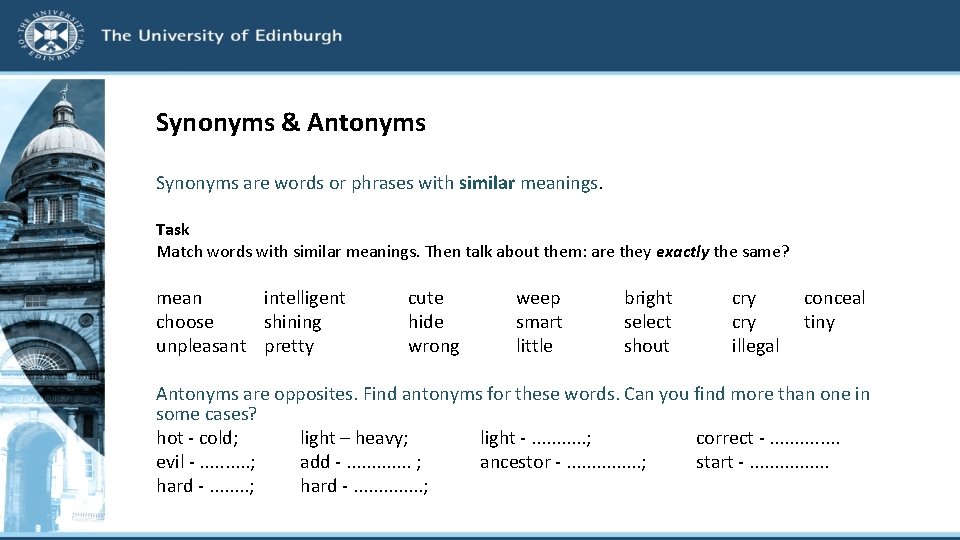
Synonyms & Antonyms Synonyms are words or phrases with similar meanings. Task Match words with similar meanings. Then talk about them: are they exactly the same? mean intelligent choose shining unpleasant pretty cute hide wrong weep smart little bright select shout cry illegal conceal tiny Antonyms are opposites. Find antonyms for these words. Can you find more than one in some cases? hot - cold; light – heavy; light -. . . ; correct -. . . evil -. . ; add -. . . ; ancestor -. . . . ; start -. . . . hard -. . . . ; hard -. . . ;

Recording Vocabulary
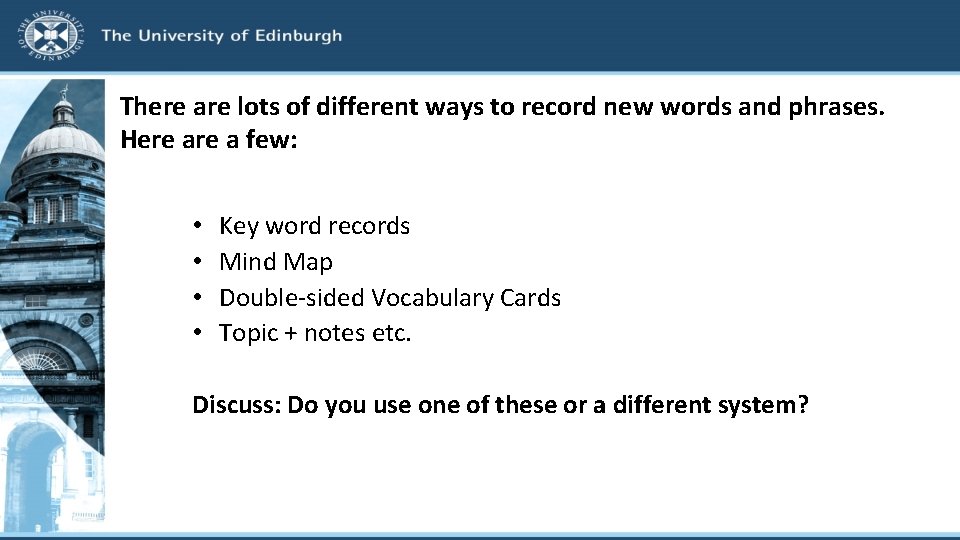
There are lots of different ways to record new words and phrases. Here a few: • • Key word records Mind Map Double-sided Vocabulary Cards Topic + notes etc. Discuss: Do you use one of these or a different system?
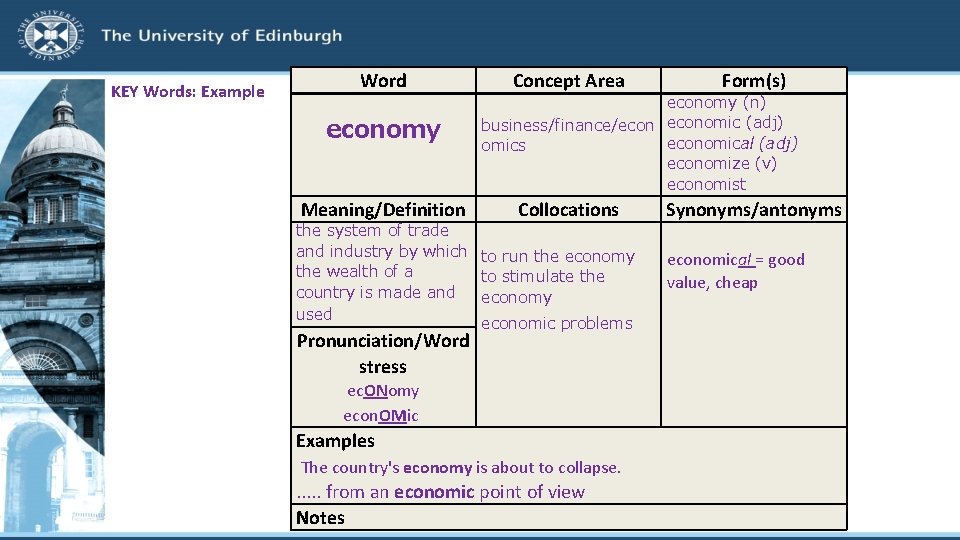
KEY Words: Example Word economy Meaning/Definition Concept Area Form(s) Collocations Synonyms/antonyms economy (n) business/finance/economic (adj) economical (adj) omics economize (v) economist the system of trade and industry by which to run the economy the wealth of a to stimulate the country is made and economy used economic problems Pronunciation/Word stress ec. ONomy econ. OMic Examples The country's economy is about to collapse. . . from an economic point of view Notes economical = good value, cheap
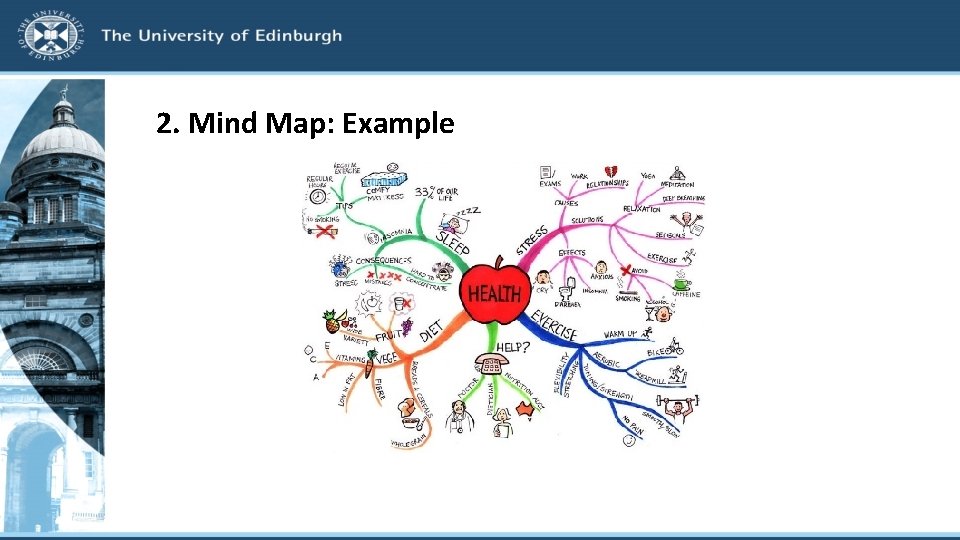
2. Mind Map: Example
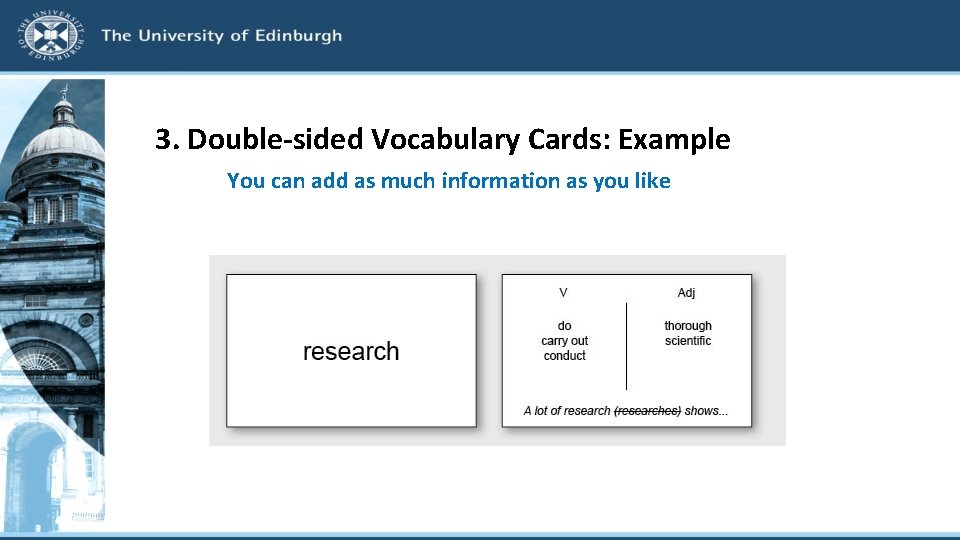
3. Double-sided Vocabulary Cards: Example You can add as much information as you like
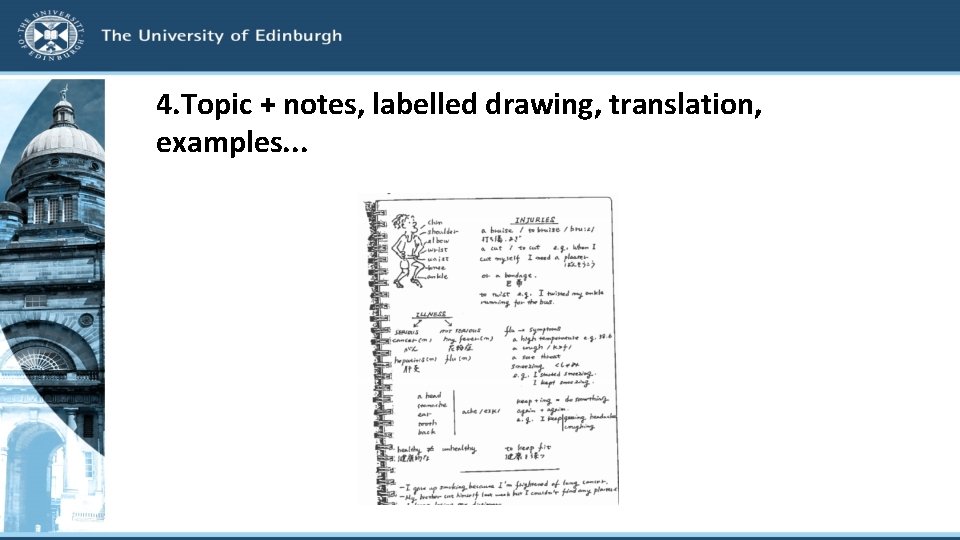
4. Topic + notes, labelled drawing, translation, examples. . .
Your task before leaving Japan 1. Get a new notebook for your vocabulary. 2. When you are doing the preparation tasks for your course, use it to record new words and phrases. 3. Try out different ways to do this. 4. Remember to take it with you to Edinburgh. Your teacher will want to see it. 5. Continue to use it in Edinburgh.
Useful websites • https: //www. wiki. ed. ac. uk/display/eltcswb/THE+UNIVERSITY+OF+EDINBURGH
- Slides: 15