
Developing Quality TIEPs Writing Quality Annual Goals Objectives
Developing Quality T/IEPs Writing Quality Annual Goals, Objectives and Benchmarks, Reporting Progress 2012 - 2013 1
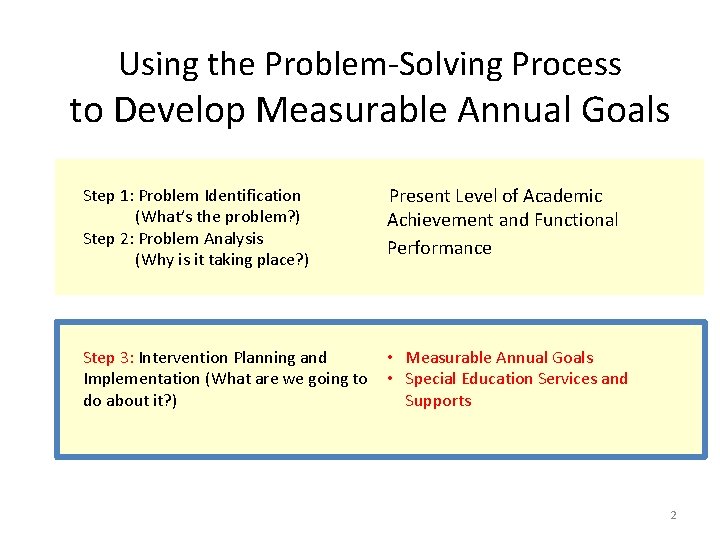
Using the Problem-Solving Process to Develop Measurable Annual Goals Step 1: Problem Identification (What’s the problem? ) Step 2: Problem Analysis (Why is it taking place? ) Present Level of Academic Achievement and Functional Performance Step 3: Intervention Planning and • Measurable Annual Goals Implementation (What are we going to • Special Education Services and do about it? ) Supports 2
Measurable Annual Goals • What specific knowledge, skill, or behavior does the student need to learn to be involved and make progress in the general curriculum? • What does the student need to learn to meet other educational needs that result from the disability? • How will student progress be monitored to determine the effectiveness of the intervention and support? 3
Make It Measurable • Specific – The action, behavior, or skill to be measured – Tells what to measure and how to measure it • Objective – Yields same result no matter who measures it • Quantifiable – Numerical or descriptive information to compare to baseline • Clear – Understandable by all involved Bateman & Herr, 2003 4
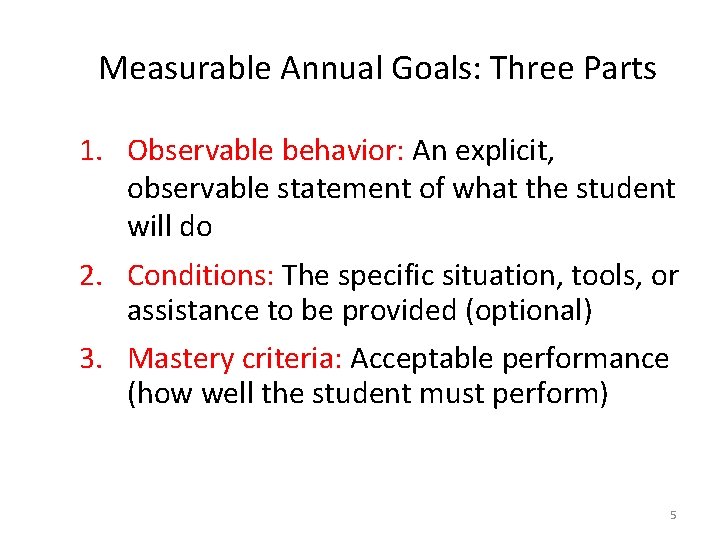
Measurable Annual Goals: Three Parts 1. Observable behavior: An explicit, observable statement of what the student will do 2. Conditions: The specific situation, tools, or assistance to be provided (optional) 3. Mastery criteria: Acceptable performance (how well the student must perform) 5

Handout: Action Verbs Observable Behaviors • An observable behavior should be stated using verbs and phrases that describe actions that can be observed. Examples: – Mark will describe… – Mary will create… – Melissa will compare…
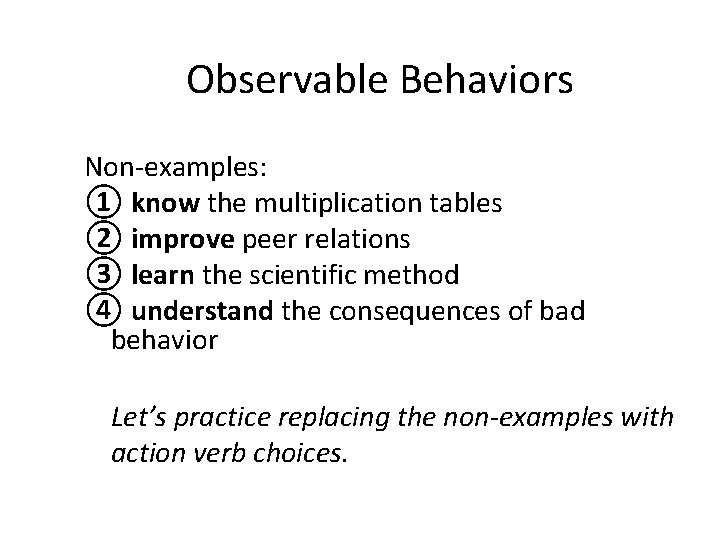
Observable Behaviors Non-examples: ① know the multiplication tables ② improve peer relations ③ learn the scientific method ④ understand the consequences of bad behavior Let’s practice replacing the non-examples with action verb choices.
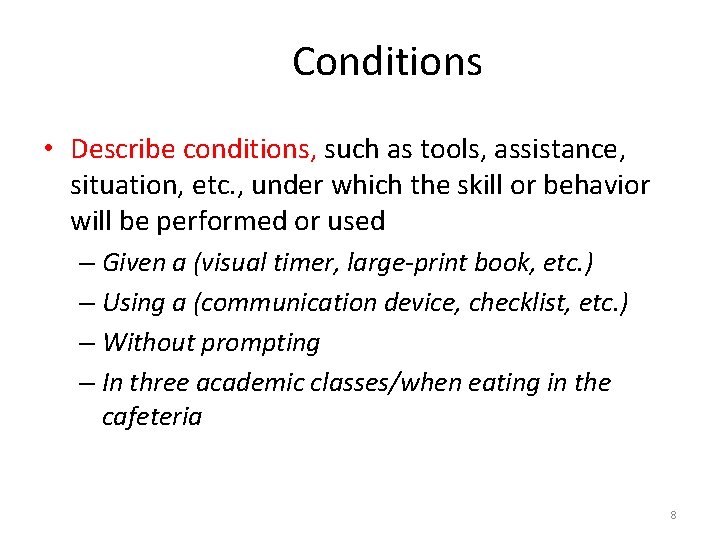
Conditions • Describe conditions, such as tools, assistance, situation, etc. , under which the skill or behavior will be performed or used – Given a (visual timer, large-print book, etc. ) – Using a (communication device, checklist, etc. ) – Without prompting – In three academic classes/when eating in the cafeteria 8
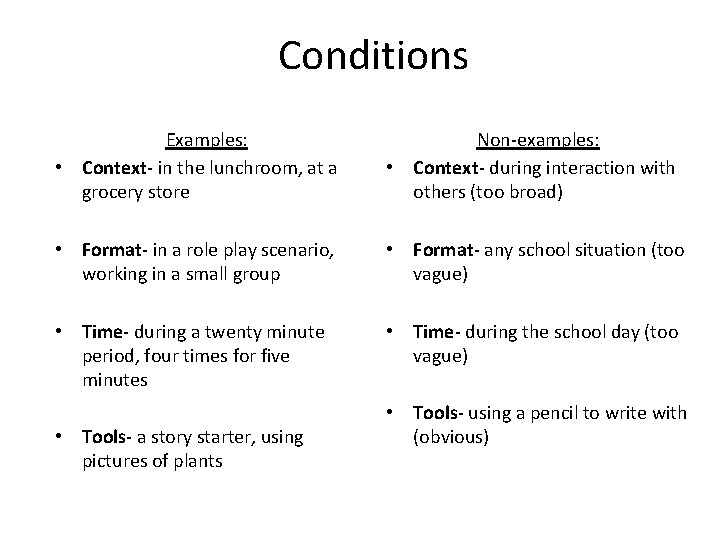
Conditions Examples: • Context- in the lunchroom, at a grocery store Non-examples: • Context- during interaction with others (too broad) • Format- in a role play scenario, working in a small group • Format- any school situation (too vague) • Time- during a twenty minute period, four times for five minutes • Time- during the school day (too vague) • Tools- a story starter, using pictures of plants • Tools- using a pencil to write with (obvious)
Mastery Criteria • Accuracy – 90% accuracy; 9 out of 10 items correct • Duration (time) – Stays on task for 10 consecutive minutes • Speed/Rate – With fluency of 85 words correct per minute – Within two minutes 10
Other Mastery Criteria • Timeframe (period of time) – Over five consecutive assignments – Over three consecutive weekly probes • Distance – Travels independently for 50 yards • Set of required characteristics – Complete all steps in a 10 -step process on the job 11
Cautions for Using Percent or Number of Items • Does it make sense? – Cross the street safely four out of five times – Cross the street safely five out of five times • Is it reasonable? – Exhibit appropriate behavior 90% of the time – During a 30 minute observation period, Johnny will exhibit appropriate behavior (keeping hands to self) 90% of the time. 12
Measurable Annual Goals: Examples Given 10 two-step addition word problems, Leroy will solve 9 out of 10 problems correctly. Behavior: Solve the problems Conditions: Given 10 two-step addition word problems Criteria: 9 out of 10 correctly 13
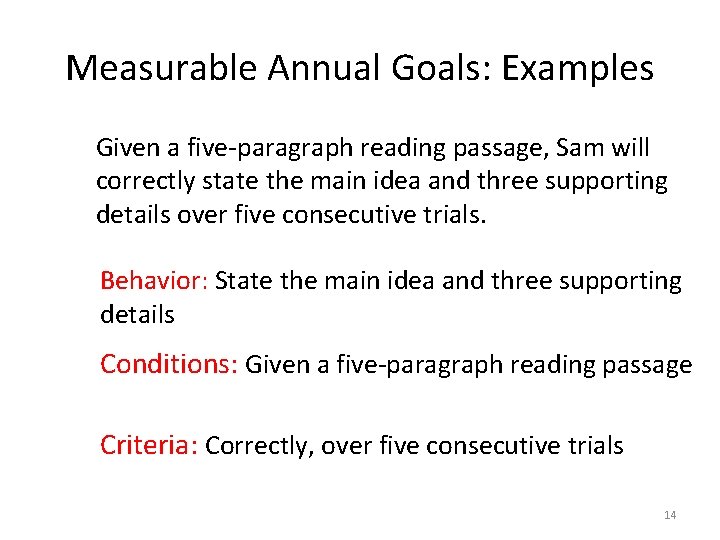
Measurable Annual Goals: Examples Given a five-paragraph reading passage, Sam will correctly state the main idea and three supporting details over five consecutive trials. Behavior: State the main idea and three supporting details Conditions: Given a five-paragraph reading passage Criteria: Correctly, over five consecutive trials 14
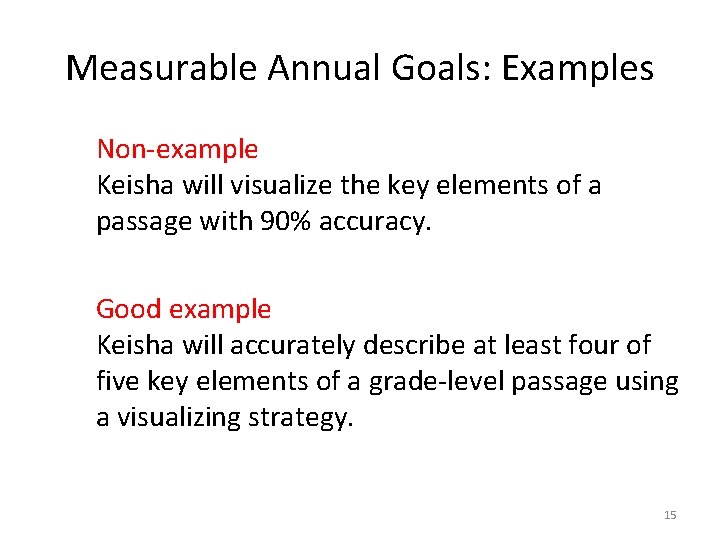
Measurable Annual Goals: Examples Non-example Keisha will visualize the key elements of a passage with 90% accuracy. Good example Keisha will accurately describe at least four of five key elements of a grade-level passage using a visualizing strategy. 15
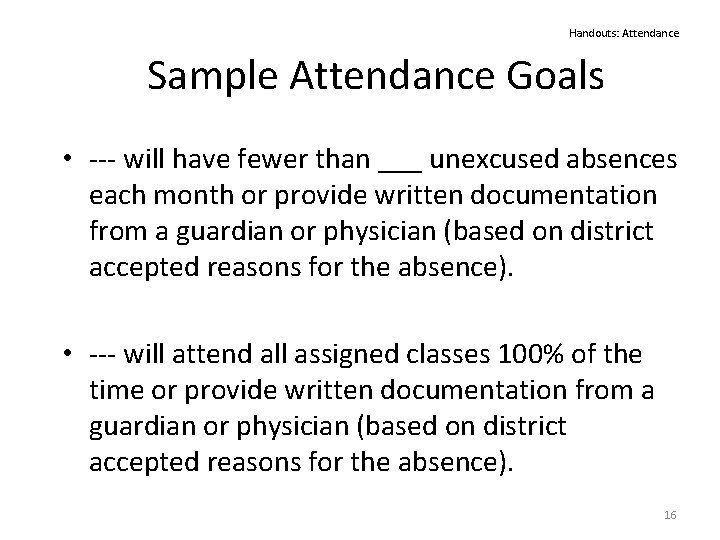
Handouts: Attendance Sample Attendance Goals • --- will have fewer than ___ unexcused absences each month or provide written documentation from a guardian or physician (based on district accepted reasons for the absence). • --- will attend all assigned classes 100% of the time or provide written documentation from a guardian or physician (based on district accepted reasons for the absence). 16
Short-Term Objectives & Benchmarks • Short-term objectives and/or benchmarks are required for students with disabilities who take alternate assessments • They may be written for other students with a disability 17
Short-Term Objectives & Benchmarks • Short-term objectives – Intermediate steps or subskills • Benchmarks – Major milestones that describe the expected student performance level during specific time periods in the year 18
What’s the Difference? • Short-term objectives – Same format as an annual goal • Benchmarks – Behavior and condition – Criteria (if less than 100%) – Date for mastery 19
Can You See the Difference? • Short-term objective Given 10 sets of one to five objects, Michael will count the sets with 90% accuracy. • Benchmark Given 10 sets of one to five objects, Michael will count the sets with 90% accuracy by the end of the first nine weeks. 20
Objectives and Benchmarks • At least two per annual goal • Provide a path student will take to attain the goal • Link present level statement (baseline) and annual goal • Align with the annual goal (not repeat) • Guide instructional strategies 21
Jenny’s Annual Goal Present Level (Baseline): Follows one-step directions presented orally Annual Goal: Given three-step directions, presented orally in classroom activities, Jenny will complete the steps in order in four out of five opportunities over three consecutive weekly trials. 22
Short-Term Objectives 1. Given two-step directions presented orally in classroom activities, Jenny will complete the steps in order in four out of five opportunities over three consecutive trials. 2. Given three-step directions presented orally in classroom activities, Jenny will complete the steps in order with one reminder in four out of five opportunities over three consecutive trials. 23
Ralph’s Annual Goal Present Level (Baseline): Currently responds to his name and simple commands; does not initiate conversation with adults and peers Annual Goal: Ralph will express needs by initiating conversation with adults and peers in school settings, two times in three consecutive daily 30 -minute observation periods. 24
Short-Term Objectives 1. When prompted verbally, Ralph will ask adults and peers for desired objects or activities in the classroom… 2. Ralph will ask adults and peers for desired objects or activities in the classroom, without prompts… 3. Ralph will ask adults and peers for desired objects or activities in the cafeteria and art class… 25
Measuring and Reporting Progress • Assessment Procedures (used to measure progress): – Teacher Developed Checklist or Chart – Test(s): Teacher and/or Standardized – Student Work Product – Interview – Graded Work Sample – Curriculum-Based Assessments – Documented Observation – Other: 26
Quarterly Reports • Quarterly reports are used to report student progress towards goals. • Basic education teacher(s) needs to provide input if applicable. • Comments need to be concise and to the point (if information does not fit in the space, then have a conference with the parent).
- Slides: 27