
Developing Print Advertisements Print advertisements have four key
- Slides: 17
Developing Print Advertisements Print advertisements have four key elements: • Headline • Copy • Illustrations • Signature Some ads also include a company slogan. Marketing Essentials Chapter 20, Section 20. 1
Headline Effective headlines are brief. They identify a benefit of the product or service and stress those benefits by making promises, asking questions, posing challenges, or using testimonials. Marketing Essentials Chapter 20, Section 20. 1
Copy The copy is the selling message of a written advertisement. It details how the product or service meets the customer needs. It should: • Be personal and friendly • Be simple and direct • Appeal to the senses Marketing Essentials Chapter 20, Section 20. 1
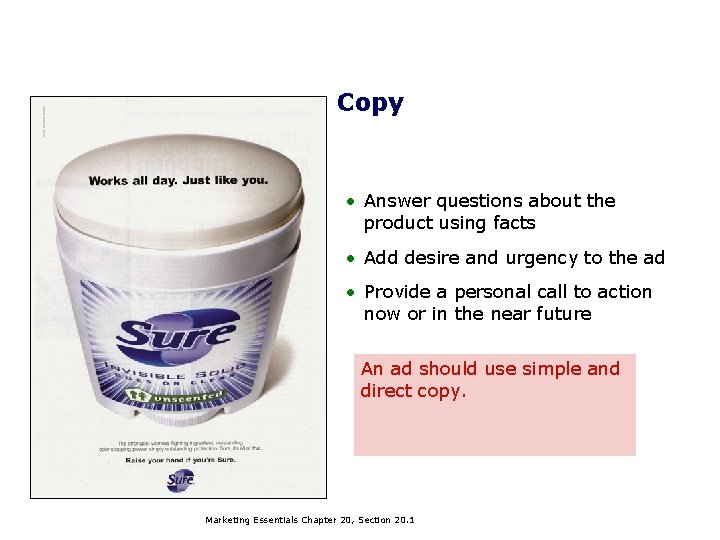
Copy • Answer questions about the product using facts • Add desire and urgency to the ad • Provide a personal call to action now or in the near future An ad should use simple and direct copy. Marketing Essentials Chapter 20, Section 20. 1
Illustration The illustration is the photograph, drawing, or other graphic elements used in an ad. It should attract and hold attention and encourage action. Clip art takes the form of images, stock drawings, and photographs. Clip art is often used for print advertisements. Marketing Essentials Chapter 20, Section 20. 1
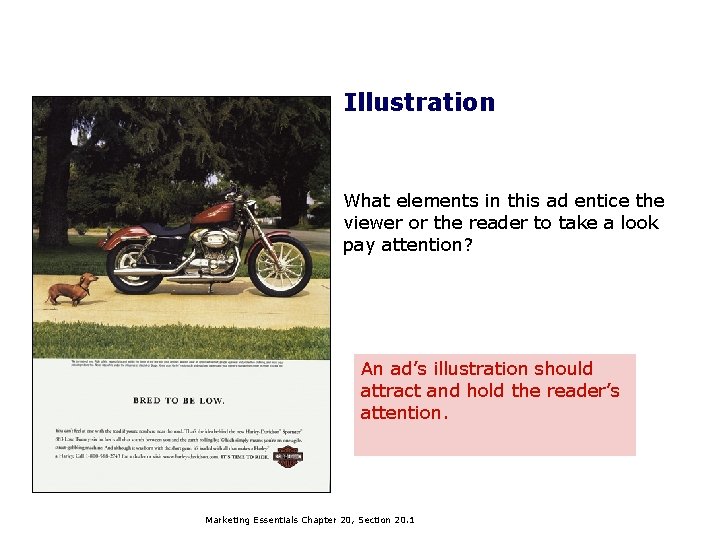
Illustration What elements in this ad entice the viewer or the reader to take a look pay attention? An ad’s illustration should attract and hold the reader’s attention. Marketing Essentials Chapter 20, Section 20. 1
Signature The signature , or logotype (logo), is the distinctive identification symbol for a business. A well-designed signature gets instant recognition for a business. Marketing Essentials Chapter 20, Section 20. 1
Signature A slogan is a catchy phrase or words that identify a product or company. Here are some techniques copywriters use when developing slogans: • Alliteration uses repeating initial consonant sounds. • A paradox is a seeming contradiction that could be true. Marketing Essentials Chapter 20, Section 20. 1
Signature • Rhyme uses rhyming words or phrases. • A pun is a humorous use of a word that suggests two or more of its meanings or the meaning of a similarly-sounding word. • A play on words cleverly uses words to mean something else. Marketing Essentials Chapter 20, Section 20. 1
Developing Print Advertising Layouts An ad layout is a sketch that shows the general arrangement and appearance of a finished ad. It clearly indicates the position of the: • Headline • Illustration and copy • Signature Marketing Essentials Chapter 20, Section 20. 2
Components of Effective Ad Layouts Ad layouts should be prepared in exactly the same size as the final advertisement. The illustrations should grab attention through size, humor, or dramatic content. The best ads contain a focal point and lines of force that guide the viewer through the copy. Marketing Essentials Chapter 20, Section 20. 2
Using Color In Print Advertisements A color ad is usually more realistic and visually appealing and commands the reader’s attention more than a black-andwhite ad does. Although color ads are more expensive than black-and-white ads, studies have they are more cost-effective. Marketing Essentials Chapter 20, Section 20. 2
Using Color In Print Advertisements Be sure to choose colors appropriate to the mood of your ad. Also, consider the fact that colors have different meanings in different cultures. Marketing Essentials Chapter 20, Section 20. 2
Selecting Typefaces and Type Sizes for Print Advertisements The look and appearance of the type is called the typeface. A complete set of letters in a specific size and typeface is called a font. Marketing Essentials Chapter 20, Section 20. 2
Selecting Typefaces and Type Sizes for Print Advertisements The appearance of the typeface affects the entire character of an advertisement. It is important that the font is large enough to read. Marketing Essentials Chapter 20, Section 20. 2
Discovery Project Create an advertisement for your favorite beverage. Remember, What key components make a print advertisement effective? • • Headline Copy Illustration Signature
Evaluation • You and your partner use the Discovery Project Evaluation Rubric to rate your performance. Attach your self-evaluation to a colored copy of your print ad. • Be prepared to share your ad with the class and review the 4 major components.