
Developing of the Periodic Table and Classifying its
Developing of the Periodic Table and Classifying its Elements.
Meet the Elements
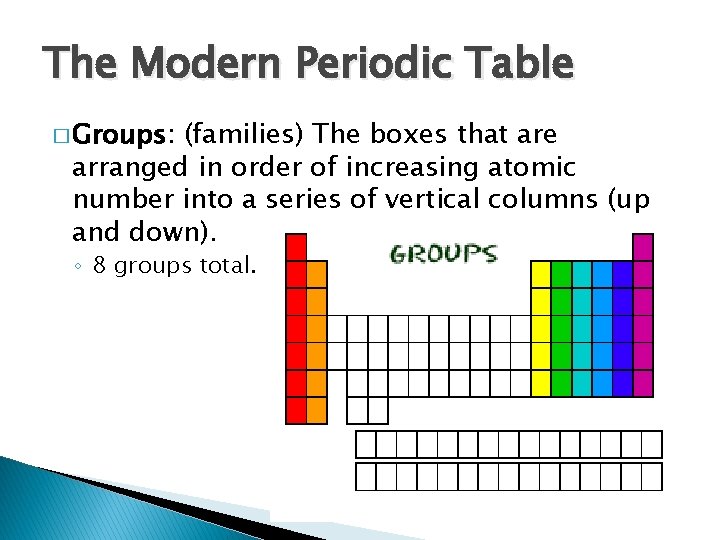
The Modern Periodic Table � Groups: (families) The boxes that are arranged in order of increasing atomic number into a series of vertical columns (up and down). ◦ 8 groups total.
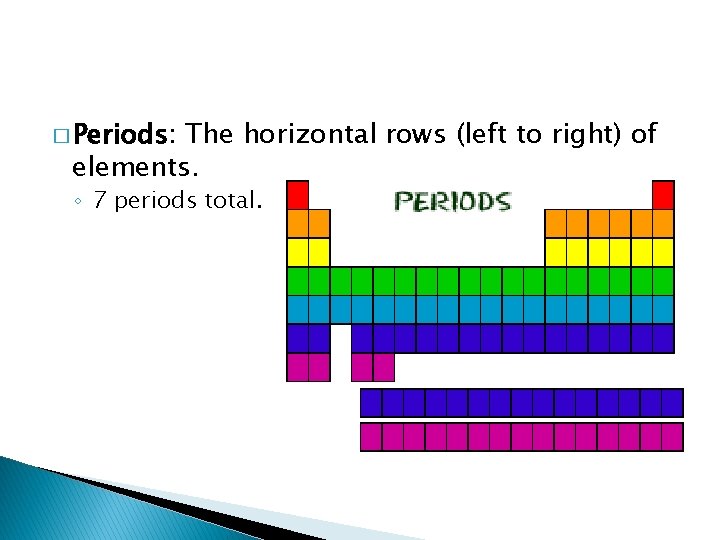
� Periods: The horizontal rows (left to right) of elements. ◦ 7 periods total.

Valence Electrons � Period 1 Hydrogen 1 s 1 � Period 2 Lithium 1 s 22 s 1 � Period 3 Sodium 1 s 12 s 22 p 63 s 1 � Period 4 Potassium 1 s 12 s 22 p 63 s 23 p 64 s 1

IMPORTANT � Atoms in the same group have similar chemical properties because they have the same number of valence electrons. ◦ Group 1 A Valence Electron Configuration of s 1 ◦ Group 2 A s 2
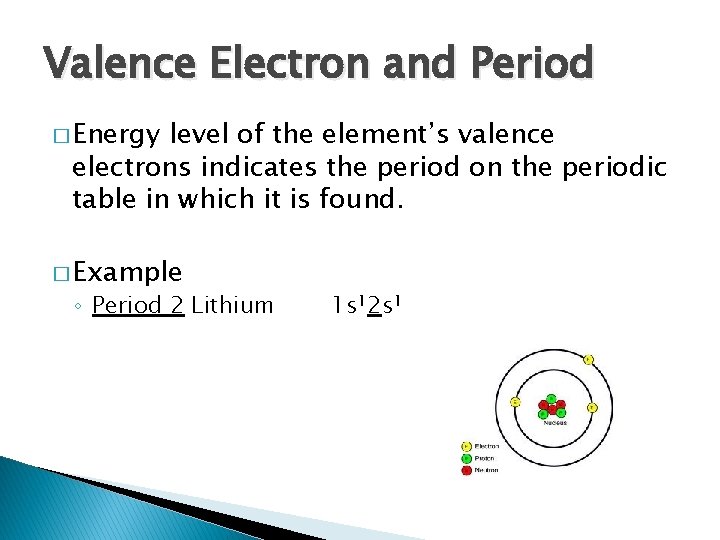
Valence Electron and Period � Energy level of the element’s valence electrons indicates the period on the periodic table in which it is found. � Example ◦ Period 2 Lithium 1 s 12 s 1
Valence Electrons and Group Numbers � Group 1 A One valence electron � Group 2 A Two valence electrons � Group 8 A eight valence electrons

Blocks
S-block elements � Groups 1 A and 2 A and He � Group 1 A only holds 1 valence electron. � Group 2 A only holds 2 valence electrons. � S orbitals only hold 2 electrons so it only spans to two groups.
P-block elements � Groups 3 A through 8 A. � Spans to six groups because the p orbital can hold a max of 6 electrons.

D-block elements � Contains the transition metals and is the largest of the blocks. � Energy level = n-1 ◦ Example Ni [Ar]4 s 13 d 8 ◦ is in energy level n=4 ◦ D orbitals are n-1 = 3 � Five d orbitals can hold a total of 10 electrons, so it is 10 groups.

F-block elements � Inner transition metals � Filled or partially filled s orbital and 4 f and 5 f � Don’t fill up orbitals in a predictable manner. � 7 orbitals holding a max of 14 electrons, there are 14 columns.
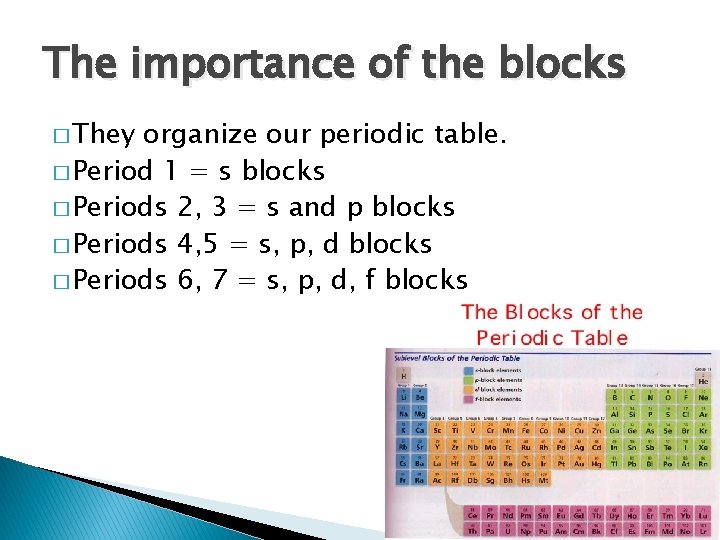
The importance of the blocks � They organize our periodic table. � Period 1 = s blocks � Periods 2, 3 = s and p blocks � Periods 4, 5 = s, p, d blocks � Periods 6, 7 = s, p, d, f blocks
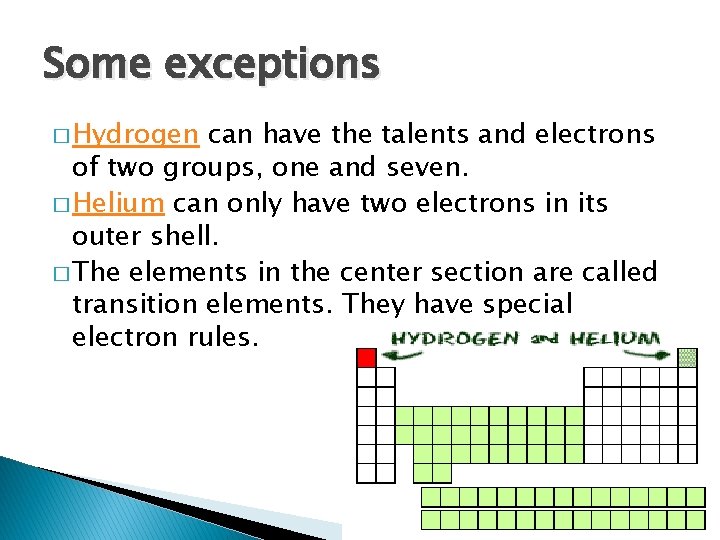
Some exceptions � Hydrogen can have the talents and electrons of two groups, one and seven. � Helium can only have two electrons in its outer shell. � The elements in the center section are called transition elements. They have special electron rules.
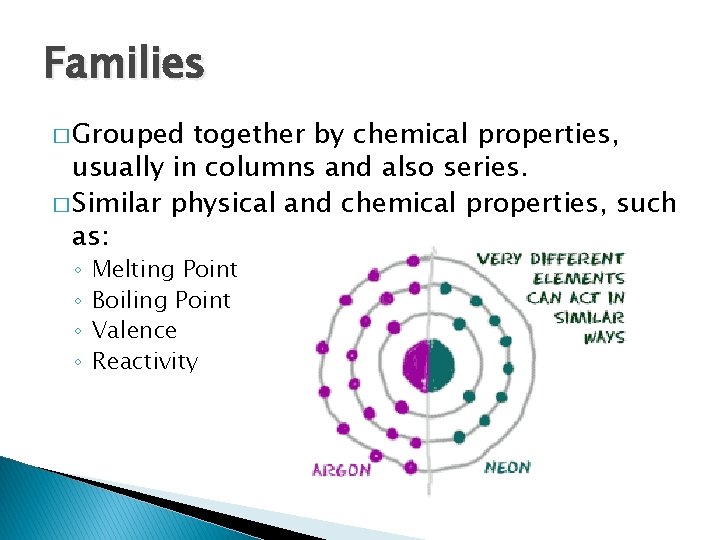
Families � Grouped together by chemical properties, usually in columns and also series. � Similar physical and chemical properties, such as: ◦ ◦ Melting Point Boiling Point Valence Reactivity
Groups � Groups are categorized with an A or a B � 1 A through 8 A are the “main group” or representative elements because they posses a wide range of chemical and physical properties. � 1 B through 8 B are transition elements
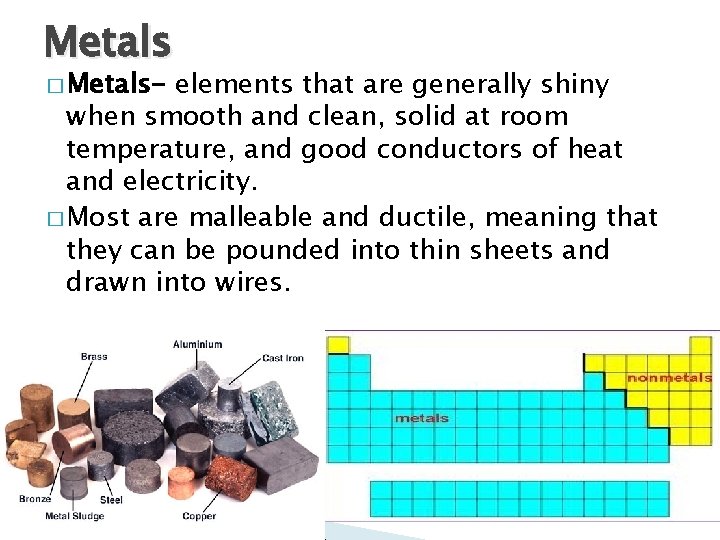
Metals � Metals- elements that are generally shiny when smooth and clean, solid at room temperature, and good conductors of heat and electricity. � Most are malleable and ductile, meaning that they can be pounded into thin sheets and drawn into wires.
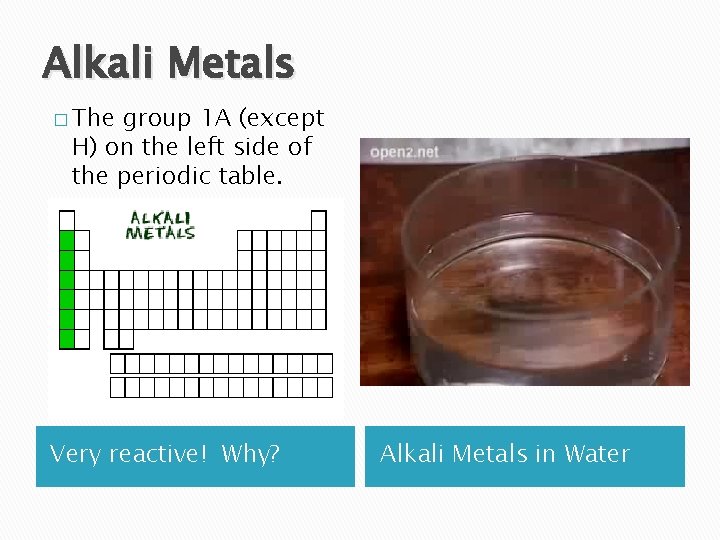
Alkali Metals � The group 1 A (except H) on the left side of the periodic table. Very reactive! Why? Alkali Metals in Water
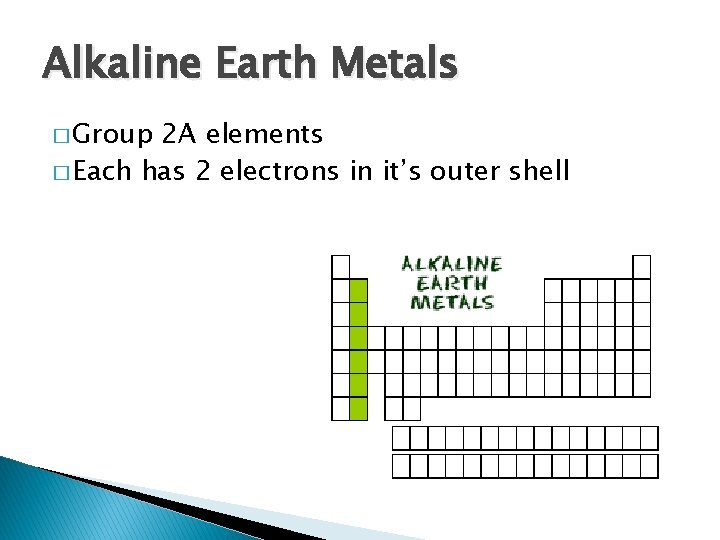
Alkaline Earth Metals � Group 2 A elements � Each has 2 electrons in it’s outer shell
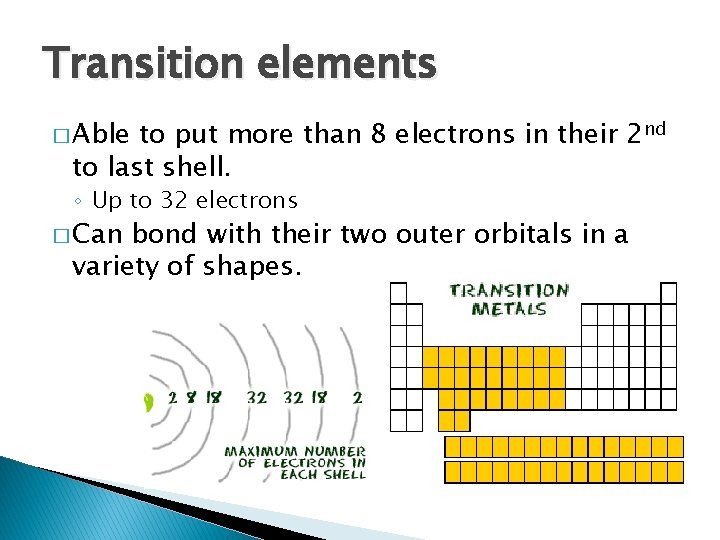
Transition elements � Able to put more than 8 electrons in their 2 nd to last shell. ◦ Up to 32 electrons � Can bond with their two outer orbitals in a variety of shapes.
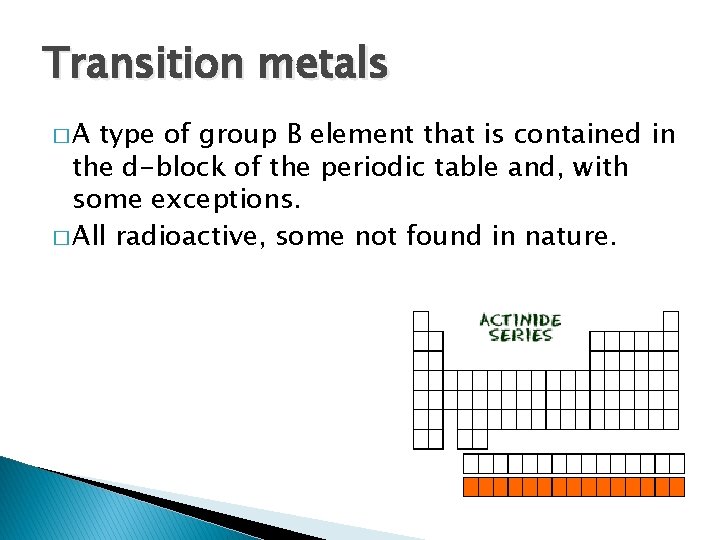
Transition metals �A type of group B element that is contained in the d-block of the periodic table and, with some exceptions. � All radioactive, some not found in nature.
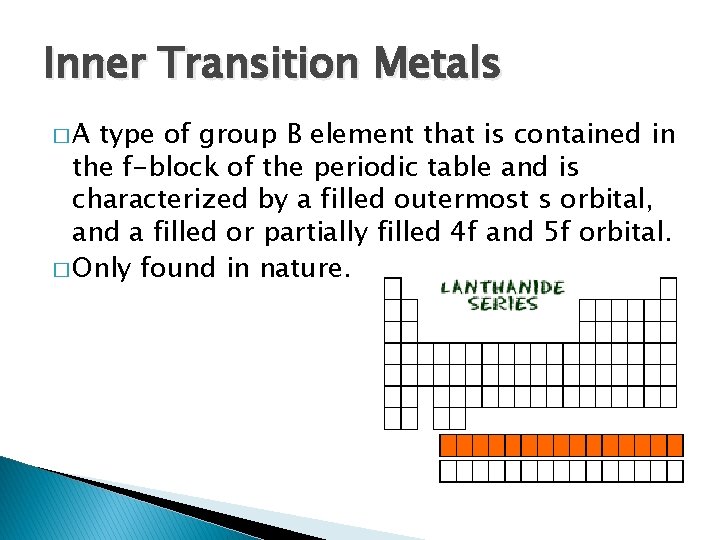
Inner Transition Metals �A type of group B element that is contained in the f-block of the periodic table and is characterized by a filled outermost s orbital, and a filled or partially filled 4 f and 5 f orbital. � Only found in nature.
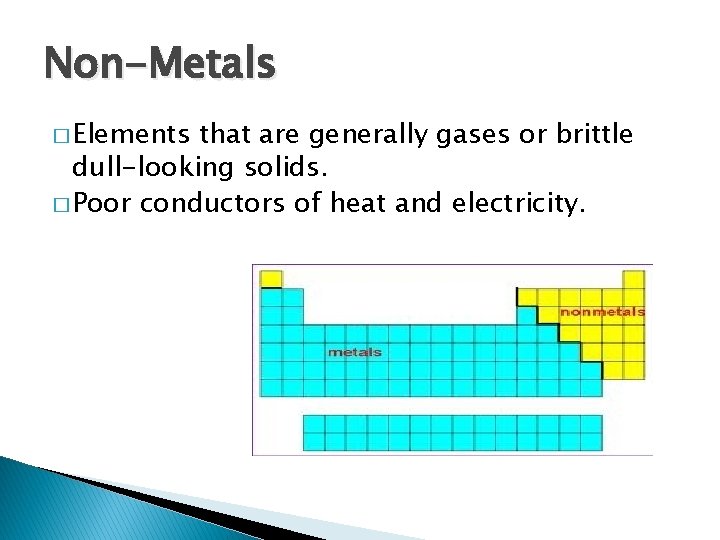
Non-Metals � Elements that are generally gases or brittle dull-looking solids. � Poor conductors of heat and electricity.
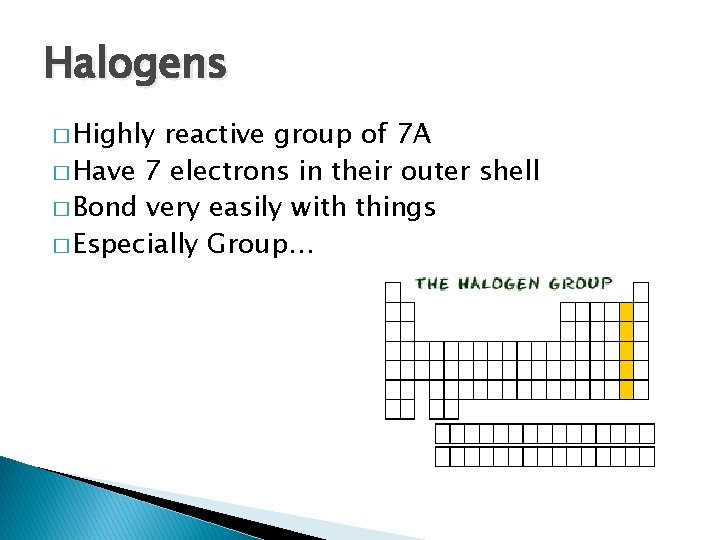
Halogens � Highly reactive group of 7 A � Have 7 electrons in their outer shell � Bond very easily with things � Especially Group…
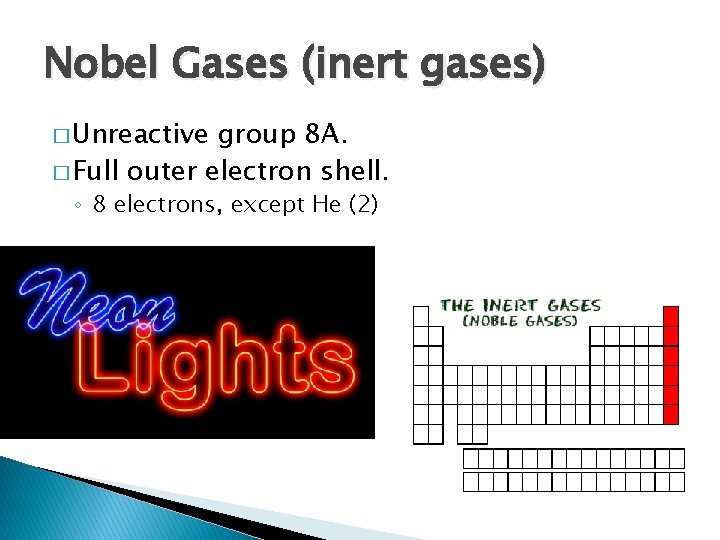
Nobel Gases (inert gases) � Unreactive group 8 A. � Full outer electron shell. ◦ 8 electrons, except He (2)
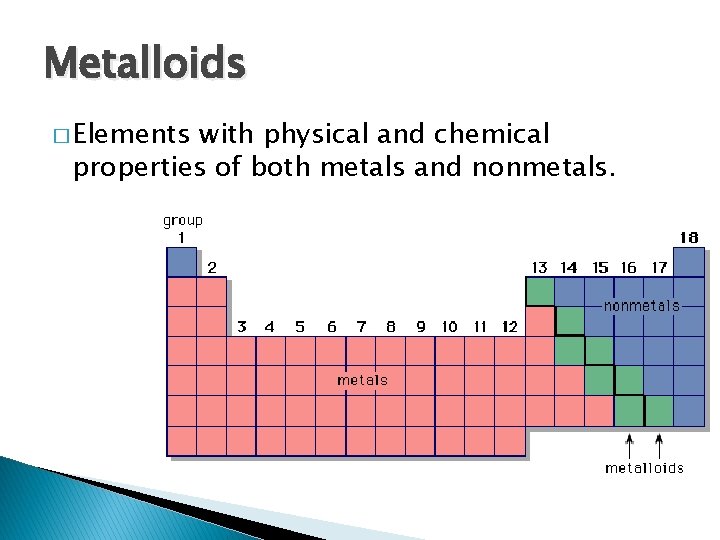
Metalloids � Elements with physical and chemical properties of both metals and nonmetals.
Let the Competition begin � What type of metal is Potassium? ◦ Alkali metals � True or False. Groups are the horizontal rows going left to right. ◦ False. Periods are. � What is the electron configuration of Sodium? ◦ 1 s 12 s 22 p 63 s 1
� How many valence electrons alkaline earth metals have? ◦ Two � What is unique about nobel gases? ◦ They have a full outer orbital with 8 valence electrons and are NONREACTIVE. � Give me three of the four characteristics that metals have? ◦ ◦ Shiny and smooth when clean Solid at room temperature Good conductors of heat and electricity Malleable and ductile
� How many elements are metalloids? Name them. � How many groups and periods are there? ◦ 8: boron, Silicon, Germanium, Arsenic, Antimony, Tellurium, Polonium, Astatine ◦ 8 groups ◦ 7 periods � Fill in the blank: atoms in the same group have similar chemical properties because they have the same number of _________. ◦ Valence electrons
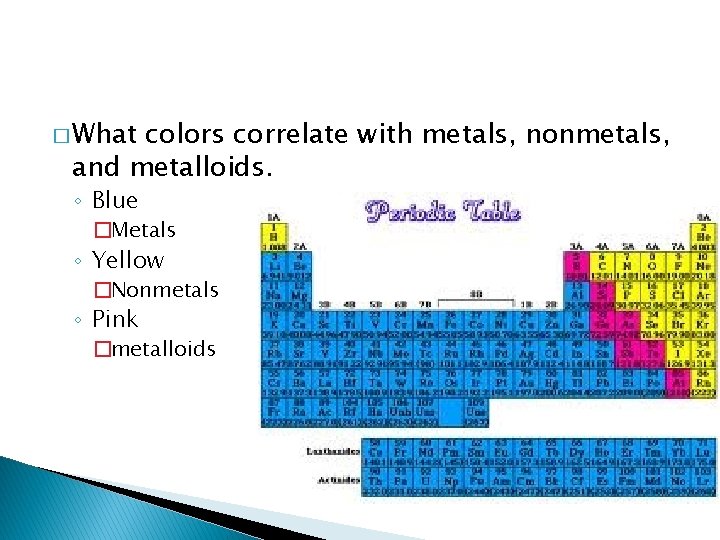
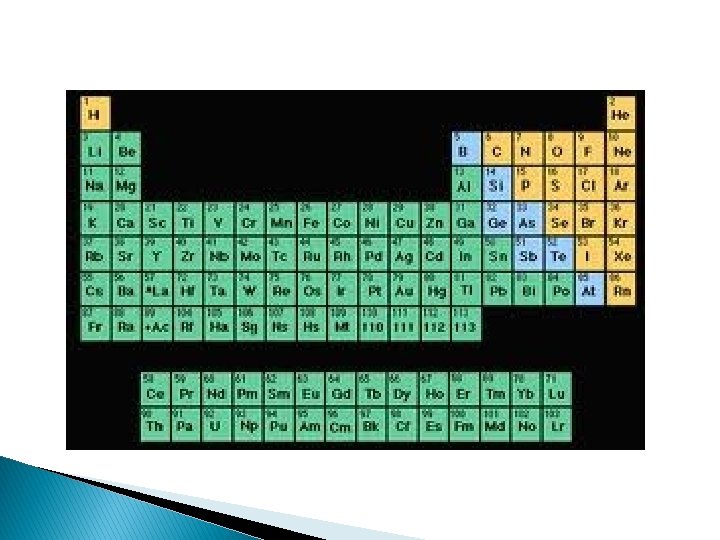
� What colors correlate with metals, nonmetals, and metalloids. ◦ Blue �Metals ◦ Yellow �Nonmetals ◦ Pink �metalloids
� Group 7 is known as _____ and what about their electron configuration allows these elements to be grouped together? ◦ Halogens. They all fill up to p 6 on the periodic table. � What block is Einsteinium located in? ◦ F block � If an elements valance electrons are in the fourth energy level, what period is it located in? ◦ Fourth period ie [Ar] 4 s 23 d 1 o 4 p 1
![� Give the following information for this electron configuration: [Ar] 4 s 23 d](http://slidetodoc.com/presentation_image_h2/445e4092d8225446bc131ce47a8e8845/image-34.jpg "� Give the following information for this electron configuration: [Ar] 4 s 23 d")
� Give the following information for this electron configuration: [Ar] 4 s 23 d 104 p 6 ◦ ◦ ◦ Element name Group number Period number Family name Metal, nonmetal, or metalloid �Element name : Krypton �Group number: 8 A �Period number: 4 �Family name: noble gases �Metal, nonmetal, or metalloid: nonmetal
Final Question � Sketch the periodic table on your white board and indicate the location of: ◦ ◦ ◦ groups periods metals nonmetals metalloids and s-, p-, d-, f- blocks
- Slides: 35