
Developing Mathematics Identity and Competence among student teachers




- Slides: 15
Developing Mathematics Identity and Competence among student teachers Dian & Miriam
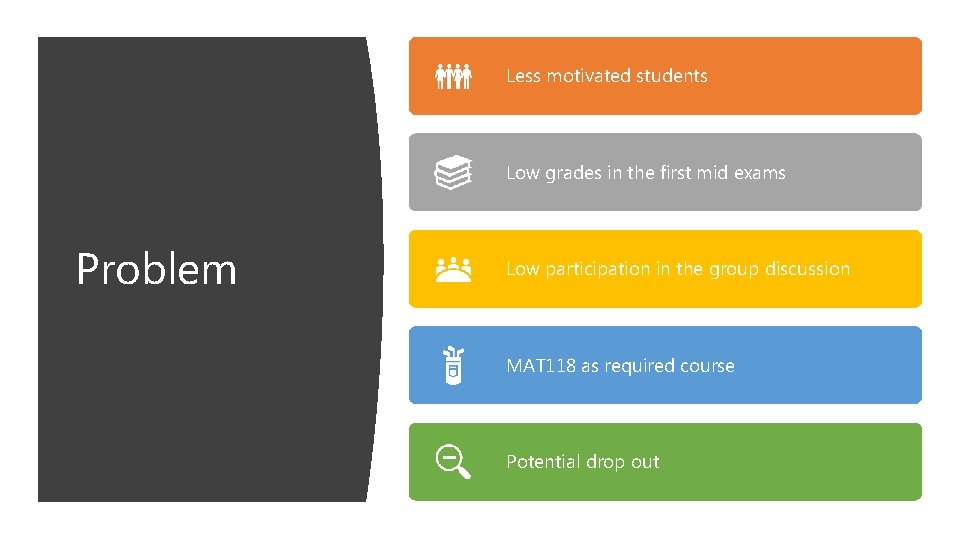
Less motivated students Low grades in the first mid exams Problem Low participation in the group discussion MAT 118 as required course Potential drop out
Expected Outcomes • To create a model or design that would develop student teachers' mathematical identity, competence and beliefs in mathematics
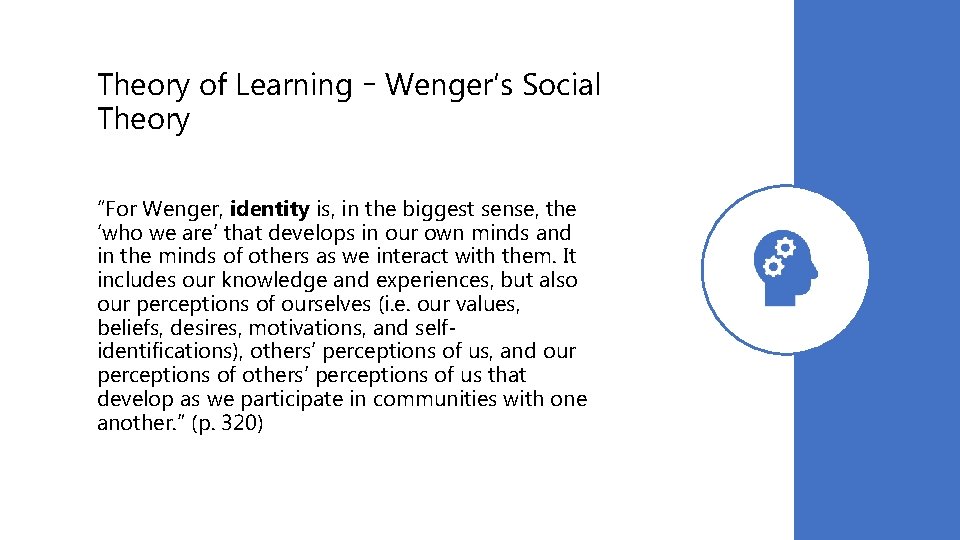
Theory of Learning – Wenger’s Social Theory “For Wenger, identity is, in the biggest sense, the ‘who we are’ that develops in our own minds and in the minds of others as we interact with them. It includes our knowledge and experiences, but also our perceptions of ourselves (i. e. our values, beliefs, desires, motivations, and selfidentifications), others’ perceptions of us, and our perceptions of others’ perceptions of us that develop as we participate in communities with one another. ” (p. 320)
Theory of Learning Carlone and Johnson (2007) - ) initially framed identity as consisting of three constructs, namely, perceived recognition, belief in ability to perform, and belief in one's competence.
Carlone and Johnson (2007) Belief in ability to perform Belief in one’s competence Perceive recognition Identity
Design Principle Effective mentoring sessions will involve informal meeting (active vs reactive – topics, directive vs non-directive – the course of dialogue) because research has shown that mentoring provide the opportunity to develop, discuss, share, and critique knowledge between mentor and mentee (Mena, Hennissen, .
The improvement in the students’ performance in MAT 118 will be influenced by the amount of support (intervention) given to them. Learning Conjectures Engaging in one-on-one mentoring will motivate students to improve their competence in mathematical problem solving. Supporting students through mentoring will improve students' positive identity as future teachers of mathematics.
Improvement in students' identity and competence as future elementary school teachers. Learning Trajectory Assumption on how mentoring sessions will develop or influence their mathematical identity.
How does a mentoring design or model effectively develop student teachers' mathematical identity, competence, and belief in mathematics? Research Question
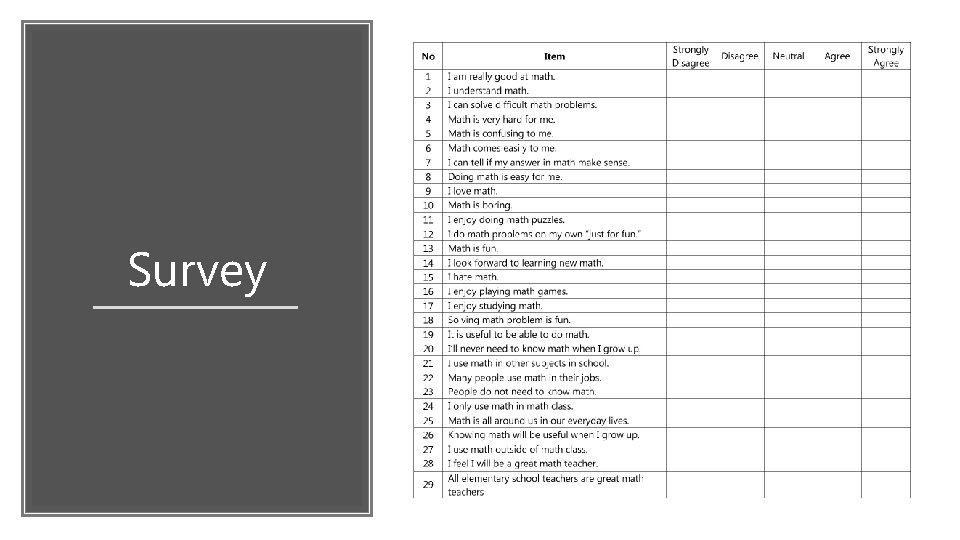
Instruments/ Measures MATH AND ME SURVEY, MENTORING SESSIONS, CLASSROOM OBSERVATIONS. STUDENTS' AUTOBIOGRAPHIES.
Survey
Initial Learnings (7 consented, 5 surveys, 2 interviews) • Generally, the students don't believe they have math competence. • They don't identify themselves as strong performers in mathematics. • Supporting role in their previous learning experience. • Acknowledge a good math teacher understands content well and understands their students • Time and perseverence are key in teaching and learning mathematics.
Iteration Plan 1 -3 Meeting 1 • Introduction Meeting 2 • Problem solving activities (puzzles or class activities) • Talk again about any interesting or challenging activity in class • Talk about what does it take to be a great mathematics student • Discussion on mathematics problem that is related to student’s interest Meeting 3
Next Steps Ongoing Data Analysis • Use SPSS to analyze the survey • Coding the interview