
Developing managing and using customerrelated database By the
Developing, managing and using customer-related database
By the end of this chapter, you will understand : 1. the central role of customer-related databases to the successful delivery of CRM outcomes 2. the importance of high quality data to CRM performance 3. the issues that need to be considered in developing a customer-related database 4. what data integration contributes to CRM performance 5. the purpose of a data warehouse and data mart 6. how data access can be obtained by CRM users 7. the data protection and privacy issues that concern public policy makers.
In this chapter we discuss the importance of developing an intimate knowledge and understanding of customers. This is essential to achieving CRM success. Strategic CRM, which focuses on winning and keeping profi table customers, relies on customer-related data to identify which customers to target, win and keep. Operational CRM, which focuses on the automation of customer-facing processes such as selling, marketing and customer service, needs customer-related data to be able to deliver excellent service, run successful marketing campaigns and track sales opportunities.
Analytical CRM mines customer-related data for strategic or tactical purposes. Collaborative CRM involves the sharing of customerrelated data with organizational partners, with a view to enhancing company, partner and customer value Customer-related databases are the foundation for the execution of CRM strategy. Profi ciency at acquiring, enhancing, storing, distributing and using customerrelated data is critical to CRM performance
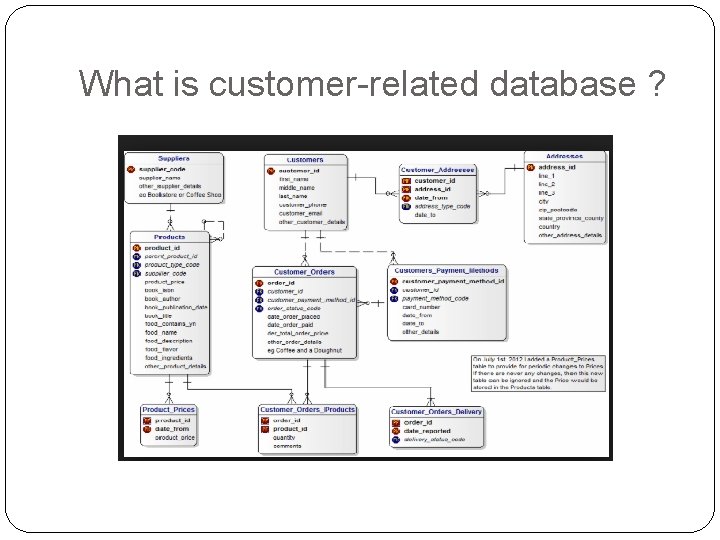
What is customer-related database ?
Customer-related database might be maintained in a number of functional areas – sales, marketing, service, logistics and accounts – each serving different operational purposes. Customer-related data can have a current, past or future perspective, focusing upon current opportunities, historic sales or potential opportunities. Customer-related data might be about individual customers, customer cohorts, customer segments, market segments or entire markets.
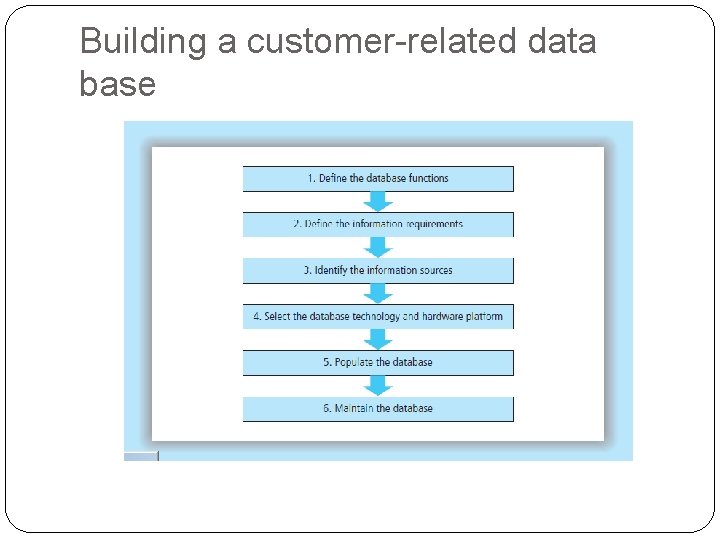
Building a customer-related data base
Databases support the four forms of CRM – strategic, operational, analytical and collaborative. Strategic CRM needs data about markets, market offerings, customers, channels, competitors, performance and potential to be able to identify which customers to target for customer acquisition, retention and development, and what to offer them. Collaborative CRM implementations generally use the operational and analytical data as described below, so that partners in distribution channels can align their efforts to serveend-customers.
Operational CRM uses customer-related data to help in the everyday running of the business. For example: ● a telecoms customer service representative (CSR) needs to access a customer record when she receives a telephone query ● a hotel receptionist needs access to a guest’s history so that she can reserve the preferred type of room – smoking or non-smoking, standard or de-luxe ● a salesperson needs to check a customer’s payment history to fi nd out whether the account has reached the maximum credit limit.
Analytical CRM uses customer-related data to support the marketing, sales and service decisions that aim to enhance the value created for and from customers. For example: ● the telecoms company might want to target a retention offer to customers who are signalling an intention to switch to a different supplier ● the hotel company might want to promote a weekend break to customers who have indicated their complete delight in previous customer satisfaction surveys ● a sales manager might want to compute his sales representatives ’ customer profitability, given the level of service that is being provided
Customer-related data are typically organized into two subsets, refl ecting these operational and analytical purposes. Operational data resides in an OLTP (online transaction processing) database, and analytical data resides in an OLAP (online analytical processing) database. The information in the OLAP database is normally a summarized, restructured, extract of the OLTP database, sufficient to perform the analytical tasks.
Define the information requirements Senior managers reviewing your company’s strategic CRM decisions will require a completely different set of information. They may want to know the following. How is the market segmented? Who are our current customers? What do they buy? Who else do they buy from? What are our customers ’ requirements, expectations and preferences across all components of the value proposition, including product, service, channel and communication?
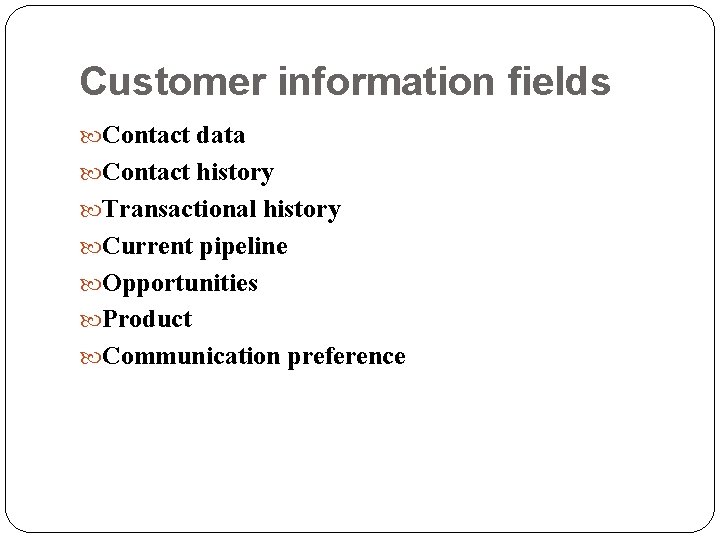
Customer information fields Contact data Contact history Transactional history Current pipeline Opportunities Product Communication preference
Identify the information sources Information for customer-related databases can be sourced internally or externally. Prior to building the database it is necessary to audit the company to fi nd out what data are available. Internal data are the foundation of most CRM programmes, though the amount of information available about customers depends on the degree of contact that the company has with the customer
Select the database technology and hardware platform Customer-related data can be stored in a database in a number of different ways. 1. hierarchical 2. network 3. relational.
Mantain the Database Ensure that data from all new transactions, campaigns and communications is inserted into the database immediately. You will need to develop rules and ensure that they are applied. Regularly de-duplicate databases. 3. Audit a subset of the fi les every year. Measure the amount of degradation. Identify the source of degradation: is it a particular data source or fi eld?
Purge customers who have been inactive for a certain period of time. For frequently bought products, the dormant time period might be six months or less. For products with a longer repeat purchase cycle, the period will be longer. It is not always clear what a suitable dormancy period is. Some credit-card users, for example, may have different cards in different currencies. Inactivity for a year only indicates that the owner has not travelled to a country in the previous year. Drip-feed the database. Every time there is a customer contact there is an opportunity to add new or verify existing data.
Get customers to update their own records. When Amazon customers buy online, they need to confirm or update invoice and delivery details. Remove customers ’ records when they request this. Insert decoy records. If the database is managed by an external agency, you might want to check the effectiveness of the agency’s performance by inserting a few dummy records into the database. If the agency fails to spot the dummies, you may have a problem with their service standards.
- Slides: 18