
Developing Management Skills Chapter 3 Solving Problems Analytically
Developing Management Skills Chapter 3: Solving Problems Analytically and Creatively Copyright © 2011 Pearson Education, Inc. publishing as Prentice Hall 3 -1 1
Learning Objectives • Increase proficiency in analytic problem solving • Recognize personal conceptual blocks • Enhance creativity by overcoming conceptual blocks • Foster innovation among others Copyright © 2011 Pearson Education, Inc. publishing as Prentice Hall 3 -2 2
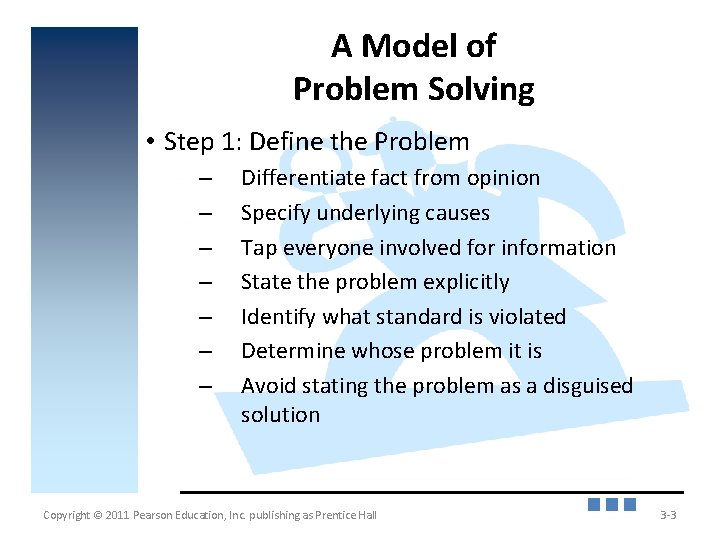
A Model of Problem Solving • Step 1: Define the Problem – – – – Differentiate fact from opinion Specify underlying causes Tap everyone involved for information State the problem explicitly Identify what standard is violated Determine whose problem it is Avoid stating the problem as a disguised solution Copyright © 2011 Pearson Education, Inc. publishing as Prentice Hall 3 -3 3
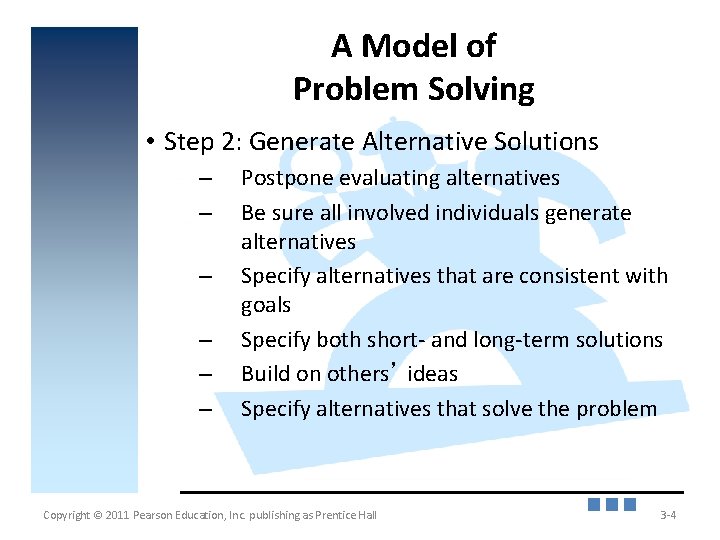
A Model of Problem Solving • Step 2: Generate Alternative Solutions – – – Postpone evaluating alternatives Be sure all involved individuals generate alternatives Specify alternatives that are consistent with goals Specify both short- and long-term solutions Build on others’ ideas Specify alternatives that solve the problem Copyright © 2011 Pearson Education, Inc. publishing as Prentice Hall 3 -4 4
A Model of Problem Solving • Step 3: Evaluate and Select an Alternative – – – Evaluate relative to an optimal standard Evaluate systematically Evaluate relative to goals Evaluate main effects and side effects State the selected alternative explicitly Copyright © 2011 Pearson Education, Inc. publishing as Prentice Hall 3 -5 5
A Model of Problem Solving • Step 4: Implement and Follow Up on the Solution – – – Implement at proper time and in the right sequence Provide opportunities for feedback Engender acceptance Establish ongoing monitoring system Evaluate based on problem solution Copyright © 2011 Pearson Education, Inc. publishing as Prentice Hall 3 -6 6
Constraints on the Analytical Problem. Solving Model • Defining the problems – Lack of consensus on the problem – Acceptance of problem definition – Symptoms are often confused with the real problem – Confusing information Copyright © 2011 Pearson Education, Inc. publishing as Prentice Hall 3 -7 7
Constraints on the Analytical Problem. Solving Model • Generating Alternatives – Alternatives are evaluated as they are proposed – Few possible alternatives are usually known – The first acceptable solution is usually accepted – Alternatives are based on what was successful in the past Copyright © 2011 Pearson Education, Inc. publishing as Prentice Hall 3 -8 8
Constraints on the Analytical Problem. Solving Model • Evaluating and Select an Alternative – – – Information on alternatives is limited Search for information occurs close to home The type of information is constrained by other factors Gathering information is costly Preferences for the best alternatives are not always known Copyright © 2011 Pearson Education, Inc. publishing as Prentice Hall 3 -9 9
Constraints on the Analytical Problem. Solving Model • Implementation and Follow up – – – Acceptance is not always forthcoming Resistance to change Uncertainty about what part of solution to monitor Political and organizational processes must be managed It may take a long time to implement a solution Copyright © 2011 Pearson Education, Inc. publishing as Prentice Hall 3 -10 10
Impediments to Creative Problem Solving • Most people assume creativity is one dimensional • Almost everyone has created blocks that inhibit our creativity Copyright © 2011 Pearson Education, Inc. publishing as Prentice Hall 3 -11 11
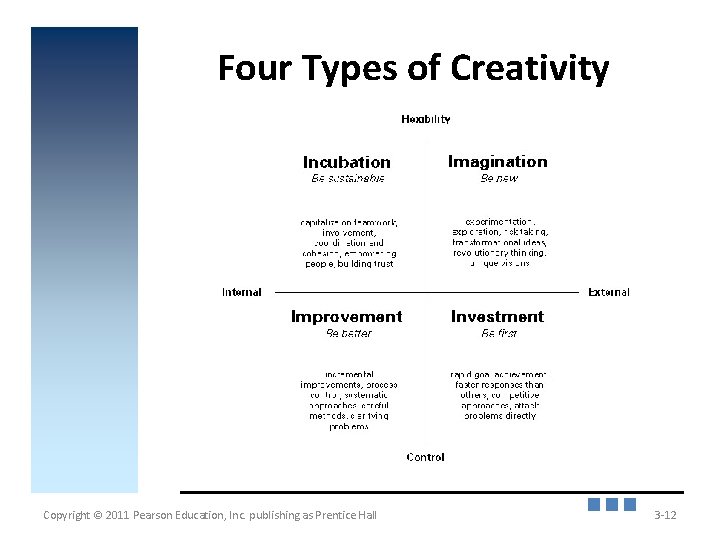
Four Types of Creativity Insert Figure 3. 1 Copyright © 2011 Pearson Education, Inc. publishing as Prentice Hall 3 -12 12
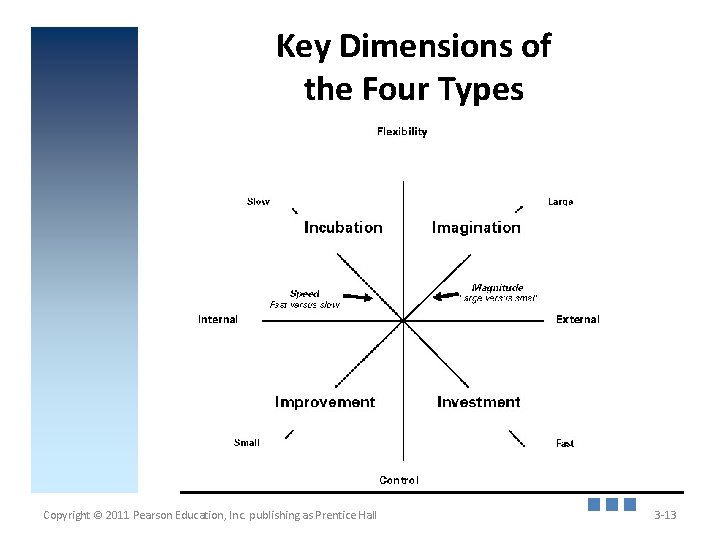
Key Dimensions of the Four Types Insert Figure 3. 2 Copyright © 2011 Pearson Education, Inc. publishing as Prentice Hall 3 -13 13
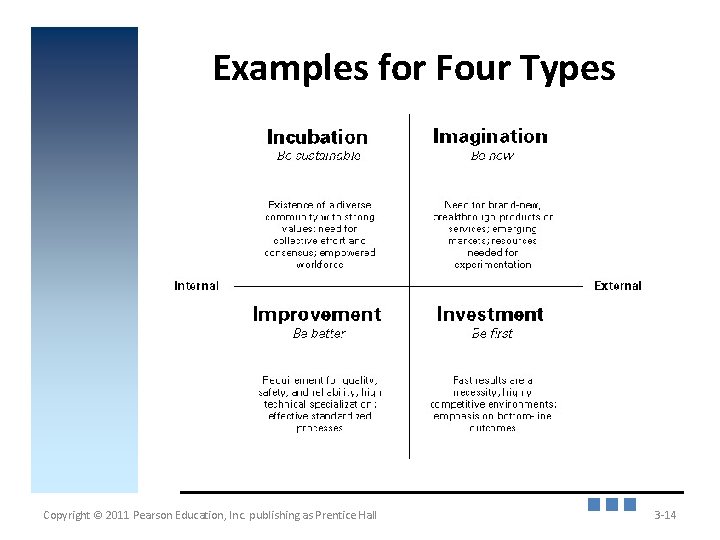
Examples for Four Types Copyright © 2011 Pearson Education, Inc. publishing as Prentice Hall 3 -14 14
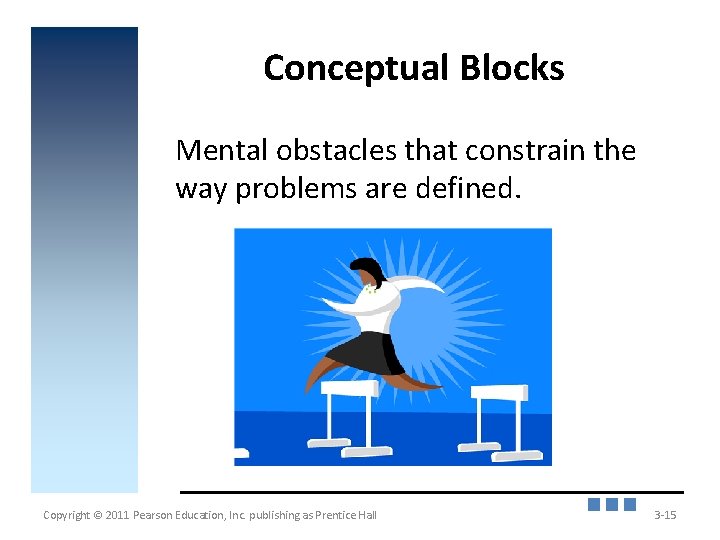
Conceptual Blocks Mental obstacles that constrain the way problems are defined. Copyright © 2011 Pearson Education, Inc. publishing as Prentice Hall 3 -15 15
Two Examples 1. Percy Spencer’s Magnetron led to the invention of the microwave 2. Spence Silver’s Glue led to the development of the enormously popular Post-It Notes Copyright © 2011 Pearson Education, Inc. publishing as Prentice Hall 3 -16 16
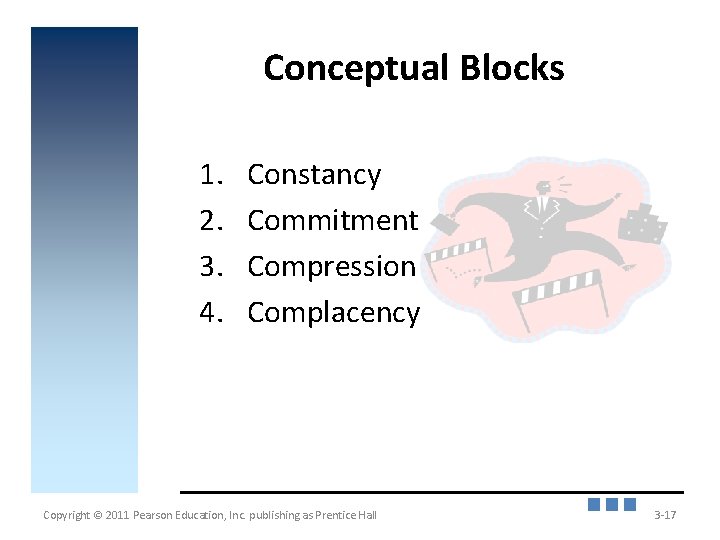
Conceptual Blocks 1. 2. 3. 4. Constancy Commitment Compression Complacency Copyright © 2011 Pearson Education, Inc. publishing as Prentice Hall 3 -17 17
de. Bono’s Ways of Thinking • Vertical Thinking Continuity Chooses Stability Searches for what is right – Analytic – Where the idea came from – Develops an idea – – Copyright © 2011 Pearson Education, Inc. publishing as Prentice Hall • Lateral Thinking Discontinuity Changes Instability Searches for what is different – Provocative – Where the idea is going – Discovers the idea – – 3 -18 18
Multiple Thinking Languages • Words • Symbols • Sensory (i. e. smell) • Feelings and emotions • Visual imagery Copyright © 2011 Pearson Education, Inc. publishing as Prentice Hall 3 -19 19
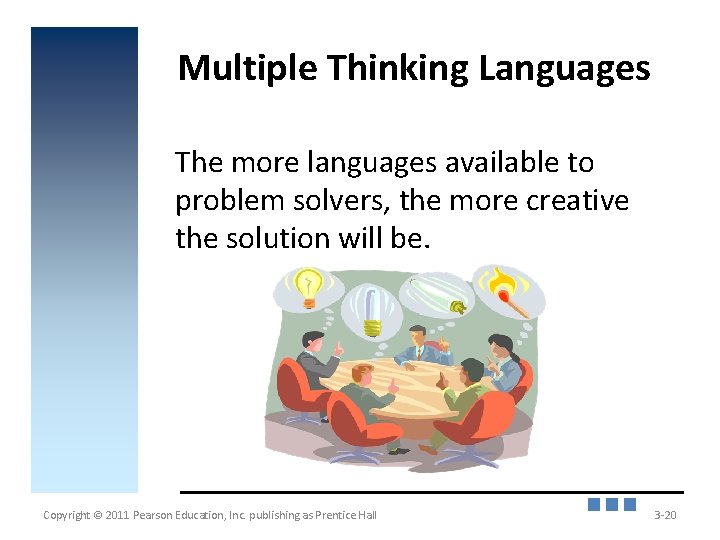
Multiple Thinking Languages The more languages available to problem solvers, the more creative the solution will be. Copyright © 2011 Pearson Education, Inc. publishing as Prentice Hall 3 -20 20
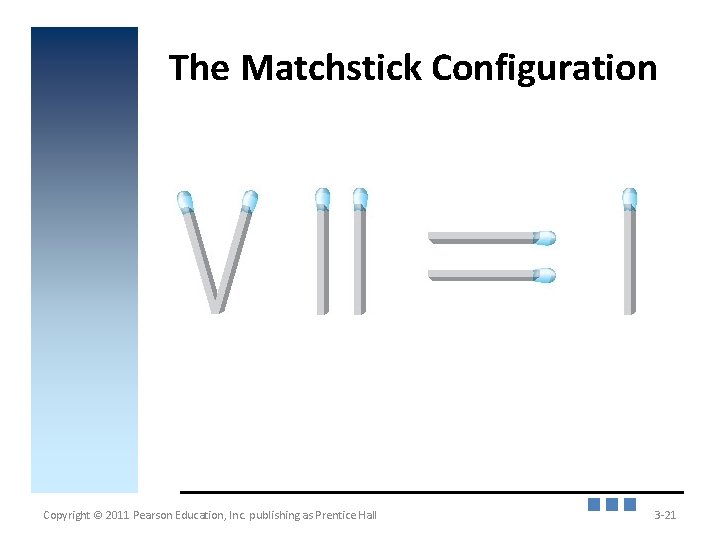
The Matchstick Configuration Copyright © 2011 Pearson Education, Inc. publishing as Prentice Hall 3 -21 21
Perceptual Stereotyping When individuals define present problems in terms of problems that they have faced in the past. Copyright © 2011 Pearson Education, Inc. publishing as Prentice Hall 3 -22 22
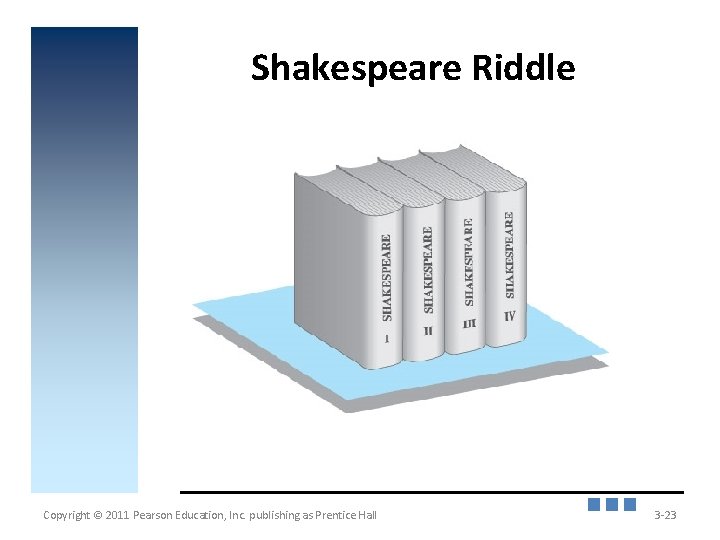
Shakespeare Riddle Copyright © 2011 Pearson Education, Inc. publishing as Prentice Hall 3 -23 23
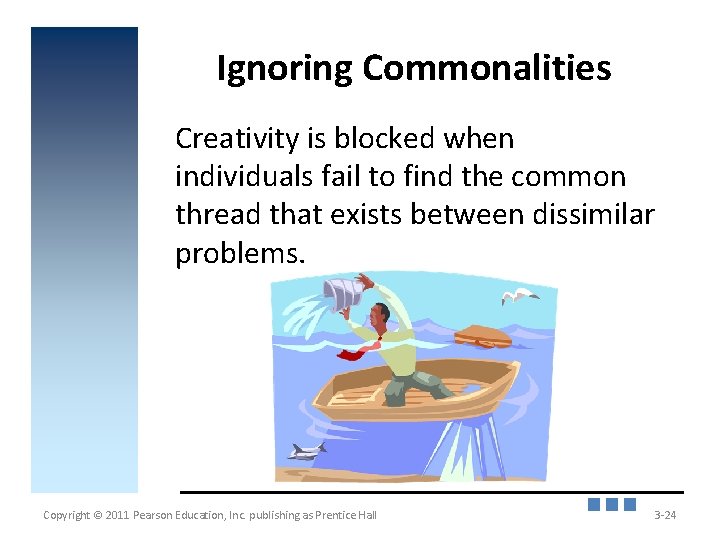
Ignoring Commonalities Creativity is blocked when individuals fail to find the common thread that exists between dissimilar problems. Copyright © 2011 Pearson Education, Inc. publishing as Prentice Hall 3 -24 24
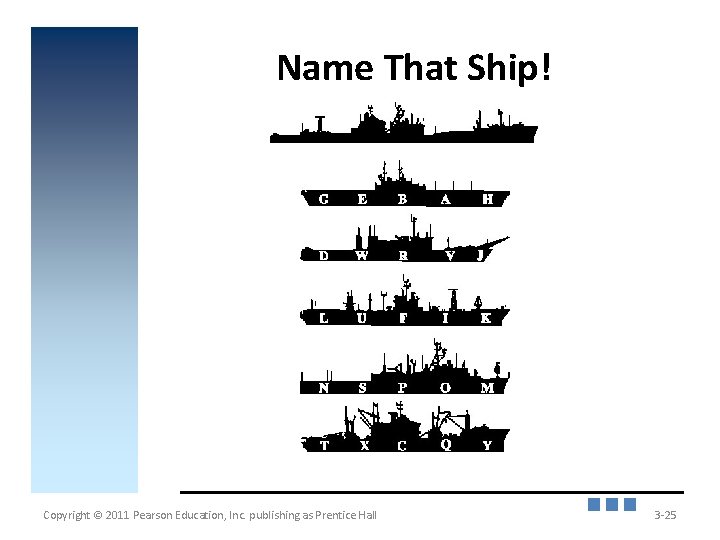
Name That Ship! Insert figure 3. 6 Copyright © 2011 Pearson Education, Inc. publishing as Prentice Hall 3 -25 25
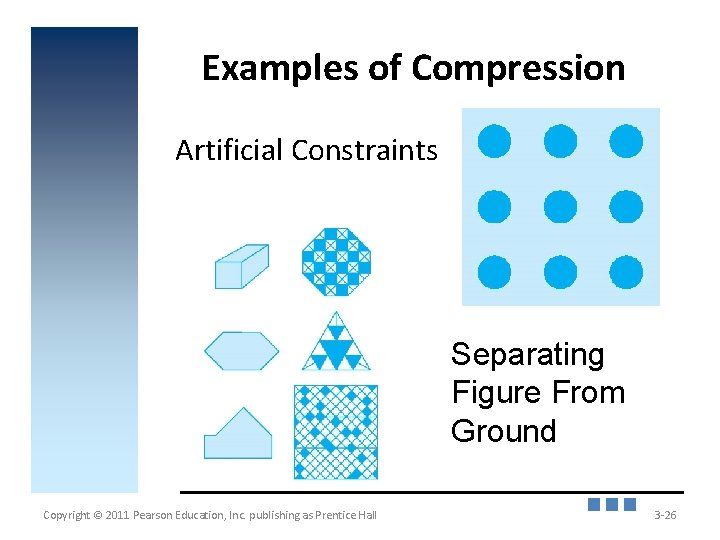
Examples of Compression Artificial Constraints Separating Figure From Ground Copyright © 2011 Pearson Education, Inc. publishing as Prentice Hall 3 -26 26
Examples of Complacency • Noninquisitiveness: Unwillingness to ask questions • Bias against thinking: Proclivity to avoid doing mental work Copyright © 2011 Pearson Education, Inc. publishing as Prentice Hall 3 -27 27
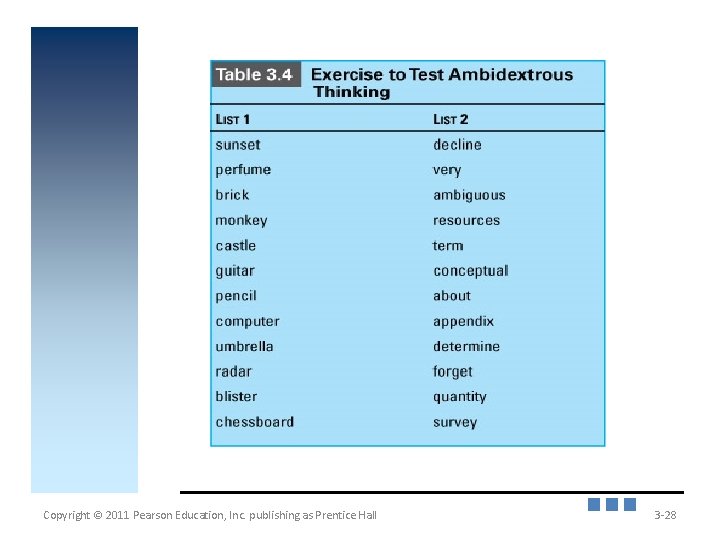
Insert Table 3. 4 Copyright © 2011 Pearson Education, Inc. publishing as Prentice Hall 3 -28 28
Stages in Creative Thought • Preparation • Incubation • Illumination • Verification Copyright © 2011 Pearson Education, Inc. publishing as Prentice Hall 3 -29 29
Ways to Improve Problem Definition • Make the strange familiar and the familiar strange – Synectics • Elaborate the definition • Reverse the definition Copyright © 2011 Pearson Education, Inc. publishing as Prentice Hall 3 -30 30
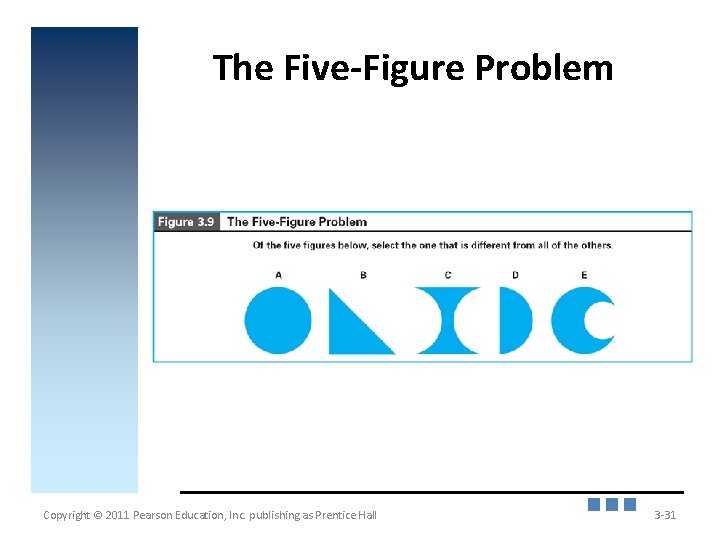
The Five-Figure Problem Copyright © 2011 Pearson Education, Inc. publishing as Prentice Hall 3 -31 31
Four Types of Analogies 1. 2. 3. 4. Copyright © 2011 Pearson Education, Inc. publishing as Prentice Hall Personal Direct Symbolic Fantasy 3 -32 32
Ways to Generate More Alternatives 1. Defer judgment – Brainstorming 2. Expand current alternatives 3. Combine unrelated attributes Copyright © 2011 Pearson Education, Inc. publishing as Prentice Hall 3 -33 33
Rules of Brainstorming 1. No evaluation of ideas is permitted 2. Wild ideas are encouraged 3. Quantity before quality 4. Build on ideas of others Copyright © 2011 Pearson Education, Inc. publishing as Prentice Hall 3 -34 34
Morphological Synthesis 1. The problem is written down 2. Attributes of the problem are listed 3. Alternatives to each attribute are listed 4. Different alternatives from the attributes are combined Copyright © 2011 Pearson Education, Inc. publishing as Prentice Hall 3 -35 35
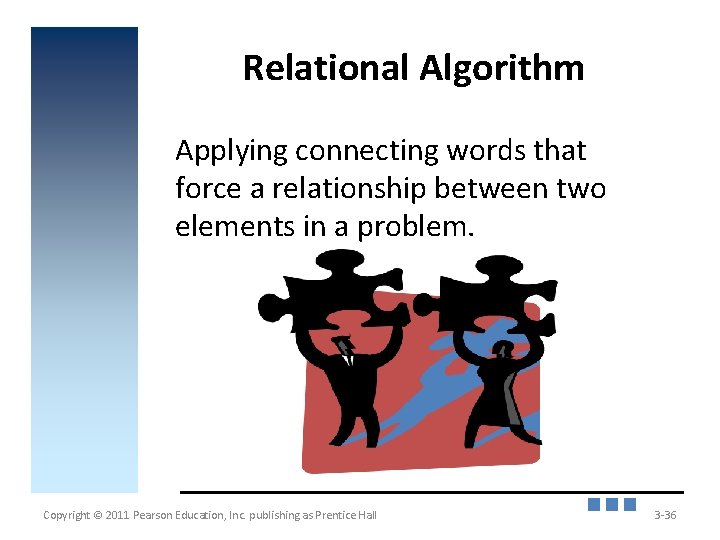
Relational Algorithm Applying connecting words that force a relationship between two elements in a problem. Copyright © 2011 Pearson Education, Inc. publishing as Prentice Hall 3 -36 36
Hints to Facilitate Creative Problem Solving • Give yourself relaxation time • Find a place where you can think • Talk to other people about ideas • Ask other people for their suggestions about your problems • Read a lot • Protect yourself from idea-killers Copyright © 2011 Pearson Education, Inc. publishing as Prentice Hall 3 -37 37
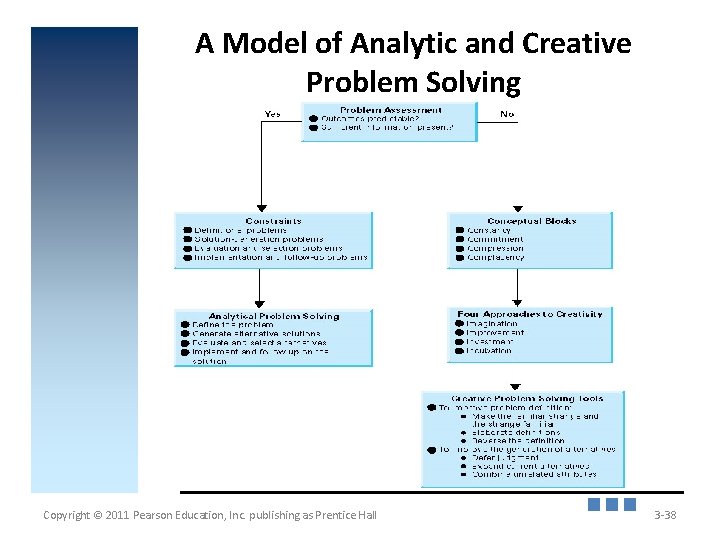
A Model of Analytic and Creative Problem Solving Insert figure 3. 10 Copyright © 2011 Pearson Education, Inc. publishing as Prentice Hall 3 -38 38
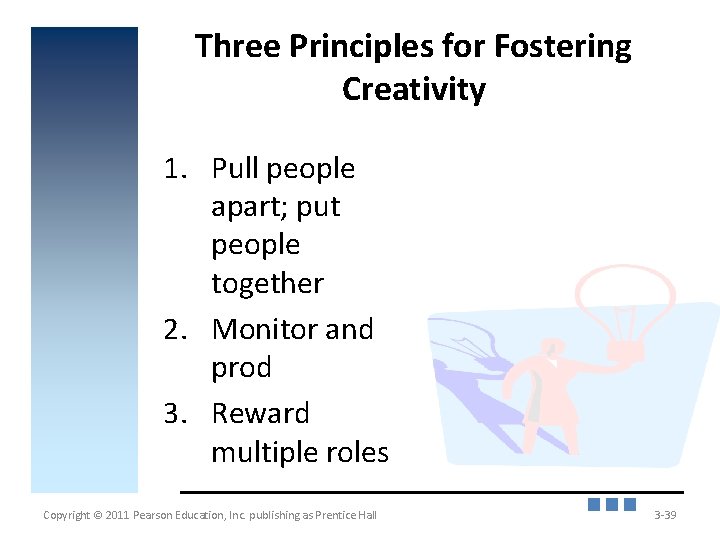
Three Principles for Fostering Creativity 1. Pull people apart; put people together 2. Monitor and prod 3. Reward multiple roles Copyright © 2011 Pearson Education, Inc. publishing as Prentice Hall 3 -39 39
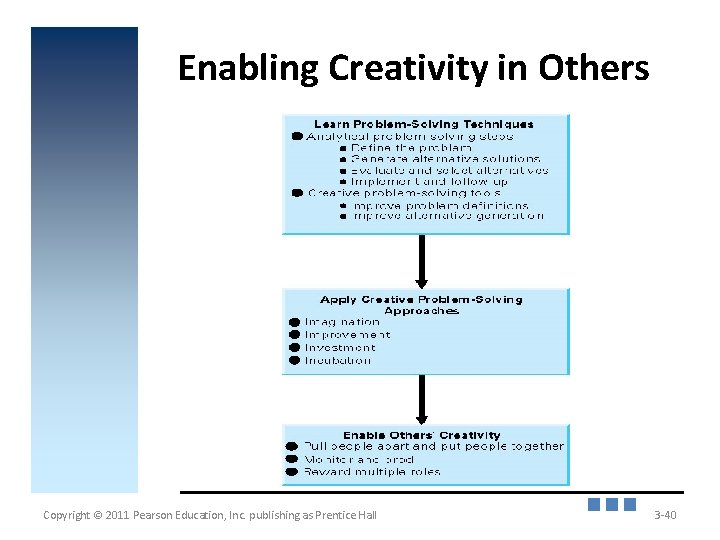
Enabling Creativity in Others Copyright © 2011 Pearson Education, Inc. publishing as Prentice Hall 3 -40 40
Behavioral Guidelines • Follow the four-step procedure for analytical decision-making • Employ the four types of creative decision-making • Implement steps to overcome conceptual blocks Copyright © 2011 Pearson Education, Inc. publishing as Prentice Hall 3 -41 41
Behavioral Guidelines • Use techniques to elaborate the problem definition • Foster creativity among those with whom you work Copyright © 2011 Pearson Education, Inc. publishing as Prentice Hall 3 -42 42

All rights reserved. No part of this publication may be reproduced, stored in a retrieval system, or transmitted, in any form or by any means, electronic, mechanical, photocopying, recording, or otherwise, without the prior written permission of the publisher. Printed in the United States of America. Copyright © 2011 Pearson Education, Inc. publishing as Prentice Hall
- Slides: 43