
Developing Individualized Intervention Plans and Programs and Monitoring
- Slides: 20
Developing Individualized Intervention Plans and Programs and Monitoring Progress CHAPTER 3 (COOK)
Learning Outcomes Describe IFSP and IEP processes. Explain that essential to planning processes is effective collaboration among families & service providers. Explain how to identify family concerns, priorities, and resources through a family-directed approach. Describe how a multidisciplinary assessment team is expected to collaborate with the parents in developing the individualized service plans and programs. Describe how to minimize family stress by careful planning of transition steps to the next educational environment.
The Individualized Family Service Plan (IFSP) Process for Infants, Toddlers, and their Families IFSP=Individualized Family Service Plan-a written document specified in IDEA to guide the implementation of early intervention services for children from birth to age 3 and their families. developed through collaborative interchanges between families & professionals the role of the IFSP is to identify & organize formal and informal resources to facilitate families’ goals for their children & themselves it is more so a process rather than a product for establishing & maintaining a productive and supportive professionalfamily relationship the process itself is intended to support the natural caregiving role of families there is a continuous gathering, sharing, exchanging, ad expanding of information family-centered
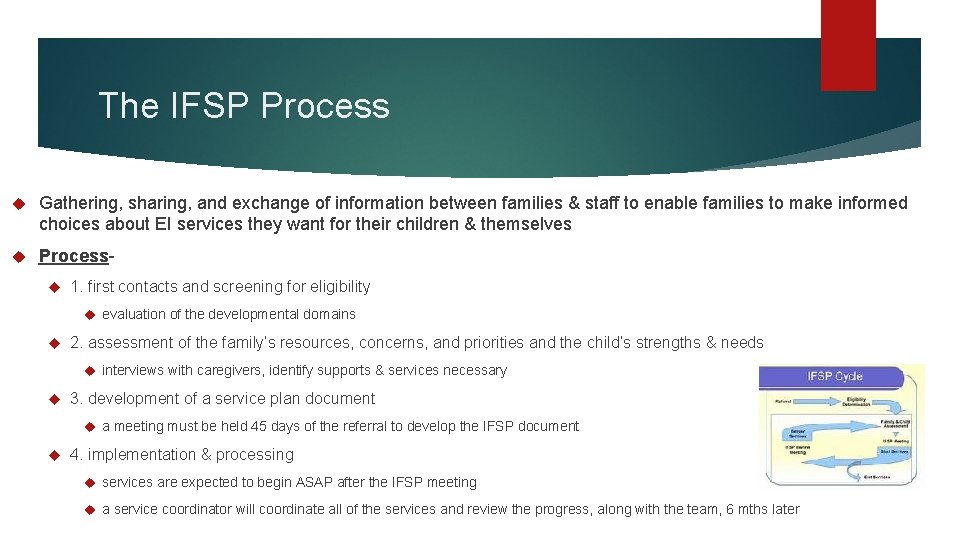
The IFSP Process Gathering, sharing, and exchange of information between families & staff to enable families to make informed choices about EI services they want for their children & themselves Process 1. first contacts and screening for eligibility evaluation of the developmental domains 2. assessment of the family’s resources, concerns, and priorities and the child’s strengths & needs interviews with caregivers, identify supports & services necessary 3. development of a service plan document a meeting must be held 45 days of the referral to develop the IFSP document 4. implementation & processing services are expected to begin ASAP after the IFSP meeting a service coordinator will coordinate all of the services and review the progress, along with the team, 6 mths later
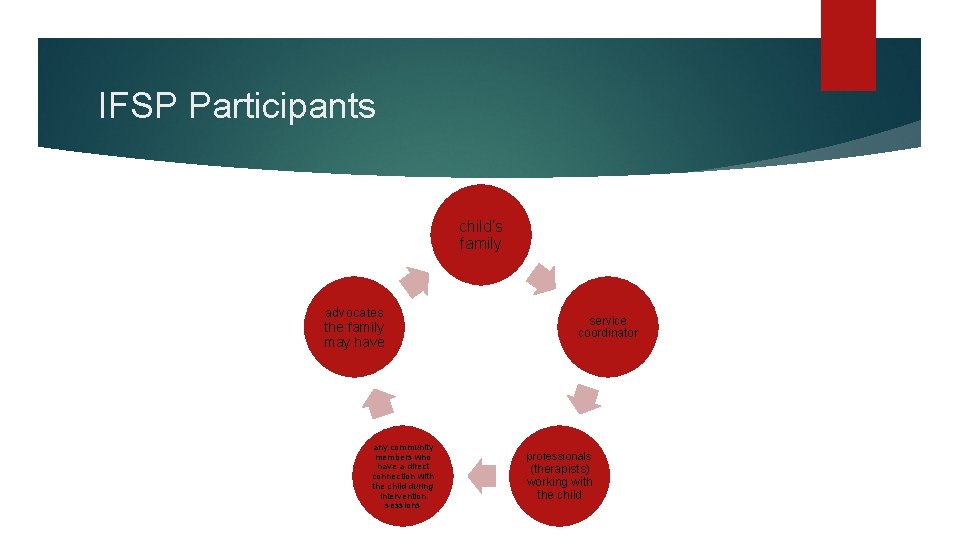
IFSP Participants child’s family advocates the family may have any community members who have a direct connection with the child during intervention sessions service coordinator professionals (therapists) working with the child
IFSP-Identifying Family Concerns The word “concern” is used instead of the word “needs, ” which implies the child/family needs to be fixed. The term concern is used in an effort to encourage the view that families are competent and able to make choices based on their concerns & priorities. The law states that there must be “ a family-directed assessment of the resources, priorities, and concerns of the family” (PL 108 -446); family-centered approach to assessment integrity of each family to be primary decisions makers; opinions of the family should be sought 4 basic qualities educators must develop to effectively collaborate with families: 1. possess knowledge & skills related to children w/disabilities 2. work within the context of the family & community 3. be positive & open-minded 4. follow through on promises
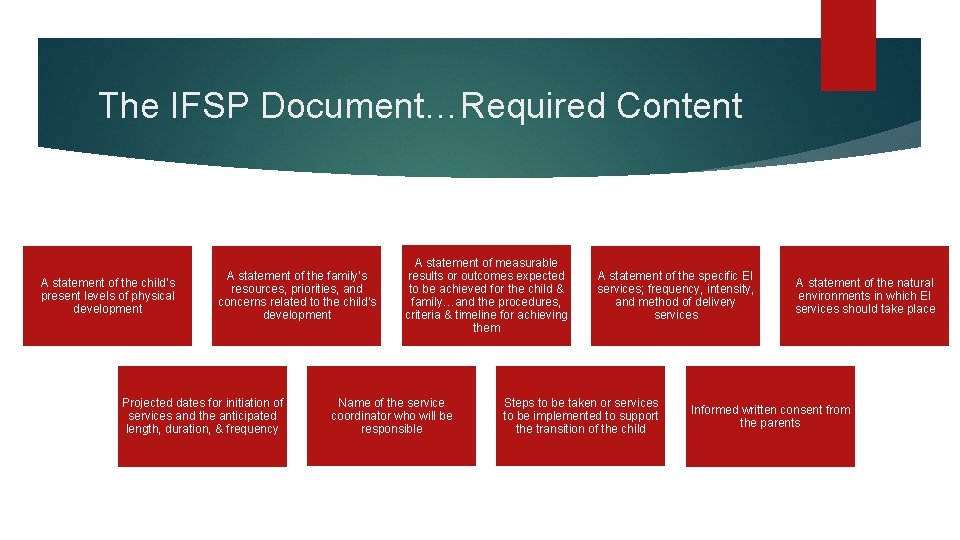
The IFSP Document…Required Content A statement of the child’s present levels of physical development A statement of the family’s resources, priorities, and concerns related to the child’s development Projected dates for initiation of services and the anticipated length, duration, & frequency A statement of measurable results or outcomes expected to be achieved for the child & family…and the procedures, criteria & timeline for achieving them Name of the service coordinator who will be responsible A statement of the specific EI services; frequency, intensity, and method of delivery services Steps to be taken or services to be implemented to support the transition of the child A statement of the natural environments in which EI services should take place Informed written consent from the parents
The IFSP Document IFSP outcome statements-are to reflect changes family members want to see for their child or themselves. Each outcome is to be stated functionally (in the language of the family) in terms of what is to occur (process) and what is to be expected as a result of these actions (product). Example: “Josh will pull to stand cruise along the sofa in order to begin walking. ” they should refer to practical activities that fit into a family’s daily life and represent skills that enhance the child’s ability to participate in daily routines this “formula” allows the result (product: walking) of the process (pull to stand) to be readily understood & identifies the daily routine in which the child will be motivated to learn the skill (Mc. William, 2010) Activity: Using pgs 73 -78 in the textbook, locate and identify each required component of sample document. the IFSP
Service Coordination Laws mandate that a service coordinator be designated to endure the full development of the IFSP for birth-3 yr olds & their families. Service coordination consists primarily of activities designed to assist & enable an eligible child & the child’s family to receive the rights, procedural safeguards, and services that are authorized through the state’s EI program. full coordination of the IFSP process inclusion of parents as team members scheduling & facilitating assessments & meetings acquiring an interpreter, if needed informing families of community resources and advocacy services facilitating the development of a transition plan to preschool services, when needed
Promoting Essential Interagency Collaboration Community networking-describes the efforts involved in coordinating services among agencies. reduces fragmentation of services, duplication of services, and can help families gain easy access to needed services Early education specialists need to develop a clear understanding of the needs child and family and a thorough knowledge of the available resources. of each
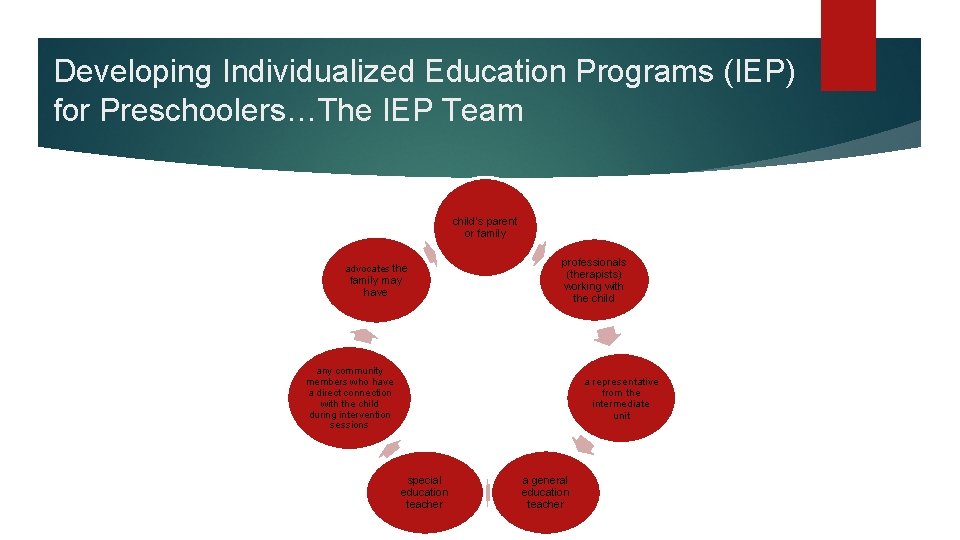
Developing Individualized Education Programs (IEP) for Preschoolers…The IEP Team child’s parent or family advocates the family may have professionals (therapists) working with the child any community members who have a direct connection with the child during intervention sessions a representative from the intermediate unit special education teacher a general education teacher
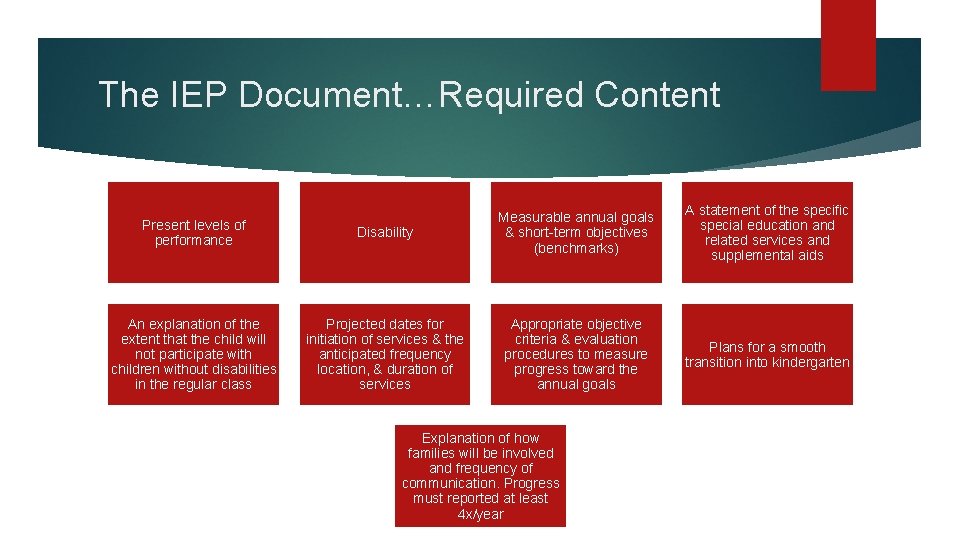
The IEP Document…Required Content Present levels of performance Disability Measurable annual goals & short-term objectives (benchmarks) An explanation of the extent that the child will not participate with children without disabilities in the regular class Projected dates for initiation of services & the anticipated frequency location, & duration of services Appropriate objective criteria & evaluation procedures to measure progress toward the annual goals Explanation of how families will be involved and frequency of communication. Progress must reported at least 4 x/year A statement of the specific special education and related services and supplemental aids Plans for a smooth transition into kindergarten
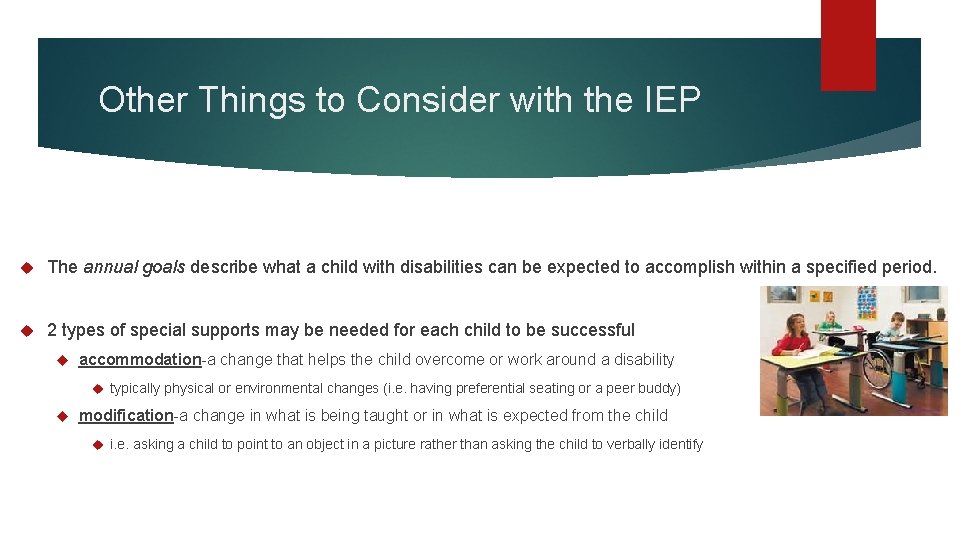
Other Things to Consider with the IEP The annual goals describe what a child with disabilities can be expected to accomplish within a specified period. 2 types of special supports may be needed for each child to be successful accommodation-a change that helps the child overcome or work around a disability typically physical or environmental changes (i. e. having preferential seating or a peer buddy) modification-a change in what is being taught or in what is expected from the child i. e. asking a child to point to an object in a picture rather than asking the child to verbally identify
The IEP Document A very important legal document meant to ensure the provisions of appropriate, effective, educational services for children who have disabilities. Very detailed and lengthy electronic document Includes both goals and behavioral objectives (used to describe observable behaviors) Behavioral objectives (“SMART”) Specific Measurable use Action words Realistic & relevant Time-limited Examples of “goal verbs: ” to decrease, to develop, to improve, to practice Examples of “behavioral verbs: ” to color, to imitate, to look at, to say, to sort, to hold
Video: Model IEP Meeting You Tube-Transition from Early Intervention to Preschool: Model IEP Meeting (14: 06 min) https: //www. youtube. com/watch? v=MWnb. HPMg 2 EA
Becoming a Skilled Observer Informal observations help provide a more comprehensive view of the child than do sole checklists, rating scales, and tests. primary purpose of observation is to determine the strength’s and weaknesses in children’s learning repertoires to develop instructional goals & strategies. Teachers should incorporate the following abilities into their observational repertoire: understanding of what is to be considered “normal” behavior recognizing risk factors or high-risk signals ability to follow guidelines for responsible observation awareness of the influence of performance styles, motivational factors, environmental variabilities, & extraneous behaviors on the judgments to be made about the strengths/weaknesses use of confidentiality, restraint from labeling and stereo-typed expectations
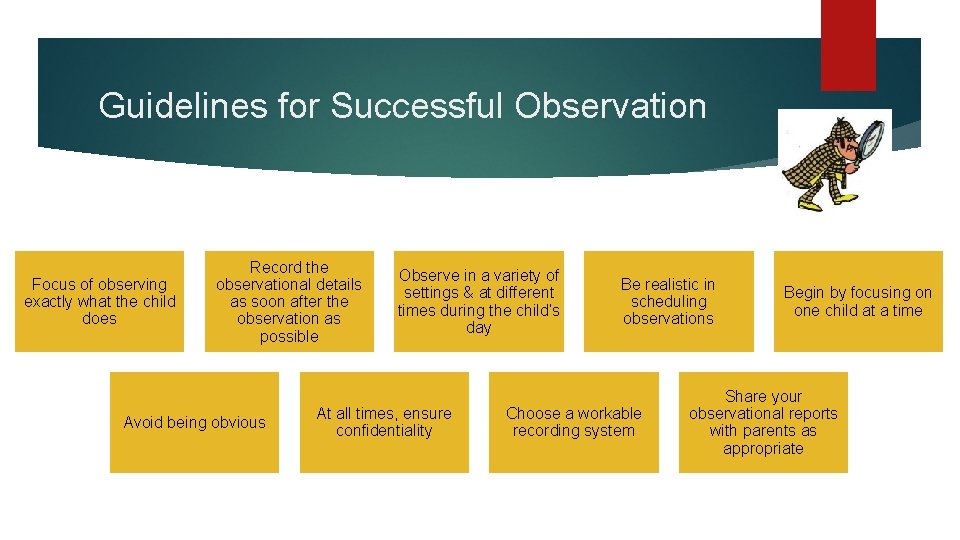
Guidelines for Successful Observation Focus of observing exactly what the child does Record the observational details as soon after the observation as possible Avoid being obvious Observe in a variety of settings & at different times during the child’s day At all times, ensure confidentiality Be realistic in scheduling observations Choose a workable recording system Begin by focusing on one child at a time Share your observational reports with parents as appropriate
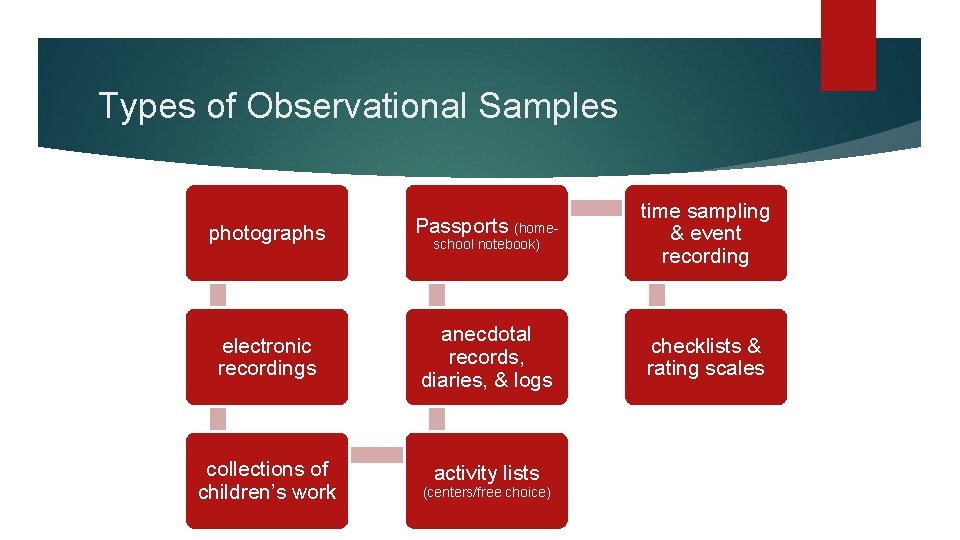
Types of Observational Samples photographs Passports (home- time sampling & event recording electronic recordings anecdotal records, diaries, & logs checklists & rating scales collections of children’s work activity lists school notebook) (centers/free choice)
Video: Video 3. 2 Foundations of Transition (8: 18 min) https: //www. youtube. com/watch? v=CUHk. AENZi. Rc Overview of the desirable outcomes of transition, effective transition practices, & legal requirements for early childhood transition
Facilitating Program Transitions mean change! IDEA makes a major distinction between services for infants & toddlers (birth-3) and preschoolers (3 -5/6 year old), transitions from early intervention to preschool, and from preschool to kindergarten. Transitions must be spelled out in IFSP’s and IEP’s & service coordinators must help support families during these times of change. involves careful planning implemented in the context of a partnership with the child’s family Transition planning begins 6 months prior to the transition taking placement should be discussed visits to potential programs may occur information is shared The transition process should be made as smooth as possible for the child & family!