
Developing HighQuality Functional IFSP Outcomes and IEP Goals
- Slides: 49
Developing High-Quality, Functional IFSP Outcomes and IEP Goals presented in collaboration with
Developers Anne Lucas ECTA Center / WRRC Kathi Gillaspy ECTA Center Mary Peters ECTA Center With contributions from Naomi Younggren, Department of Defense/Army Early Intervention; Debbie Cate, ECTA Center; Megan Vinh, WRRC; Joicey Hurth, ECTA Center/NERRC; Christina Kasprzak, ECTA Center; and Grace Kelley, SERRC 2
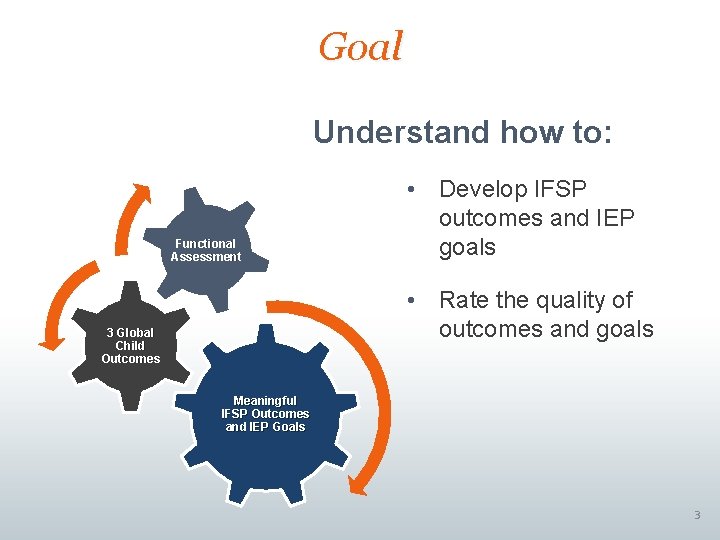
Goal Understand how to: Functional Assessment • Develop IFSP outcomes and IEP goals • Rate the quality of outcomes and goals 3 Global Child Outcomes Meaningful IFSP Outcomes and IEP Goals 3
SECTION 4 ______________________________ FUNCTIONAL, HIGHQUALITY IFSP OUTCOMES • IFSP Outcome Requirements AND IEP GOALS • Developing Functional, High Quality IFSP Outcomes • IEP Goal Requirements • Developing Functional, High Quality IEP Goals • Rating Activity: IFSP Outcome and IEP Goal Statements
Using Information to Develop Outcomes/Goals 1) Start with parents’/caregivers’ priorities about child’s learning/development and/or family’s needs 2) Consider what’s working and what’s challenging in everyday routines and activities 3) Consider how the child’s developmental skills, needs and disability influence the child’s learning and participation in everyday routines and activities 5
Relationship of Outcomes/Goals to Placement and Services First… develop IFSP outcomes/IEP goals based on functional, authentic assessment information Then… determine placement, services and supports based on what is necessary to meet the outcomes/goals 6
Requirements for IFSP Outcomes IFSP must include: • A statement of the measurable results or measurable outcomes expected to be achieved for the child and family (including pre-literacy and language skills as developmentally appropriate for the child) • The criteria, procedures, and timelines used to determine the degree to which progress toward achieving the results or outcomes is being made and whether modifications or revision of the expected results or outcomes or services are necessary 34 CFR § 303. 344 (c) 7
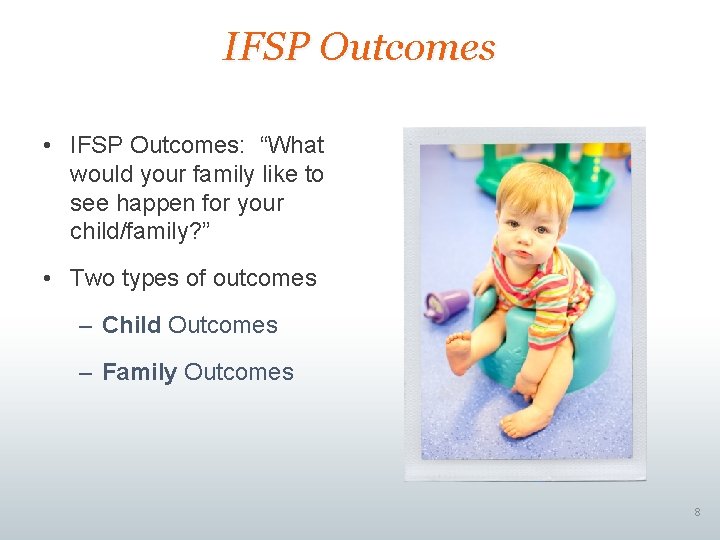
IFSP Outcomes • IFSP Outcomes: “What would your family like to see happen for your child/family? ” • Two types of outcomes – Child Outcomes – Family Outcomes 8
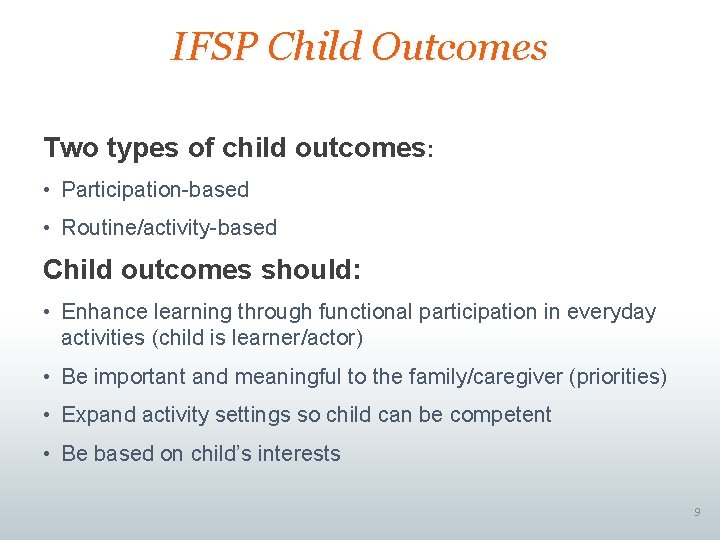
IFSP Child Outcomes Two types of child outcomes: • Participation-based • Routine/activity-based Child outcomes should: • Enhance learning through functional participation in everyday activities (child is learner/actor) • Be important and meaningful to the family/caregiver (priorities) • Expand activity settings so child can be competent • Be based on child’s interests 9
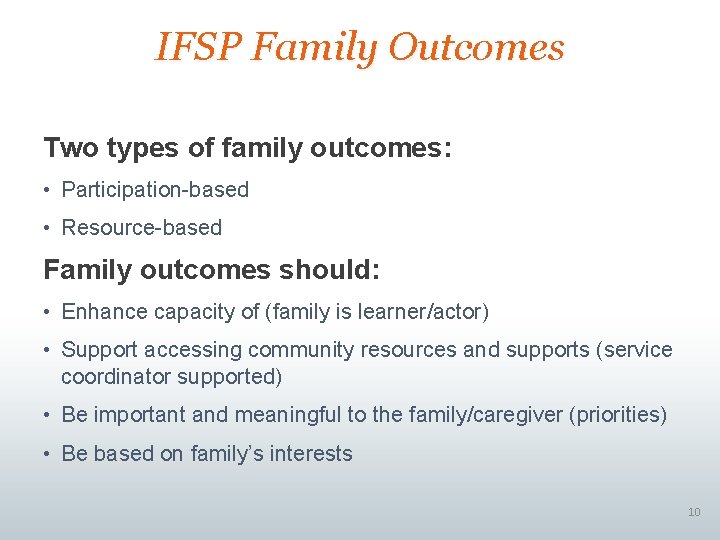
IFSP Family Outcomes Two types of family outcomes: • Participation-based • Resource-based Family outcomes should: • Enhance capacity of (family is learner/actor) • Support accessing community resources and supports (service coordinator supported) • Be important and meaningful to the family/caregiver (priorities) • Be based on family’s interests 10
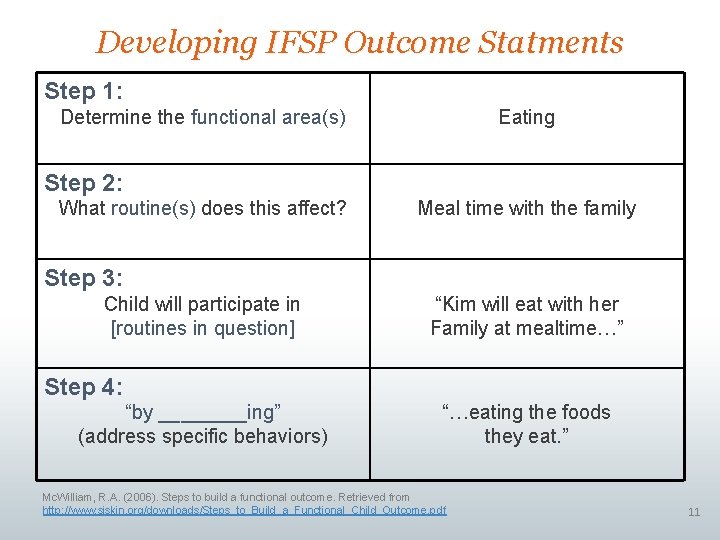
Developing IFSP Outcome Statments Step 1: Determine the functional area(s) Eating Step 2: What routine(s) does this affect? Meal time with the family Step 3: Child will participate in [routines in question] “Kim will eat with her Family at mealtime…” Step 4: “by ____ing” (address specific behaviors) “…eating the foods they eat. ” Mc. William, R. A. (2006). Steps to build a functional outcome. Retrieved from http: //www. siskin. org/downloads/Steps_to_Build_a_Functional_Child_Outcome. pdf 11
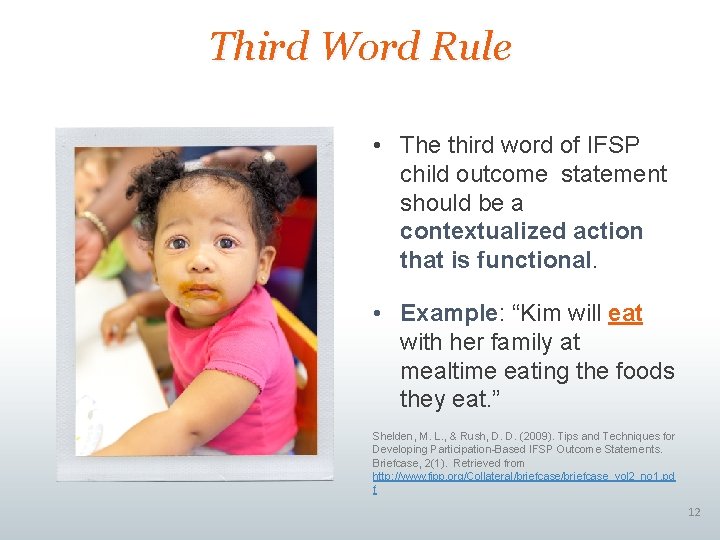
Third Word Rule • The third word of IFSP child outcome statement should be a contextualized action that is functional. • Example: “Kim will eat with her family at mealtime eating the foods they eat. ” Shelden, M. L. , & Rush, D. D. (2009). Tips and Techniques for Developing Participation-Based IFSP Outcome Statements. Briefcase, 2(1). Retrieved from http: //www. fipp. org/Collateral/briefcase_vol 2_no 1. pd f 12
Developing Criteria, Procedures and Timelines • What are the ways in which the family and team will work toward achieving this outcome? • Who will help and what will they do? • How will the team know they’ve made progress or if revisions are needed to outcomes or services? 13
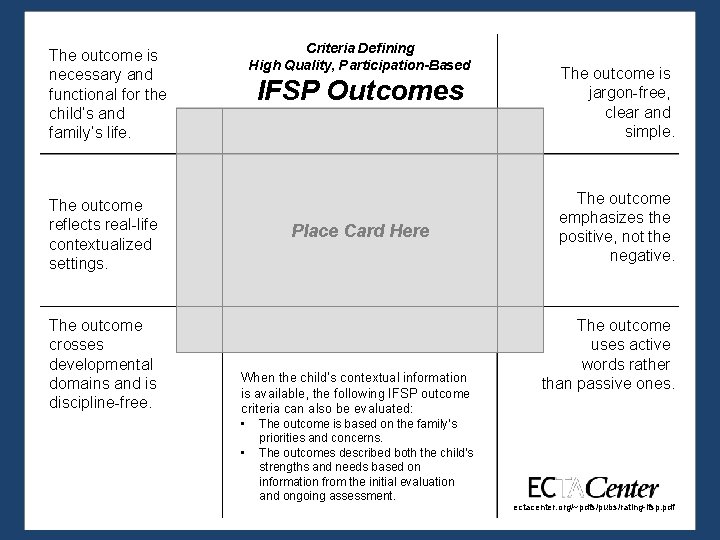
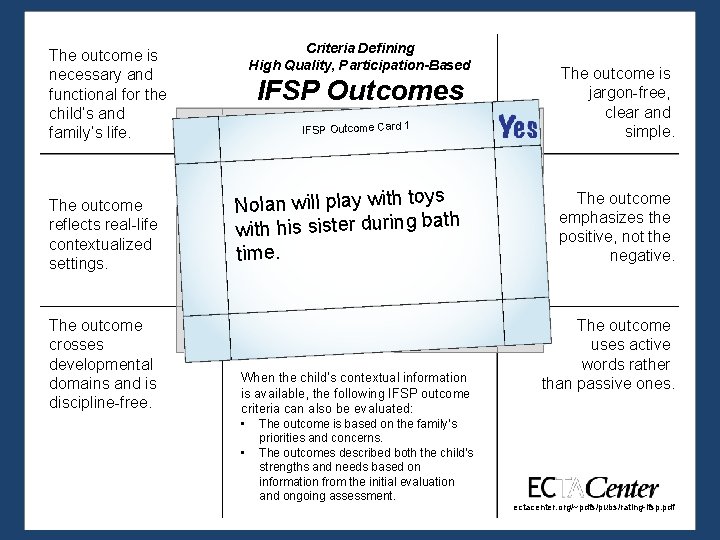
High-Quality, Functional IFSP Outcomes • Necessary and functional for child’s and family’s life • Reflect real-life contextualized settings • Crosses developmental domains and is discipline-free • Jargon-free, clear and simple • Emphasize the positive, not the negative • Uses active words rather than passive words 14
Criteria Definitions • Necessary and functional for child’s and family’s life – Supports participation in community life and family activities – Based up on what is important to the family – Supports child’s progress towards outcomes • It is not based on what the practitioner thinks 15
Criteria Definitions • Reflects real-life, contextualized settings – Everyday activity settings and routines for the child and family • Includes typical routines such as meal time • Also includes routines and activities specific to the family. • Test items are not real-life or contextualized 16
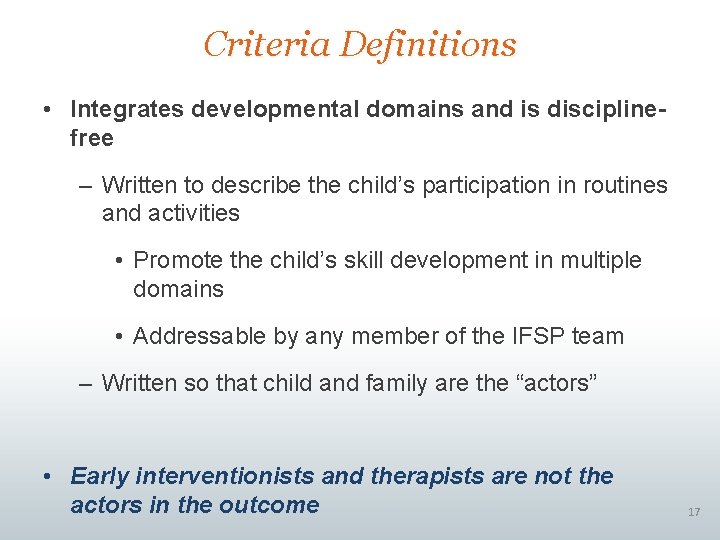
Criteria Definitions • Integrates developmental domains and is disciplinefree – Written to describe the child’s participation in routines and activities • Promote the child’s skill development in multiple domains • Addressable by any member of the IFSP team – Written so that child and family are the “actors” • Early interventionists and therapists are not the actors in the outcome 17
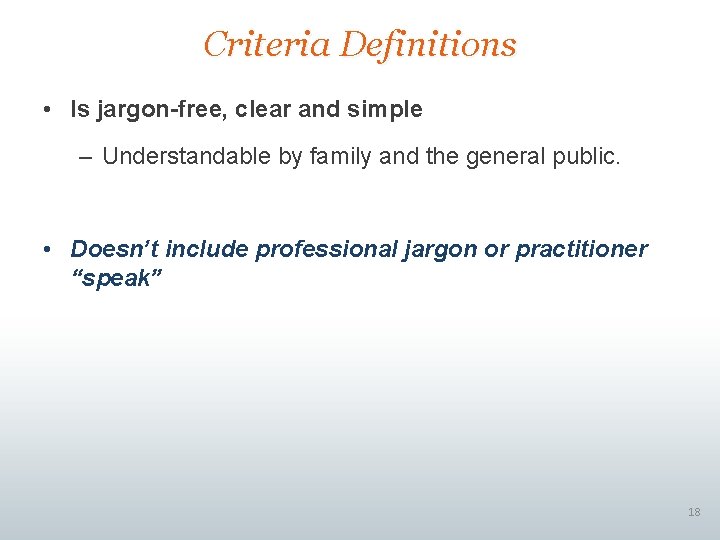
Criteria Definitions • Is jargon-free, clear and simple – Understandable by family and the general public. • Doesn’t include professional jargon or practitioner “speak” 18
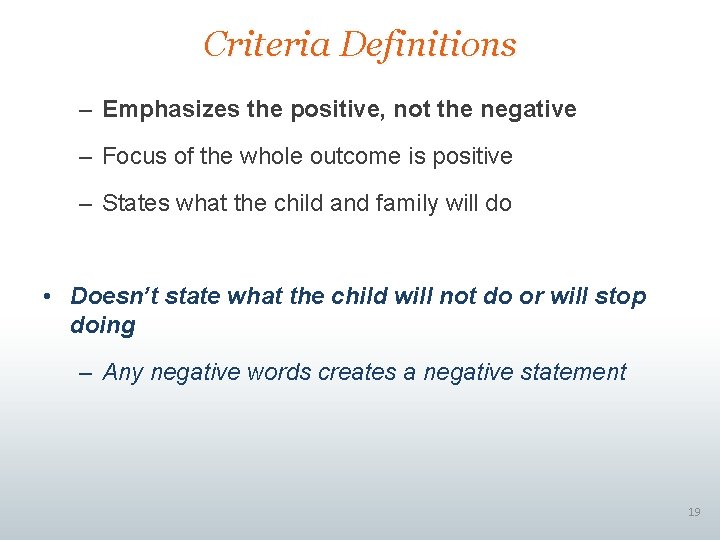
Criteria Definitions – Emphasizes the positive, not the negative – Focus of the whole outcome is positive – States what the child and family will do • Doesn’t state what the child will not do or will stop doing – Any negative words creates a negative statement 19
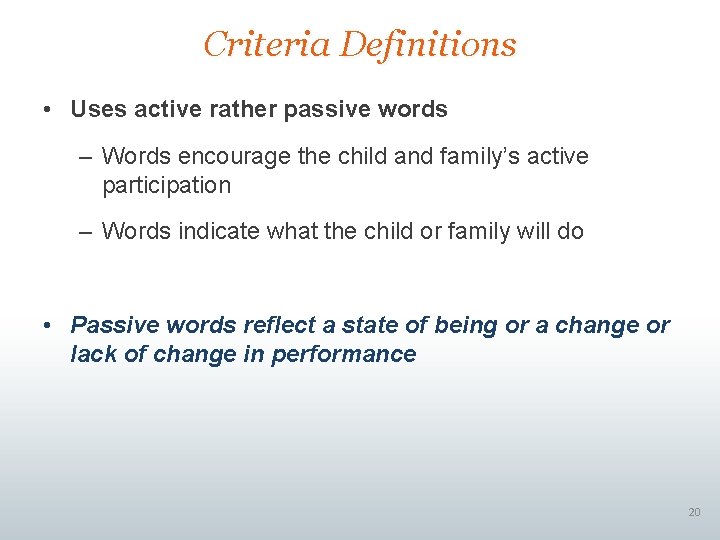
Criteria Definitions • Uses active rather passive words – Words encourage the child and family’s active participation – Words indicate what the child or family will do • Passive words reflect a state of being or a change or lack of change in performance 20
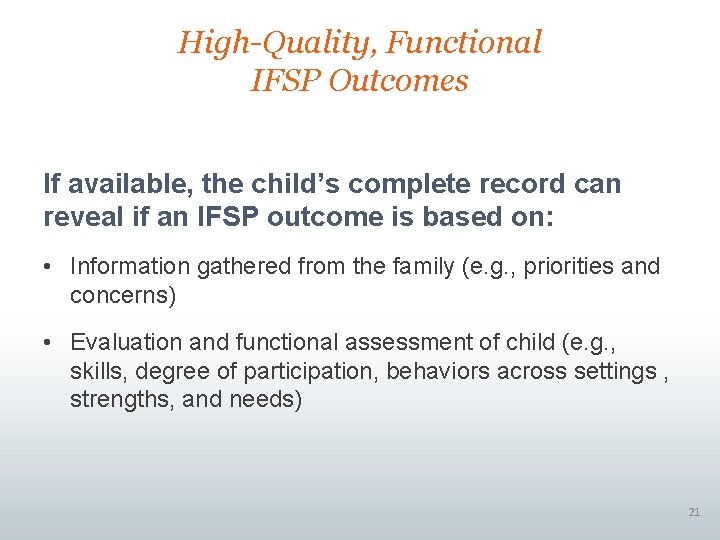
High-Quality, Functional IFSP Outcomes If available, the child’s complete record can reveal if an IFSP outcome is based on: • Information gathered from the family (e. g. , priorities and concerns) • Evaluation and functional assessment of child (e. g. , skills, degree of participation, behaviors across settings , strengths, and needs) 21
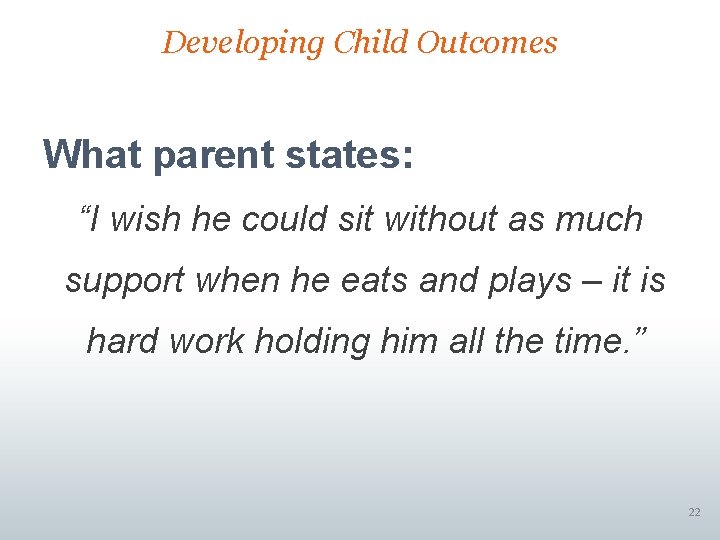
Developing Child Outcomes What parent states: “I wish he could sit without as much support when he eats and plays – it is hard work holding him all the time. ” 22
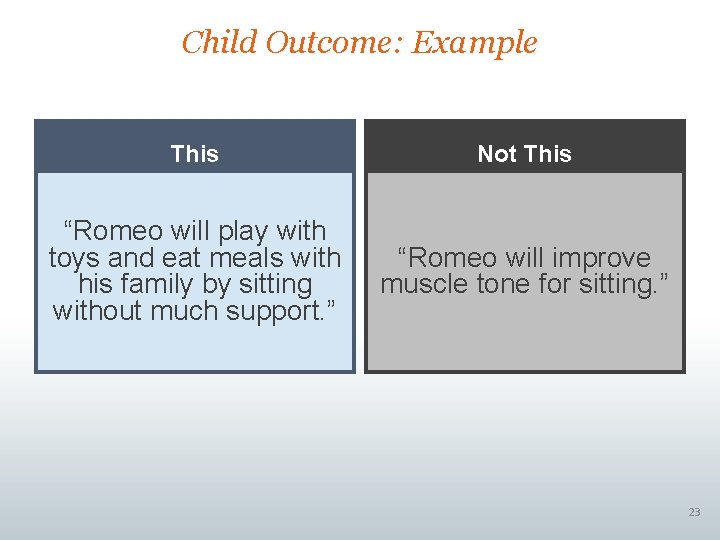
Child Outcome: Example This Not This “Romeo will play with toys and eat meals with his family by sitting without much support. ” “Romeo will improve muscle tone for sitting. ” 23
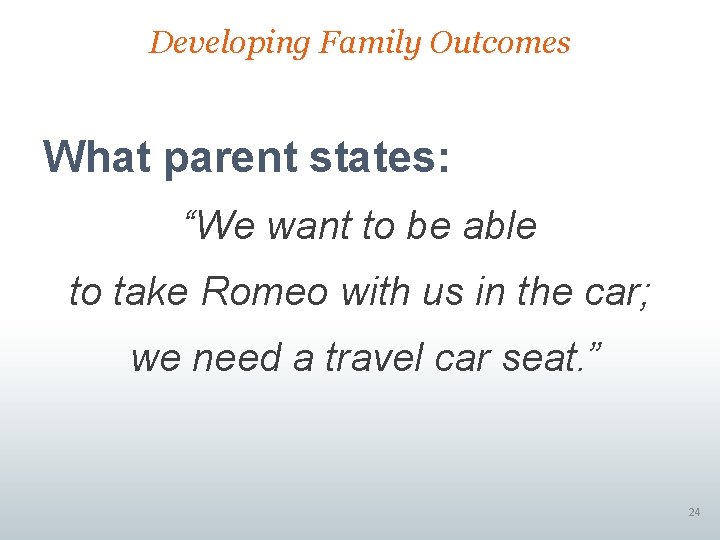
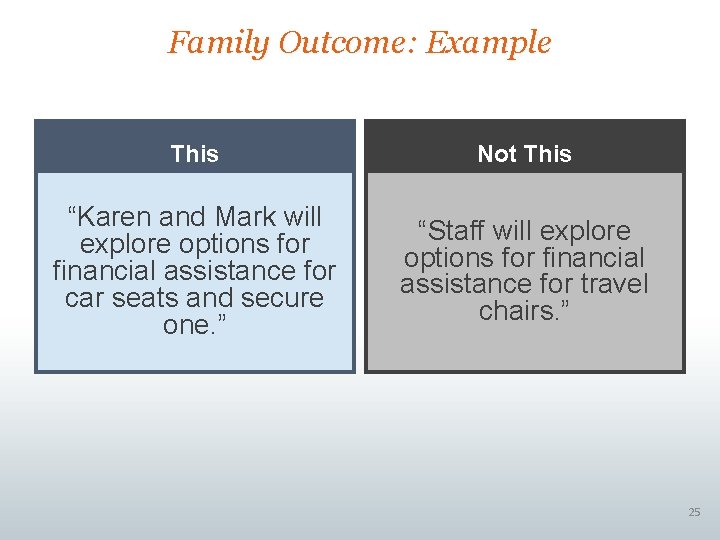
Developing Family Outcomes What parent states: “We want to be able to take Romeo with us in the car; we need a travel car seat. ” 24
Family Outcome: Example This Not This “Karen and Mark will explore options for financial assistance for car seats and secure one. ” “Staff will explore options for financial assistance for travel chairs. ” 25
the IEP: IDEA Requirements 1. Present levels of academic achievement and functional performance, including: • How the child's disability affects the child's involvement and progress in the general education curriculum (i. e. , the same curriculum as for nondisabled children), or • For preschool children, as appropriate, how the disability affects the child's participation in appropriate activities 34 CFR § 300. 320 -324 26
the IEP: IDEA Requirements 2. Measurable annual goals, including academic and functional goals: • Related to the child's needs that result from the disability to enable the child to be involved in and make progress in the general education curriculum, and • Meet each of the child's other educational needs that result from the child's disability - Where required, benchmarks or short-term objectives must be included 34 CFR § 300. 320 -324 27
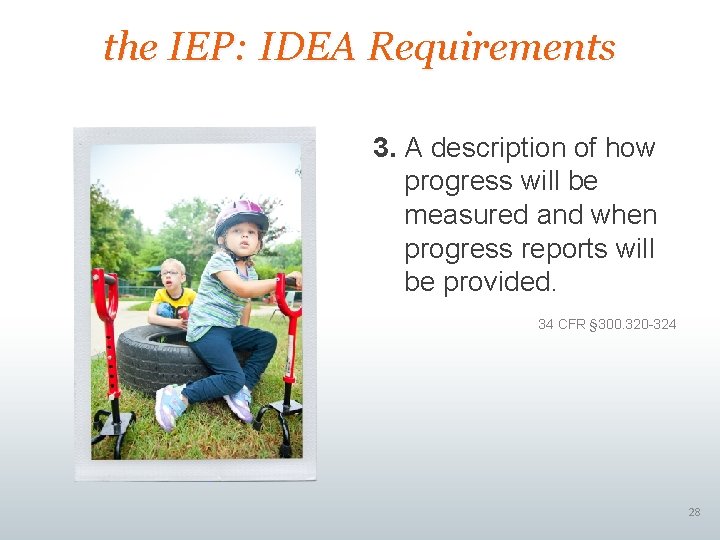
the IEP: IDEA Requirements 3. A description of how progress will be measured and when progress reports will be provided. 34 CFR § 300. 320 -324 28
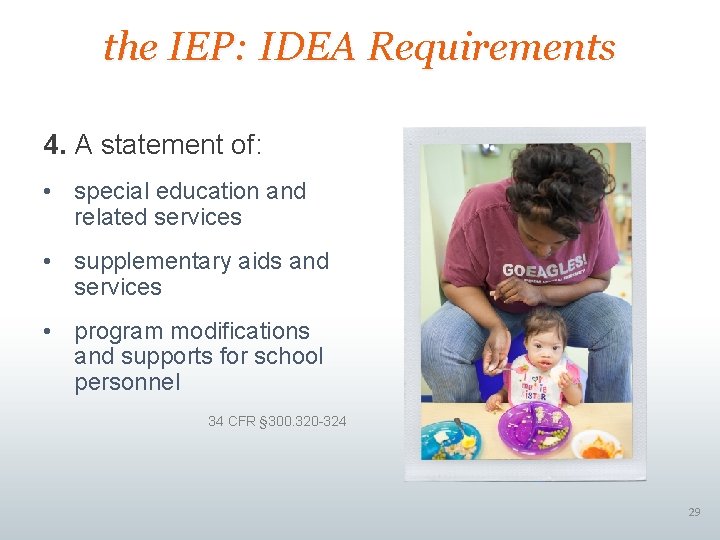
the IEP: IDEA Requirements 4. A statement of: • special education and related services • supplementary aids and services • program modifications and supports for school personnel 34 CFR § 300. 320 -324 29
the IEP: IDEA Requirements 5. The projected beginning service date including the anticipated frequency, location, and duration 34 CFR § 300. 320 -324 30
the IEP: IDEA Requirements 6. An explanation of the extent, if any, to which the child will not participate with nondisabled children in the regular class and activities 34 CFR § 300. 320 -324 31
the IEP: IDEA Requirements 7. Individually appropriate accommodations necessary to measure the academic achievement and functional performance of the child on State and district-wide assessments 34 CFR § 300. 320 -324 32
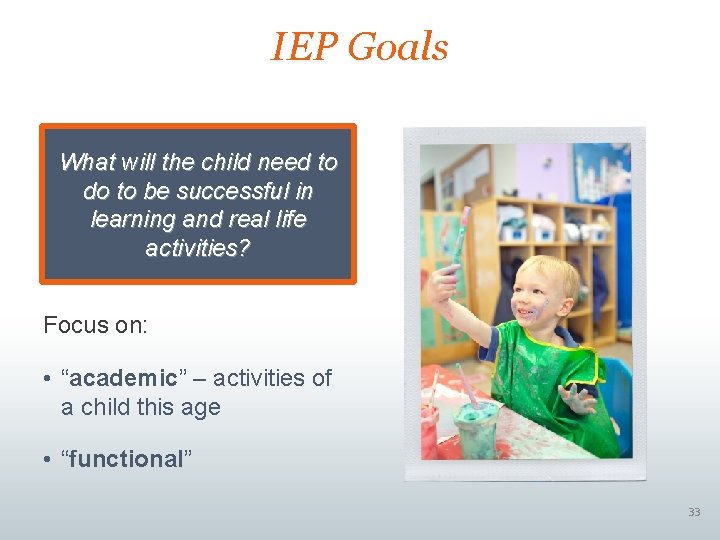
IEP Goals What will the child need to do to be successful in learning and real life activities? Focus on: • “academic” – activities of a child this age • “functional” 33
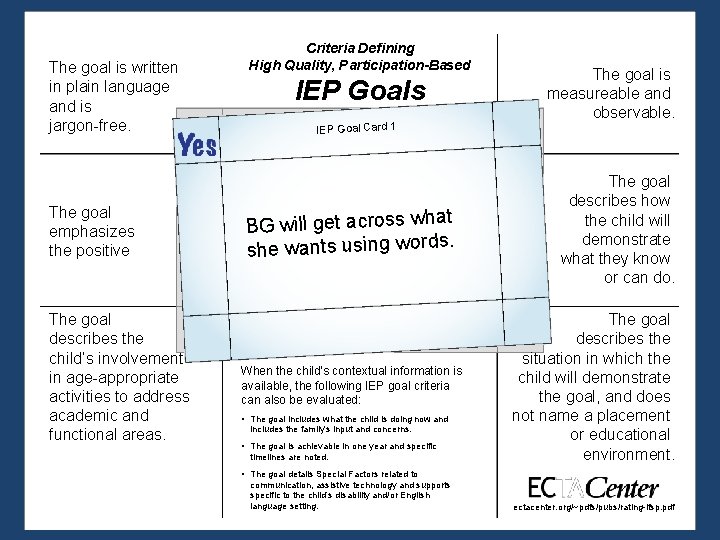
High-Quality, Functional IEP Goals • Describe how the child will demonstrate what s/he knows • Are written in plain language and are jargon free • Describe the child’s involvement in age-appropriate activities to address ‘academic and functional’ areas • Emphasize the positive • Describe conditions in which the child will demonstrate progress • Are measurable and observable 34
High-Quality, Functional IEP Goals The child’s complete IEP will reveal if an IEP goal is: • Achievable in one year • Includes what the child is doing now and the family’s input and concerns • Includes special factors related to communication, assistive technology and supports specific to the child’s disability and/or English language learning 35
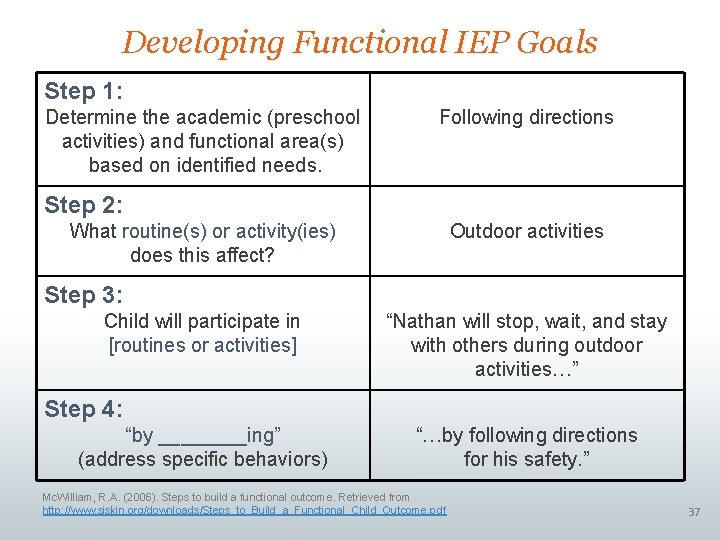
Developing IEP Goals What parent states: “Nathan runs across the parking lot when we leave the grocery store and we are very concerned for his safety. ” Teacher input: “When Nathan is inside he listens to a reminder to stay with his friends, but when he is outside he often runs toward the bus. ” 36
Developing Functional IEP Goals Step 1: Determine the academic (preschool activities) and functional area(s) based on identified needs. Following directions Step 2: What routine(s) or activity(ies) does this affect? Outdoor activities Step 3: Child will participate in [routines or activities] “Nathan will stop, wait, and stay with others during outdoor activities…” Step 4: “by ____ing” (address specific behaviors) “…by following directions for his safety. ” Mc. William, R. A. (2006). Steps to build a functional outcome. Retrieved from http: //www. siskin. org/downloads/Steps_to_Build_a_Functional_Child_Outcome. pdf 37
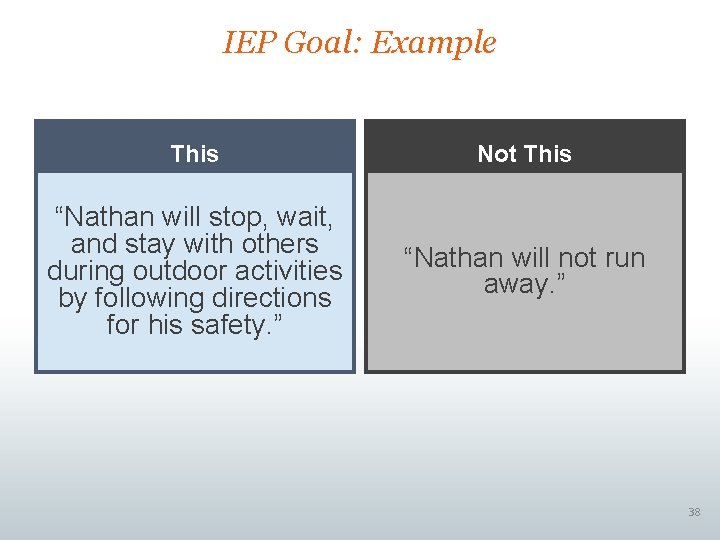
IEP Goal: Example This Not This “Nathan will stop, wait, and stay with others during outdoor activities by following directions for his safety. ” “Nathan will not run away. ” 38
Developing High-Quality, Functional IFSP Outcomes and IEP Goals Rating IFSP Outcomes and IEP Goals Lucas, A. , Gillaspy, K. , Peters, M. L. , & Hurth, J. (2014). Enhancing Recognition of High. Quality, Functional IFSP Outcomes: A training activity for Infant and Toddler service providers. Retrieved from http: //www. ectacenter. org/~pdfs/pubs/rating-ifsp. pdf Lucas, A. , Gillaspy, K. , Peters, M. L. , & Hurth, J. (2014). Enhancing Recognition of High. Quality, Functional IEP goals: A training activity for Early Childhood Special Education staff. Retrieved from http: //www. ectacenter. org/~pdfs/pubs/rating-iep. pdf 39
Criteria Defining High Quality, Participation-Based The outcome is necessary and functional for the child’s and family’s life. IFSP Outcomes The outcome reflects real-life contextualized settings. The outcome crosses developmental domains and is discipline-free. Place Card Here When the child’s contextual information is available, the following IFSP outcome criteria can also be evaluated: • The outcome is based on the family’s • priorities and concerns. The outcomes described both the child’s strengths and needs based on information from the initial evaluation and ongoing assessment. The outcome is jargon-free, clear and simple. The outcome emphasizes the positive, not the negative. The outcome uses active words rather than passive ones. ectacenter. org/~pdfs/pubs/rating-ifsp. pdf
Criteria Defining High Quality, Participation-Based The outcome is necessary and functional for the child’s and family’s life. The outcome reflects real-life contextualized settings. The outcome crosses developmental domains and is discipline-free. IFSP Outcomes IFSP Outcome Card 1 s Nolan will play with toy ath with his sister during b time. When the child’s contextual information is available, the following IFSP outcome criteria can also be evaluated: • The outcome is based on the family’s • priorities and concerns. The outcomes described both the child’s strengths and needs based on information from the initial evaluation and ongoing assessment. The outcome is jargon-free, clear and simple. The outcome emphasizes the positive, not the negative. The outcome uses active words rather than passive ones. ectacenter. org/~pdfs/pubs/rating-ifsp. pdf
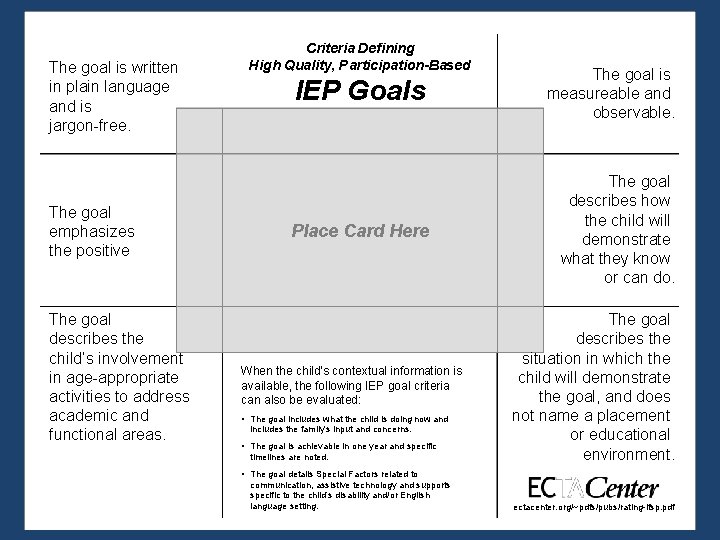
The goal is written in plain language and is jargon-free. The goal emphasizes the positive The goal describes the child’s involvement in age-appropriate activities to address academic and functional areas. Criteria Defining High Quality, Participation-Based IEP Goals The goal is measureable and observable. Place Card Here The goal describes how the child will demonstrate what they know or can do. When the child’s contextual information is available, the following IEP goal criteria can also be evaluated: • The goal includes what the child is doing now and includes the family’s input and concerns. • The goal is achievable in one year and specific timelines are noted. The goal describes the situation in which the child will demonstrate the goal, and does not name a placement or educational environment. • The goal details Special Factors related to communication, assistive technology and supports specific to the child’s disability and/or English language setting. ectacenter. org/~pdfs/pubs/rating-ifsp. pdf
The goal is written in plain language and is jargon-free. The goal emphasizes the positive The goal describes the child’s involvement in age-appropriate activities to address academic and functional areas. Criteria Defining High Quality, Participation-Based IEP Goals IEP Goal Card 1 t BG will get across wha s. she wants using word When the child’s contextual information is available, the following IEP goal criteria can also be evaluated: • The goal includes what the child is doing now and includes the family’s input and concerns. • The goal is achievable in one year and specific timelines are noted. The goal is measureable and observable. The goal describes how the child will demonstrate what they know or can do. The goal describes the situation in which the child will demonstrate the goal, and does not name a placement or educational environment. • The goal details Special Factors related to communication, assistive technology and supports specific to the child’s disability and/or English language setting. ectacenter. org/~pdfs/pubs/rating-ifsp. pdf
Developing High-Quality, Functional IFSP Outcomes and IEP Goals Debrief Rating IFSP Outcomes and IEP Goals 44
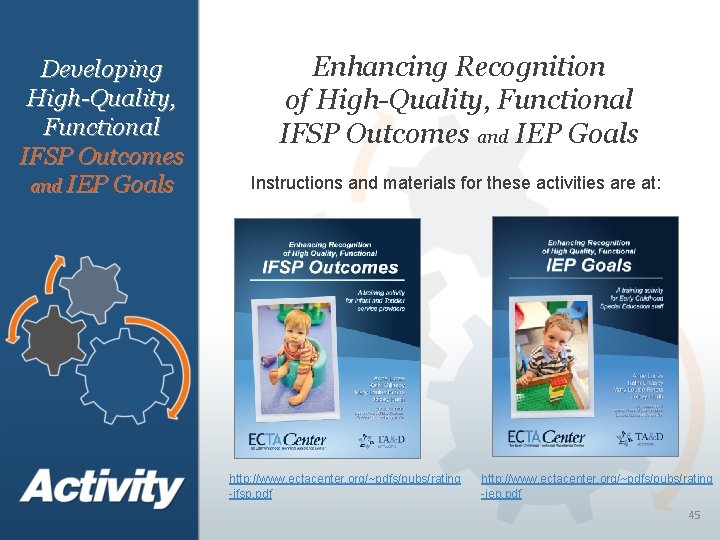
Developing High-Quality, Functional IFSP Outcomes and IEP Goals Enhancing Recognition of High-Quality, Functional IFSP Outcomes and IEP Goals Instructions and materials for these activities are at: http: //www. ectacenter. org/~pdfs/pubs/rating -ifsp. pdf http: //www. ectacenter. org/~pdfs/pubs/rating -iep. pdf 45
Resources on IFSPs and IEPs IFSP • Agreed Upon Practices For Providing Early Intervention Services In Natural Environments http: //www. ectacenter. org/~pdfs/topics/families/Agre ed. Upon. Practices_Final. Draft 2_01_08. pdf • Rush and Shelden. Tips and Techniques for Developing Participation-Based IFSP Outcomes Statements, Brief. CASE, Vol 2, No. 1 http: //www. fippcase. org/briefcase_vol 2_no 1. pdf • ECTA Center website http: //www. ectacenter. org/topics/families/famresour ces. asp IEP • Key Practices Underlying the IEP Process http: //www. ectacenter. org/~pdfs/knowledgepath/ifsp outcomes-iepgoals/Key_Practices_IEP_Process. pdf • Contents of the IEP http: //www 2. ed. gov/parents/needs/speced/iepguide/ index. html#contents • OSEP model IEP forms http: //www 2. ed. gov/policy/speced/guid/idea/modelfo rm-iep. pdf • Special Factors To Consider http: //www 2. ed. gov/parents/needs/speced/iepguide/ index. html#contents • Wisconsin Guide to Connecting Academic Standards and IEPs http: //dpi. state. wi. us/sped/pdf/iepstandardsguide. pdf 46
Questions?
Evaluate this training package online! We value your experiences and suggestions, which we use to improve our TA products and services. If you used this product, please consider evaluating it at: http: //ectacenter. org/eval Your feedback is important to us. Thank you for your time and attention!
Contact Information Firstname Lastname Title Organization email@address. org 555 -555 -5555 This product was developed collaboratively with staff from ECTA Center and WRRC in response to the need expressed from state and local providers to have specific information and resources about developing IFSP outcomes and IEP goals. The full training package, including a full reference list, is freely available online: http: //www. ectacenter. org/knowledgepath/ifspoutcomes-iepgoals. asp 49