
Developing High Frequency Economic Indicators using data from

- Slides: 23
Developing High Frequency Economic Indicators using data from Google Platforms MAY 26, 2021 Marco Marini, Alberto Sanchez, Jim Tebrake, Paul Austin, Chima Simpson-Bell IMF Statistics Department IMF | Statistics Disclaimer: The views expressed in this paper are those of the authors and do not necessarily represent the views of the IMF, its Executive Board, or IMF management. 1
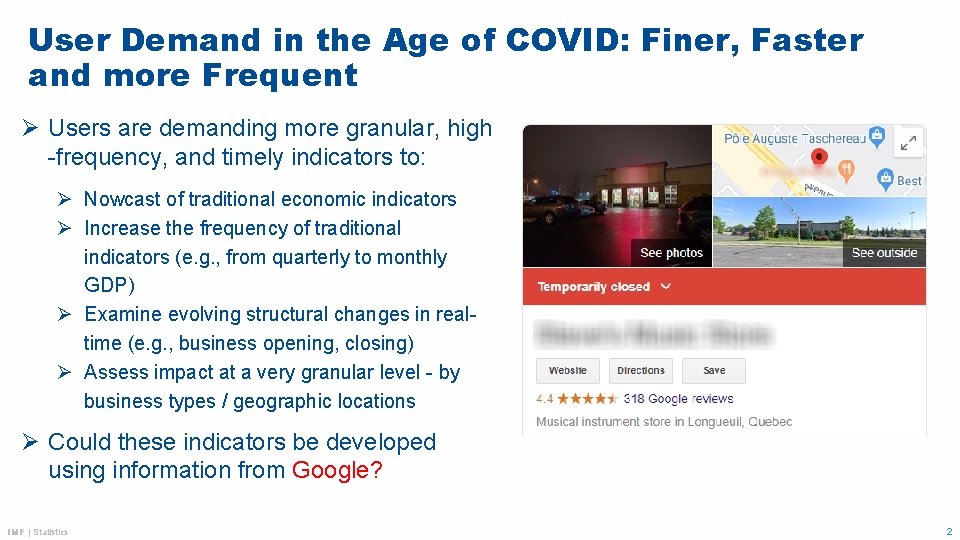
User Demand in the Age of COVID: Finer, Faster and more Frequent Ø Users are demanding more granular, high -frequency, and timely indicators to: Ø Nowcast of traditional economic indicators Ø Increase the frequency of traditional indicators (e. g. , from quarterly to monthly GDP) Ø Examine evolving structural changes in realtime (e. g. , business opening, closing) Ø Assess impact at a very granular level - by business types / geographic locations Ø Could these indicators be developed using information from Google? IMF | Statistics 2
Is it possible to produce timely, high frequency economic indicators consistent with international classifications and statistical methods using data extracted from the Google Places API and Google Trends Platform. IMF | Statistics 3
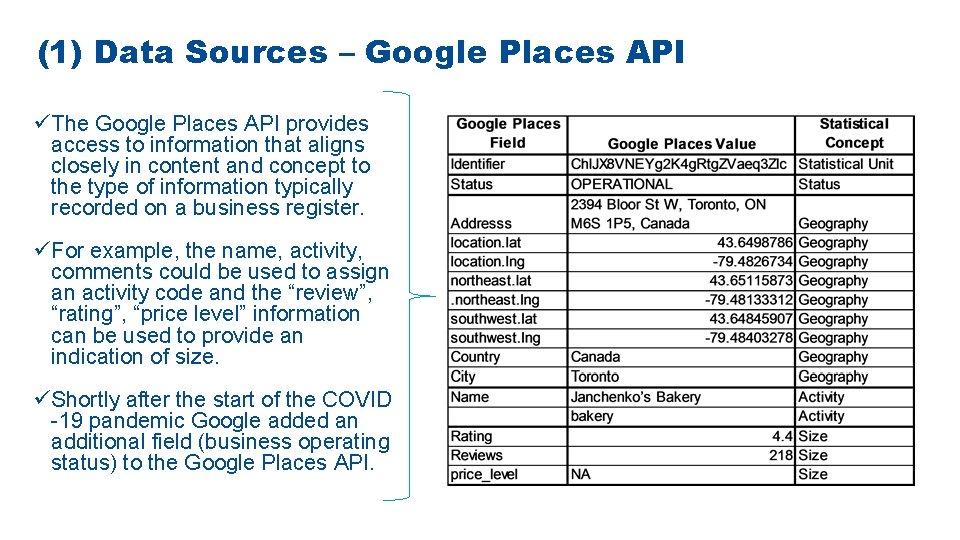
(1) Data Sources – Google Places API üThe Google Places API provides access to information that aligns closely in content and concept to the type of information typically recorded on a business register. üFor example, the name, activity, comments could be used to assign an activity code and the “review”, “rating”, “price level” information can be used to provide an indication of size. üShortly after the start of the COVID -19 pandemic Google added an additional field (business operating status) to the Google Places API.
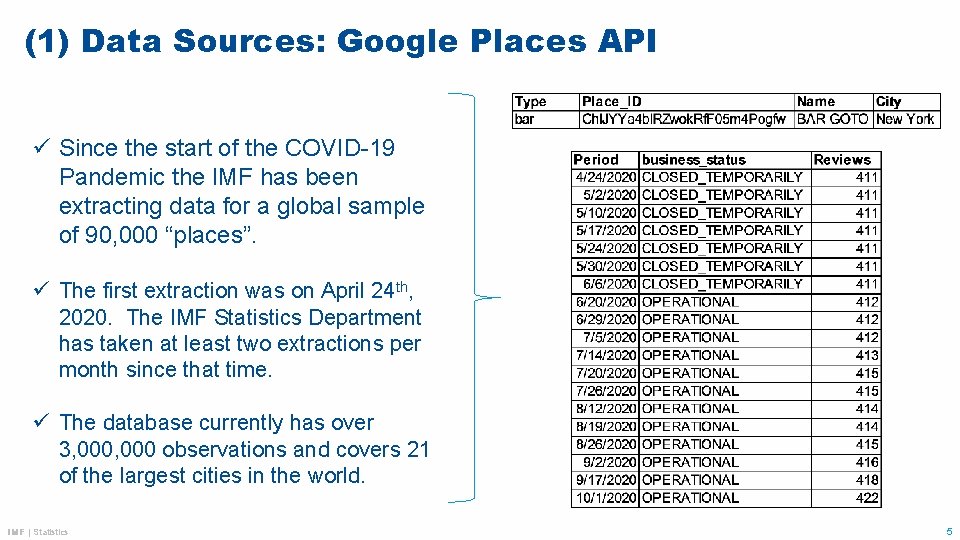
(1) Data Sources: Google Places API ü Since the start of the COVID-19 Pandemic the IMF has been extracting data for a global sample of 90, 000 “places”. ü The first extraction was on April 24 th, 2020. The IMF Statistics Department has taken at least two extractions per month since that time. ü The database currently has over 3, 000 observations and covers 21 of the largest cities in the world. IMF | Statistics 5
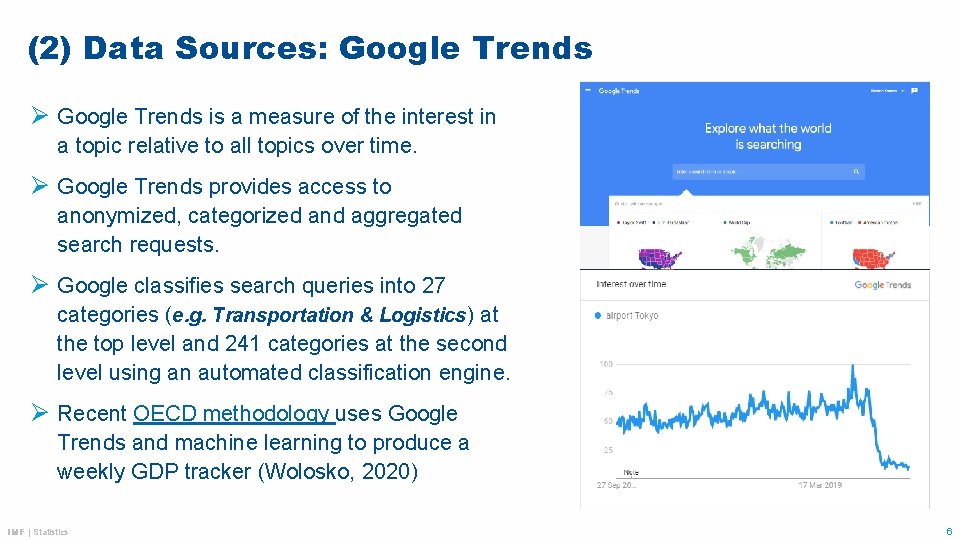
(2) Data Sources: Google Trends Ø Google Trends is a measure of the interest in a topic relative to all topics over time. Ø Google Trends provides access to anonymized, categorized and aggregated search requests. Ø Google classifies search queries into 27 categories (e. g. Transportation & Logistics) at the top level and 241 categories at the second level using an automated classification engine. Ø Recent OECD methodology uses Google Trends and machine learning to produce a weekly GDP tracker (Wolosko, 2020) IMF | Statistics 6
We are working with these data sources to deterime if. . 1. These data be used to develop a set of timely, high frequency economic indicators consistent with international statistical classifications and concepts. 2. These economic activity indicator be integrated with official statistics to improve their timeliness and frequency (e. g. be used to “nowcast” real GDP for a given country/region). IMF | Statistics 7
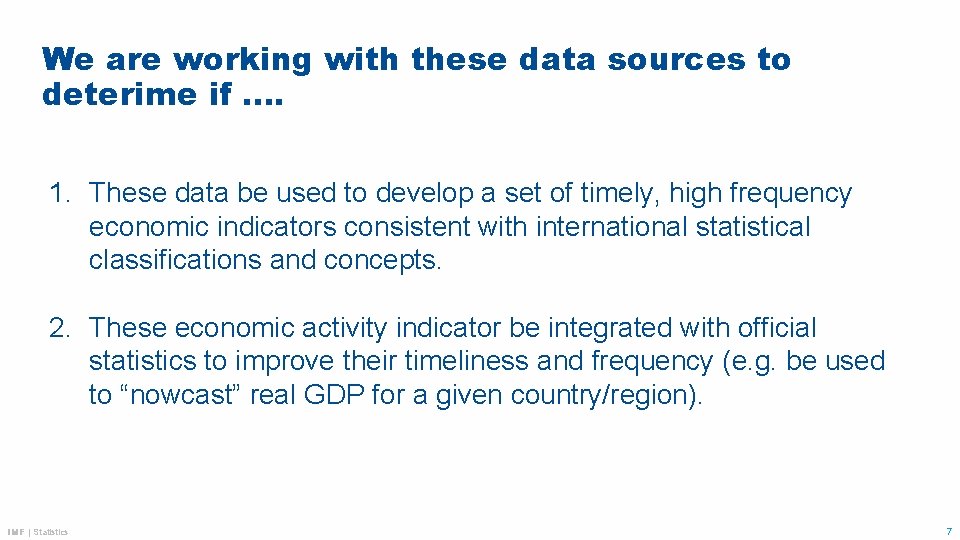
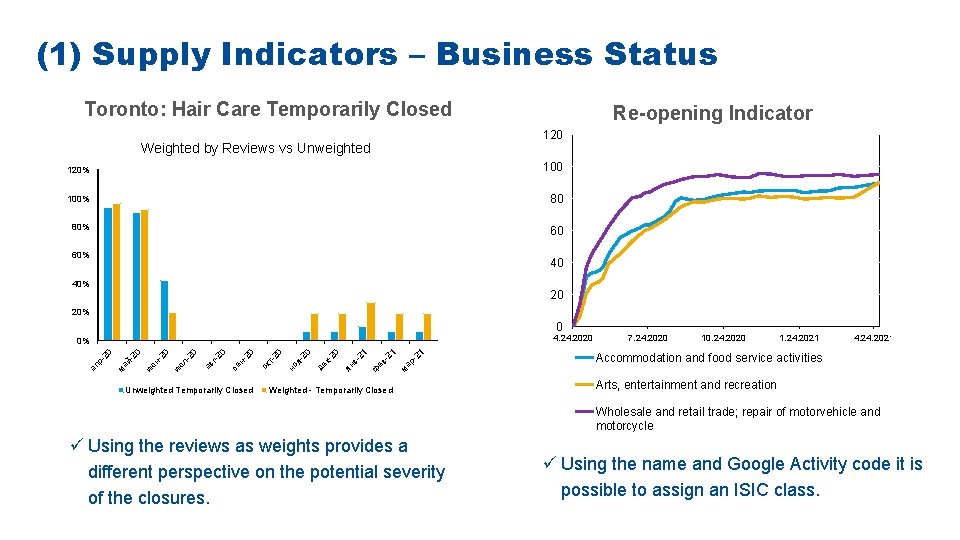
(1) Supply Indicators – Business Status The reopening indicator measures the percentage of businesses temporarily closed on a baseline date that have since re-opened. ü Start with an initial sample of businesses that temporarily closed due to COVID-19. ü Track their “status” at each collection (bi-weekly) IMF | Statistics 8
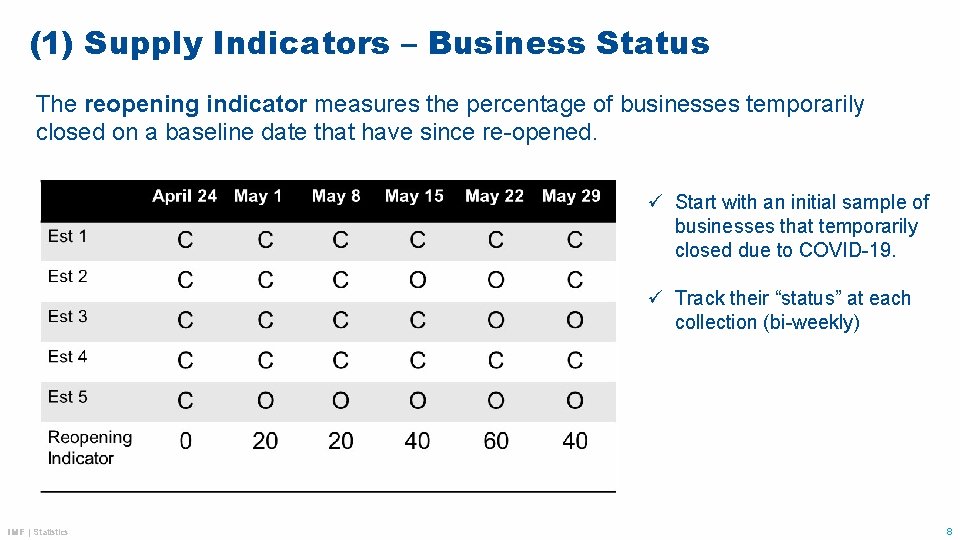
(1) Supply Indicators – Business Status Re-opening Indicator 120 100 80 60 40 20 0 4. 2020 7. 24. 2020 London 10. 24. 2020 Los Angeles 1. 24. 2021 Paris 4. 2021 Toronto Share of “places” temporarily closed on April 24, 2020 that have since re-opened. IMF | Statistics 9
(1) Supply Indicators – Business Status Toronto: Hair Care Temporarily Closed Re-opening Indicator 120 Weighted by Reviews vs Unweighted 120% 100% 80 80% 60 60% 40 40% 20 20% 0 4. 2020 Unweighted Temporarily Closed 1 р2 21 7. 24. 2020 10. 24. 2020 1. 24. 2021 Accommodation and food service activities ма 21 ев ф вян 20 де к- 20 яно 20 ток 0 20 нсе 0 г-2 ав л 2 ию н- 20 0 ию й 2 ма ап р- 20 0% Weighted - Temporarily Closed Arts, entertainment and recreation Wholesale and retail trade; repair of motorvehicle and motorcycle ü Using the reviews as weights provides a different perspective on the potential severity of the closures. ü Using the name and Google Activity code it is possible to assign an ISIC class.
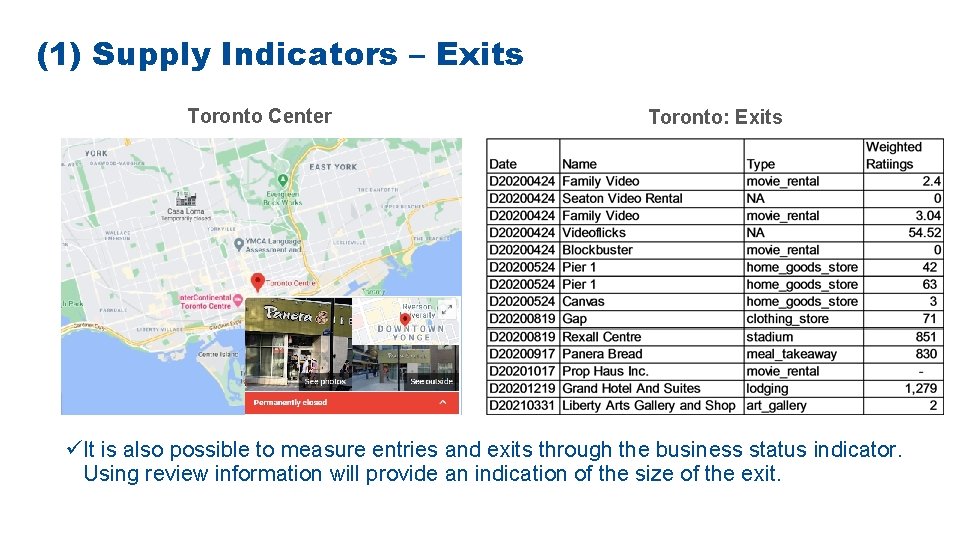
(1) Supply Indicators – Exits Toronto Center Toronto: Exits üIt is also possible to measure entries and exits through the business status indicator. Using review information will provide an indication of the size of the exit.
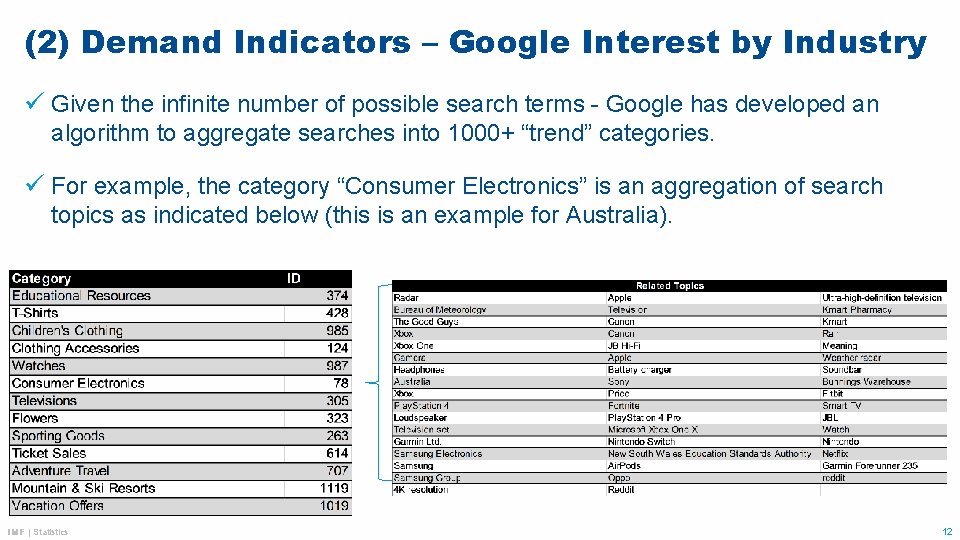
(2) Demand Indicators – Google Interest by Industry ü Given the infinite number of possible search terms - Google has developed an algorithm to aggregate searches into 1000+ “trend” categories. ü For example, the category “Consumer Electronics” is an aggregation of search topics as indicated below (this is an example for Australia). IMF | Statistics 12
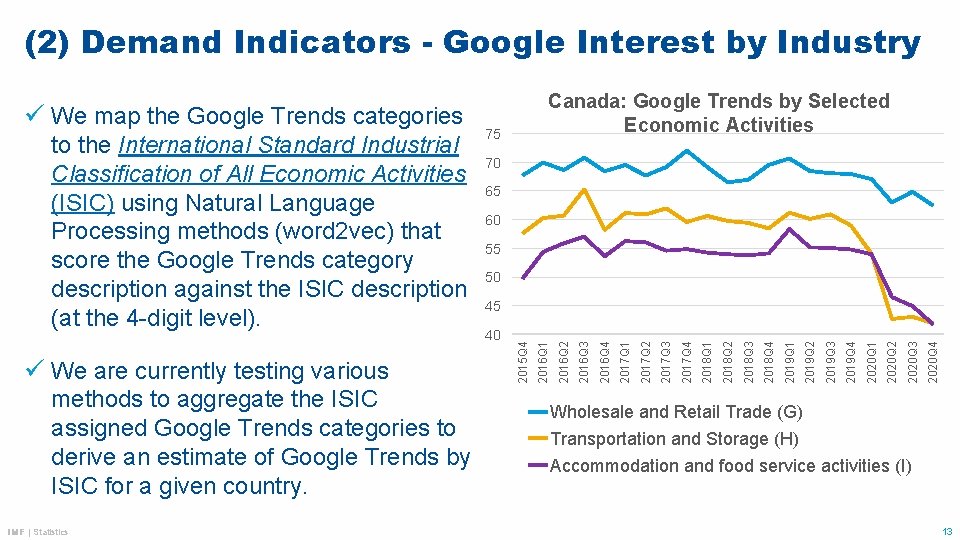
(2) Demand Indicators - Google Interest by Industry methods to aggregate the ISIC assigned Google Trends categories to derive an estimate of Google Trends by ISIC for a given country. IMF | Statistics 65 60 55 50 2020 Q 4 2020 Q 3 2020 Q 2 2020 Q 1 2019 Q 4 2019 Q 3 2019 Q 2 2019 Q 1 2018 Q 4 2018 Q 3 2018 Q 2 2018 Q 1 2017 Q 4 2017 Q 3 2017 Q 2 2017 Q 1 2016 Q 4 40 2016 Q 3 45 2016 Q 2 ü We are currently testing various 70 2016 Q 1 to the International Standard Industrial Classification of All Economic Activities (ISIC) using Natural Language Processing methods (word 2 vec) that score the Google Trends category description against the ISIC description (at the 4 -digit level). 75 2015 Q 4 ü We map the Google Trends categories Canada: Google Trends by Selected Economic Activities Wholesale and Retail Trade (G) Transportation and Storage (H) Accommodation and food service activities (I) 13
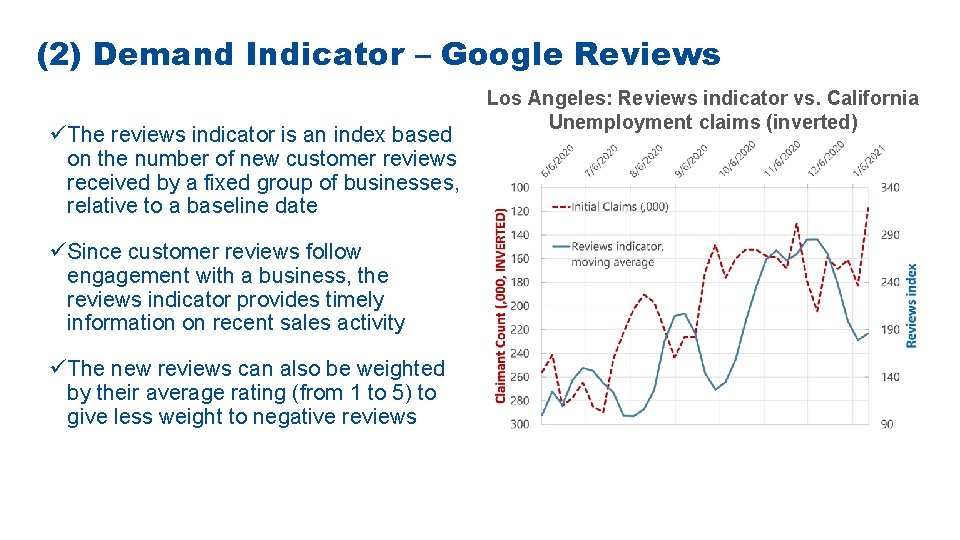
(2) Demand Indicator – Google Reviews üThe reviews indicator is an index based on the number of new customer reviews received by a fixed group of businesses, relative to a baseline date üSince customer reviews follow engagement with a business, the reviews indicator provides timely information on recent sales activity üThe new reviews can also be weighted by their average rating (from 1 to 5) to give less weight to negative reviews Los Angeles: Reviews indicator vs. California Unemployment claims (inverted)
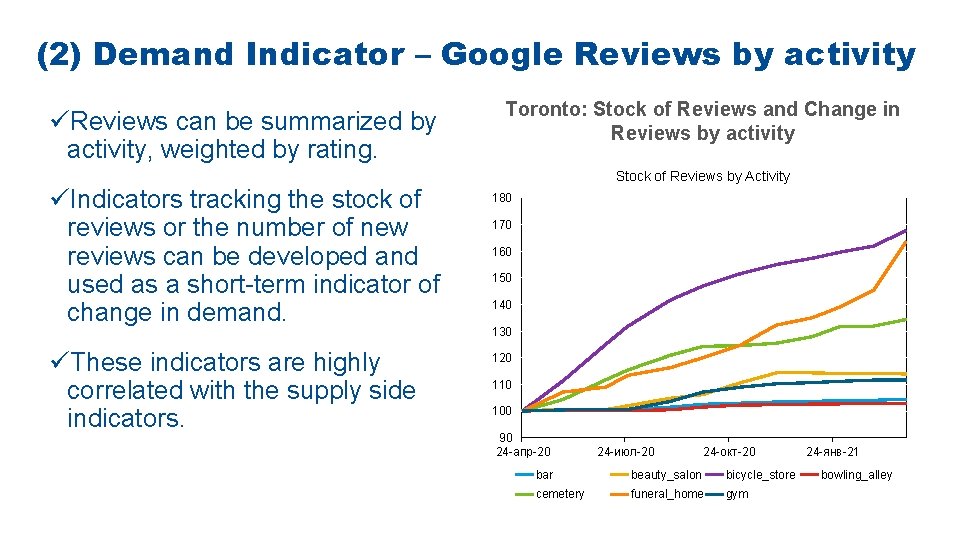
(2) Demand Indicator – Google Reviews by activity üReviews can be summarized by activity, weighted by rating. Toronto: Stock of Reviews and Change in Reviews by activity Stock of Reviews by Activity üIndicators tracking the stock of reviews or the number of new reviews can be developed and used as a short-term indicator of change in demand. üThese indicators are highly correlated with the supply side indicators. 180 170 160 150 140 130 120 110 100 90 24 -апр-20 24 -июл-20 24 -окт-20 bar beauty_salon bicycle_store cemetery funeral_home gym 24 -янв-21 bowling_alley
Application to Selected Countries: Nowcasting Quarterly GDP during COVID-19 using Google Based High Frequency Indicators by Economic Activity IMF | Statistics 16
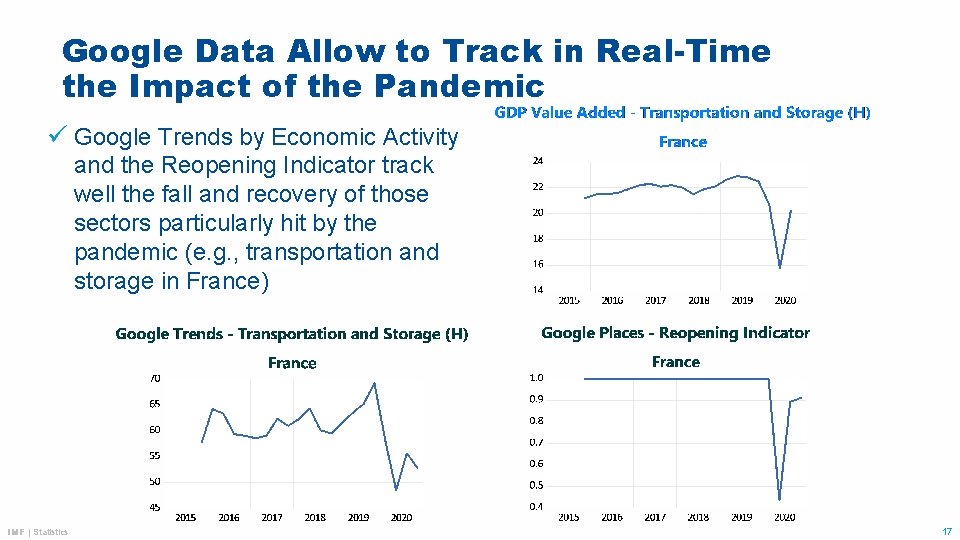
Google Data Allow to Track in Real-Time the Impact of the Pandemic ü Google Trends by Economic Activity and the Reopening Indicator track well the fall and recovery of those sectors particularly hit by the pandemic (e. g. , transportation and storage in France) IMF | Statistics 17
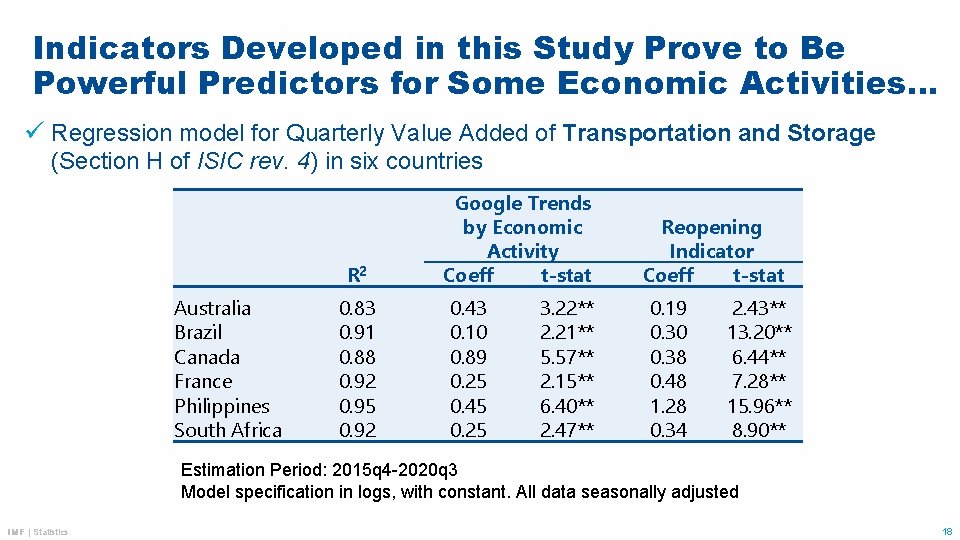
Indicators Developed in this Study Prove to Be Powerful Predictors for Some Economic Activities… ü Regression model for Quarterly Value Added of Transportation and Storage (Section H of ISIC rev. 4) in six countries R 2 Australia Brazil Canada France Philippines South Africa 0. 83 0. 91 0. 88 0. 92 0. 95 0. 92 Google Trends by Economic Activity Coeff t-stat 0. 43 0. 10 0. 89 0. 25 0. 45 0. 25 3. 22** 2. 21** 5. 57** 2. 15** 6. 40** 2. 47** Reopening Indicator Coeff t-stat 0. 19 0. 30 0. 38 0. 48 1. 28 0. 34 2. 43** 13. 20** 6. 44** 7. 28** 15. 96** 8. 90** Estimation Period: 2015 q 4 -2020 q 3 Model specification in logs, with constant. All data seasonally adjusted IMF | Statistics 18
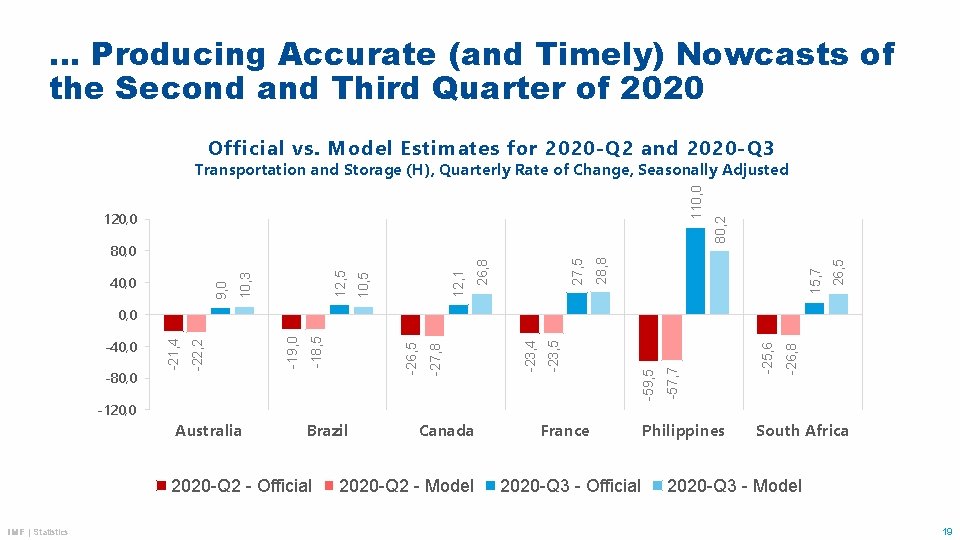
… Producing Accurate (and Timely) Nowcasts of the Second and Third Quarter of 2020 Official vs. Model Estimates for 2020 -Q 2 and 2020 -Q 3 26, 5 15, 7 28, 8 26, 8 12, 1 10, 5 10, 3 9, 0 40, 0 12, 5 80, 0 27, 5 120, 0 80, 2 110, 0 Transportation and Storage (H), Quarterly Rate of Change, Seasonally Adjusted -120, 0 Australia Brazil 2020 -Q 2 - Official IMF | Statistics Canada 2020 -Q 2 - Model France 2020 -Q 3 - Official Philippines -26, 8 -25, 6 -57, 7 -59, 5 -23, 4 -27, 8 -26, 5 -18, 5 -19, 0 -80, 0 -22, 2 -40, 0 -21, 4 0, 0 South Africa 2020 -Q 3 - Model 19
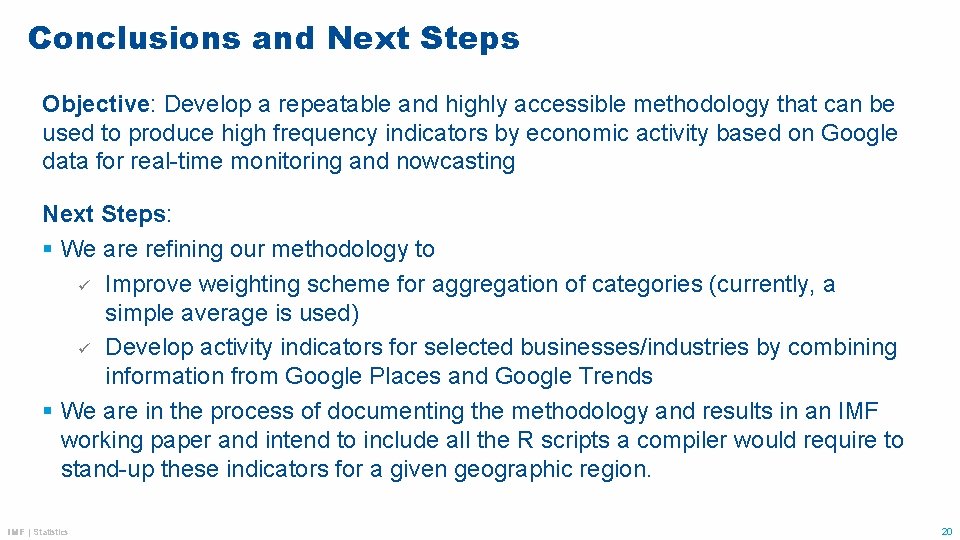
Conclusions and Next Steps Objective: Develop a repeatable and highly accessible methodology that can be used to produce high frequency indicators by economic activity based on Google data for real-time monitoring and nowcasting Next Steps: § We are refining our methodology to ü Improve weighting scheme for aggregation of categories (currently, a simple average is used) ü Develop activity indicators for selected businesses/industries by combining information from Google Places and Google Trends § We are in the process of documenting the methodology and results in an IMF working paper and intend to include all the R scripts a compiler would require to stand-up these indicators for a given geographic region. IMF | Statistics 20
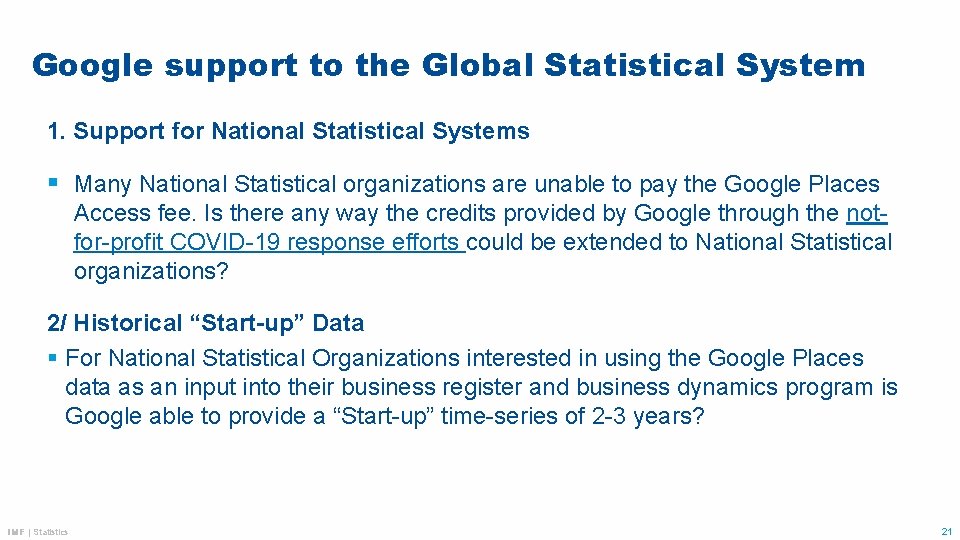
Google support to the Global Statistical System 1. Support for National Statistical Systems § Many National Statistical organizations are unable to pay the Google Places Access fee. Is there any way the credits provided by Google through the notfor-profit COVID-19 response efforts could be extended to National Statistical organizations? 2/ Historical “Start-up” Data § For National Statistical Organizations interested in using the Google Places data as an input into their business register and business dynamics program is Google able to provide a “Start-up” time-series of 2 -3 years? IMF | Statistics 21
Thank you! Marco Marini (mmarini@imf. org) Alberto Sanchez (asanchez 3@imf. org) Jim Tebrake (jtebrake@imf. org) Paul Austin (paustin@imf. org) Chima Simpson-Bell (csimpson-bell@imf. org) IMF Statistics Department IMF | Statistics 22
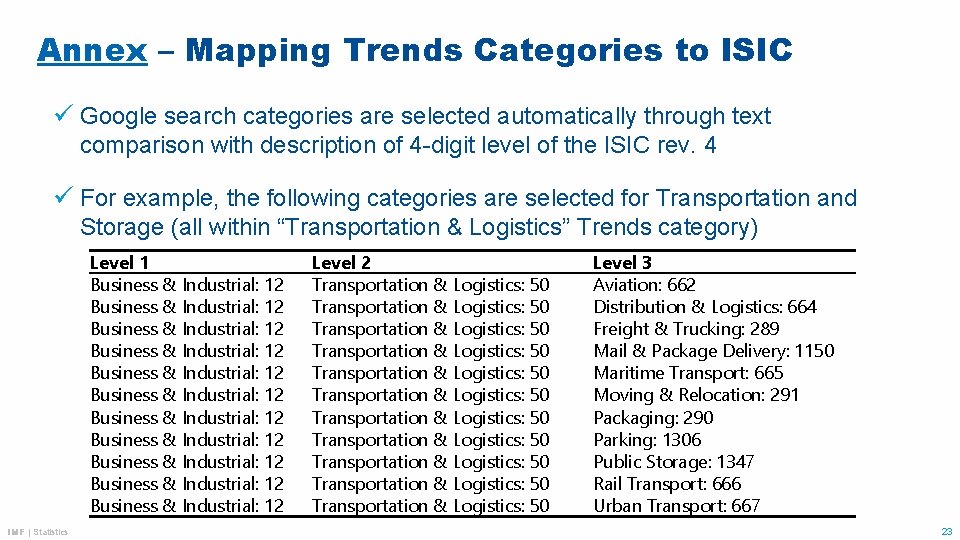
Annex – Mapping Trends Categories to ISIC ü Google search categories are selected automatically through text comparison with description of 4 -digit level of the ISIC rev. 4 ü For example, the following categories are selected for Transportation and Storage (all within “Transportation & Logistics” Trends category) Level 1 Business & Industrial: 12 Business & Industrial: 12 Business & Industrial: 12 IMF | Statistics Level 2 Transportation & Logistics: 50 Transportation & Logistics: 50 Transportation & Logistics: 50 Level 3 Aviation: 662 Distribution & Logistics: 664 Freight & Trucking: 289 Mail & Package Delivery: 1150 Maritime Transport: 665 Moving & Relocation: 291 Packaging: 290 Parking: 1306 Public Storage: 1347 Rail Transport: 666 Urban Transport: 667 23