
Developing Guidance Skills LIFE MANAGEMENT Unit 5 Module
- Slides: 12
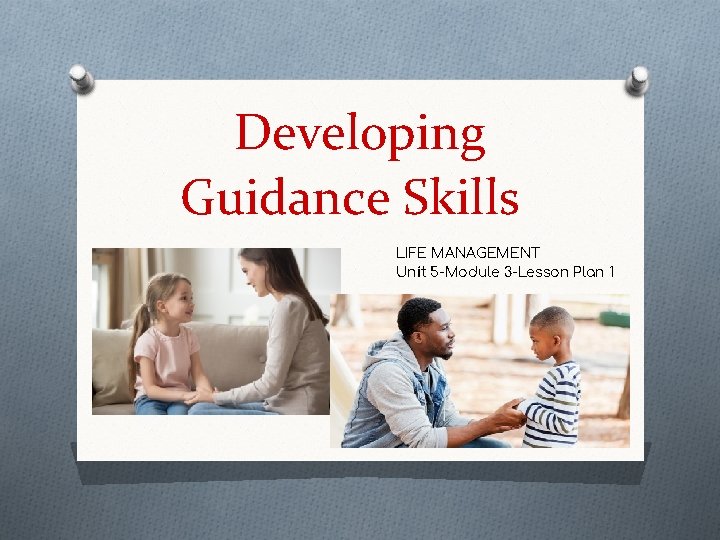
Developing Guidance Skills LIFE MANAGEMENT Unit 5 -Module 3 -Lesson Plan 1
Discipline: Guidance Versus Punishment Discipline: -To teach a child to have self-control. Guidance: -Consists of direct and indirect actions to help children develop internal controls and appropriate behavior patterns.
Punishment: -Strict control used to enforce obedience. -Punishment does little to respect children. It is intended to humiliate or hurt. -Punishment focuses on the use of unreasonable, often harsh, actions to force children into behaving the way adults want.
Why is guidance recommended over punishment? ● Guidance helps children to take personal responsibility for their actions. ● Punishment does not teach children, it only focuses on correcting negative behavior. children learn how to make choices.
Goals of Effective Guidance -For children to -To promote prosocial maintain self-worth behaviors among and develop children. self-control. -Prosocial behaviors are acts of kindness -Self-worth is the belief that benefit others that you are loveable and demonstrate and valuable cooperation and regardless of how you helpfulness. evaluate your traits.
Turn to a partner and take turns answering the following questions: ● What is an example of a way you control your behavior as a result of effective guidance? ● How do you show prosocial behaviors at home and at school?
Techniques for Effective Guidance Create a positive verbal environment: -What is said and how it is said determines whether the environment is positive or negative. Use positive reinforcement: -Children’s behavior can often be molded by rewarding positive behavior. -Positive messages will encourage the child to repeat the behavior.
Implement consequences when needed: -Consequences are results that follow an action or behavior that are important in molding children’s behavior. -Natural consequences follow naturally as a result of a behavior without anyone’s intervention. -Logical consequences are deliberately set up by an adult to show what will happen if a limit is not followed.
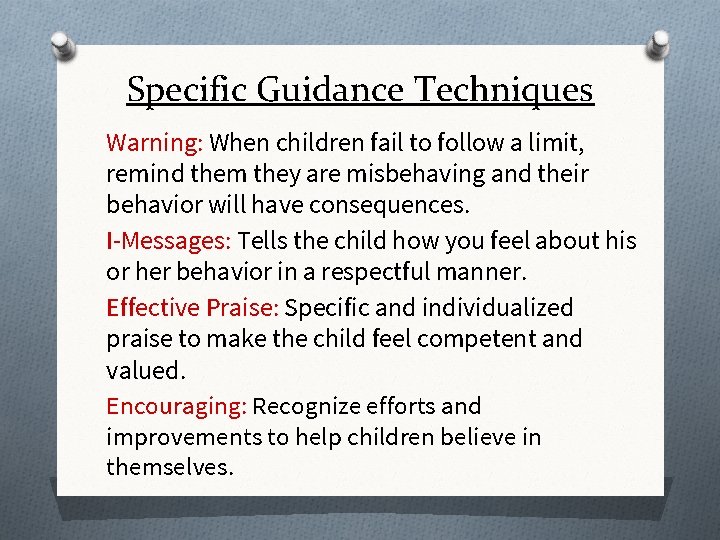
Specific Guidance Techniques Warning: When children fail to follow a limit, remind them they are misbehaving and their behavior will have consequences. I-Messages: Tells the child how you feel about his or her behavior in a respectful manner. Effective Praise: Specific and individualized praise to make the child feel competent and valued. Encouraging: Recognize efforts and improvements to help children believe in themselves.
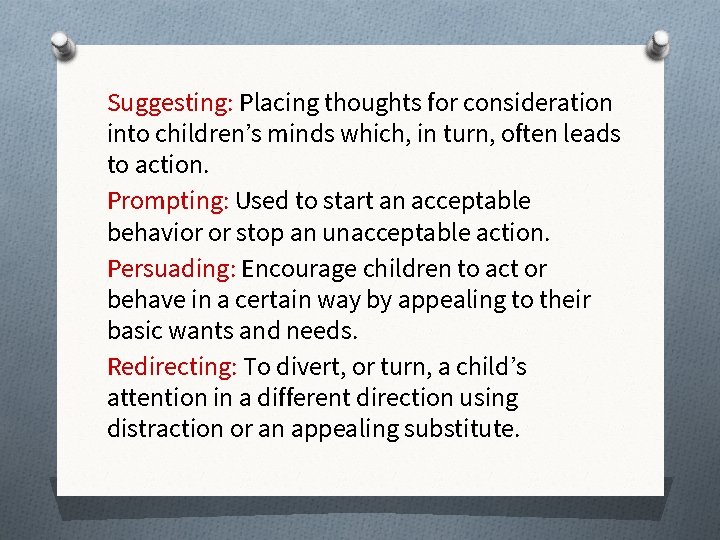
Suggesting: Placing thoughts for consideration into children’s minds which, in turn, often leads to action. Prompting: Used to start an acceptable behavior or stop an unacceptable action. Persuading: Encourage children to act or behave in a certain way by appealing to their basic wants and needs. Redirecting: To divert, or turn, a child’s attention in a different direction using distraction or an appealing substitute.
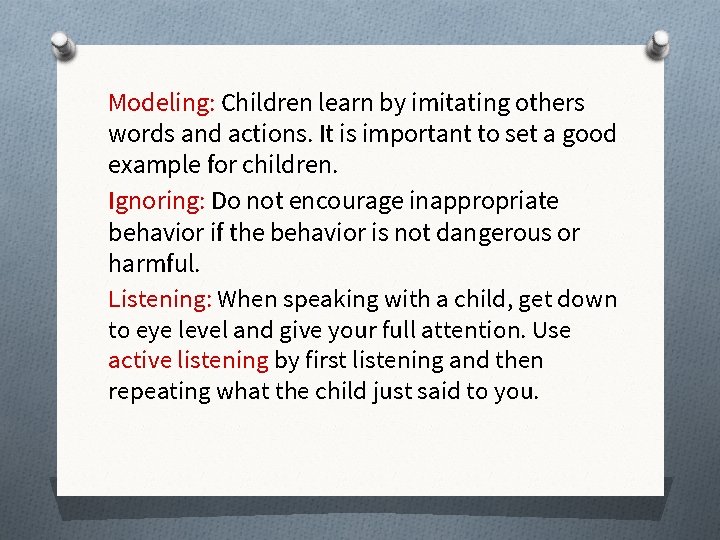
Modeling: Children learn by imitating others words and actions. It is important to set a good example for children. Ignoring: Do not encourage inappropriate behavior if the behavior is not dangerous or harmful. Listening: When speaking with a child, get down to eye level and give your full attention. Use active listening by first listening and then repeating what the child just said to you.
Turn to a partner and take turns answering the following questions: ● Which techniques do you think would be most effective when guiding young children? ● Which techniques do your parents or guardians use most often at home?