
Developing Global Citizenship Reflection and response to the
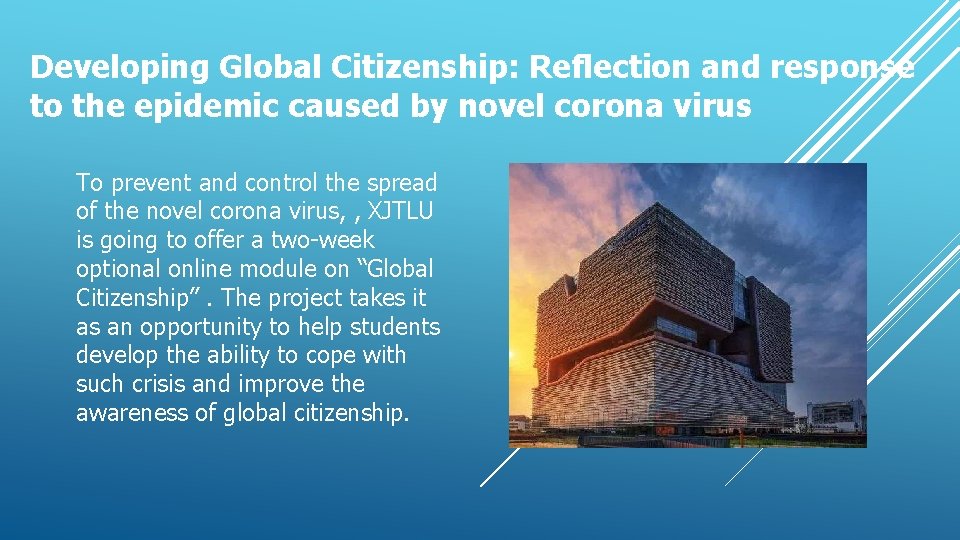
Developing Global Citizenship: Reflection and response to the epidemic caused by novel corona virus To prevent and control the spread of the novel corona virus, , XJTLU is going to offer a two-week optional online module on “Global Citizenship”. The project takes it as an opportunity to help students develop the ability to cope with such crisis and improve the awareness of global citizenship.
Developing Global Citizenship: Reflection and response to the epidemic caused by novel corona virus Digital literacy group 33

CONTENT Group members Digital literacy levels How we work 8 aspects we focused on Our harvest in this project
Debora Malito As a mentor to guide us through the work
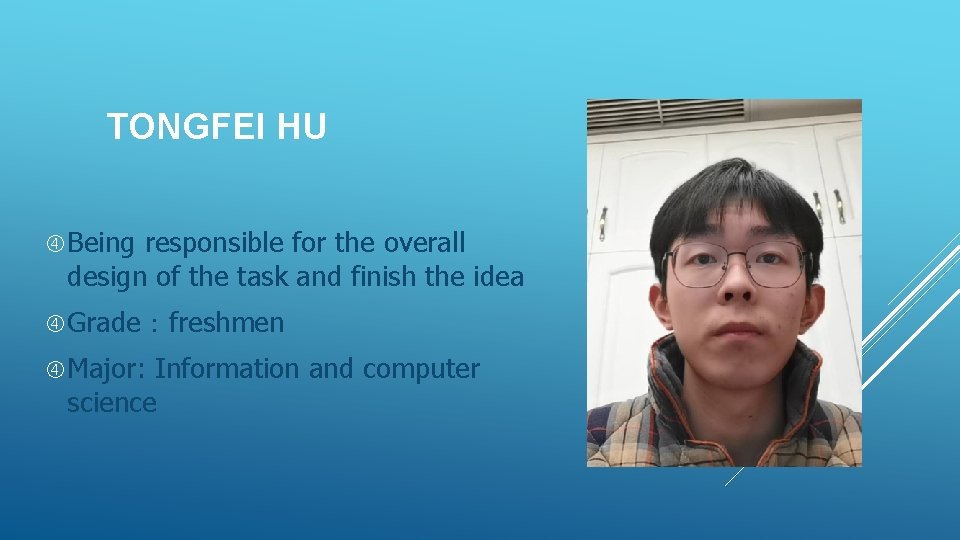
TONGFEI HU Being responsible for the overall design of the task and finish the idea Grade:freshmen Major: Information and computer science
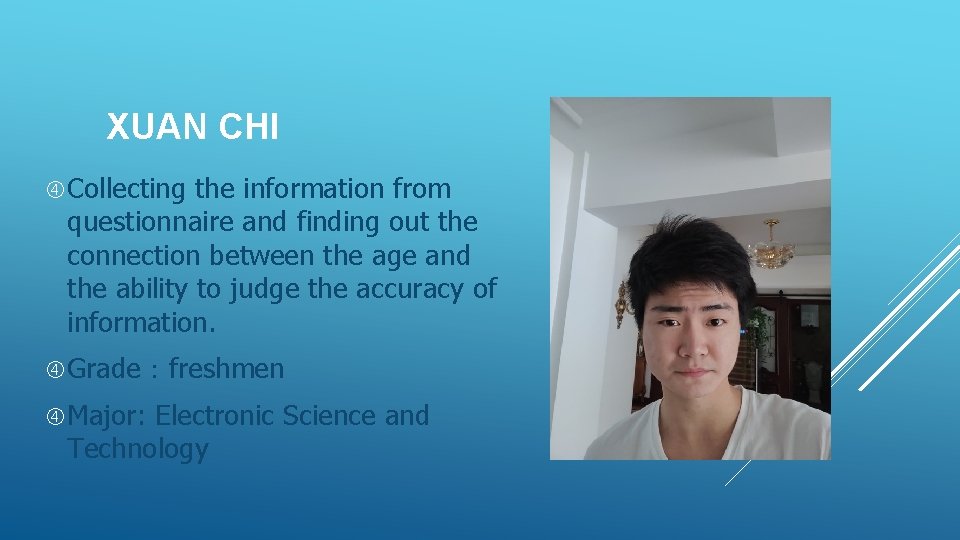
XUAN CHI Collecting the information from questionnaire and finding out the connection between the age and the ability to judge the accuracy of information. Grade:freshmen Major: Electronic Science and Technology
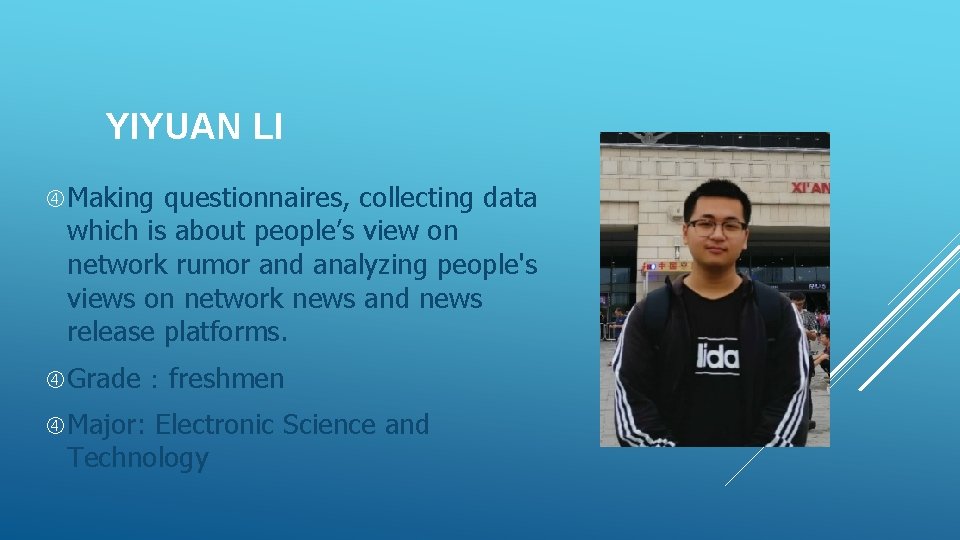
YIYUAN LI Making questionnaires, collecting data which is about people’s view on network rumor and analyzing people's views on network news and news release platforms. Grade:freshmen Major: Electronic Science and Technology
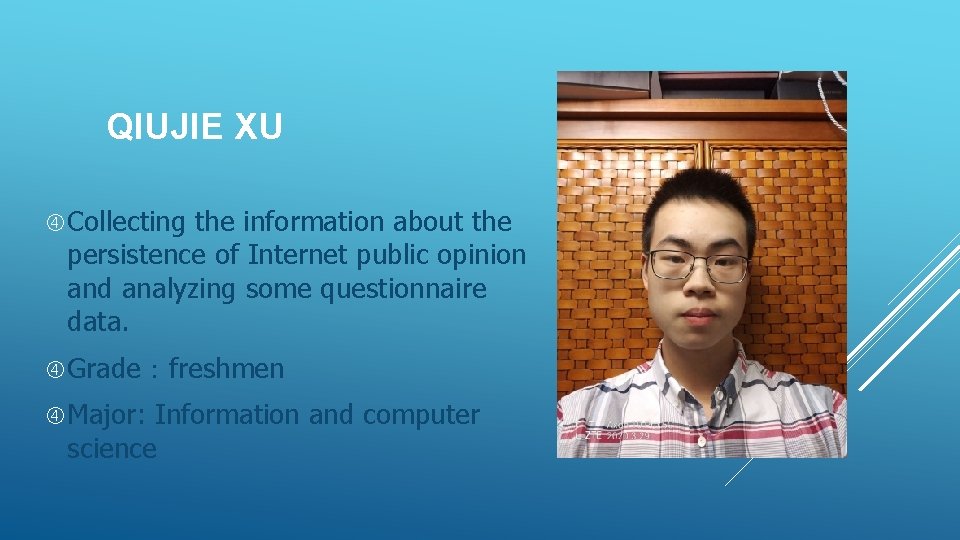
QIUJIE XU Collecting the information about the persistence of Internet public opinion and analyzing some questionnaire data. Grade:freshmen Major: Information and computer science
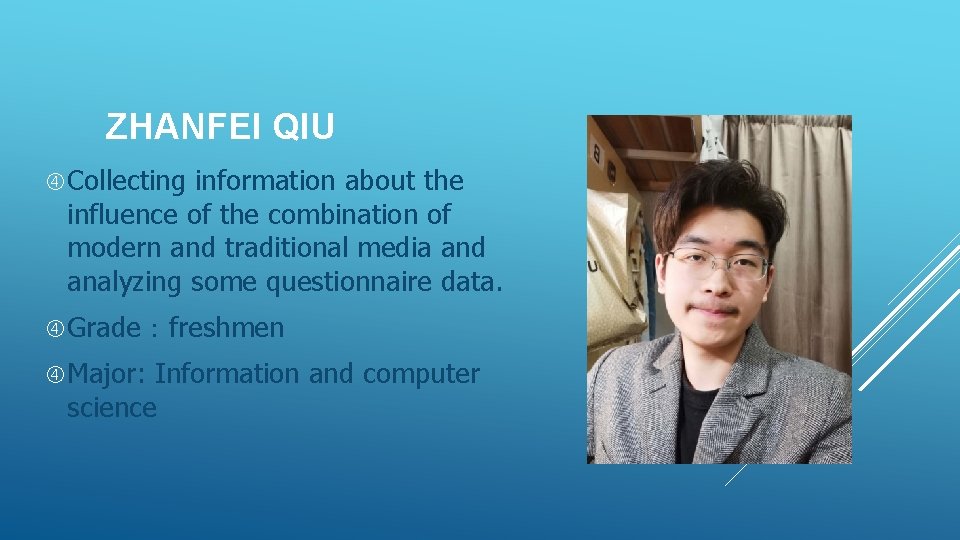
ZHANFEI QIU Collecting information about the influence of the combination of modern and traditional media and analyzing some questionnaire data. Grade:freshmen Major: Information and computer science
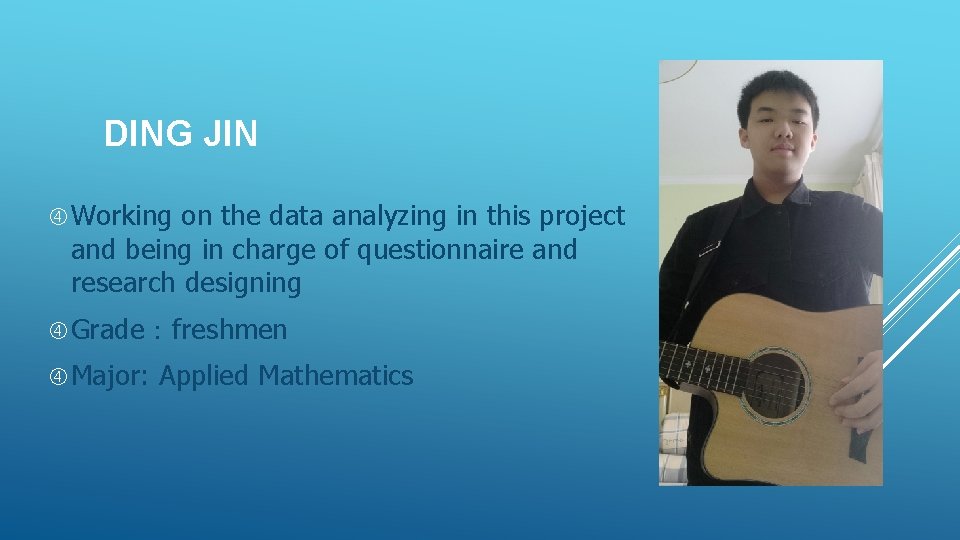
DING JIN Working on the data analyzing in this project and being in charge of questionnaire and research designing Grade:freshmen Major: Applied Mathematics
YANGFAN ZHOU Focusing on our harvest and aspect. Grade:freshmen Major: Applied Mathematics
ZHENYU JIANG Working with the data and conclude in formation. Grade:freshmen
DIGITAL LITERACY LEVELS Level 1: In good command of tools, be able to get information Level 2: Have the ability to recognize true and useful information on the internet Level 3: Be willing to participate in internet discussion, refute a rumor and spread true information Level 4: Join in the online space construction Level 5: Become an intelligent internet user
HOW WE WORK 3 STEPS TAKEN IN THIS PROJECT Step 1: Collect data and information concerning internet user behavior Step 2: Analyze the data, figure out digital literacy levels of internet users Step 3: Find some possible solutions to this problem
STEP 1 Design a questionnaire to acquire one-hand data about online behavior and recognition of internet information Collect other information to see the current situation We finally collect about 200 data and nearly 50 of them we think is useless as they did the questionnaire in a very short time which shows that they were making choice without deep consideration. 145 Useful data are collected.
STEP 2 Analyze the data collected in step 1, consider this problem from the aspect of digital literacy level Compare to other research results and conclude the cause and the influence of this problem We collected gender, ages and works in step one so that differences between different groups of people can be analyzed
STEP 3 Solve this problem by improving digital literacy level of citizens. Consider to contribute to this problem from the aspects of the government, the media and so on. Reflecting on our project and do something to show our results and ideas.
ASPECT 1: AGE AND GENDER DIFFERENCES The data shows that people over 20 years age are more accurate in judging the accuracy of the data. The main sources of information for people under the age of 20 are We Chat and Microblog, and the main sources of information for those who are over 20 are We Chat and Tencent News. gender has no effect on results. However, age has. Senior citizens have a slightly better judgment. We Chat has become one of the main sources for people of all ages in China.
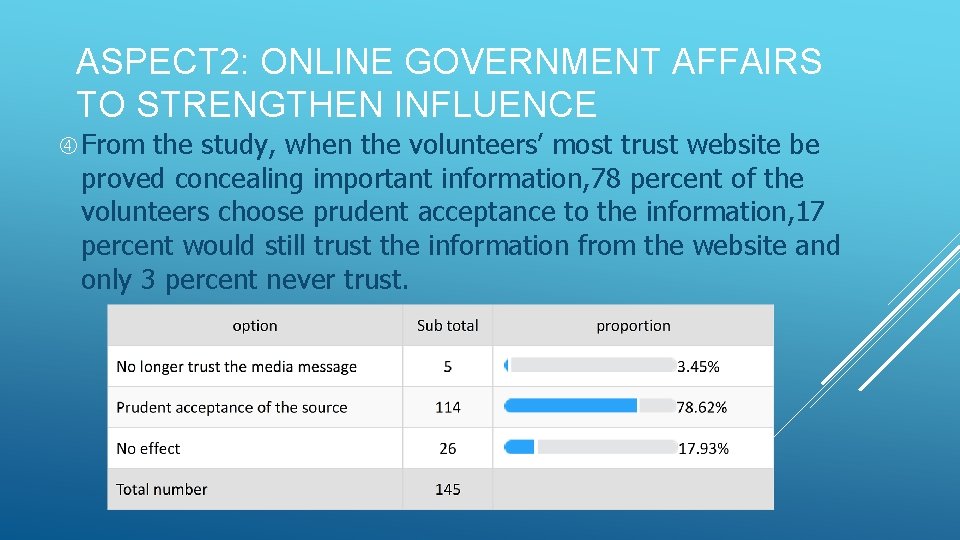
ASPECT 2: ONLINE GOVERNMENT AFFAIRS TO STRENGTHEN INFLUENCE From the study, when the volunteers’ most trust website be proved concealing important information, 78 percent of the volunteers choose prudent acceptance to the information, 17 percent would still trust the information from the website and only 3 percent never trust.
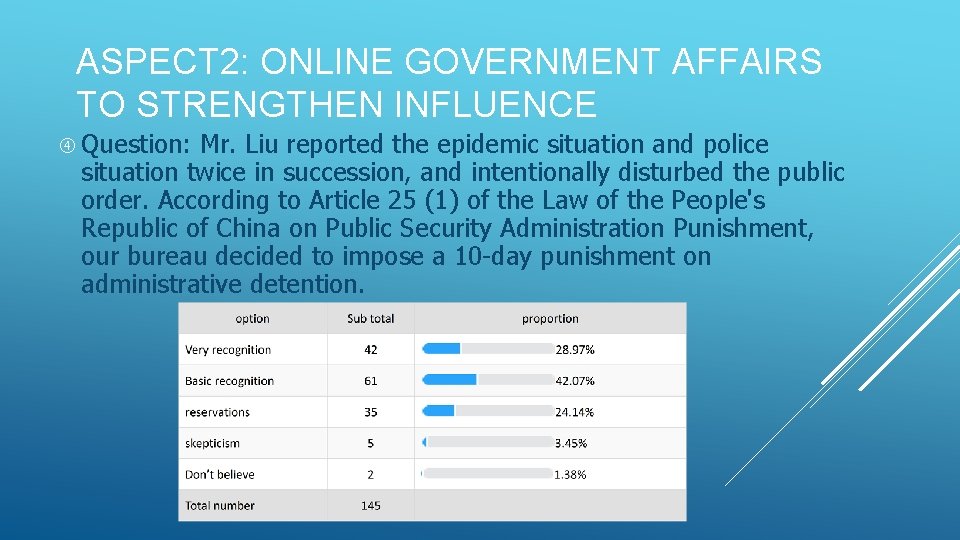
ASPECT 2: ONLINE GOVERNMENT AFFAIRS TO STRENGTHEN INFLUENCE Question: Mr. Liu reported the epidemic situation and police situation twice in succession, and intentionally disturbed the public order. According to Article 25 (1) of the Law of the People's Republic of China on Public Security Administration Punishment, our bureau decided to impose a 10 -day punishment on administrative detention.
ASPECT 2: ONLINE GOVERNMENT AFFAIRS TO STRENGTHEN INFLUENCE Solution: The government must improve its ability to acquire the correct message to strength its accountability. For example, the government should never conceal the events. The citizens should actively coordinate with the government. If necessary, the citizens should point out the mistakes of the government. Conclusion: The incorrect information may cause negative effects that reduce the influence of Chinese government. To the statements published by the government, people pay high tribute to them.
ASPECT 3: THE COMBINATION OF MODERN AND TRADITIONAL MEDIA Network consensus has promoted the development of the event more and more obviously through in-depth interaction with traditional media. The "disclosure" in the network consensus can often trigger the positive response of the traditional media and bring a wide range of public discussion.
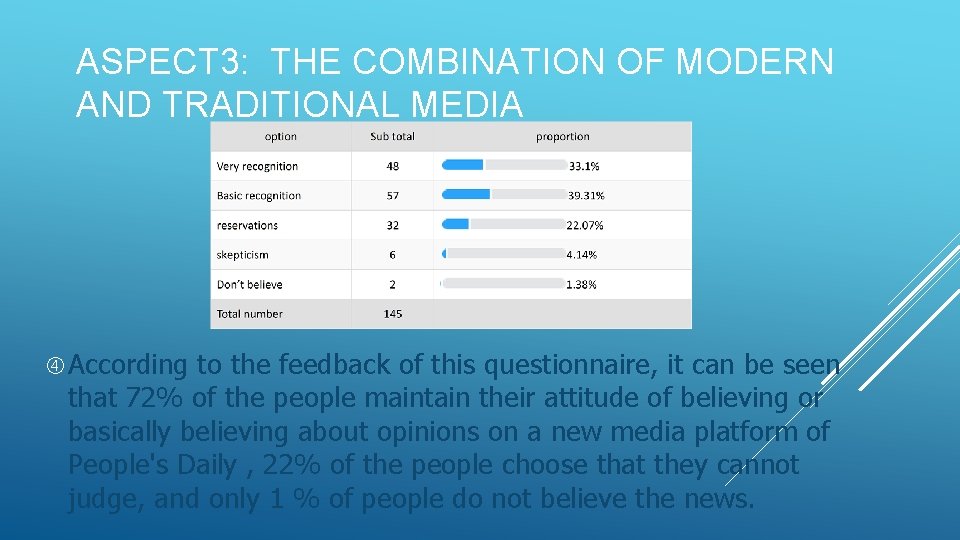
ASPECT 3: THE COMBINATION OF MODERN AND TRADITIONAL MEDIA According to the feedback of this questionnaire, it can be seen that 72% of the people maintain their attitude of believing or basically believing about opinions on a new media platform of People's Daily , 22% of the people choose that they cannot judge, and only 1 % of people do not believe the news.
ASPECT 3: THE COMBINATION OF MODERN AND TRADITIONAL MEDIA Recommendations: New and old media should encourage and cultivate the public opinion field with positive energy. Resolve the problem of the overflow of network consensus. Guide the online users to use the network consensus rationally. Conclusion:Both traditional and new media should undertake the relevant responsibilities; they should play a supervisory role, and keep alert to the overflow of network public opinion.
ASPECT 4: CHANNELS AND METHODS OF NEWS SOURCES Findings 1: According to our group of investigation, nowadays, most people get information on the internet through Microblog and We Chat social platform. In the information society,the social public opinion often dominated by traditional media agenda setting. But the advent of new media has made the changes. Just like the night of Microblog which definitely shows the power of social media.
ASPECT 4: CHANNELS AND METHODS OF NEWS SOURCES Findings 2: In the survey, we found that 80 percent of people get information from We chat, 66. 9 percent of them get information from Microblog and few people choose news platform. We can learn from this that the influence of social platforms has surpassed that of news platforms. Because of popularization of mobile phone, each one of us is a media. For example, let’s imagine that you are only a farmer of a small country, but within only one day, because of the spread of the media, you can be an internet celebrity with millions of fans.
ASPECT 4: CHANNELS AND METHODS OF NEWS SOURCES Conclusions: Media propagation velocity is the bright eye of the new media age. The interactivity and anonymity of information spread on the Internet lay a solid foundation for carrier diversification. In the last several years, therefore, the influence of social media platforms might become bigger and bigger.
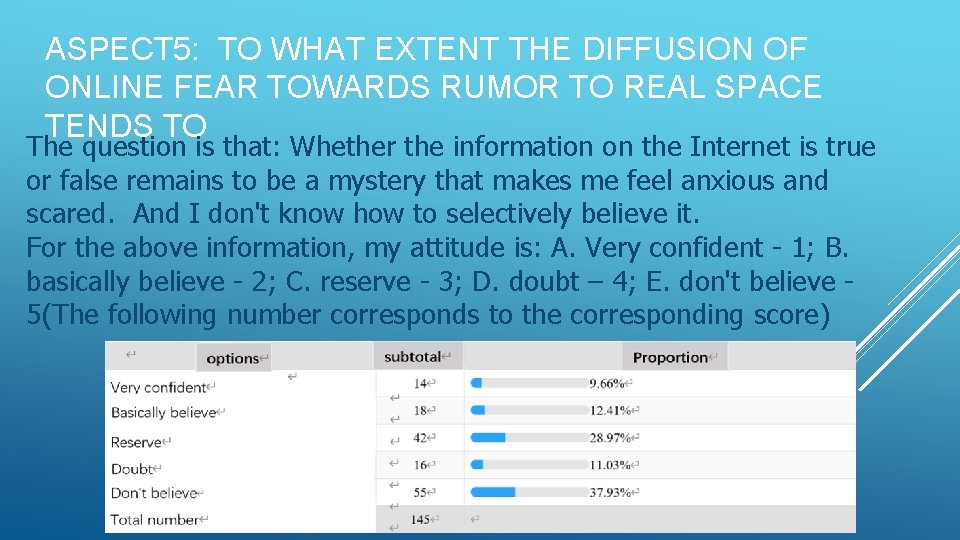
ASPECT 5: TO WHAT EXTENT THE DIFFUSION OF ONLINE FEAR TOWARDS RUMOR TO REAL SPACE TENDS TO The question is that: Whether the information on the Internet is true or false remains to be a mystery that makes me feel anxious and scared. And I don't know how to selectively believe it. For the above information, my attitude is: A. Very confident - 1; B. basically believe - 2; C. reserve - 3; D. doubt – 4; E. don't believe - 5(The following number corresponds to the corresponding score)
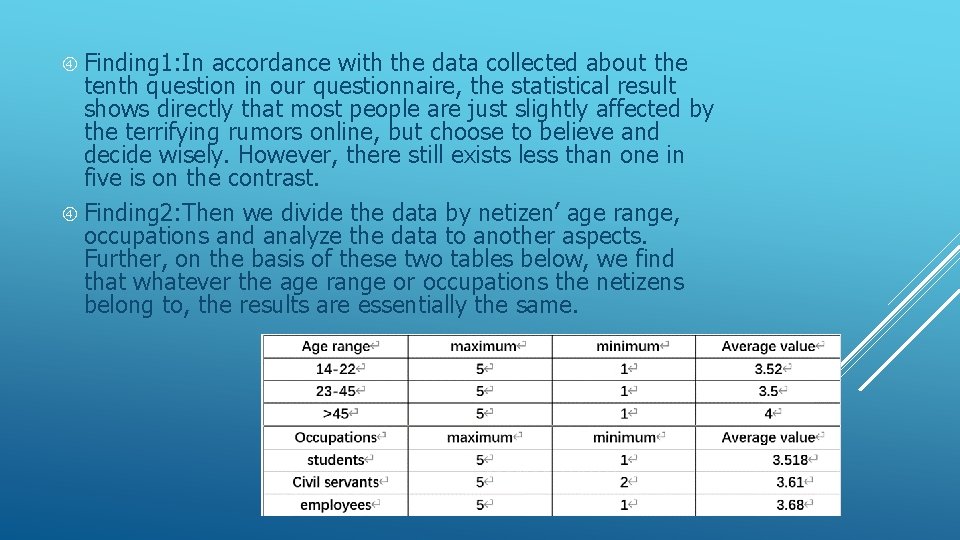
Finding 1: In accordance with the data collected about the tenth question in our questionnaire, the statistical result shows directly that most people are just slightly affected by the terrifying rumors online, but choose to believe and decide wisely. However, there still exists less than one in five is on the contrast. Finding 2: Then we divide the data by netizen’ age range, occupations and analyze the data to another aspects. Further, on the basis of these two tables below, we find that whatever the age range or occupations the netizens belong to, the results are essentially the same.
Recommendations: From the perspective of netizens themselves, they should cultivate basis common sense basically and step by step, they can enhance their ability to discriminate whether the information is true or false to improve or maintain their level of digital literacy. When the news is doubtful, they could consult with relevant authorities to judge wisely. The government should also advocate and maintain a stable and reliable environment network to guarantee the information security and credibility. Conclusions: The trend of diffusion of online fear towards rumor to real space is not obvious at all. The situation of the contemporary level of netizen’s digital literacy is optimistic.
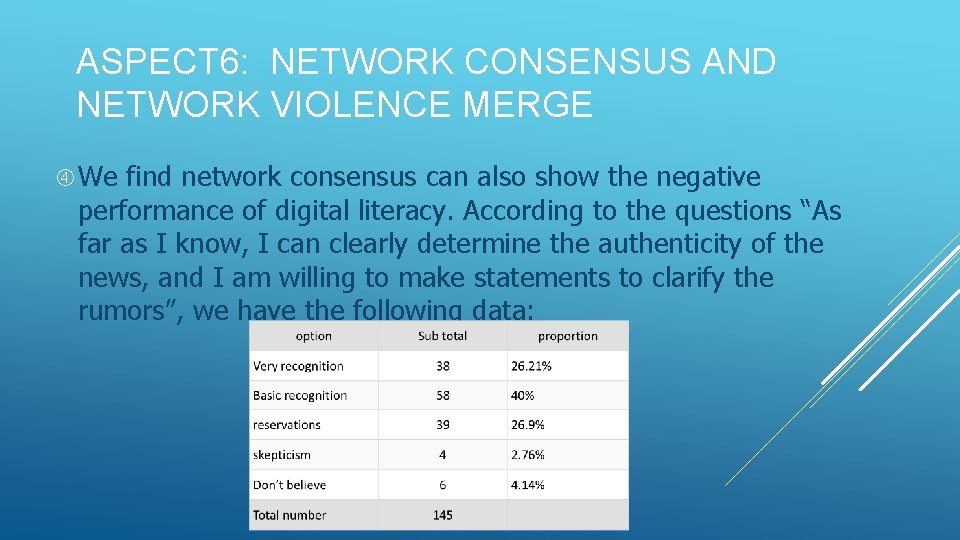
ASPECT 6: NETWORK CONSENSUS AND NETWORK VIOLENCE MERGE We find network consensus can also show the negative performance of digital literacy. According to the questions “As far as I know, I can clearly determine the authenticity of the news, and I am willing to make statements to clarify the rumors”, we have the following data:
ASPECT 6: NETWORK CONSENSUS AND NETWORK VIOLENCE MERGE Solutions: Every netizen should become an intelligent internet user and have the courage to express their thoughts. Conclusions: The result that everyone can speak is a "majority" in the field of thought. Most netizens are beaten, abused, and forcefully used by a few people to find the most secure point of view. A little carelessness leads to siege and abuse. Individuals who rank lower on the social and political ladder may turn to presenting the majority view in lieu of speaking their mind, hence the result of everyone's voice eventually become a majority decision in the field of thought. Switching over to positive network consensus is strongly linked to improved digital literacy of those who are less privileged.
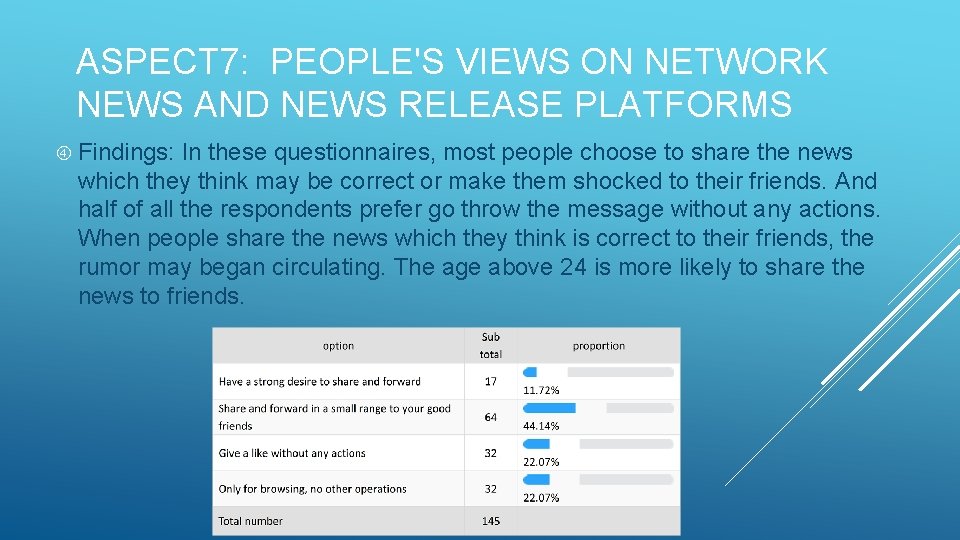
ASPECT 7: PEOPLE'S VIEWS ON NETWORK NEWS AND NEWS RELEASE PLATFORMS Findings: In these questionnaires, most people choose to share the news which they think may be correct or make them shocked to their friends. And half of all the respondents prefer go throw the message without any actions. When people share the news which they think is correct to their friends, the rumor may began circulating. The age above 24 is more likely to share the news to friends.
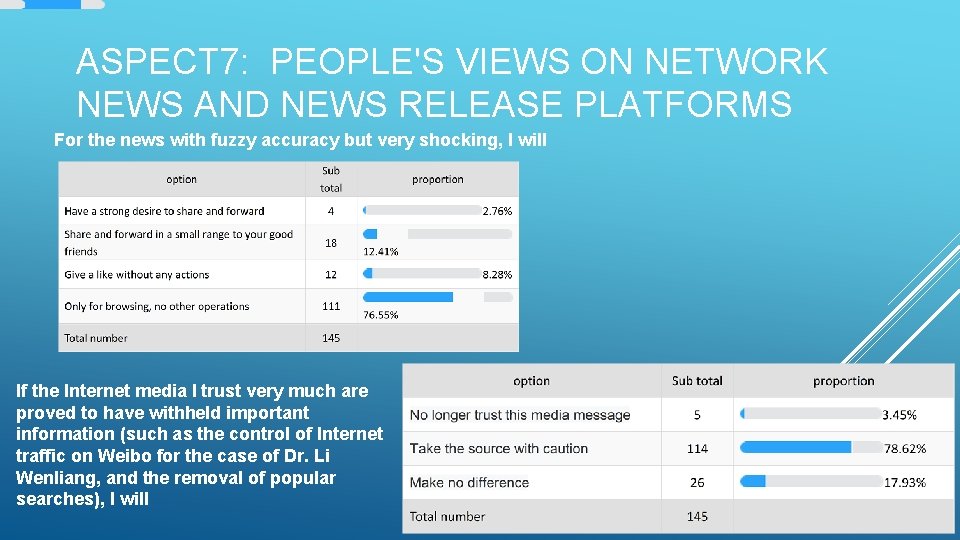
ASPECT 7: PEOPLE'S VIEWS ON NETWORK NEWS AND NEWS RELEASE PLATFORMS For the news with fuzzy accuracy but very shocking, I will If the Internet media I trust very much are proved to have withheld important information (such as the control of Internet traffic on Weibo for the case of Dr. Li Wenliang, and the removal of popular searches), I will
ASPECT 7: PEOPLE'S VIEWS ON NETWORK NEWS AND NEWS RELEASE PLATFORMS Solutions: For the news from non-authoritative platform, we should accept carefully. It is good for people to go throw the website without doing any other actions, when you cannot recognize whether it is correct. If the government can verify the news is true, then it is great for people to share the truth to friends. Respect for authoritative platforms should be maintained, though it has announced some false information. Conclusions: Interestingly, most of age above 25 is more likely to share the news to friends, and most young adult just browsing. In general, the public's current network literacy is good. They can choose the most correct approach. The situation of citizen digital literacy is fine.
ASPECT 8: ONLINE PUBLIC OPINION IS GREATLY CONCERNED TO THE FACTOR OF TIME Findings: To solve the problem of online rumors and improve the digital literacy of the netizens, strengthen their memory is of prime importance. To research this angle, we take the event of Doctor Wenliang Li as an example. Data shows that as time goes by, the number of searching related information dropped greatly. As time goes by, some big events happened online may be forgotten. Further, the effect of online rumors has little influence on the public, so they may fall into the trap of online rumors again. We made a questionnaire and one of the questions is “If you found that you are cheated by the media, would you like to trust it? ”, and the results show that in 145 people, most people choose they would like to trust the information after a deep thinking, while the number of choosing believe it as they used to be is 5 times larger than the number of choosing do not trust the information any more.
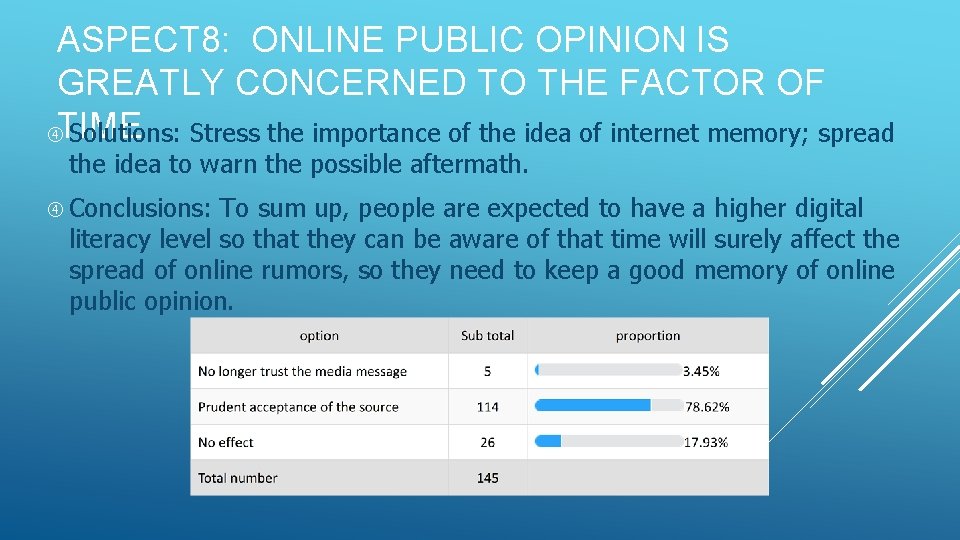
ASPECT 8: ONLINE PUBLIC OPINION IS GREATLY CONCERNED TO THE FACTOR OF TIME Solutions: Stress the importance of the idea of internet memory; spread the idea to warn the possible aftermath. Conclusions: To sum up, people are expected to have a higher digital literacy level so that they can be aware of that time will surely affect the spread of online rumors, so they need to keep a good memory of online public opinion.
8: ONLINE PUBLIC OPINION IS CONCERNED TO THE FACTOR OF TIME. To solve the problem of online rumors and improve the digital literacy of the netizens, strengthen their memory is of prime importance. Take the event of Wenliang Li as an example. Data shows that as time goes by, the number of searching related information dropped greatly. the effect of online rumors has little influence on the public, so they may fall into the trap of online rumors again.
8: ONLINE PUBLIC OPINION IS CONCERNED TO THE FACTOR OF TIME. Conclusion: To sum up, the trend of diffusion of online fear towards rumor to real space is not obvious at all. The situation of contemporary level of digital literacy is optimistic, online users can choose the most correct approach. To move forward, media propagation velocity is the bright eye of the new media age. The interactivity and anonymity of information spread on the Internet lay a solid foundation for carrier diversification in the last several years and the influence of social media platforms might become bigger and bigger. Thus, both traditional and new media should undertake the relevant responsibilities; they should play a supervisory role, and keep alert to the overflow of network public opinion. On the other aspect, for public, they are expected to have a higher digital literacy level so that they can be aware that time will surely affect the spread of online rumors, more importantly they need to keep a good memory of online public opinion.
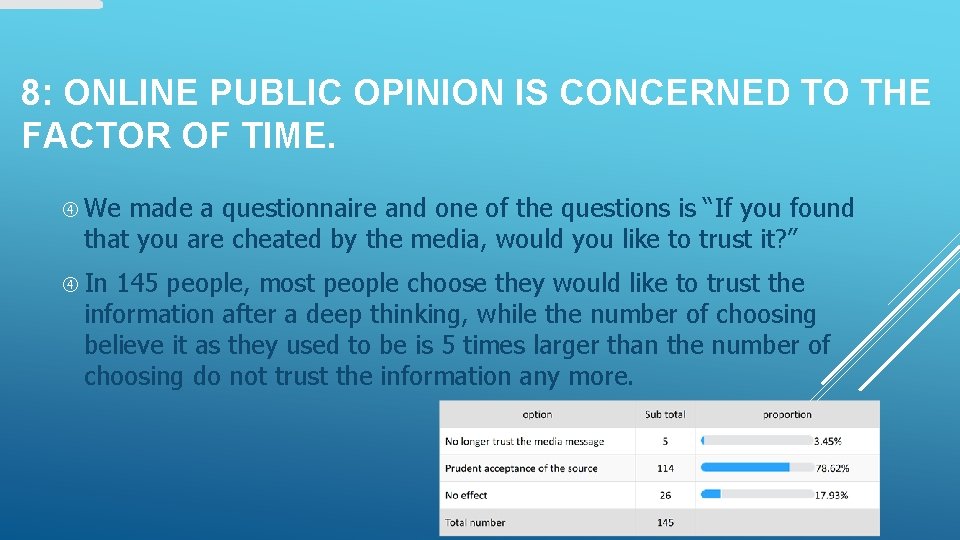
8: ONLINE PUBLIC OPINION IS CONCERNED TO THE FACTOR OF TIME. We made a questionnaire and one of the questions is “If you found that you are cheated by the media, would you like to trust it? ” In 145 people, most people choose they would like to trust the information after a deep thinking, while the number of choosing believe it as they used to be is 5 times larger than the number of choosing do not trust the information any more.
Our harvest in this project: Above all, I’d definitely like to appreciate such period of investigativebased learning. It really turned my days in boring winter sufficed and occupied. The topic laid emphasis on our critical thinking ability greatly and thus, during which we had a better chance to strength it. Also, what we learned from that is that the teamwork is of great significance. During the period, we have a team contained of 8 guys, we organized sorts of online meetings and sacrifice our free time, but contributed to this teamwork together. Hope we will have another chance like this to practice ourselves in the future.

Thank you!
- Slides: 42