
Developing Fundamental IO discrete devices Electromagnetic Control Relays
- Slides: 43
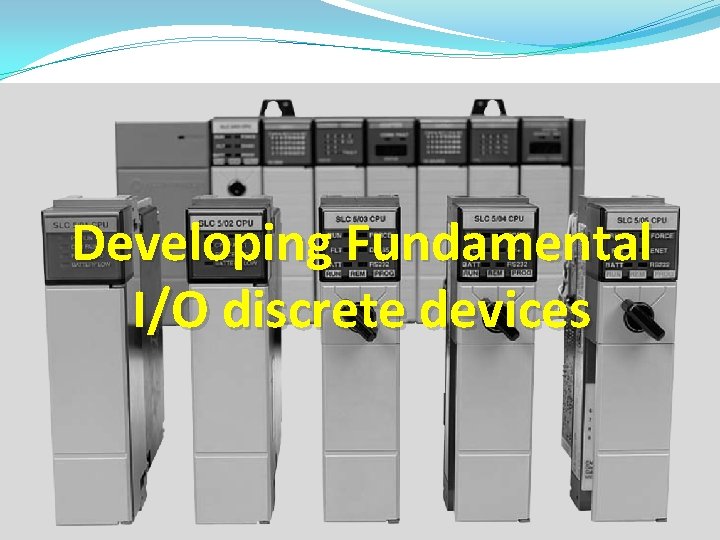
Developing Fundamental I/O discrete devices
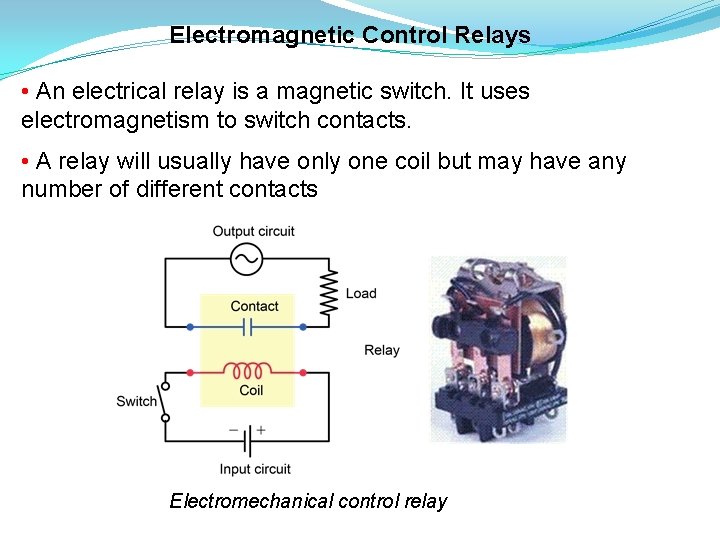
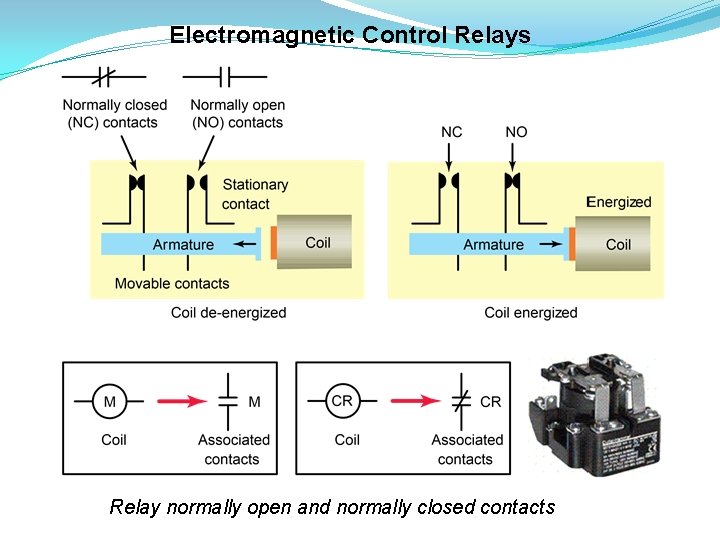
Electromagnetic Control Relays • An electrical relay is a magnetic switch. It uses electromagnetism to switch contacts. • A relay will usually have only one coil but may have any number of different contacts Electromechanical control relay
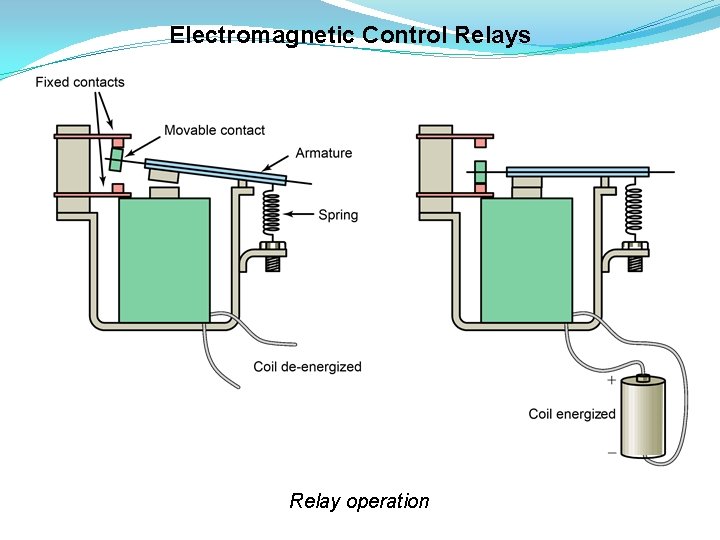
Electromagnetic Control Relays • The coil and contacts are insulated from each other; therefore, under normal conditions, no electric circuit will exist between them • The letter M frequently indicates a motor starter, while CR is used for control relays • Normally open (NO) contacts are defined as those contacts that are open when no current flows through the coil but that close as soon as the coil conducts a current or is energized • Normally closed (NC) contacts are closed when the coil is deenergized and open when the coil is energized • Control relay coils and contacts have separate ratings. Coils are rated for the type of operating current (DC or AC) and normal operating voltage
Electromagnetic Control Relays Relay operation
Electromagnetic Control Relays Relay normally open and normally closed contacts
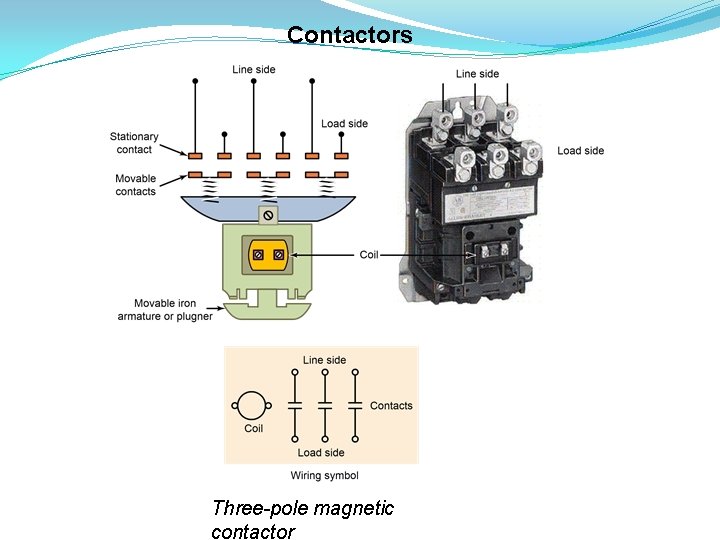
Contactors • A contactor is a special type of relay designed to handle heavy power loads that are beyond the capability of simple control relays • Unlike relays, contactors are designed to make and break higher powered circuits without being damaged • Such loads include lights, heaters, transformers, capacitors, and electric motors for which overload protection is provided separately or not required
Contactors Three-pole magnetic contactor
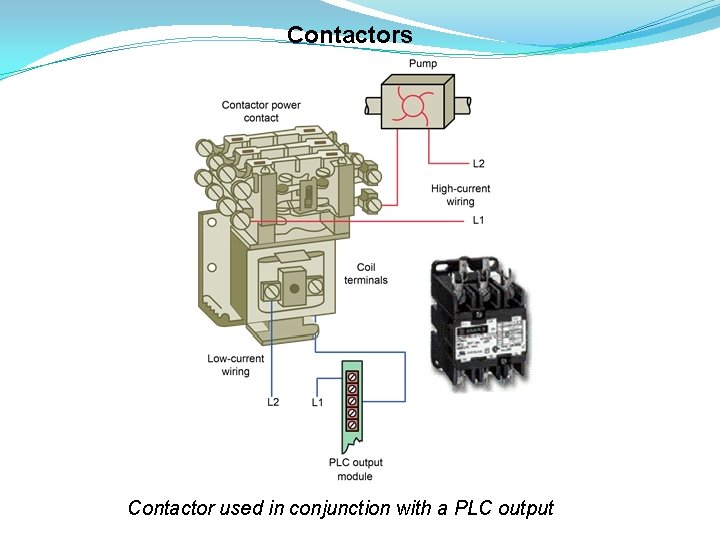
Contactors Contactor used in conjunction with a PLC output
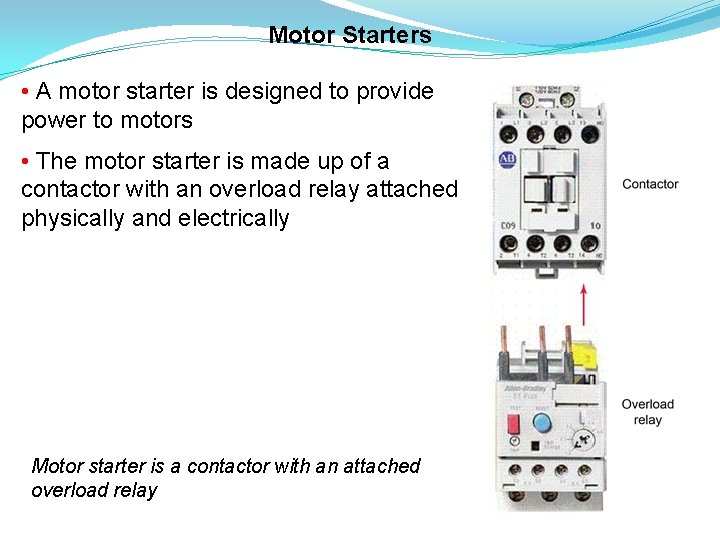
Motor Starters • A motor starter is designed to provide power to motors • The motor starter is made up of a contactor with an overload relay attached physically and electrically Motor starter is a contactor with an attached overload relay
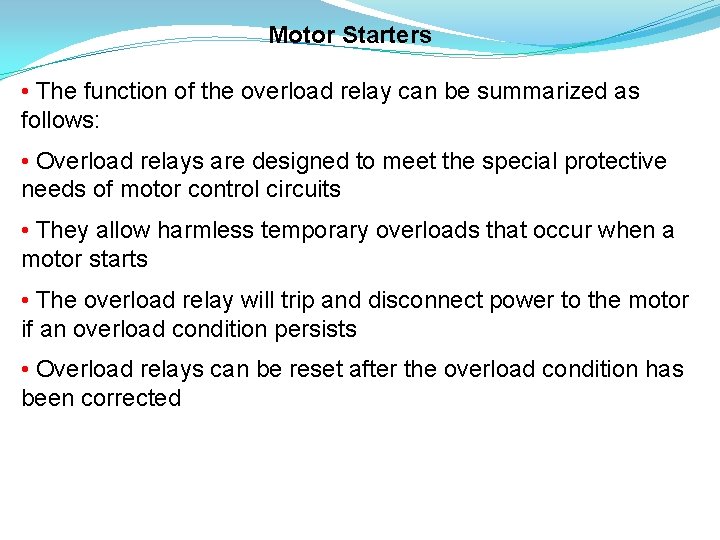
Motor Starters • The function of the overload relay can be summarized as follows: • Overload relays are designed to meet the special protective needs of motor control circuits • They allow harmless temporary overloads that occur when a motor starts • The overload relay will trip and disconnect power to the motor if an overload condition persists • Overload relays can be reset after the overload condition has been corrected
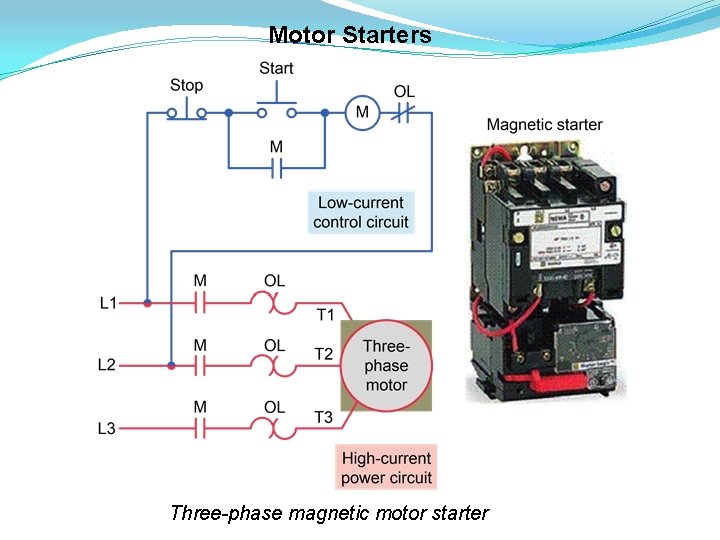
Motor Starters Three-phase magnetic motor starter
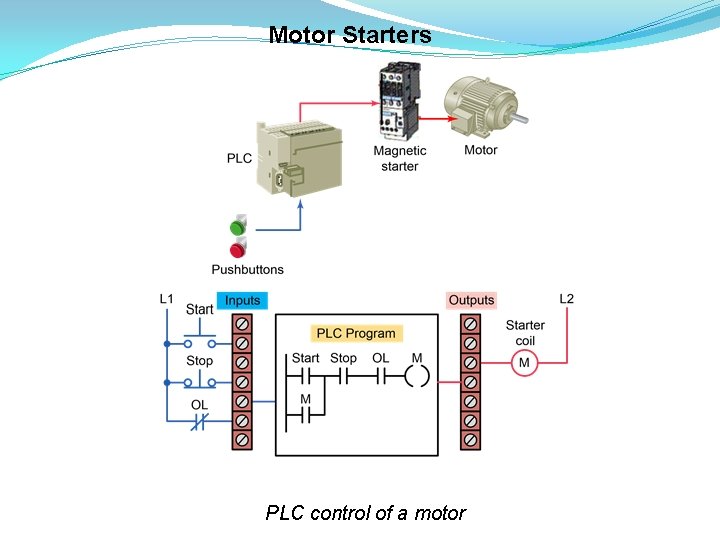
Motor Starters PLC control of a motor
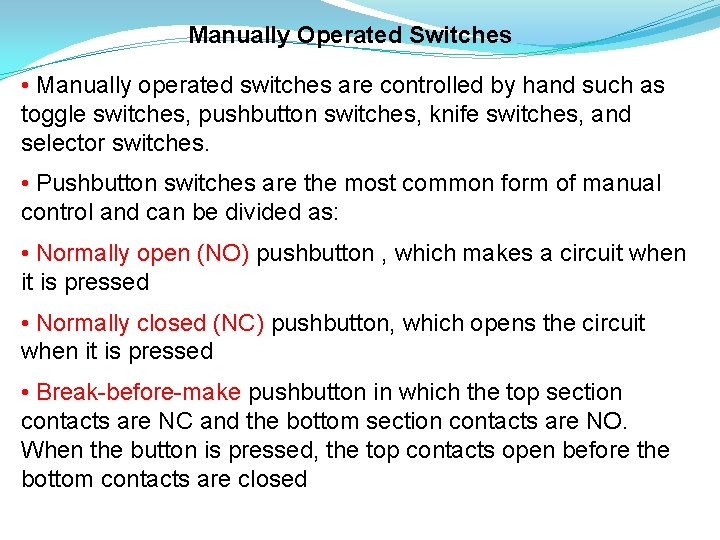
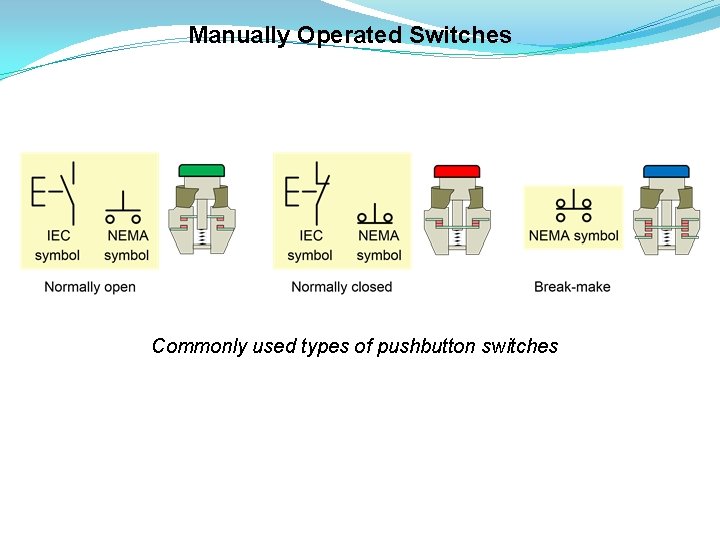
Manually Operated Switches • Manually operated switches are controlled by hand such as toggle switches, pushbutton switches, knife switches, and selector switches. • Pushbutton switches are the most common form of manual control and can be divided as: • Normally open (NO) pushbutton , which makes a circuit when it is pressed • Normally closed (NC) pushbutton, which opens the circuit when it is pressed • Break-before-make pushbutton in which the top section contacts are NC and the bottom section contacts are NO. When the button is pressed, the top contacts open before the bottom contacts are closed
Manually Operated Switches Commonly used types of pushbutton switches
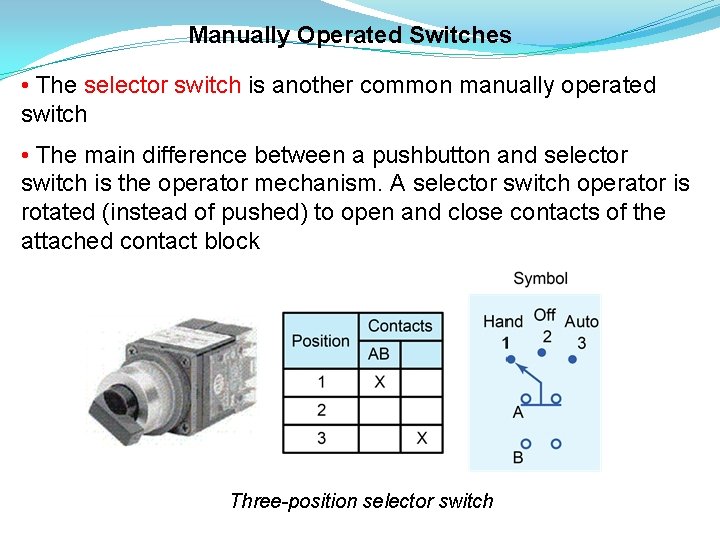
Manually Operated Switches • The selector switch is another common manually operated switch • The main difference between a pushbutton and selector switch is the operator mechanism. A selector switch operator is rotated (instead of pushed) to open and close contacts of the attached contact block Three-position selector switch
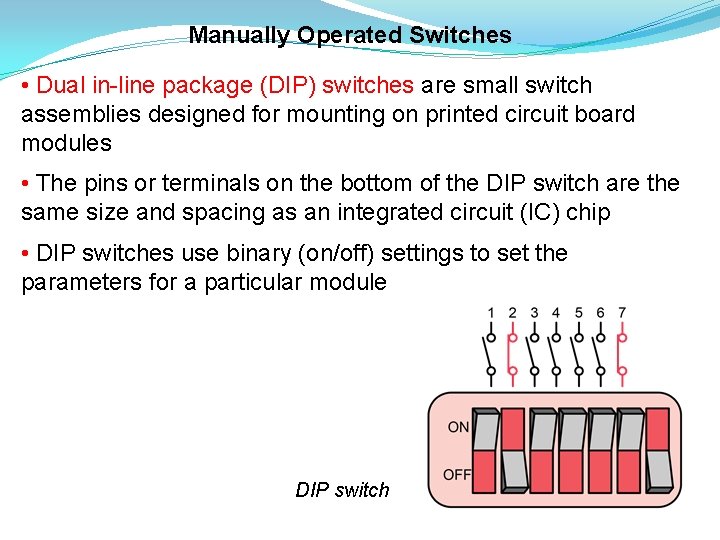
Manually Operated Switches • Dual in-line package (DIP) switches are small switch assemblies designed for mounting on printed circuit board modules • The pins or terminals on the bottom of the DIP switch are the same size and spacing as an integrated circuit (IC) chip • DIP switches use binary (on/off) settings to set the parameters for a particular module DIP switch
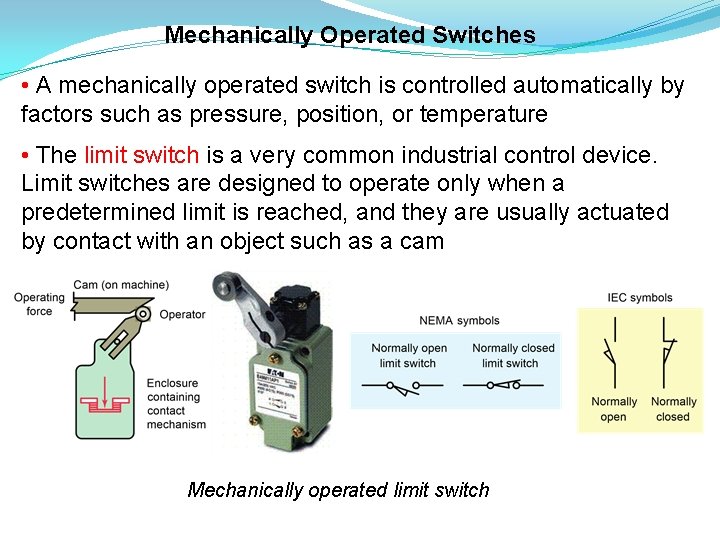
Mechanically Operated Switches • A mechanically operated switch is controlled automatically by factors such as pressure, position, or temperature • The limit switch is a very common industrial control device. Limit switches are designed to operate only when a predetermined limit is reached, and they are usually actuated by contact with an object such as a cam Mechanically operated limit switch
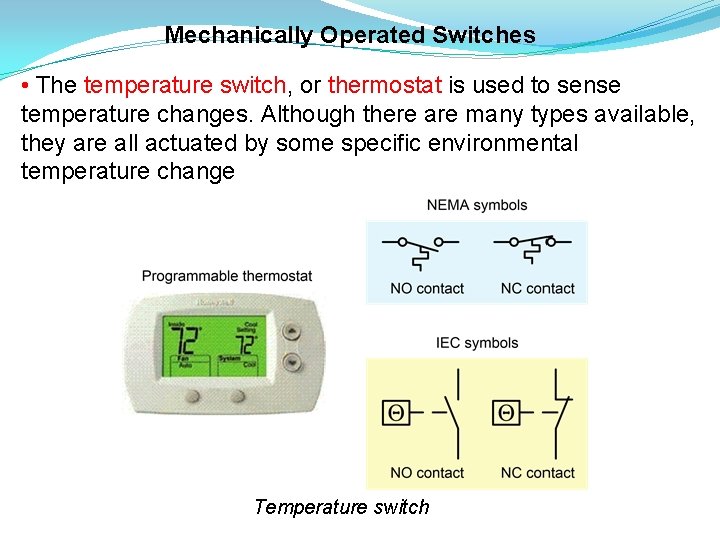
Mechanically Operated Switches • The temperature switch, or thermostat is used to sense temperature changes. Although there are many types available, they are all actuated by some specific environmental temperature change Temperature switch
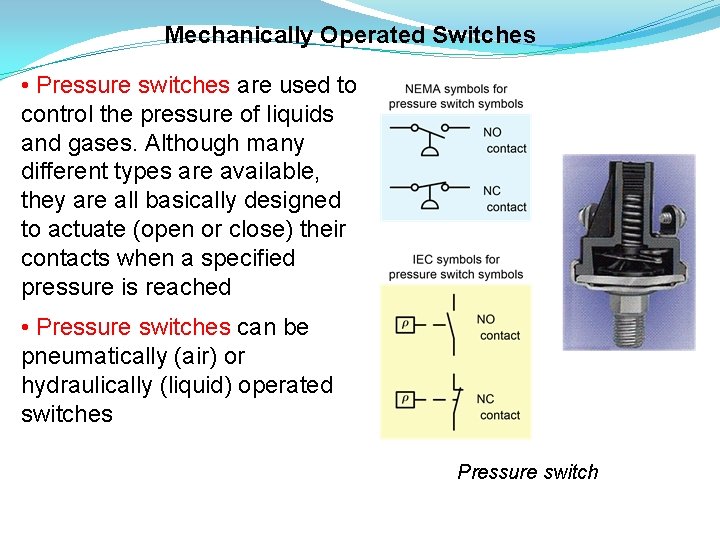
Mechanically Operated Switches • Pressure switches are used to control the pressure of liquids and gases. Although many different types are available, they are all basically designed to actuate (open or close) their contacts when a specified pressure is reached • Pressure switches can be pneumatically (air) or hydraulically (liquid) operated switches Pressure switch
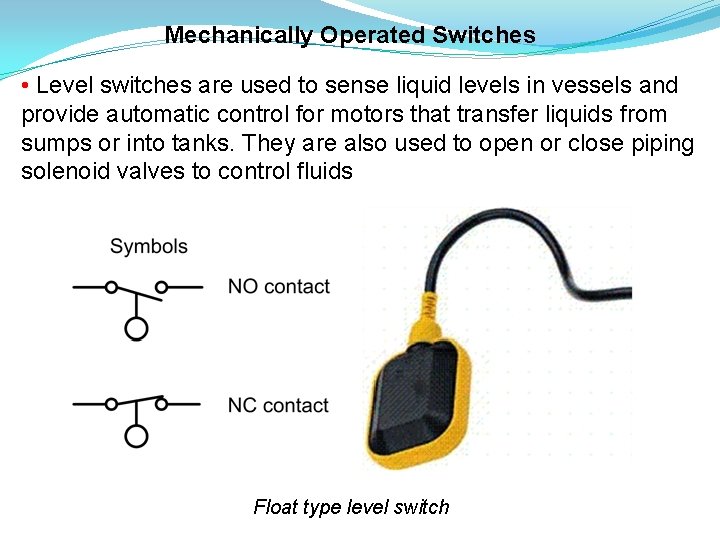
Mechanically Operated Switches • Level switches are used to sense liquid levels in vessels and provide automatic control for motors that transfer liquids from sumps or into tanks. They are also used to open or close piping solenoid valves to control fluids Float type level switch
Sensors • Sensors are used for detecting, and often measuring, the magnitude of something • They convert mechanical, magnetic, thermal, optical, and chemical variations into electric voltages and currents • Sensors are usually categorized by what they measure, and they play an important role in modern manufacturing process control
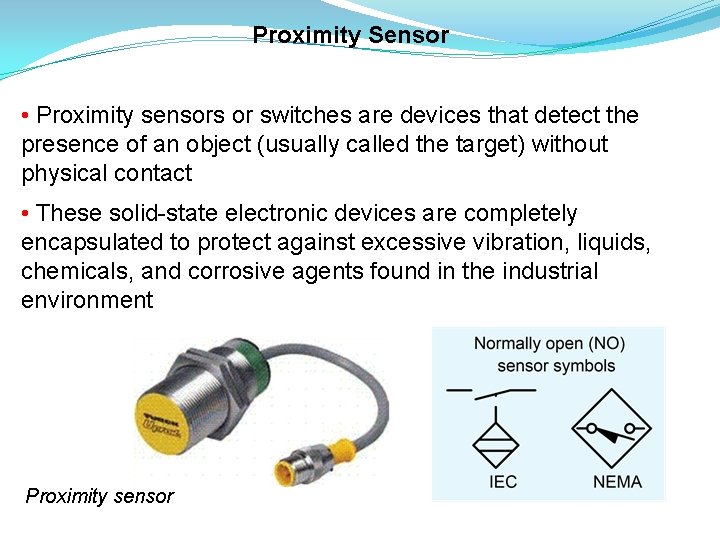
Proximity Sensor • Proximity sensors or switches are devices that detect the presence of an object (usually called the target) without physical contact • These solid-state electronic devices are completely encapsulated to protect against excessive vibration, liquids, chemicals, and corrosive agents found in the industrial environment Proximity sensor
Proximity Sensor • Proximity sensors are used when: • The object being detected is too small, lightweight, or soft to operate a mechanical switch • Rapid response and high switching rates are required, as in counting or ejection control applications • An object has to be sensed through nonmetallic barriers such as glass, plastic, and paper cartons • Unfriendly environments demand improved sealing properties, preventing properation of mechanical switches
Proximity Sensor • Proximity sensors are used when: • The object being detected is too small, lightweight, or soft to operate a mechanical switch • Rapid response and high switching rates are required, as in counting or ejection control applications • An object has to be sensed through nonmetallic barriers such as glass, plastic, and paper cartons • Unfriendly environments demand improved sealing properties, preventing properation of mechanical switches • Long life and reliable service are required • A fast electronic control system requires a bounce free input signal
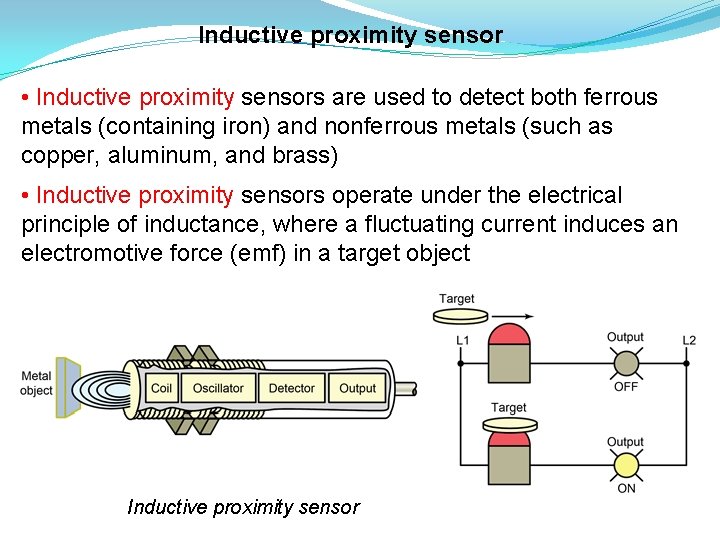
Inductive proximity sensor • Inductive proximity sensors are used to detect both ferrous metals (containing iron) and nonferrous metals (such as copper, aluminum, and brass) • Inductive proximity sensors operate under the electrical principle of inductance, where a fluctuating current induces an electromotive force (emf) in a target object Inductive proximity sensor
Inductive proximity sensor • The operation of inductive proximity sensor can be summarized as follows: • The oscillator circuit generates a high-frequency electromagnetic field that radiates from the end of the sensor • When a metal object enters the field, eddy currents are induced in the surface of the object • The eddy currents on the object absorb some of the radiated energy from the sensor, resulting in a loss of energy and change of strength of the oscillator • The sensor’s detection circuit monitors the oscillator’s strength and triggers a solid-state output at a specific level • Once the metal object leaves the sensing area, the oscillator returns to its initial value.
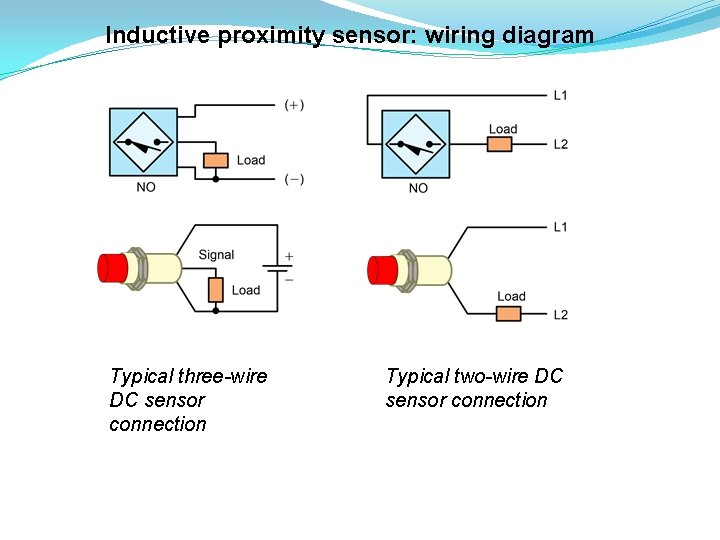
Inductive proximity sensor: wiring diagram Typical three-wire DC sensor connection Typical two-wire DC sensor connection
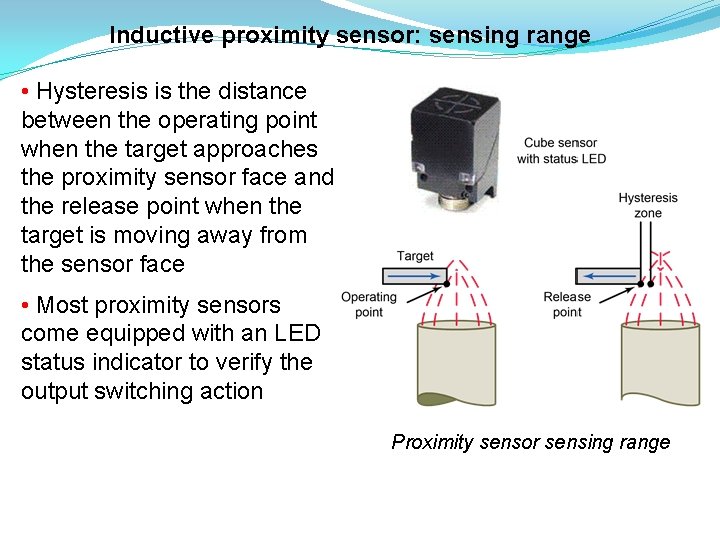
Inductive proximity sensor: sensing range • Hysteresis is the distance between the operating point when the target approaches the proximity sensor face and the release point when the target is moving away from the sensor face • Most proximity sensors come equipped with an LED status indicator to verify the output switching action Proximity sensor sensing range
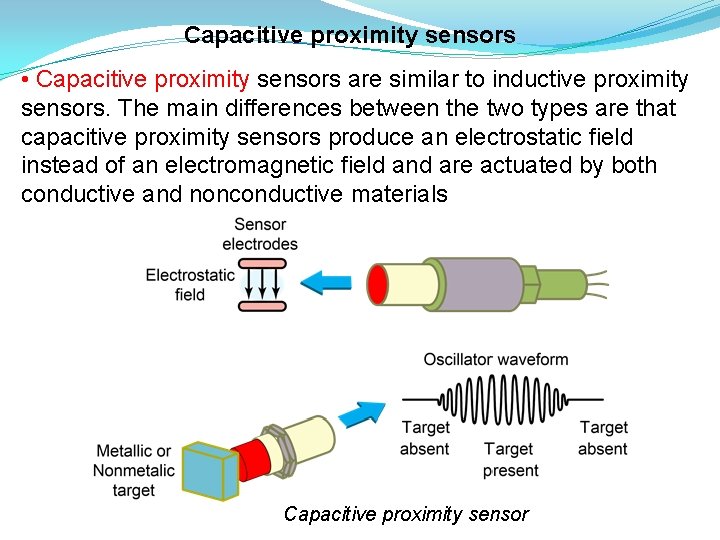
Capacitive proximity sensors • Capacitive proximity sensors are similar to inductive proximity sensors. The main differences between the two types are that capacitive proximity sensors produce an electrostatic field instead of an electromagnetic field and are actuated by both conductive and nonconductive materials Capacitive proximity sensor
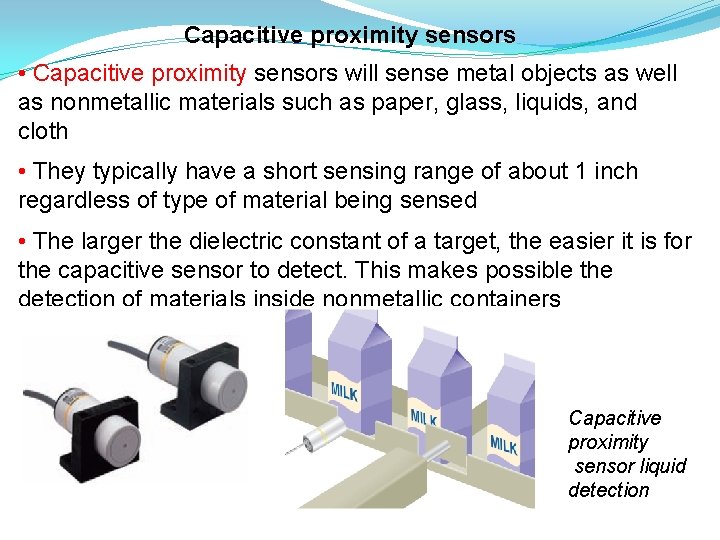
Capacitive proximity sensors • Capacitive proximity sensors will sense metal objects as well as nonmetallic materials such as paper, glass, liquids, and cloth • They typically have a short sensing range of about 1 inch regardless of type of material being sensed • The larger the dielectric constant of a target, the easier it is for the capacitive sensor to detect. This makes possible the detection of materials inside nonmetallic containers Capacitive proximity sensor liquid detection
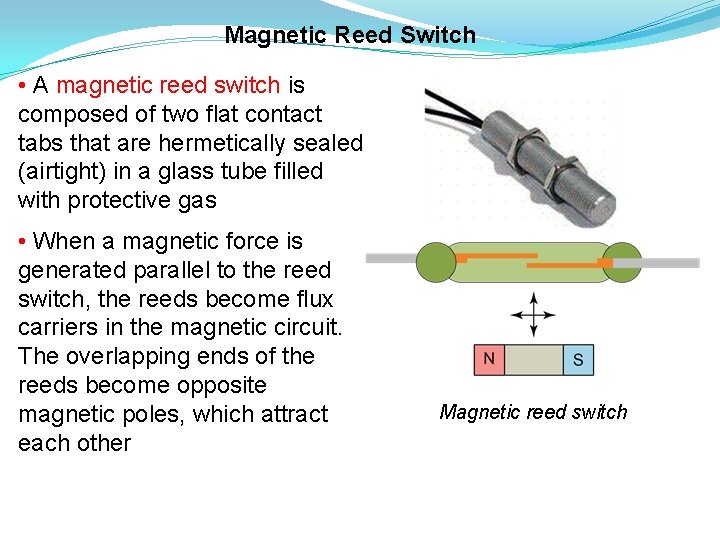
Magnetic Reed Switch • A magnetic reed switch is composed of two flat contact tabs that are hermetically sealed (airtight) in a glass tube filled with protective gas • When a magnetic force is generated parallel to the reed switch, the reeds become flux carriers in the magnetic circuit. The overlapping ends of the reeds become opposite magnetic poles, which attract each other Magnetic reed switch
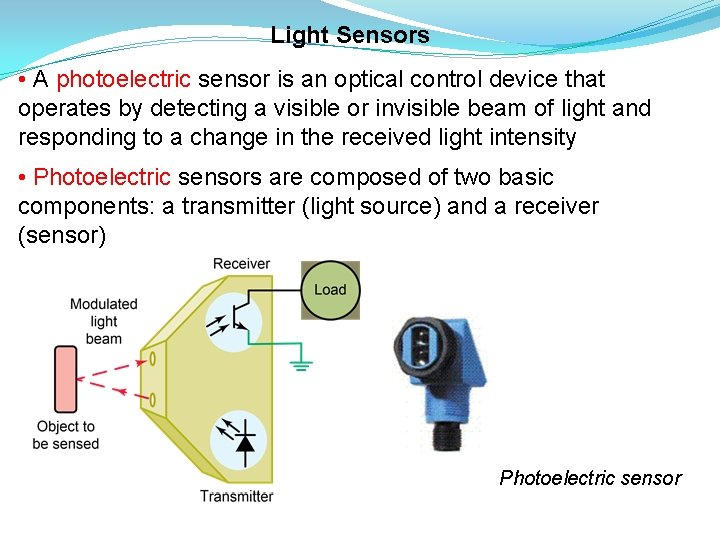
Light Sensors • A photoelectric sensor is an optical control device that operates by detecting a visible or invisible beam of light and responding to a change in the received light intensity • Photoelectric sensors are composed of two basic components: a transmitter (light source) and a receiver (sensor) Photoelectric sensor
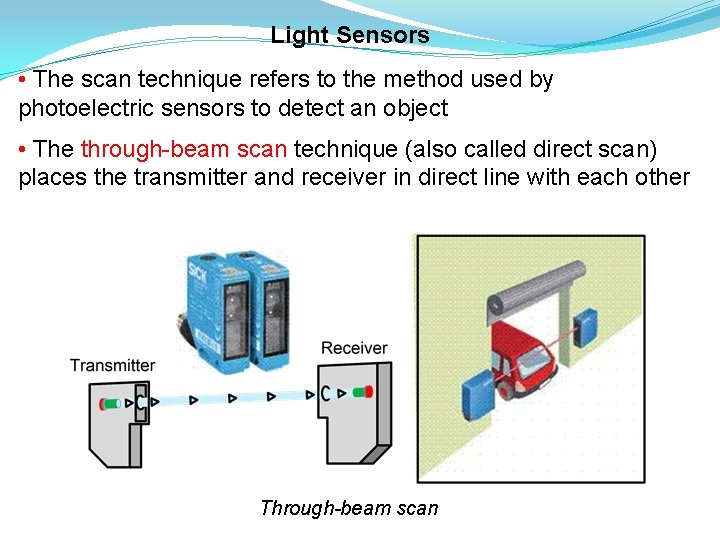
Light Sensors • The scan technique refers to the method used by photoelectric sensors to detect an object • The through-beam scan technique (also called direct scan) places the transmitter and receiver in direct line with each other Through-beam scan
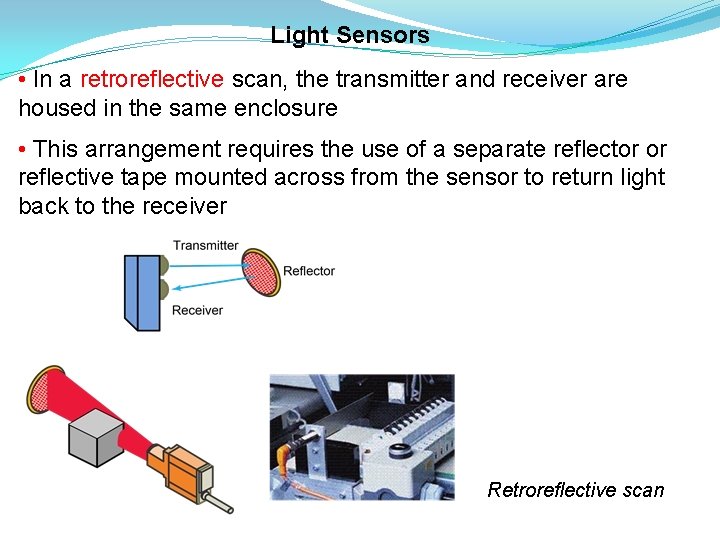
Light Sensors • In a retroreflective scan, the transmitter and receiver are housed in the same enclosure • This arrangement requires the use of a separate reflector or reflective tape mounted across from the sensor to return light back to the receiver Retroreflective scan
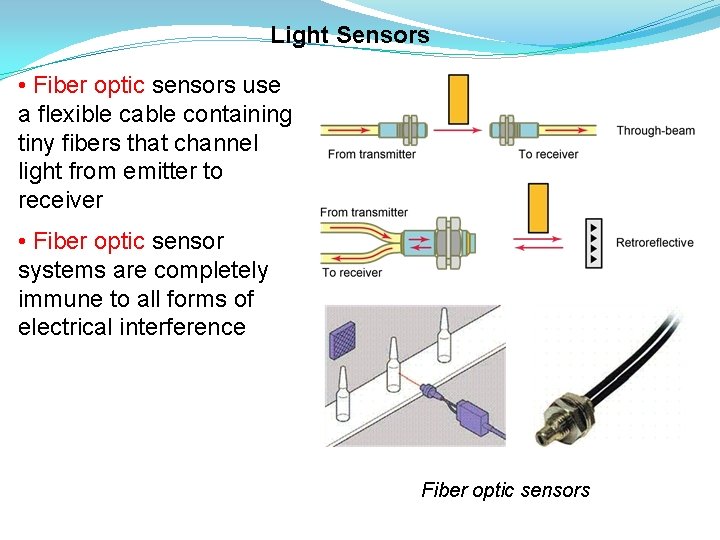
Light Sensors • Fiber optic sensors use a flexible cable containing tiny fibers that channel light from emitter to receiver • Fiber optic sensor systems are completely immune to all forms of electrical interference Fiber optic sensors
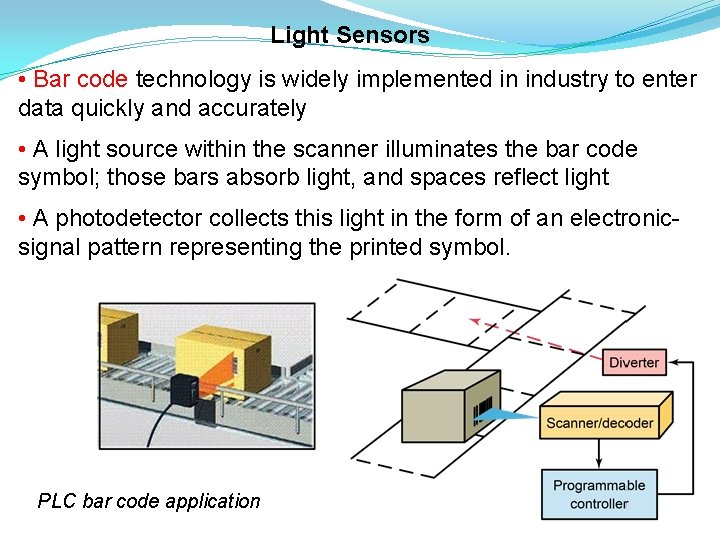
Light Sensors • Bar code technology is widely implemented in industry to enter data quickly and accurately • A light source within the scanner illuminates the bar code symbol; those bars absorb light, and spaces reflect light • A photodetector collects this light in the form of an electronicsignal pattern representing the printed symbol. PLC bar code application
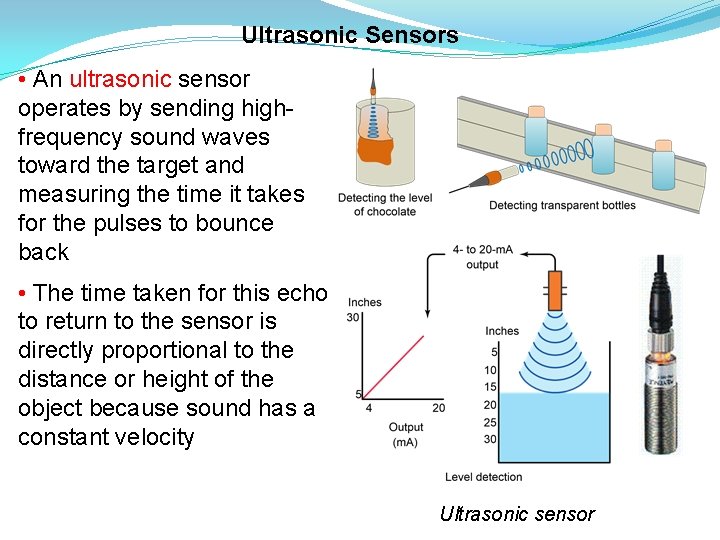
Ultrasonic Sensors • An ultrasonic sensor operates by sending highfrequency sound waves toward the target and measuring the time it takes for the pulses to bounce back • The time taken for this echo to return to the sensor is directly proportional to the distance or height of the object because sound has a constant velocity Ultrasonic sensor
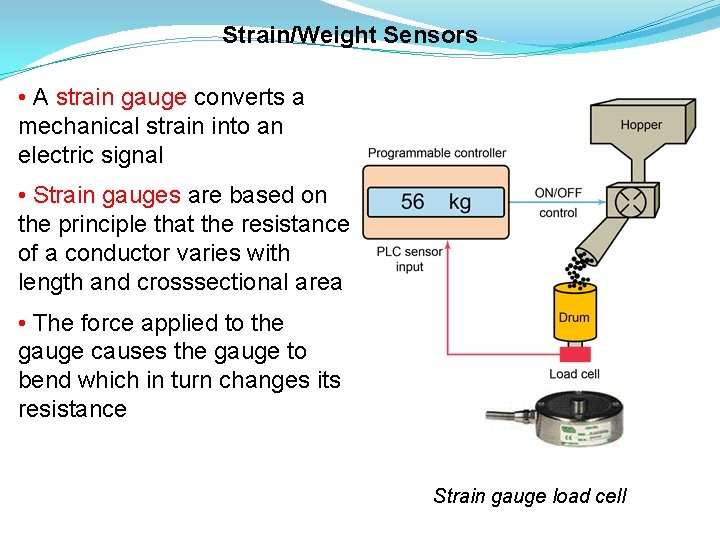
Strain/Weight Sensors • A strain gauge converts a mechanical strain into an electric signal • Strain gauges are based on the principle that the resistance of a conductor varies with length and crosssectional area • The force applied to the gauge causes the gauge to bend which in turn changes its resistance Strain gauge load cell
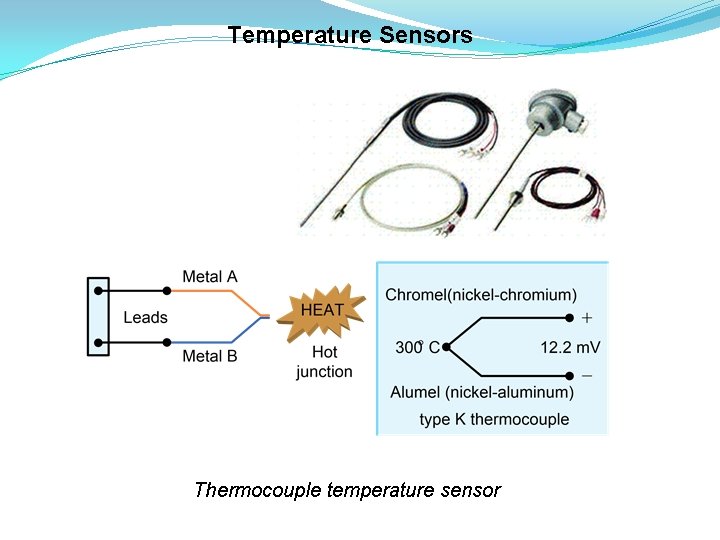
Temperature Sensors • The thermocouple is the most widely used temperature sensor • Thermocouples operate on the principle that when two dissimilar metals are joined, a predictable DC voltage will be generated that relates to the difference in temperature between the hot junction and the cold junction • The hot junction (measuring junction) is the joined end of a thermocouple that is exposed to the process where the temperature measurement is desired • The cold junction (reference junction) is the end of a thermocouple that is kept at a constant temperature to provide a reference point • Because of their ruggedness and wide temperature range, thermocouples are used in industry to monitor and control oven and furnace temperatures
Temperature Sensors Thermocouple temperature sensor
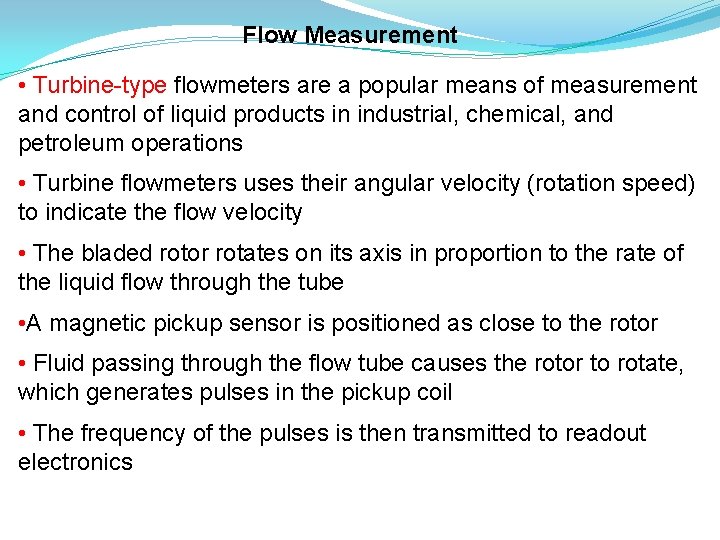
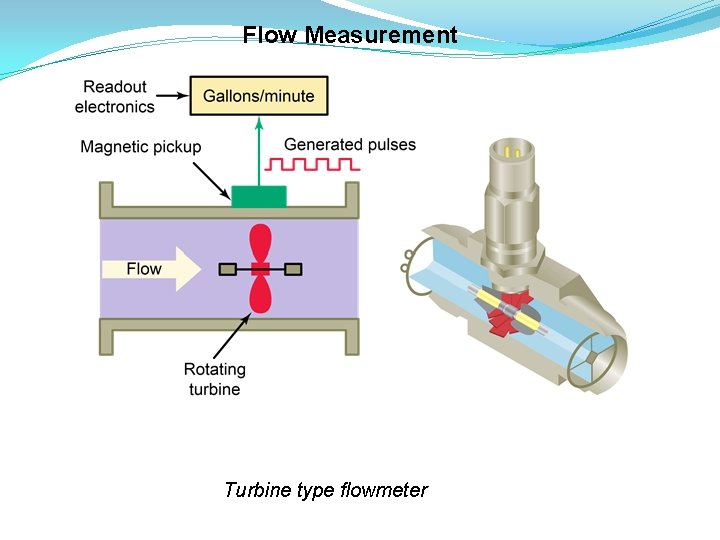
Flow Measurement • Turbine-type flowmeters are a popular means of measurement and control of liquid products in industrial, chemical, and petroleum operations • Turbine flowmeters uses their angular velocity (rotation speed) to indicate the flow velocity • The bladed rotor rotates on its axis in proportion to the rate of the liquid flow through the tube • A magnetic pickup sensor is positioned as close to the rotor • Fluid passing through the flow tube causes the rotor to rotate, which generates pulses in the pickup coil • The frequency of the pulses is then transmitted to readout electronics
Flow Measurement Turbine type flowmeter
Velocity and Position Sensors • Turbine-type