
DEVELOPING EXHIBITS LOURDES SANTAMARIAWHEELER EXHIBITS COORDINATOR The magic
DEVELOPING EXHIBITS LOURDES SANTAMARIA-WHEELER EXHIBITS COORDINATOR
The magic of exhibitions is at the intersection of design and curation. Not one or the other.
WHAT IS AN EXHIBIT? An exhibit is a story interpretation context scholarly content
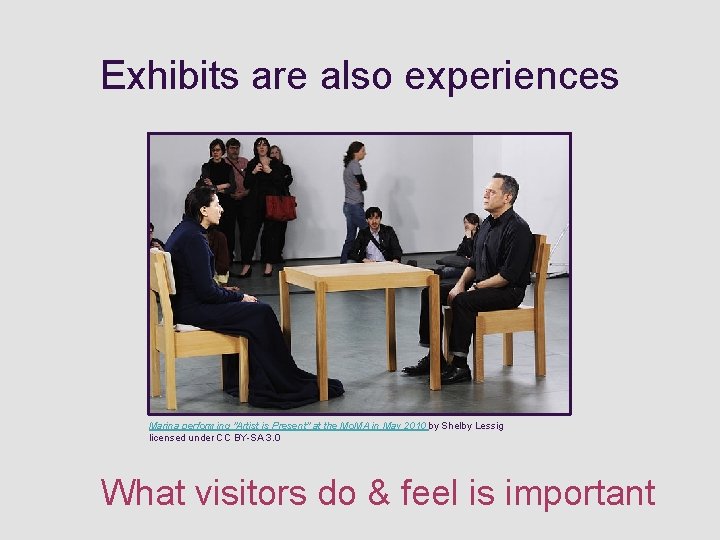
Exhibits are also experiences Marina performing "Artist is Present" at the Mo. MA in May 2010 by Shelby Lessig licensed under CC BY-SA 3. 0 What visitors do & feel is important
WHY Education - Mission fulfillment Bring awareness to hidden/low usage materials Share new findings, new acquisitions, new relationships among items Broaden audience
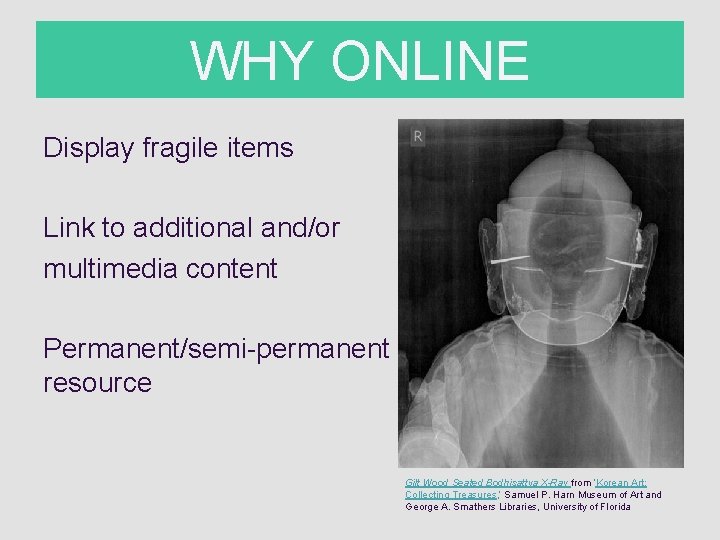
WHY ONLINE Display fragile items Link to additional and/or multimedia content Permanent/semi-permanent resource Gilt Wood Seated Bodhisattva X-Ray from ‘Korean Art: Collecting Treasures, ’ Samuel P. Harn Museum of Art and George A. Smathers Libraries, University of Florida
POLICY Goal of exhibition program is to highlight the collections Use originals whenever possible from Smathers Libraries collections, borrow as appropriate to support/augment • Loans should not be the central feature, unless it is a traveling exhibit Co-curating and collaboration within the Libraries’ various collections and with campus departments, the community, and other institutions is encouraged http: //exhibits. uflib. ufl. edu/docs/Exhibits. Policy. pdf Implemented 2012
POLICY The Libraries do not develop or host exhibits with the sole purpose of promoting agendas of organizations outside the Libraries, or to advocate for specific political, philosophical, or religious viewpoints. Do not display unsolicited exhibits Physical exhibitions created by the Libraries shall have complementary online component(s) as appropriate. All online material created for, or in conjunction with exhibitions shall be archived and publicly available in UFDC http: //exhibits. uflib. ufl. edu/docs/Exhibits. Policy. pdf Implemented 2012
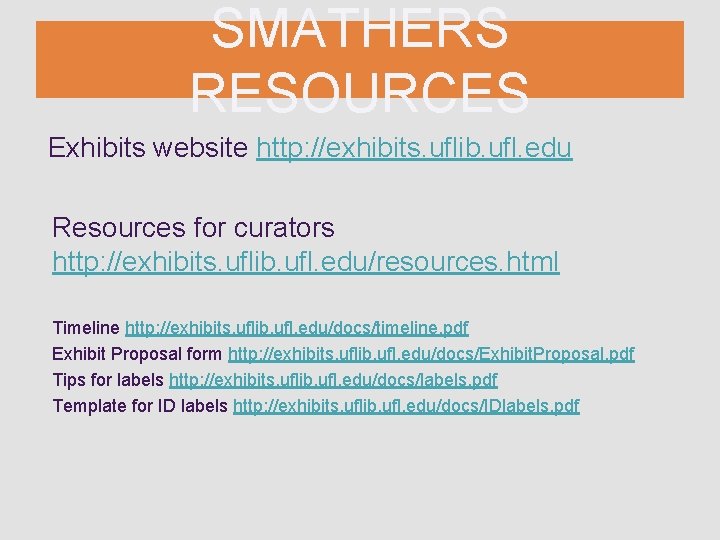
SMATHERS RESOURCES Exhibits website http: //exhibits. uflib. ufl. edu Resources for curators http: //exhibits. uflib. ufl. edu/resources. html Timeline http: //exhibits. uflib. ufl. edu/docs/timeline. pdf Exhibit Proposal form http: //exhibits. uflib. ufl. edu/docs/Exhibit. Proposal. pdf Tips for labels http: //exhibits. uflib. ufl. edu/docs/labels. pdf Template for ID labels http: //exhibits. uflib. ufl. edu/docs/IDlabels. pdf
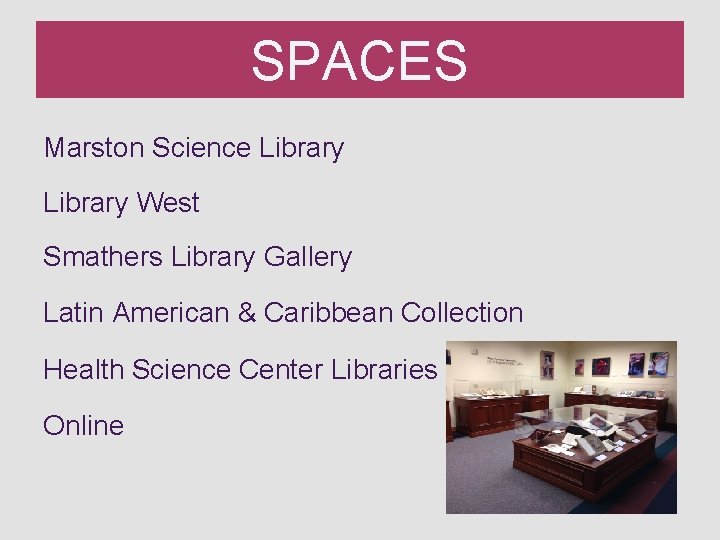
SPACES Marston Science Library West Smathers Library Gallery Latin American & Caribbean Collection Health Science Center Libraries Online
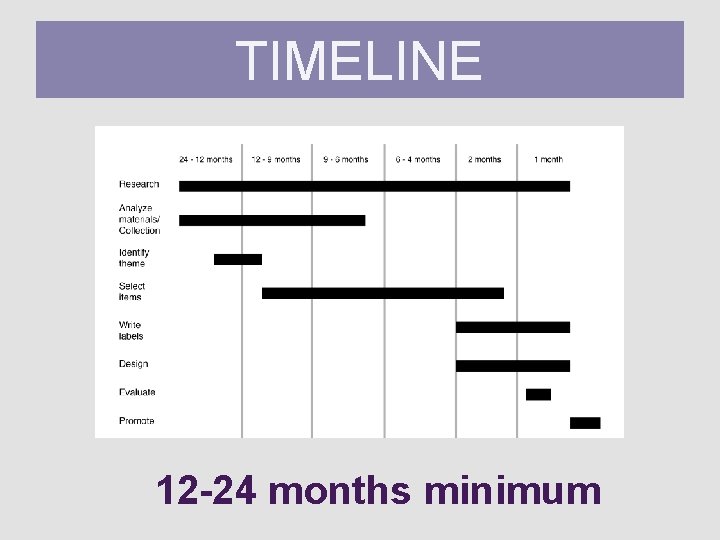
TIMELINE 12 -24 months minimum
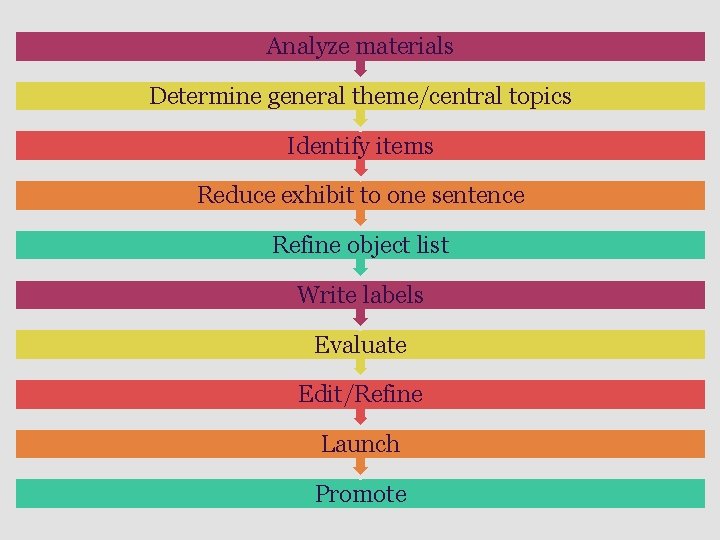
Analyze materials Determine general theme/central topics Identify items Reduce exhibit to one sentence Refine object list Write labels Evaluate Edit/Refine Launch Promote
THEMES Pick a compelling story that the materials support Think beyond directly commemorative months, milestones, anniversaries Concrete ideas not requiring a lot of background information, too much explanation
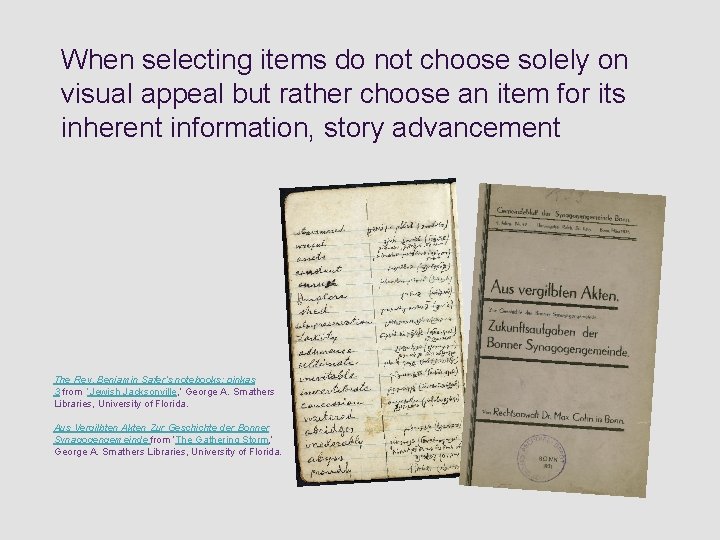
When selecting items do not choose solely on visual appeal but rather choose an item for its inherent information, story advancement The Rev. Benjamin Safer’s notebooks: pinkas 3 from ‘Jewish Jacksonville, ’ George A. Smathers Libraries, University of Florida. Aus Vergilbten Akten Zur Geschichte der Bonner Synagogengemeinde from ‘The Gathering Storm, ’ George A. Smathers Libraries, University of Florida.
GOOD EXHIBITS An aspect of the exhibition is innovative Offers a new perspective, new insight, or new information on a topic Synthesizes and presents existing knowledge and/or collection materials in a provocative way Indicators of exhibit excellence from the National Association for Museum Exhibition (NAME)
GOOD EXHIBITS Are easy to explain Make the subject come to life Are conceptually simple Emphasize connections among things
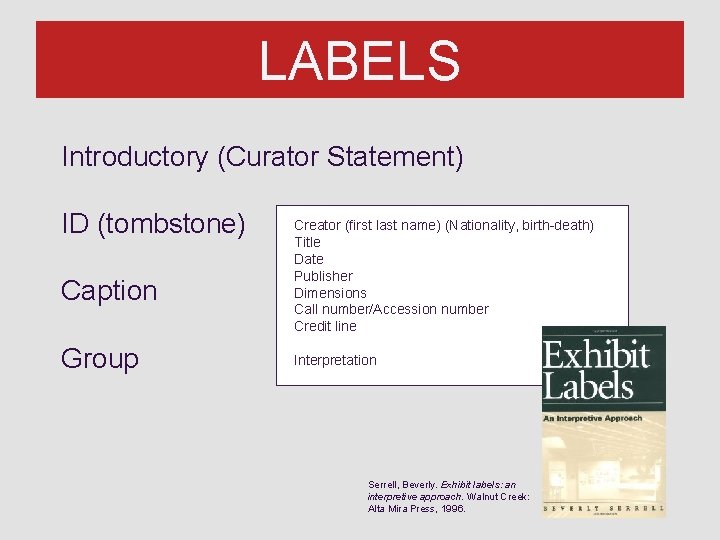
LABELS Introductory (Curator Statement) ID (tombstone) Caption Group Creator (first last name) (Nationality, birth-death) Title Date Publisher Dimensions Call number/Accession number Credit line Interpretation Serrell, Beverly. Exhibit labels: an interpretive approach. Walnut Creek: Alta Mira Press, 1996.
INTERPRETIVE LABELS Introductory, Caption, Group Conversational & narrative Just enough details to tell the story Avoid tech, specialized terms, or anything that requires lengthy explanation Not for your academic peers
AUDIENCE Who are they? What are they like? Why are they coming? What do you want them to do? Unintended audiences are common online
Don’t expect visitors to spend more than 10 minutes in online exhibit
- Slides: 20