
Developing Evaluation Plans and Logic Models Explaining the
![What does the DD Act Say? (Evaluation Plan [Section 125(C)(3) And (7)]) • The](https://slidetodoc.com/presentation_image/2aa5b08638eedf74a53b8707a99b3c76/image-29.jpg "What does the DD Act Say? (Evaluation Plan [Section 125(C)(3) And (7)]) • The")
- Slides: 50
Developing Evaluation Plans and Logic Models Explaining the Value of Your Program Susan Jenkins, Ph. D Director Office of Performance and Evaluation Center for Policy and Evaluation Office: 202 -795 -7732 E-mail: susan. jenkins@acl. hhs. gov Jennifer Tillery, MSM Social Science Analyst & COR II Office of Performance and Evaluation Center for Policy and Evaluation Office: 202 -795 -7275 E-mail: jennifer. tillery@acl. hhs. gov 1 Kristen (Krissy) Hudgins, Ph. D Senior Social Science Analyst Office of Performance and Evaluation Center for Policy and Evaluation Office: 202 -795 -7732 E-mail: kristen. hudgins@acl. hhs. gov
Agenda • Common tools for managing program performance • Logic models and why are they important • Evaluation plans and how to develop and use them • Tying it all together 2
Objectives • Increase – familiarity with performance management concepts – Awareness of performance management tools – Ability to monitor program performance and make corrections when needed 3
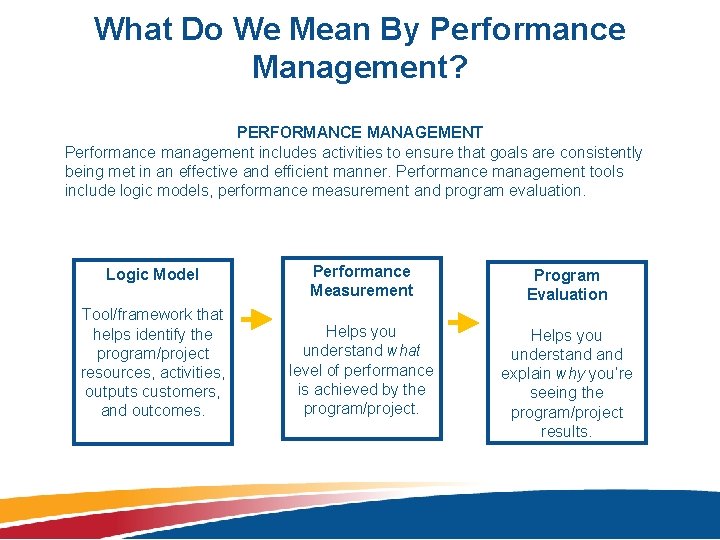
What Do We Mean By Performance Management? PERFORMANCE MANAGEMENT Performance management includes activities to ensure that goals are consistently being met in an effective and efficient manner. Performance management tools include logic models, performance measurement and program evaluation. Logic Model Performance Measurement Program Evaluation Tool/framework that helps identify the program/project resources, activities, outputs customers, and outcomes. Helps you understand what level of performance is achieved by the program/project. Helps you understand explain why you’re seeing the program/project results.
Overarching Principles • Planning • Engaging • Revisiting 5
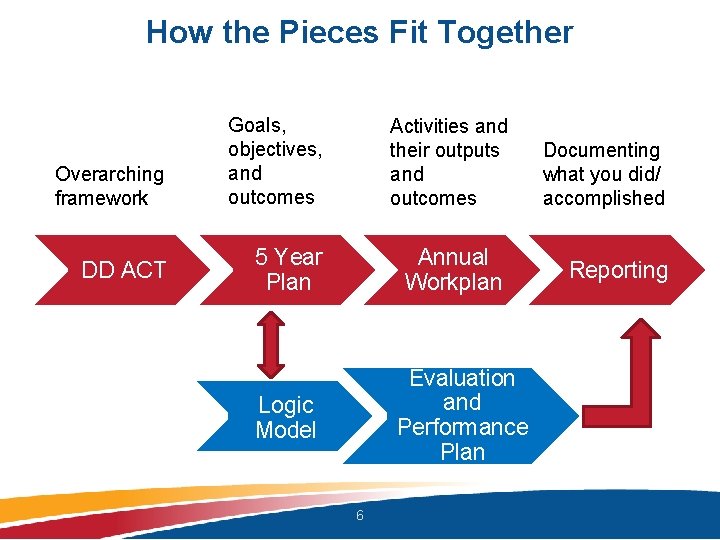
How the Pieces Fit Together Overarching framework DD ACT Goals, objectives, and outcomes Activities and their outputs and outcomes 5 Year Plan Annual Workplan Evaluation and Performance Plan Logic Model 6 Documenting what you did/ accomplished Reporting
A Fresh Look at Logic Models Jennifer Tillery, MSM Social Science Analyst & COR II Office of Performance and Evaluation Center for Policy and Evaluation Office: 202 -795 -7275 E-mail: jennifer. tillery@acl. hhs. gov 7
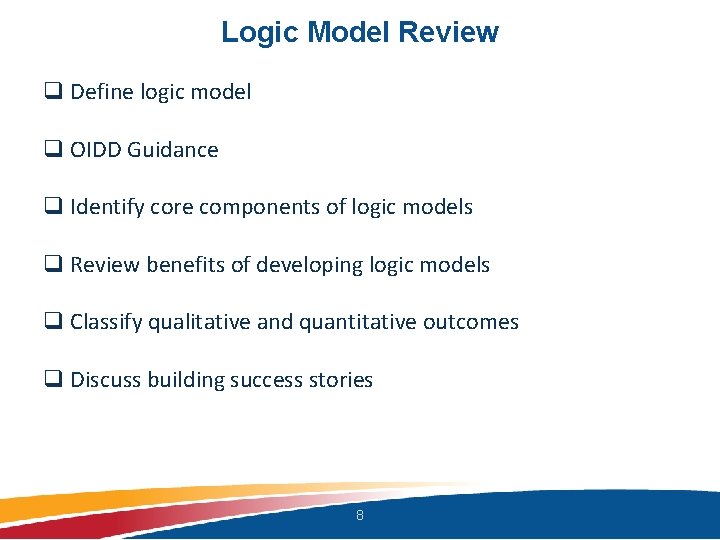
Logic Model Review q Define logic model q OIDD Guidance q Identify core components of logic models q Review benefits of developing logic models q Classify qualitative and quantitative outcomes q Discuss building success stories 8
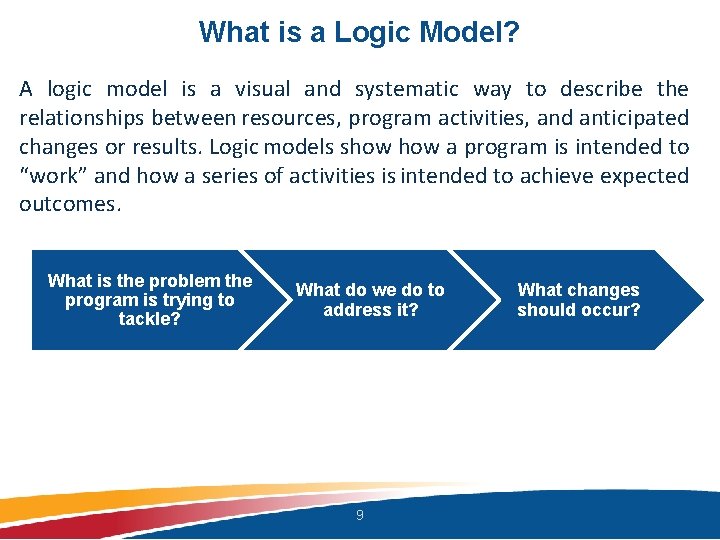
What is a Logic Model? A logic model is a visual and systematic way to describe the relationships between resources, program activities, and anticipated changes or results. Logic models show a program is intended to “work” and how a series of activities is intended to achieve expected outcomes. What is the problem the program is trying to tackle? What do we do to address it? 9 What changes should occur?
OIDD Guidance on Evaluation (Logic Model) • Requirement: As part of the evaluation plan, Councils must use and submit a 5 -year logic model that presents the logical connections between DD Council activities and desired DD Council outcomes. • The logic model should reflect an understanding of the relationships among the resources a DD Council has to operate, the strategies/activities the DD Council plans to implement, and the outputs and outcomes the DD Council expects to achieve. 10
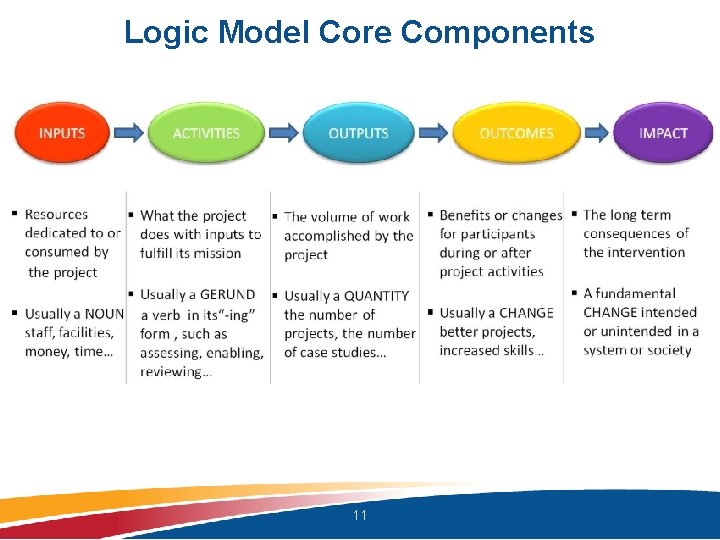
Logic Model Core Components 11
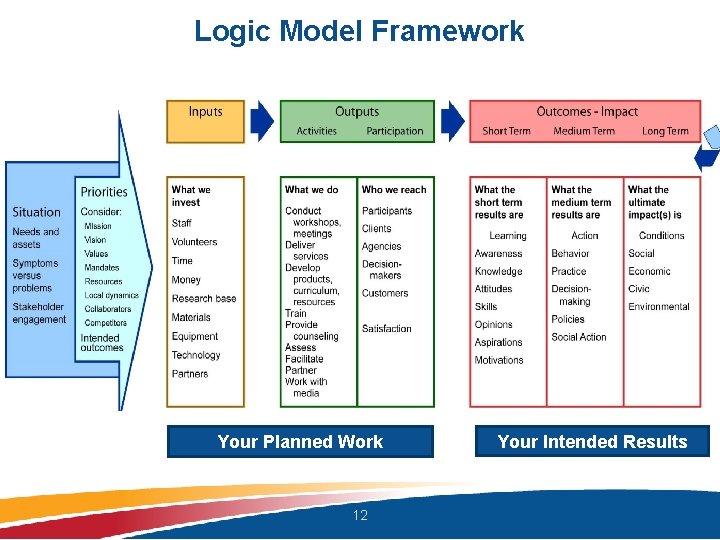
Logic Model Framework Your Planned Work 12 Your Intended Results
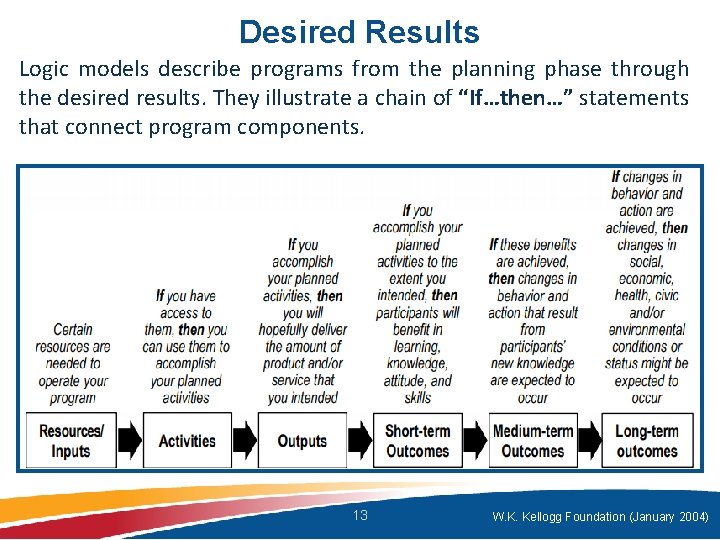
Desired Results Logic models describe programs from the planning phase through the desired results. They illustrate a chain of “If…then…” statements that connect program components. 13 W. K. Kellogg Foundation (January 2004)
Benefits of Logic Models ü Focus on key critical elements of DD Council ü When developed with stakeholders it creates a consensus ü Reduces Uncertainty: Helps to communicate complex ideas to a variety of stakeholders ü Increases Accountability: Quality Assurance/ Quality Management ü Improves program design and planning, program implementation, and strategic reporting. ü It serves as a foundation for evaluation. 14
Key Points There is no one best logic model. A logic model shouldn’t be created by one person. Developing a logic model is not completed in one session. Logic models represent intention. Models can and should change as the program changes or develops. • Logic models play a critical role in informing evaluation and building the evidence base for a program. • Programs do not need to evaluate every aspect of the logic model. • • • 15
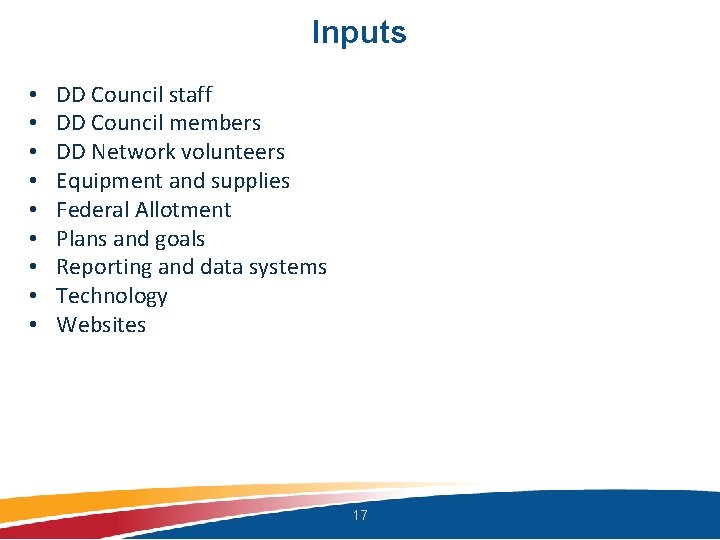
Turning Theory into Practice In order to turn theory into practice when implementing revisions to your logic model consider the following: • Determine the purpose of the logic model. • Who will use it? For what? • Involve others • Set boundaries for the logic model. • Determine the level of specificity (its intended to be a quick snapshot) • Incorporate reasonable outcomes and expectations Your logic model should answer the following: 1. What is a DD Council ? 2. Who is supported by the work of DD Councils? (Individuals with developmental disabilities, family members, others). 3. How will individuals with developmental disabilities, family members and systems benefit? 4. How will you know if you have been successful? 5. What does existing research tell us about how to solve this problem? 16
Inputs • • • DD Council staff DD Council members DD Network volunteers Equipment and supplies Federal Allotment Plans and goals Reporting and data systems Technology Websites 17
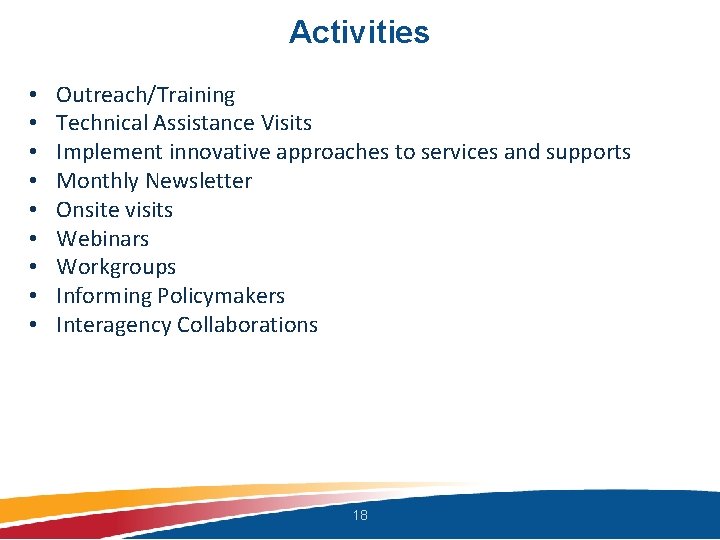
Activities • • • Outreach/Training Technical Assistance Visits Implement innovative approaches to services and supports Monthly Newsletter Onsite visits Webinars Workgroups Informing Policymakers Interagency Collaborations 18
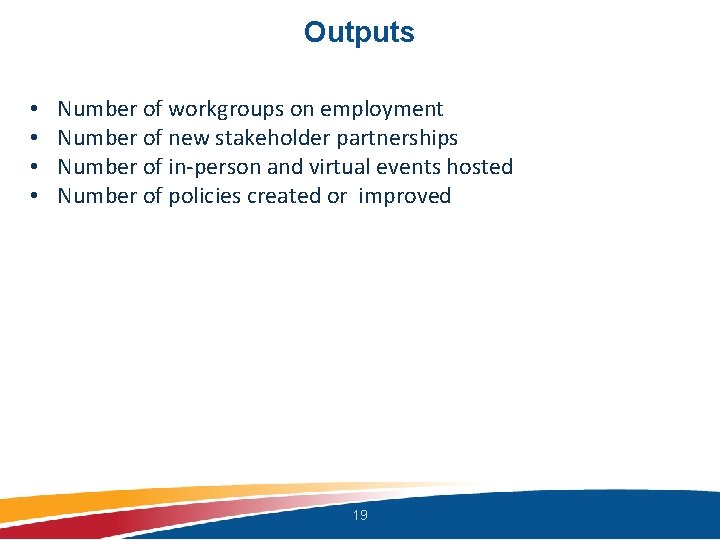
Outputs • • Number of workgroups on employment Number of new stakeholder partnerships Number of in-person and virtual events hosted Number of policies created or improved 19
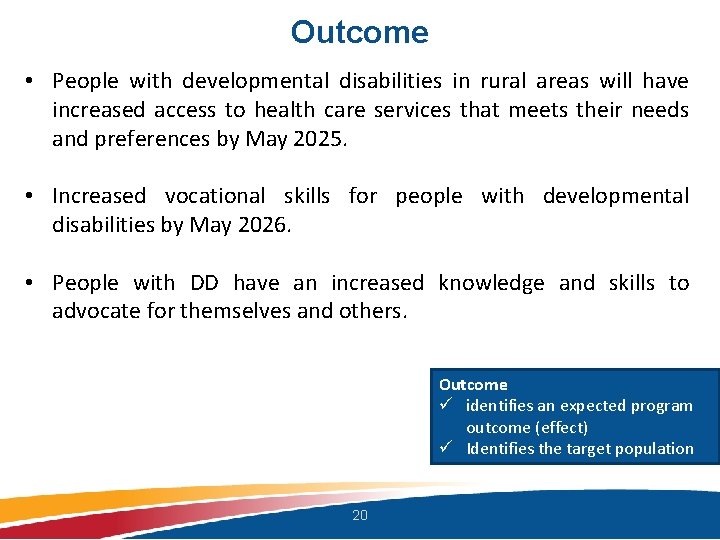
Outcome • People with developmental disabilities in rural areas will have increased access to health care services that meets their needs and preferences by May 2025. • Increased vocational skills for people with developmental disabilities by May 2026. • People with DD have an increased knowledge and skills to advocate for themselves and others. Outcome ü identifies an expected program outcome (effect) ü Identifies the target population 20
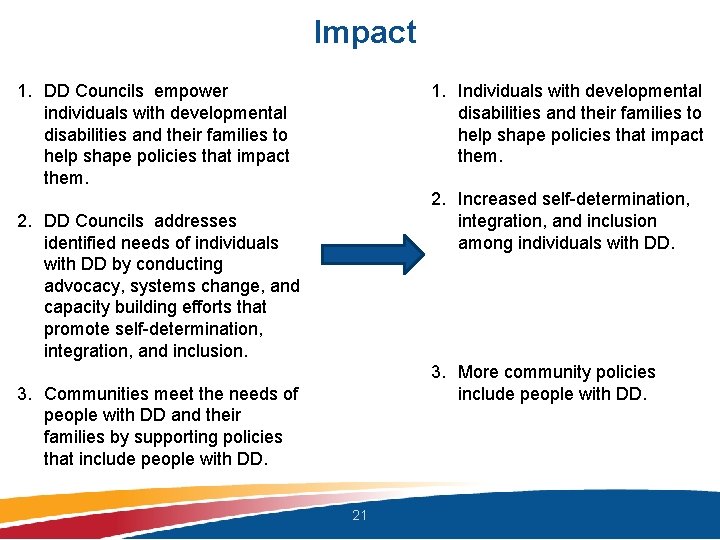
Impact 1. Individuals with developmental disabilities and their families to help shape policies that impact them. 1. DD Councils empower individuals with developmental disabilities and their families to help shape policies that impact them. 2. Increased self-determination, integration, and inclusion among individuals with DD. 2. DD Councils addresses identified needs of individuals with DD by conducting advocacy, systems change, and capacity building efforts that promote self-determination, integration, and inclusion. 3. More community policies include people with DD. 3. Communities meet the needs of people with DD and their families by supporting policies that include people with DD. 21
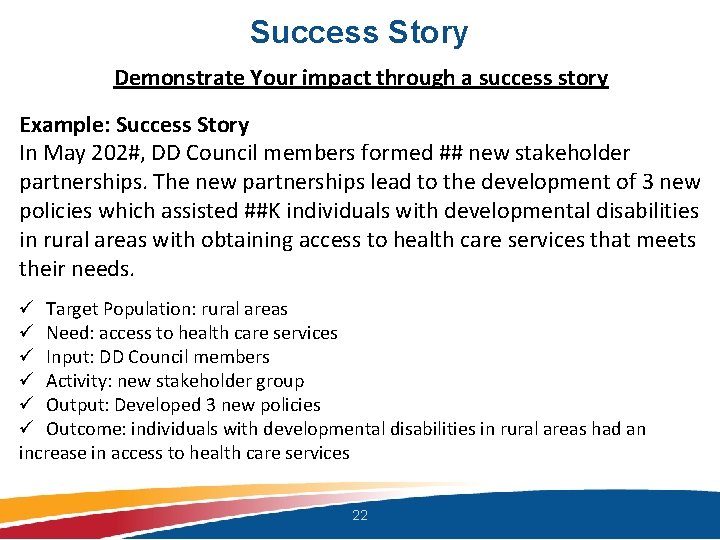
Success Story Demonstrate Your impact through a success story Example: Success Story In May 202#, DD Council members formed ## new stakeholder partnerships. The new partnerships lead to the development of 3 new policies which assisted ##K individuals with developmental disabilities in rural areas with obtaining access to health care services that meets their needs. ü Target Population: rural areas ü Need: access to health care services ü Input: DD Council members ü Activity: new stakeholder group ü Output: Developed 3 new policies ü Outcome: individuals with developmental disabilities in rural areas had an increase in access to health care services 22
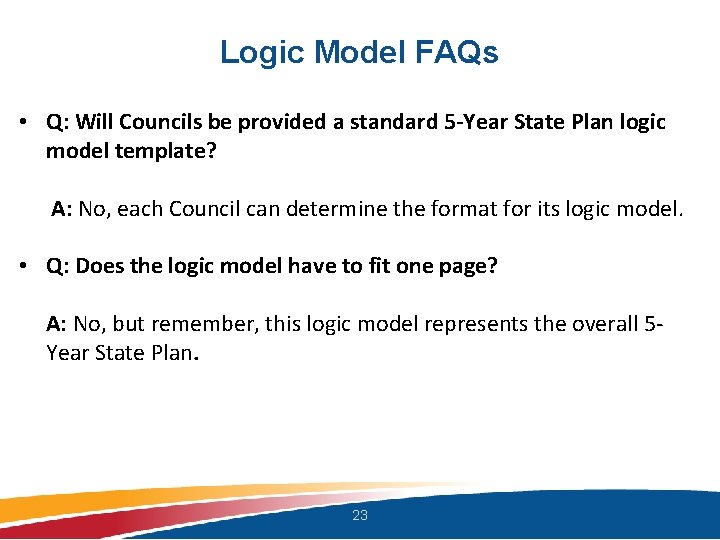
Logic Model FAQs • Q: Will Councils be provided a standard 5 -Year State Plan logic model template? A: No, each Council can determine the format for its logic model. • Q: Does the logic model have to fit one page? A: No, but remember, this logic model represents the overall 5 Year State Plan. 23
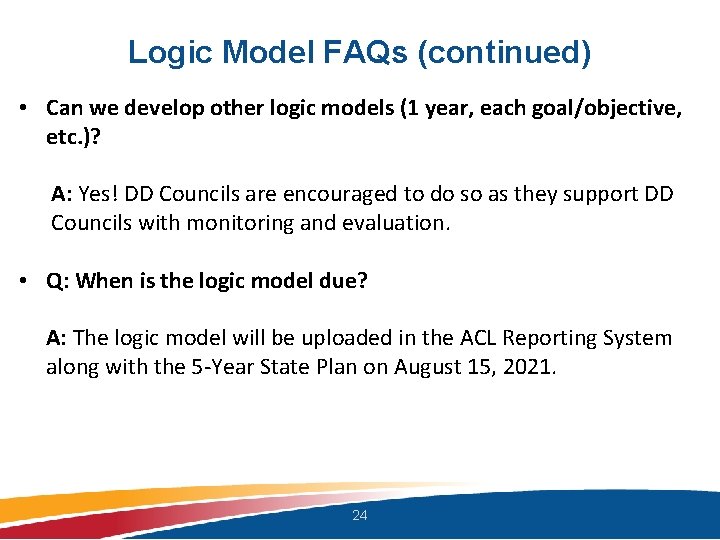
Logic Model FAQs (continued) • Can we develop other logic models (1 year, each goal/objective, etc. )? A: Yes! DD Councils are encouraged to do so as they support DD Councils with monitoring and evaluation. • Q: When is the logic model due? A: The logic model will be uploaded in the ACL Reporting System along with the 5 -Year State Plan on August 15, 2021. 24
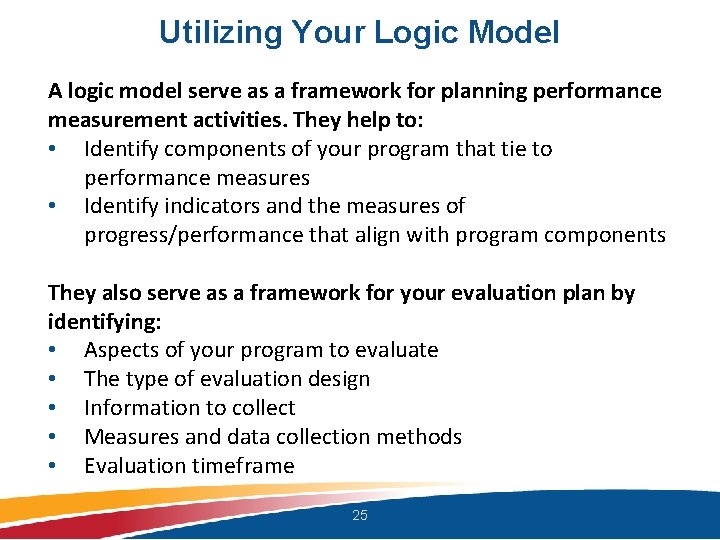
Utilizing Your Logic Model A logic model serve as a framework for planning performance measurement activities. They help to: • Identify components of your program that tie to performance measures • Identify indicators and the measures of progress/performance that align with program components They also serve as a framework for your evaluation plan by identifying: • Aspects of your program to evaluate • The type of evaluation design • Information to collect • Measures and data collection methods • Evaluation timeframe 25
Resources HHS Logic Model Tip Sheet https: //www. acf. hhs. gov/sites/default/files/fysb/prep-logic-model-ts. pdf Centers for Disease Control – Program and Performance Evaluation Office https: //www. cdc. gov/eval/resources/index. htm#logicmodels University of Wisconsin – Madison, Program Development and Evaluation https: //fyi. extension. wisc. edu/programdevelopment/logic-models/ Kellogg Foundation – Logic Model Development Guide https: //www. bttop. org/sites/default/files/public/W. K. %20 Kellogg%20 Logic. Model. pdf Arizona – Community Health Worker Evaluation Toolkit https: //azprc. arizona. edu/sites/default/files/CHWtoolkit/PDFs/EVALUAOld. P DF
References Bartholomay, T. (n. d. ). Outputs/outcomes/impacts: A framework for objectifying key aspects of a program’s intended intervention and identifying resulting intended change. University of Minnesota. Retrieved from https: //cyfar. org/sites/default/files/Outputs. Outcomes. Impacts_pres. pdf Centers for Disease Control and Prevention. (2009). Aligning a logic model with a strategic plan. Evaluation Briefs, No. 3. Retrieved from https: //www. cdc. gov/healthyyouth/evaluation/pdf/brief 8. txt Centers for Disease Control and Prevention Division of Heart Disease and Stroke Prevention. (n. d. ). Evaluation guide: Developing and using a logic model. Retrieved from https: //www. cdc. gov/dhdsp/ docs/logic_model. pdf Centers for Disease Control and Prevention Division of STD Prevention. (n. d. ). Identifying the components of a logic model. Retrieved from https: //www. cdc. gov/std/Program/pupestd/ Components%20 of%20 a%20 Logic%20 Model. pdf University of Wisconsin-Division of Extension. (2003). Enhancing Program Performance with Logic Models. Retrieved from https: //fyi. extension. wisc. edu/programdevelopment/files/2016/03/ lmcourseall. pdf
Evaluation Planning Kristen (Krissy) Hudgins Senior Social Science Analyst Office of Performance and Evaluation Center for Policy and Evaluation Office: 202 -795 -7732 E-mail: kristen. hudgins@acl. hhs. gov 28
What does the DD Act Say? (Evaluation Plan [Section 125(C)(3) And (7)]) • The extent to which the goals were achieved. • The strategies that contributed to achieving the goals. • Factors that impeded achievement of the goal(s). • Separate information on the SA goal/objective and its required elements. • As appropriate, an update on the results of the CRA. • Determine customer satisfaction with Council supported or conducted activities.
OIDD Guidance (Evaluation Plan) • Use multi-method approaches to determine if identified needs are being met and if the ultimate goals and outcomes are being achieved. • Define the procedures the Council will use to monitor progress in meeting its goals including tracking the progress to address the targeted disparity element. • Discuss Council activities that will measure the Council’s effectiveness.
OIDD Guidance (Evaluation Plans cont. ) • The evaluation plan should not be limited to measuring the progress of the performance measures. Also measure the extent to which progress is being made toward meeting the expected outcomes for the objectives and five year goals. This is above and beyond the performance measures. • Councils are encouraged to develop their own methods and measures for determining progress, such as annual benchmarks for the goals that are tied to measuring outcomes.
Why do you need an Evaluation Plan? • It provides a roadmap for how to conduct an evaluation • It will help you determine what kind of information you need • It will keep your evaluation efforts focused • It will help you pinpoint the best ways to get the information you need • It will help you figure out a timeline for evaluation • Best of all, it will help you improve your program!!!
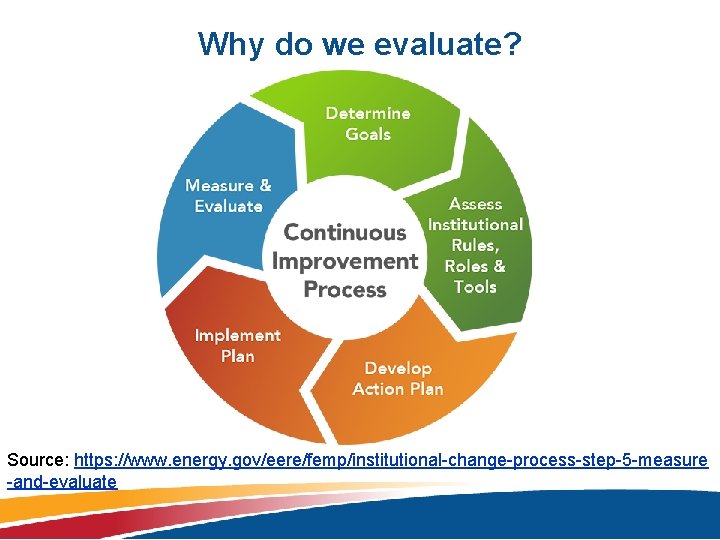
Why do we evaluate? Source: https: //www. energy. gov/eere/femp/institutional-change-process-step-5 -measure -and-evaluate
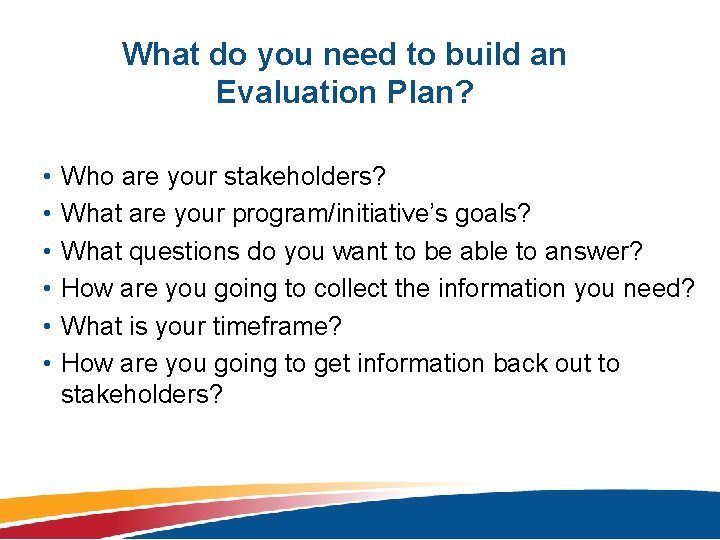
What do you need to build an Evaluation Plan? • • • Who are your stakeholders? What are your program/initiative’s goals? What questions do you want to be able to answer? How are you going to collect the information you need? What is your timeframe? How are you going to get information back out to stakeholders?
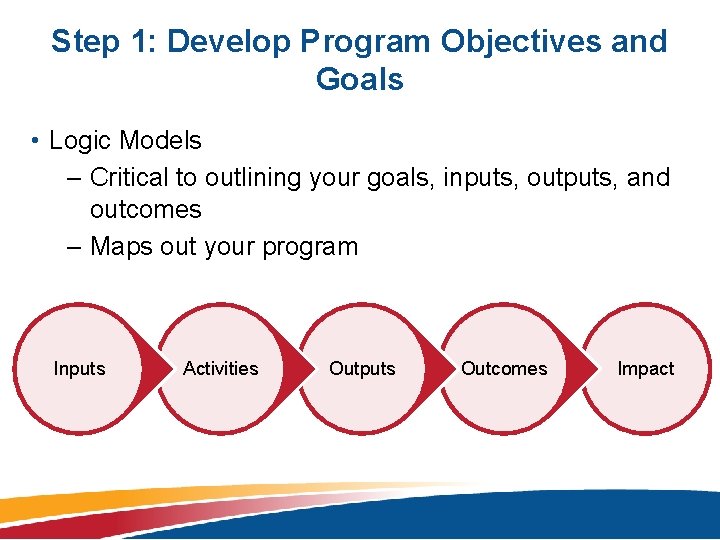
Step 1: Develop Program Objectives and Goals • Logic Models – Critical to outlining your goals, inputs, outputs, and outcomes – Maps out your program Inputs Activities Outputs Outcomes Impact
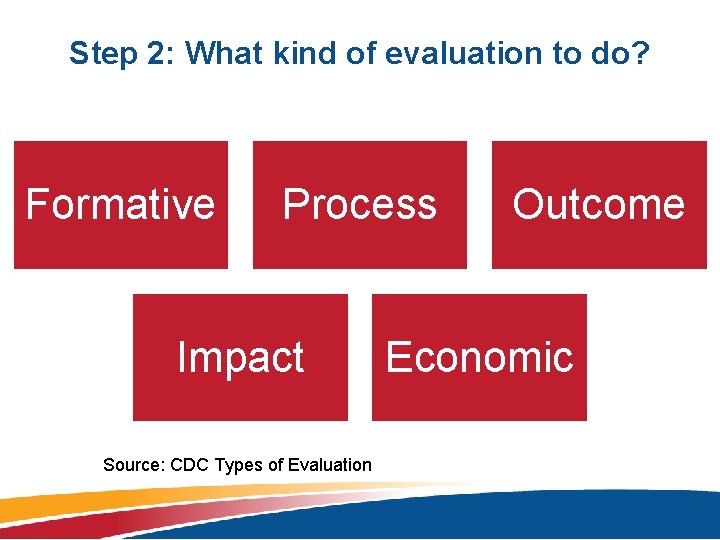
Step 2: What kind of evaluation to do? Formative Process Impact Source: CDC Types of Evaluation Outcome Economic
Step 3: Develop your Evaluation questions • Does it work? – Did the program/initiative do what we said it would? • How does it work? – Was the program/initiative implemented the way we said it would be?
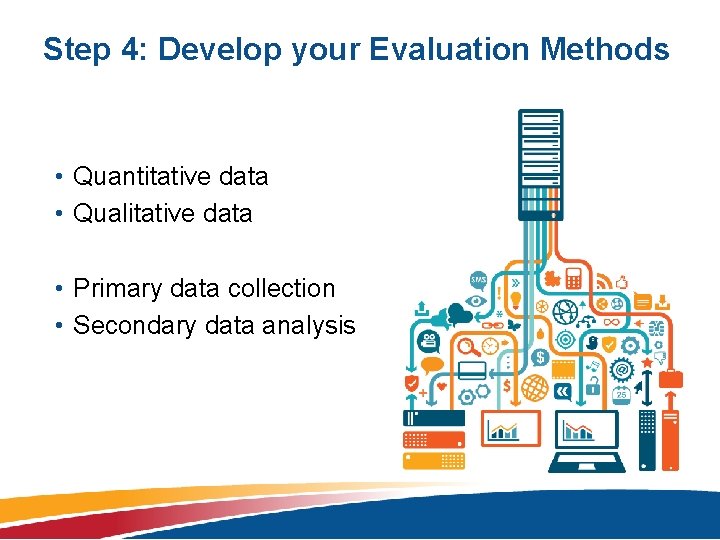
Step 4: Develop your Evaluation Methods • Quantitative data • Qualitative data • Primary data collection • Secondary data analysis
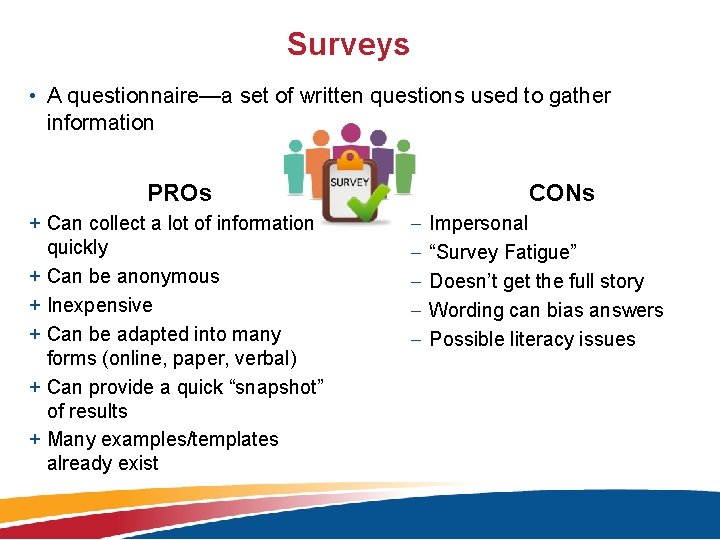
Surveys • A questionnaire—a set of written questions used to gather information PROs + Can collect a lot of information quickly + Can be anonymous + Inexpensive + Can be adapted into many forms (online, paper, verbal) + Can provide a quick “snapshot” of results + Many examples/templates already exist CONs - Impersonal “Survey Fatigue” Doesn’t get the full story Wording can bias answers Possible literacy issues
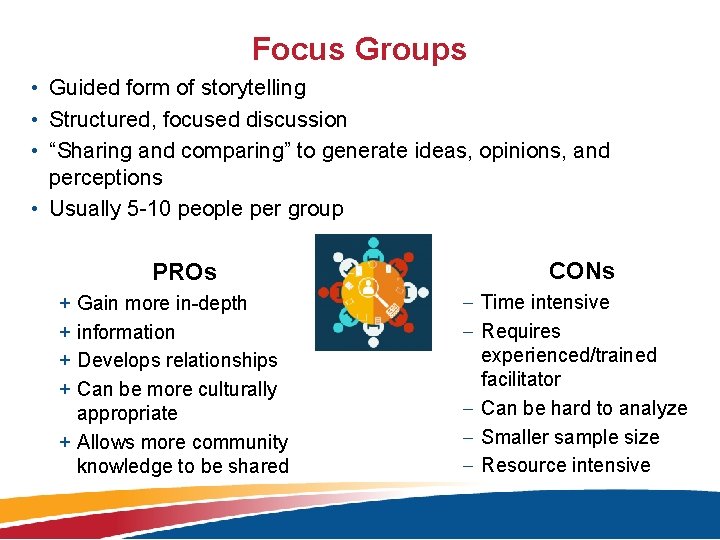
Focus Groups • Guided form of storytelling • Structured, focused discussion • “Sharing and comparing” to generate ideas, opinions, and perceptions • Usually 5 -10 people per group PROs + Gain more in-depth + information + Develops relationships + Can be more culturally appropriate + Allows more community knowledge to be shared CONs - Time intensive - Requires experienced/trained facilitator - Can be hard to analyze - Smaller sample size - Resource intensive
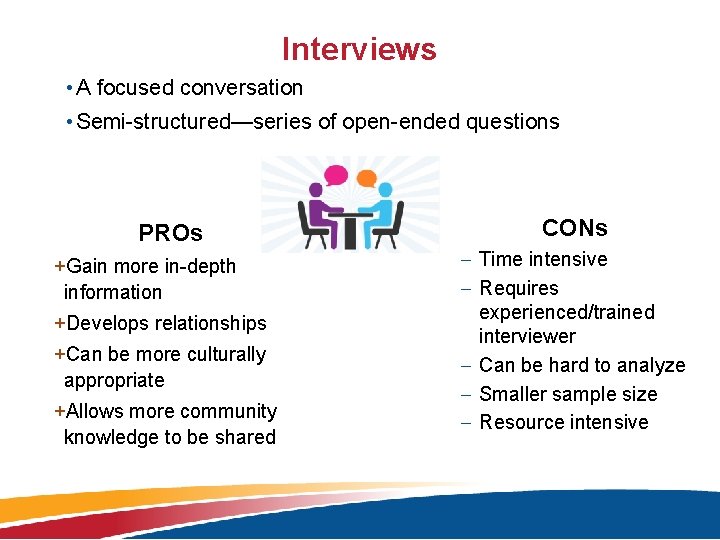
Interviews • A focused conversation • Semi-structured—series of open-ended questions PROs +Gain more in-depth information +Develops relationships +Can be more culturally appropriate +Allows more community knowledge to be shared CONs - Time intensive - Requires experienced/trained interviewer - Can be hard to analyze - Smaller sample size - Resource intensive
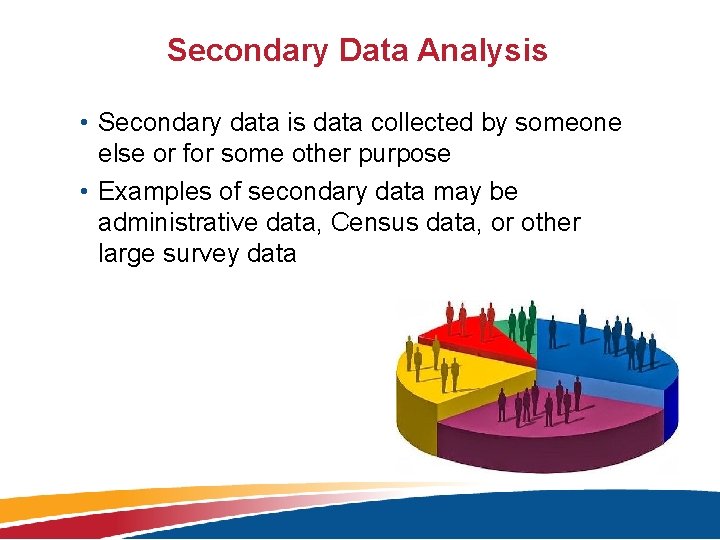
Secondary Data Analysis • Secondary data is data collected by someone else or for some other purpose • Examples of secondary data may be administrative data, Census data, or other large survey data
Using Your Data • Did we do what we said we would do? • How well did we do it? • Did it make a difference? • What could we do better next time?
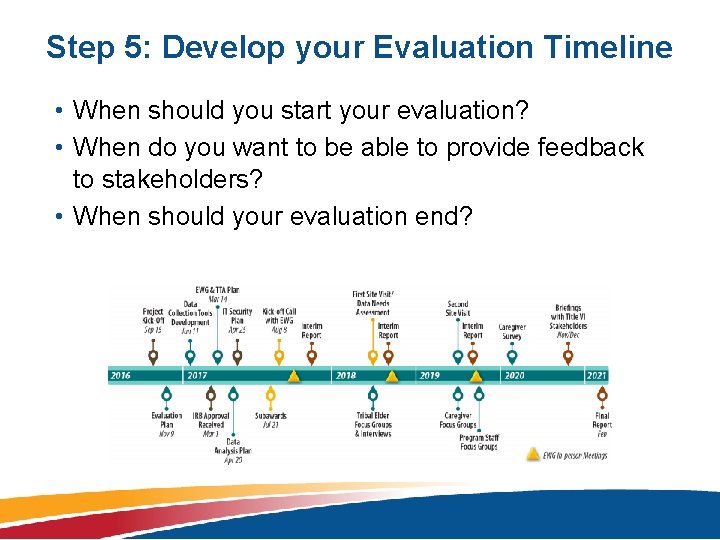
Step 5: Develop your Evaluation Timeline • When should you start your evaluation? • When do you want to be able to provide feedback to stakeholders? • When should your evaluation end?
Step 6: Disseminate Findings • What are you going to share? • Who do you need to inform? • What are the best ways to share information with your stakeholders?
Evaluation Plan Resources • The Community Toolbox - https: //ctb. ku. edu • Better Evaluation - https: //www. betterevaluation. org • Rural Health Information Hub https: //www. ruralhealthinfo. org/ • Developing an Evaluation Plan https: //ctb. ku. edu/en/table-ofcontents/evaluate/evaluation-plan/main 46
Evaluation Plan References • Center for Community Health and Development at the University of Kentucky. (n. d. ). Developing an Evaluation Plan - https: //ctb. ku. edu/en/table-of-contents/evaluate/evaluationplan/main • Corporation for National & Community Service (n. d. ). How to Write an Evaluation Plan and Report https: //www. nationalservice. gov/sites/default/files/resource/Evaluation%20 Plan%20 and%20 Report %20 for%20 ACSN%20 Grantee%20 Symposium_9. 9. 13_Greaterthan 500 k. pdf • Martin, Alison Brooks, “Plan for Program Evaluation From the Start, ” NIJ Journal 275 (2015): 2428, available at https: //www. ncjrs. gov/pdffiles 1/nij/248779. pdf • National Center for Chronic Disease Prevention and Health (2011). Developing an Effective Evaluation Plan: Setting the course for effective program evaluation https: //www. cdc. gov/obesity/downloads/CDC-Evaluation-Workbook-508. pdf • National Center for HIV/AIDS, Viral Hepatitis, STD, and TB Prevention (n. d. ). Types of Evaluation https: //www. cdc. gov/std/program/pupestd/types%20 of%20 evaluation. pdf • Office of Energy Efficiency & Renewable Energy. (n. d. ). Institutional Change Process Step 5: Measure and Evaluate - https: //www. energy. gov/eere/femp/institutional-change-process-step-5 measure-and-evaluate
ITACC Resources • Evaluation Plan FAQ’s • Example Evaluation (5 Yr. State Plan Page) • Logic Model Resource: Guidance for Developing a Five Year Logic Model for the 2022 -2026 State Plan (5 Yr. State Plan Page) • Linking the State Plan, Logic Model & Work Plan • Public Input Strategies Resource (New) 48
Summary • Clearly articulate a vision of success for your grant programs early on to staff, leadership, and grantees • Use logic models and evaluation to help your program measure and achieve success • Build evaluation into each phase of the grant process • Keep in mind that it is difficult to request more funding or replicate your program if you are not able to show results.
Evidence That Informs Action With stronger evidence, we can learn from and improve programs to better serve the American people. Source: https: //www. whitehouse. gov/wpcontent/uploads/2018/02/ap_6_evidence-fy 2019. pdf 50