
Developing Emergency Operations Plans EOPs K12 101 Training
- Slides: 64
Developing Emergency Operations Plans (EOPs) K-12 101 Training Presented by:
Agenda • Expectations, policy and law. • Preparing the plan – a six-step process. • The EOP. • Functional Annexes. • Implementation and discussion.
Expectations • Schools: § Provide safe and healthy learning environments. § Keep students safe from threats and hazards. § Plan for the safety and security of all students and staff (consider people with disabilities, access or functional needs). • Collaborate with Community Partners to: § Support the school’s EOP. § Provide resources for the implementation of the EOP. § Provide input and support for diverse populations.
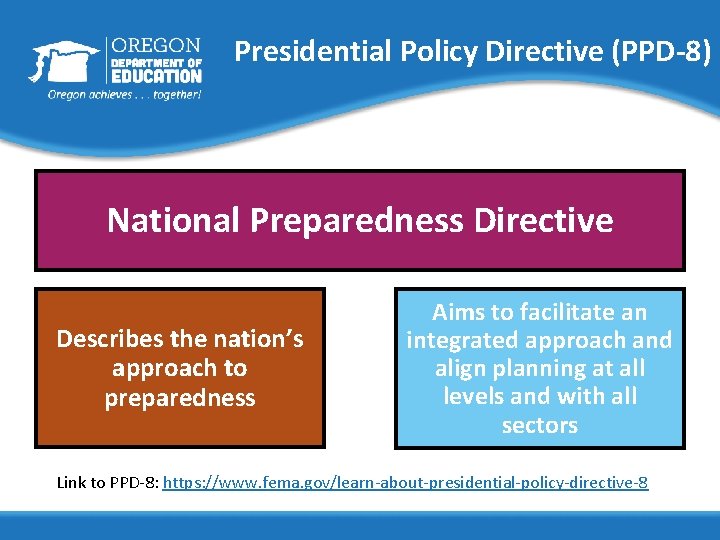
Presidential Policy Directive (PPD-8) National Preparedness Directive Describes the nation’s approach to preparedness Aims to facilitate an integrated approach and align planning at all levels and with all sectors Link to PPD-8: https: //www. fema. gov/learn-about-presidential-policy-directive-8
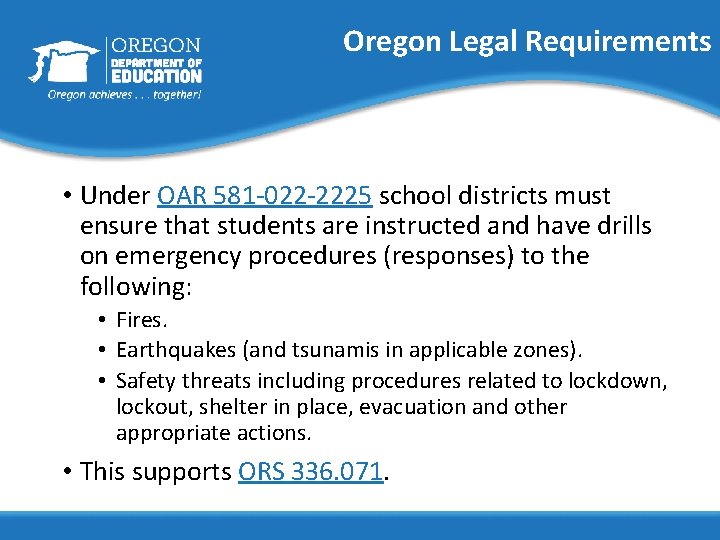
Oregon Legal Requirements • Under OAR 581 -022 -2225 school districts must ensure that students are instructed and have drills on emergency procedures (responses) to the following: • Fires. • Earthquakes (and tsunamis in applicable zones). • Safety threats including procedures related to lockdown, lockout, shelter in place, evacuation and other appropriate actions. • This supports ORS 336. 071.
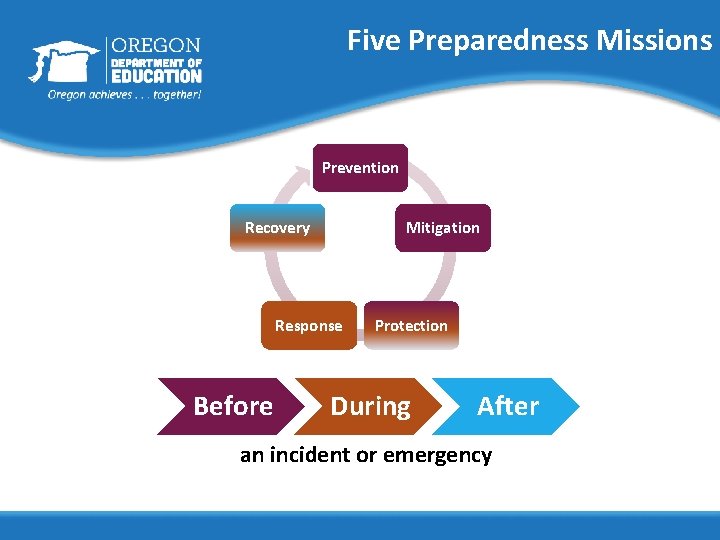
Five Preparedness Missions Prevention Recovery Mitigation Response Before Protection During After an incident or emergency
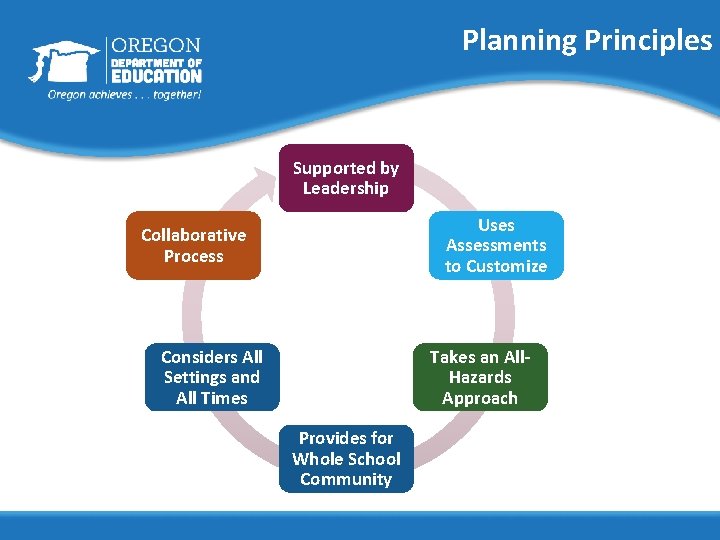
Planning Principles Supported by Leadership Uses Assessments to Customize Collaborative Process Considers All Settings and All Times Takes an All. Hazards Approach Provides for Whole School Community
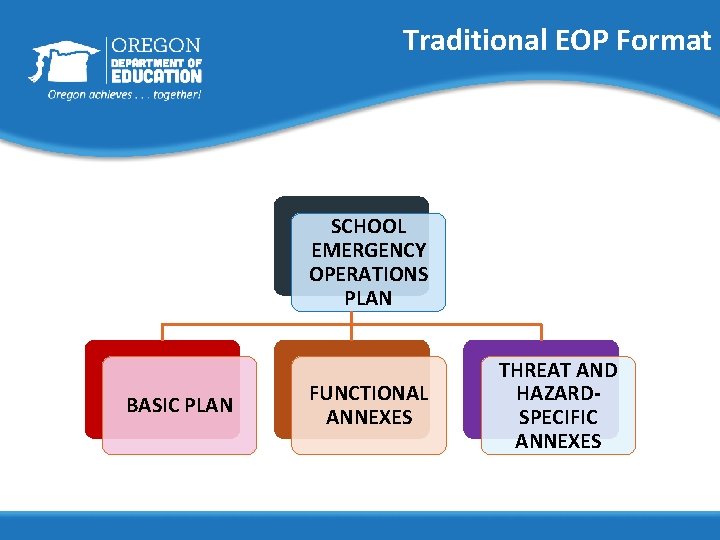
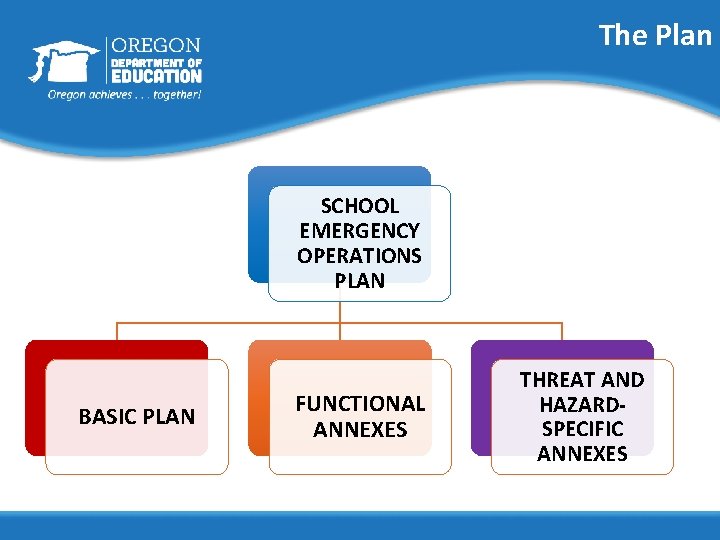
Traditional EOP Format SCHOOL EMERGENCY OPERATIONS PLAN BASIC PLAN FUNCTIONAL ANNEXES THREAT AND HAZARDSPECIFIC ANNEXES
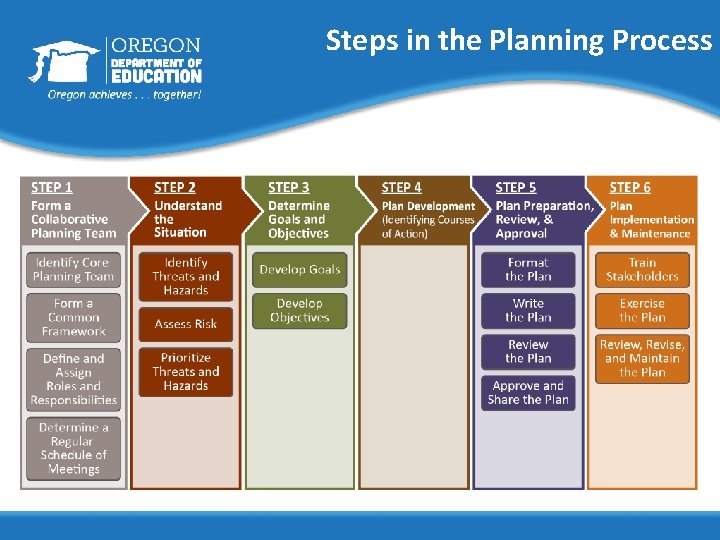
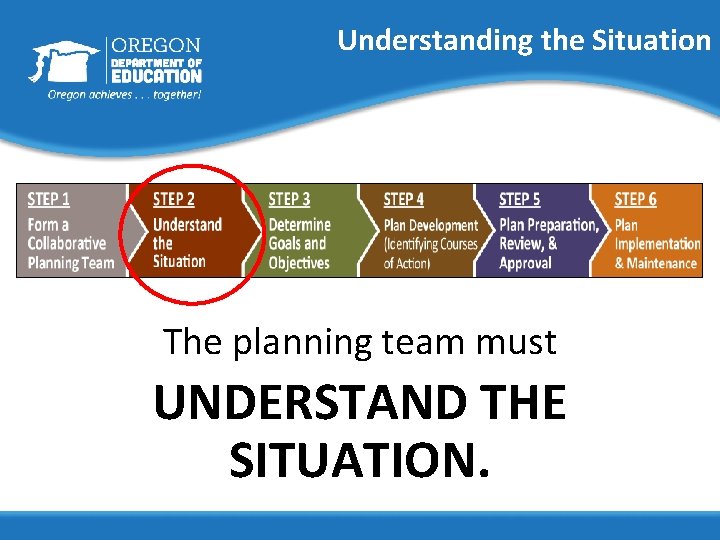
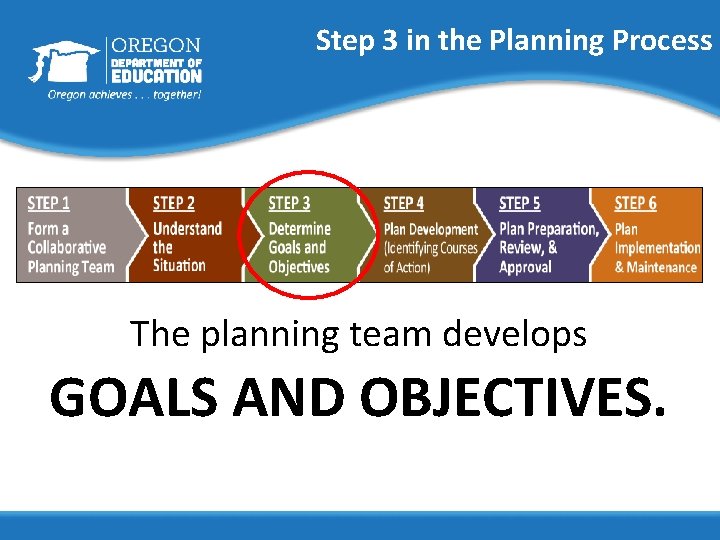
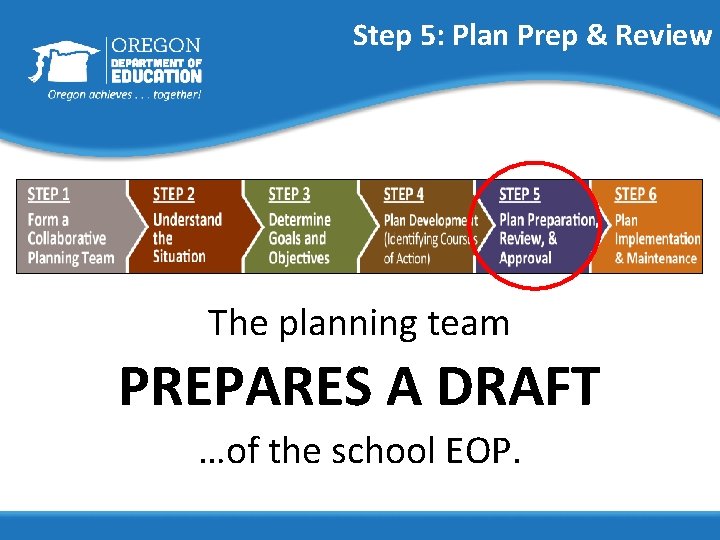
Steps in the Planning Process
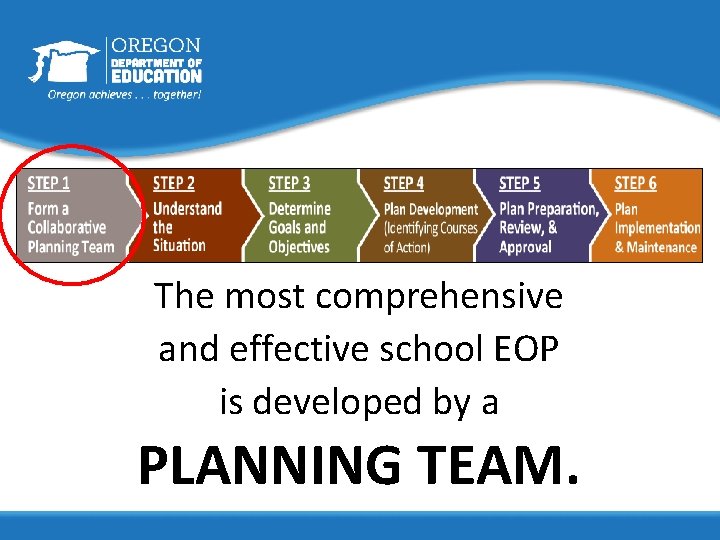
The most comprehensive and effective school EOP is developed by a PLANNING TEAM.
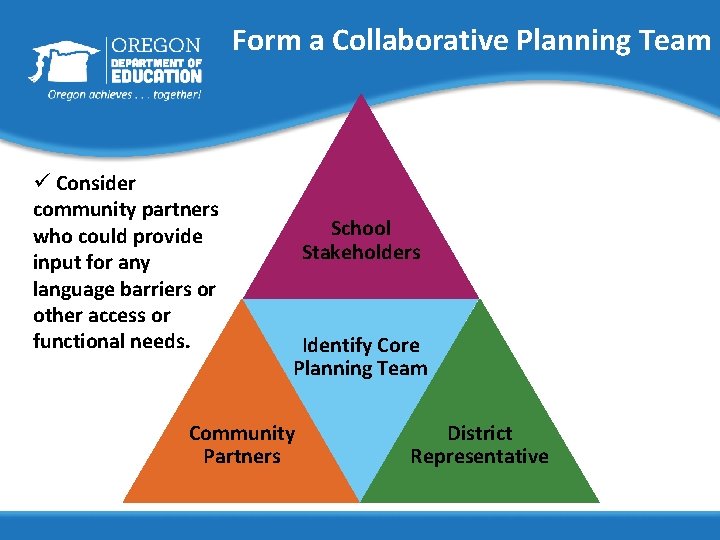
Form a Collaborative Planning Team ü Consider community partners who could provide input for any language barriers or other access or functional needs. School Stakeholders Identify Core Planning Team Community Partners District Representative
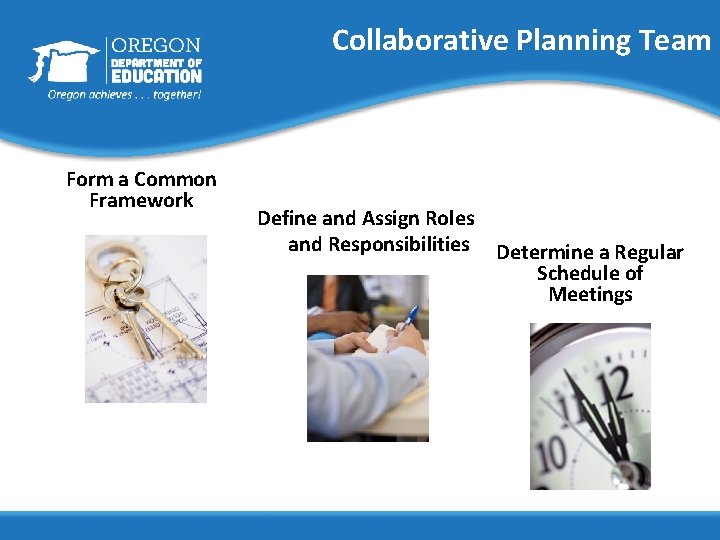
Collaborative Planning Team Form a Common Framework Define and Assign Roles and Responsibilities Determine a Regular Schedule of Meetings
Incorporating NIMS and ICS One Common Framework: National Incident Management System (NIMS) and Incident Command System (ICS) • Single system for managing domestic incidents across the United States • Suitable for all schools and educational institutions to implement throughout all phases of school emergency management • A core set of comprehensive procedures that allow schools to manage emergencies and coordinate with first responders • Connects these institutions to their community partners *This will be covered in more detail in a follow-on presentation.
Thought Exercise Who can YOU include? *Page 2 in the workbook • Who on your own staff (teachers or admin) could provide valuable input for a high-quality EOP? • Who, at the district level, should be included in coordinating your EOP planning process? • Who are your emergency response partners? • What community groups could you call on for planning input or aid during an emergency?
Understanding the Situation The planning team must UNDERSTAND THE SITUATION.
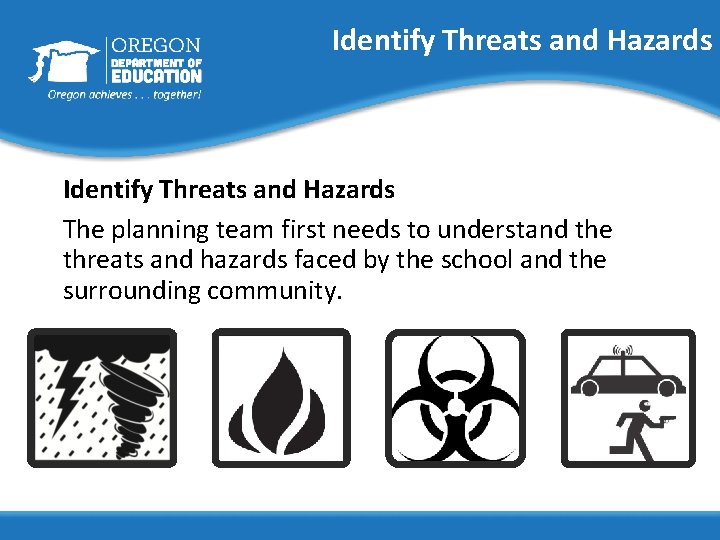
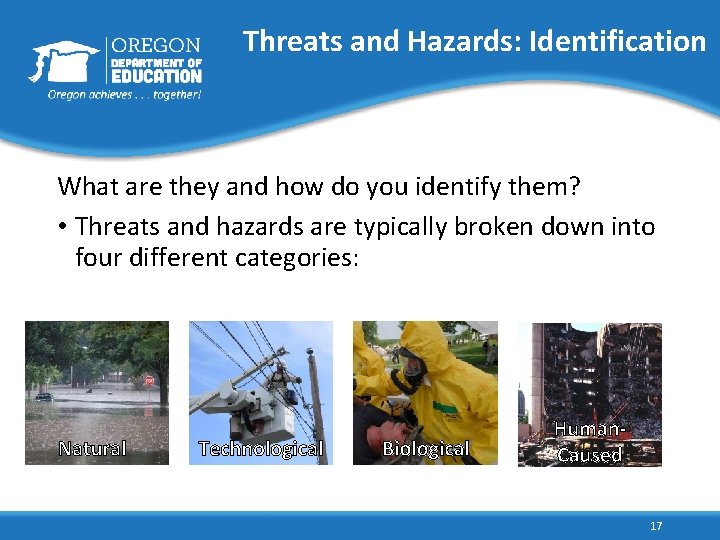
Identify Threats and Hazards The planning team first needs to understand the threats and hazards faced by the school and the surrounding community.
Threats and Hazards: Identification What are they and how do you identify them? • Threats and hazards are typically broken down into four different categories: Natural Technological Biological Human. Caused 17
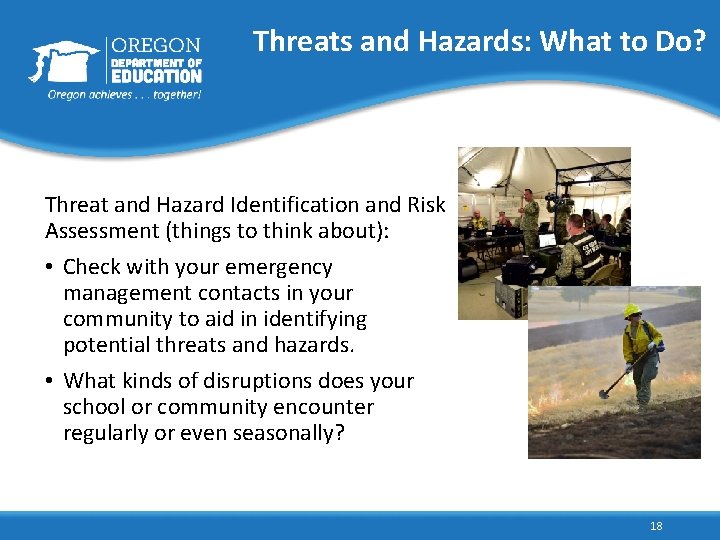
Threats and Hazards: What to Do? Threat and Hazard Identification and Risk Assessment (things to think about): • Check with your emergency management contacts in your community to aid in identifying potential threats and hazards. • What kinds of disruptions does your school or community encounter regularly or even seasonally? 18
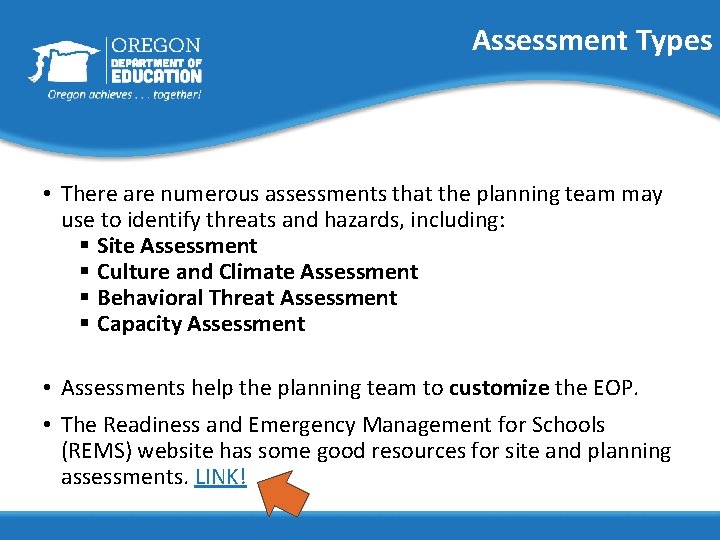
Assessment Types • There are numerous assessments that the planning team may use to identify threats and hazards, including: § Site Assessment § Culture and Climate Assessment § Behavioral Threat Assessment § Capacity Assessment • Assessments help the planning team to customize the EOP. • The Readiness and Emergency Management for Schools (REMS) website has some good resources for site and planning assessments. LINK!
Threats and Hazards: Planning • Prioritize your planning efforts. • Set goals for high-risk threats you plan for. • Incorporate those goals into the plans you create. There is nothing wrong with planning for every risk you can identify. However, we recommend that you have plans in place to respond to your extreme and high risk hazards and threats first. 20
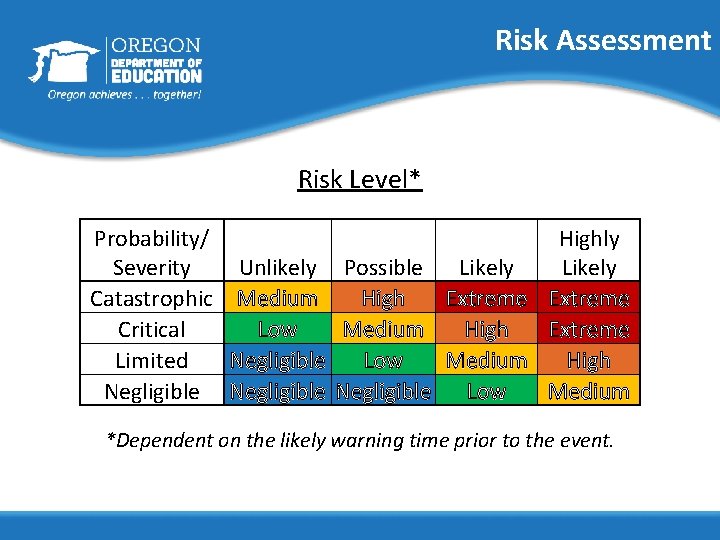
Risk Assessment Risk Level* Probability/ Highly Unlikely Possible Likely Severity Likely Catastrophic Medium High Extreme Critical Low Medium High Extreme Limited Negligible Low Medium High Negligible Low Medium *Dependent on the likely warning time prior to the event.
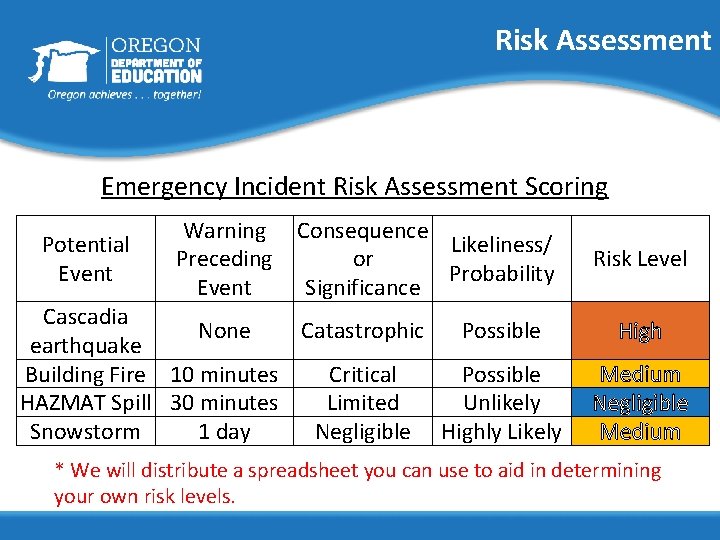
Risk Assessment Emergency Incident Risk Assessment Scoring Potential Event Warning Preceding Event Consequence Likeliness/ or Probability Significance Cascadia None Catastrophic Possible earthquake Building Fire 10 minutes Critical Possible HAZMAT Spill 30 minutes Limited Unlikely Snowstorm 1 day Negligible Highly Likely Risk Level High Medium Negligible Medium * We will distribute a spreadsheet you can use to aid in determining your own risk levels.
Thought Exercise What are your hazards and threats? • What hazards and threats have disrupted your school before? • What hazards or threats are you aware of that you may need to plan for? • What are the risks associated with the hazards and threats you have identified?
Step 3 in the Planning Process The planning team develops GOALS AND OBJECTIVES.
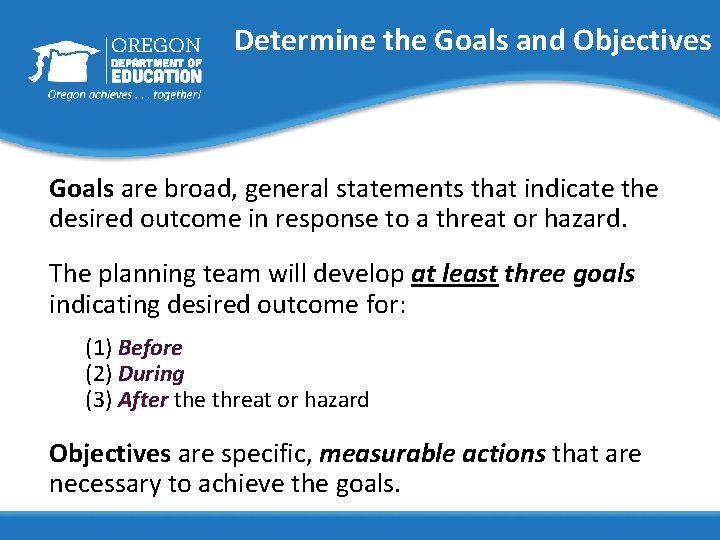
Determine the Goals and Objectives Goals are broad, general statements that indicate the desired outcome in response to a threat or hazard. The planning team will develop at least three goals indicating desired outcome for: (1) Before (2) During (3) After the threat or hazard Objectives are specific, measurable actions that are necessary to achieve the goals.
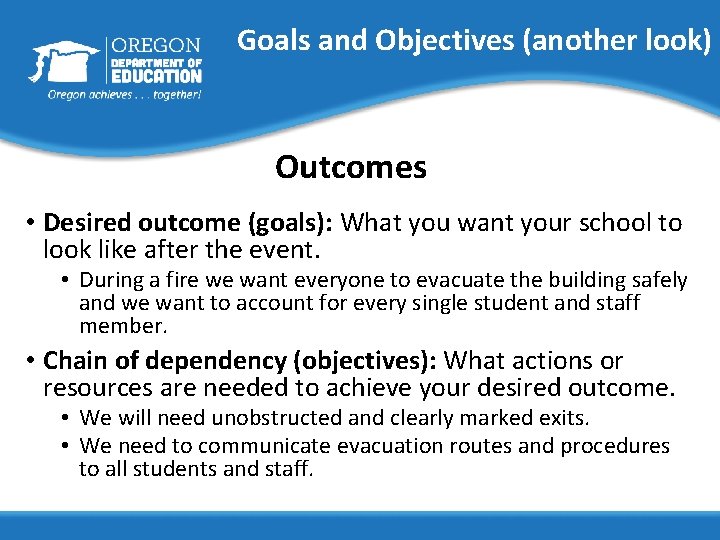
Goals and Objectives (another look) Outcomes • Desired outcome (goals): What you want your school to look like after the event. • During a fire we want everyone to evacuate the building safely and we want to account for every single student and staff member. • Chain of dependency (objectives): What actions or resources are needed to achieve your desired outcome. • We will need unobstructed and clearly marked exits. • We need to communicate evacuation routes and procedures to all students and staff.
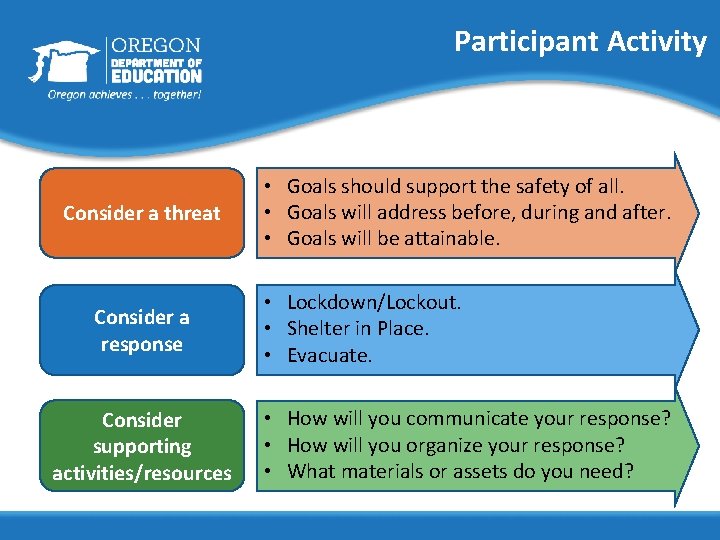
Participant Activity Consider a threat Consider a response Consider supporting activities/resources • Goals should support the safety of all. • Goals will address before, during and after. • Goals will be attainable. • Lockdown/Lockout. • Shelter in Place. • Evacuate. • How will you communicate your response? • How will you organize your response? • What materials or assets do you need?
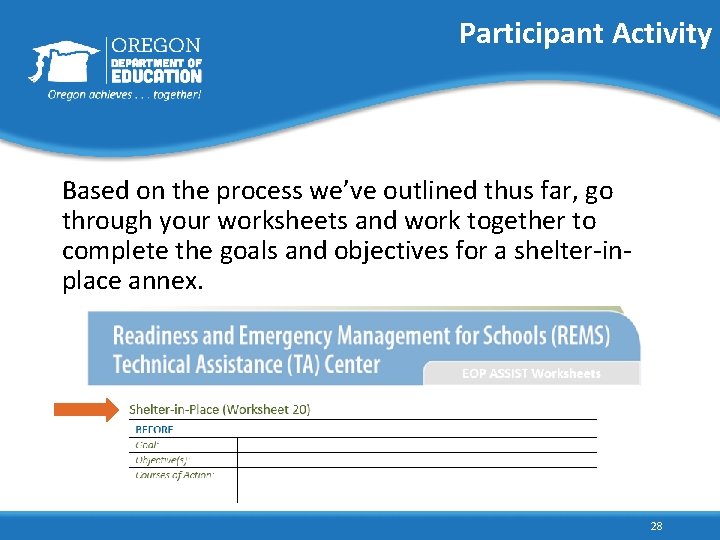
Participant Activity Based on the process we’ve outlined thus far, go through your worksheets and work together to complete the goals and objectives for a shelter-inplace annex. 28
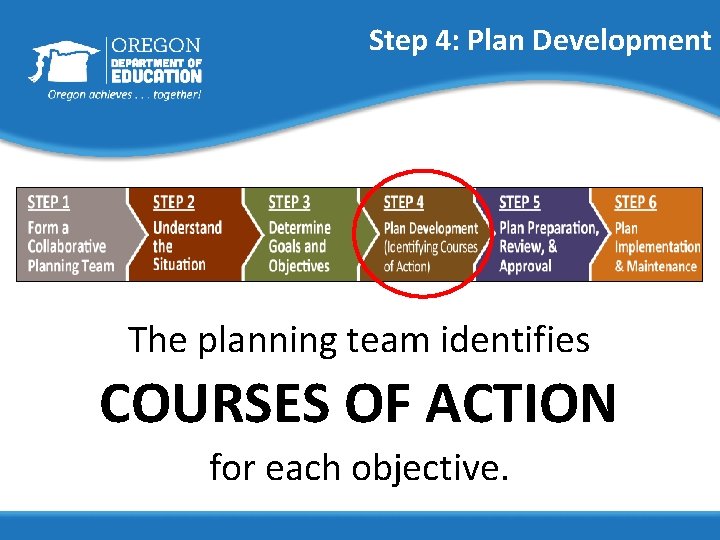
Step 4: Plan Development The planning team identifies COURSES OF ACTION for each objective.
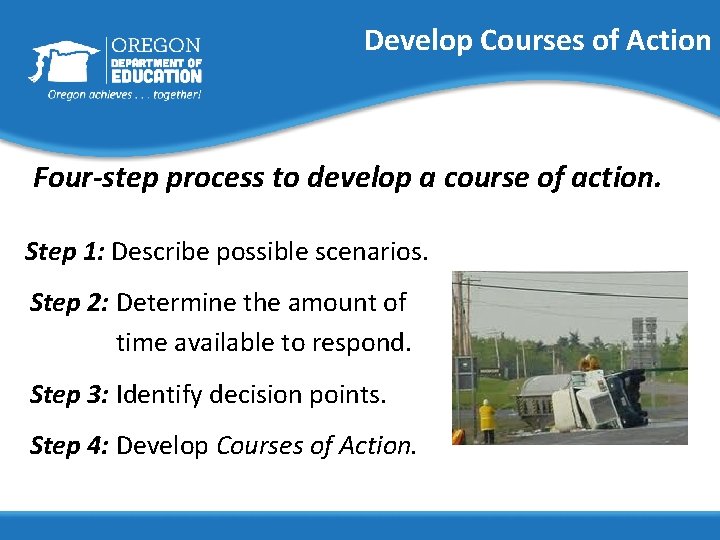
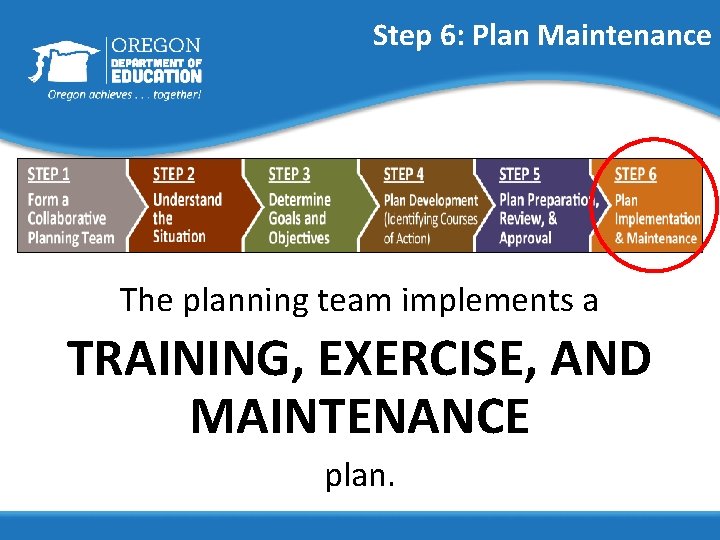
Develop Courses of Action Four-step process to develop a course of action. Step 1: Describe possible scenarios. Step 2: Determine the amount of time available to respond. Step 3: Identify decision points. Step 4: Develop Courses of Action.
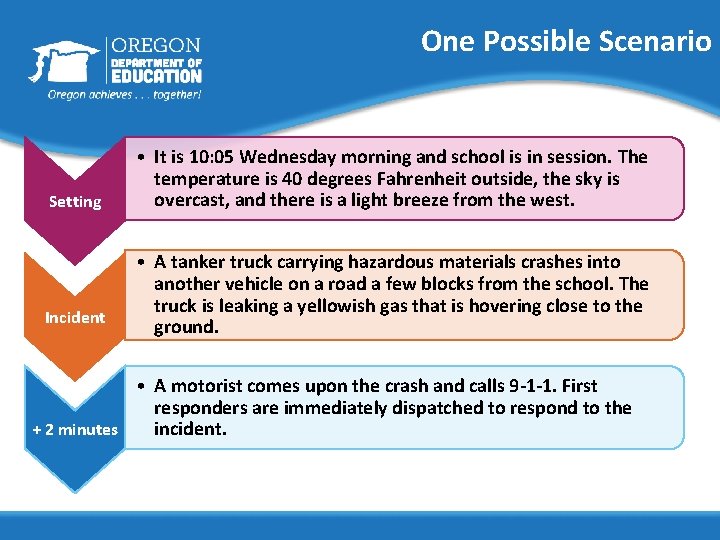
One Possible Scenario Setting Incident • It is 10: 05 Wednesday morning and school is in session. The temperature is 40 degrees Fahrenheit outside, the sky is overcast, and there is a light breeze from the west. • A tanker truck carrying hazardous materials crashes into another vehicle on a road a few blocks from the school. The truck is leaking a yellowish gas that is hovering close to the ground. • A motorist comes upon the crash and calls 9 -1 -1. First responders are immediately dispatched to respond to the + 2 minutes incident.
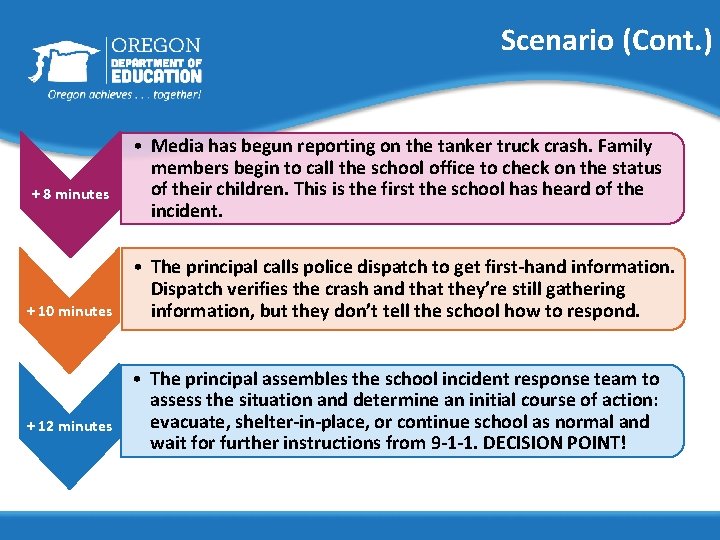
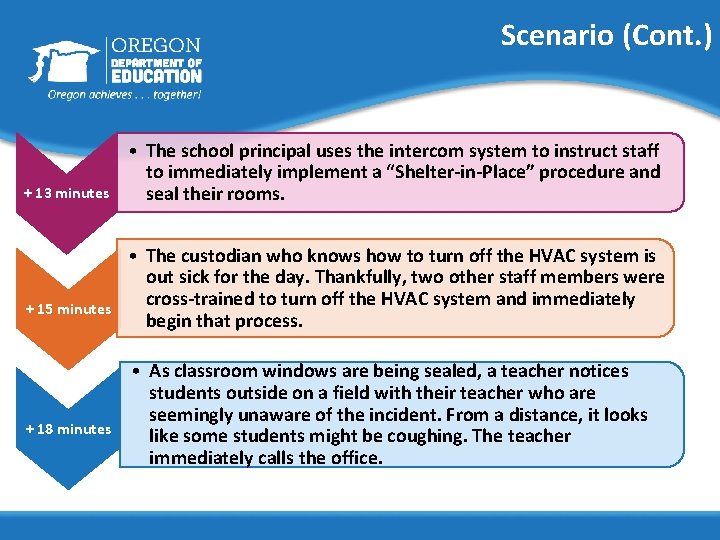
Scenario (Cont. ) + 8 minutes + 10 minutes + 12 minutes • Media has begun reporting on the tanker truck crash. Family members begin to call the school office to check on the status of their children. This is the first the school has heard of the incident. • The principal calls police dispatch to get first-hand information. Dispatch verifies the crash and that they’re still gathering information, but they don’t tell the school how to respond. • The principal assembles the school incident response team to assess the situation and determine an initial course of action: evacuate, shelter-in-place, or continue school as normal and wait for further instructions from 9 -1 -1. DECISION POINT!
Scenario (Cont. ) + 13 minutes + 15 minutes + 18 minutes • The school principal uses the intercom system to instruct staff to immediately implement a “Shelter-in-Place” procedure and seal their rooms. • The custodian who knows how to turn off the HVAC system is out sick for the day. Thankfully, two other staff members were cross-trained to turn off the HVAC system and immediately begin that process. • As classroom windows are being sealed, a teacher notices students outside on a field with their teacher who are seemingly unaware of the incident. From a distance, it looks like some students might be coughing. The teacher immediately calls the office.
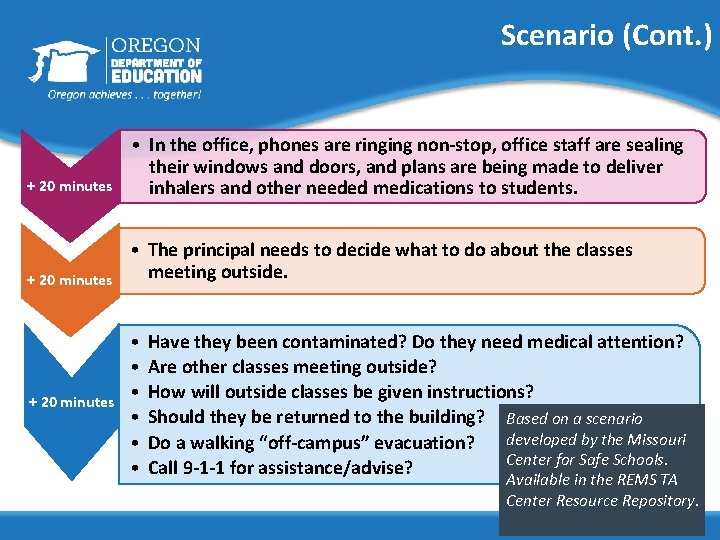
Scenario (Cont. ) + 20 minutes • In the office, phones are ringing non-stop, office staff are sealing their windows and doors, and plans are being made to deliver inhalers and other needed medications to students. + 20 minutes • The principal needs to decide what to do about the classes meeting outside. + 20 minutes • • • Have they been contaminated? Do they need medical attention? Are other classes meeting outside? How will outside classes be given instructions? Should they be returned to the building? Based on a scenario developed by the Missouri Do a walking “off-campus” evacuation? Center for Safe Schools. Call 9 -1 -1 for assistance/advise? Available in the REMS TA Center Resource Repository.
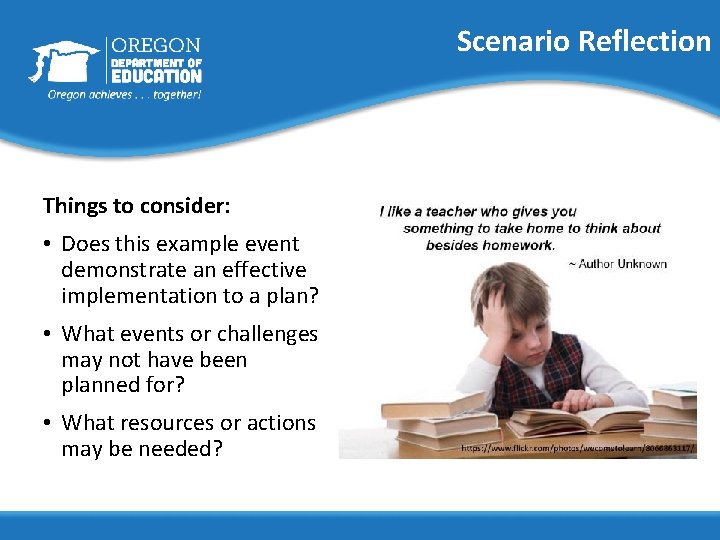
Scenario Reflection Things to consider: • Does this example event demonstrate an effective implementation to a plan? • What events or challenges may not have been planned for? • What resources or actions may be needed?
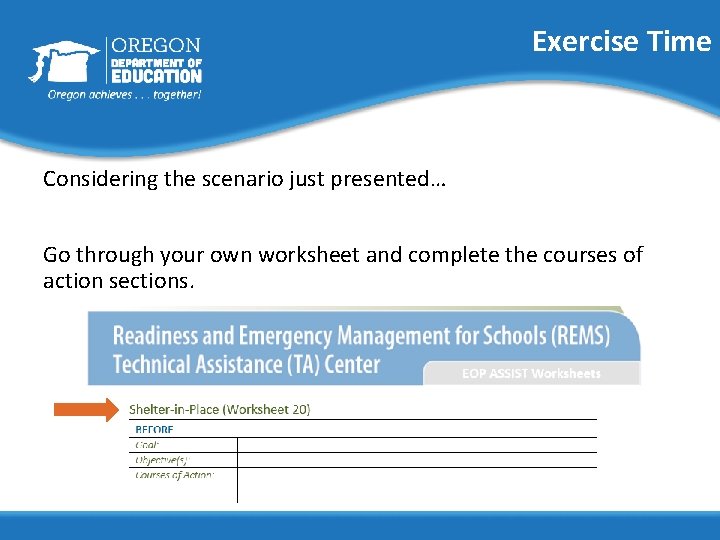
Exercise Time Considering the scenario just presented… Go through your own worksheet and complete the courses of action sections.
Step 5: Plan Prep & Review The planning team PREPARES A DRAFT …of the school EOP.
The Plan SCHOOL EMERGENCY OPERATIONS PLAN BASIC PLAN FUNCTIONAL ANNEXES THREAT AND HAZARDSPECIFIC ANNEXES
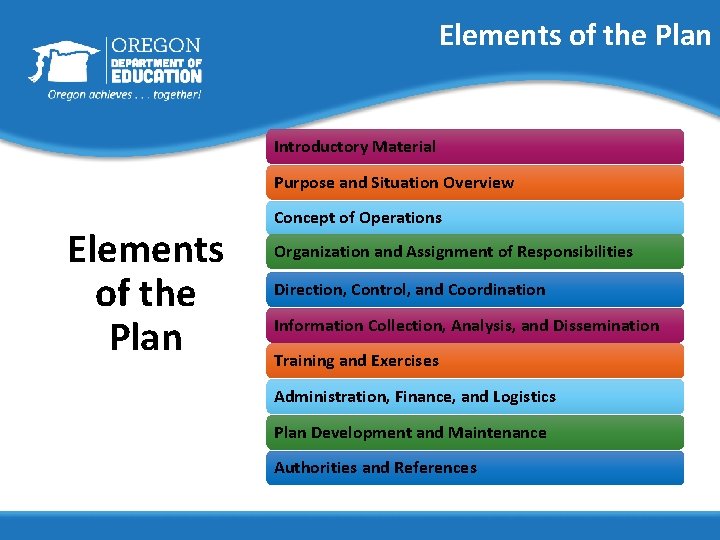
Elements of the Plan Introductory Material Purpose and Situation Overview Elements of the Plan Concept of Operations Organization and Assignment of Responsibilities Direction, Control, and Coordination Information Collection, Analysis, and Dissemination Training and Exercises Administration, Finance, and Logistics Plan Development and Maintenance Authorities and References
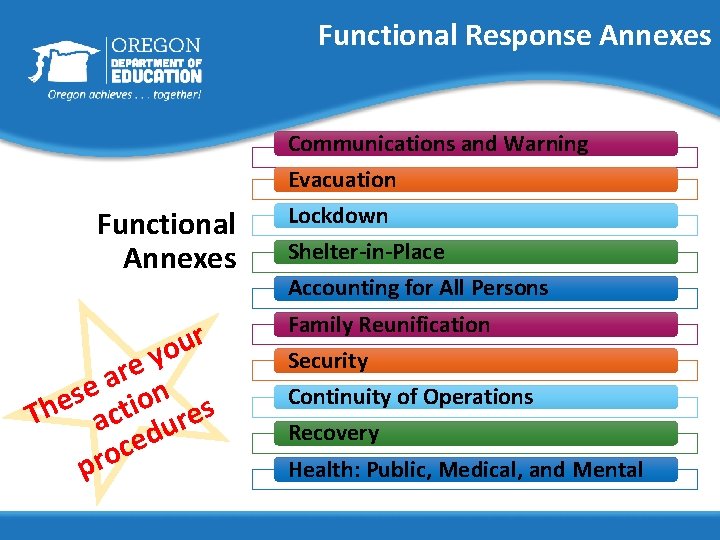
Functional Response Annexes Communications and Warning Evacuation Functional Annexes r u yo re a e ion s e Th act ures d e c pro Lockdown Shelter-in-Place Accounting for All Persons Family Reunification Security Continuity of Operations Recovery Health: Public, Medical, and Mental
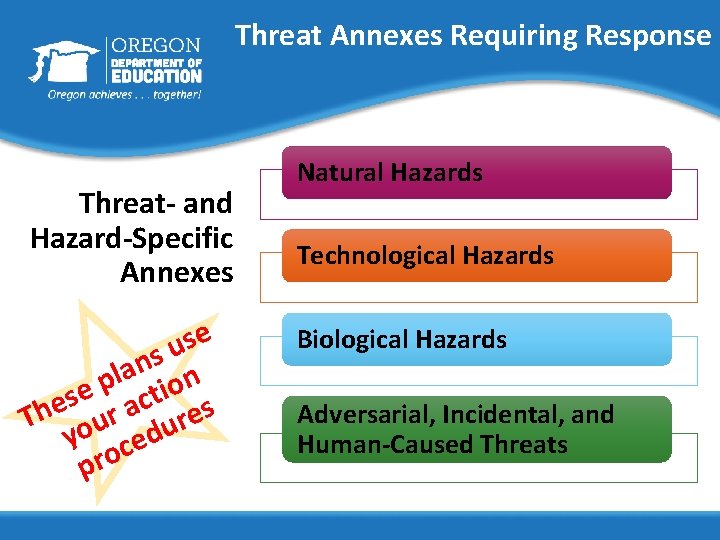
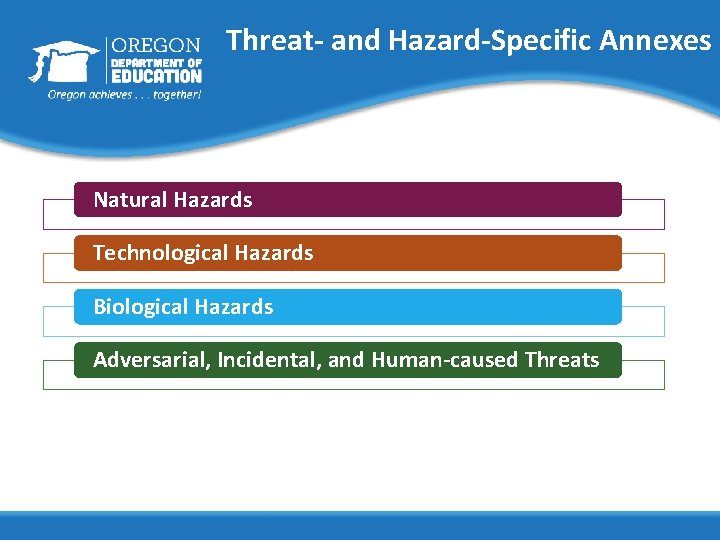
Threat Annexes Requiring Response Threat- and Hazard-Specific Annexes se u s n la ion p e act s e Th our ures y ced pro Natural Hazards Technological Hazards Biological Hazards Adversarial, Incidental, and Human-Caused Threats
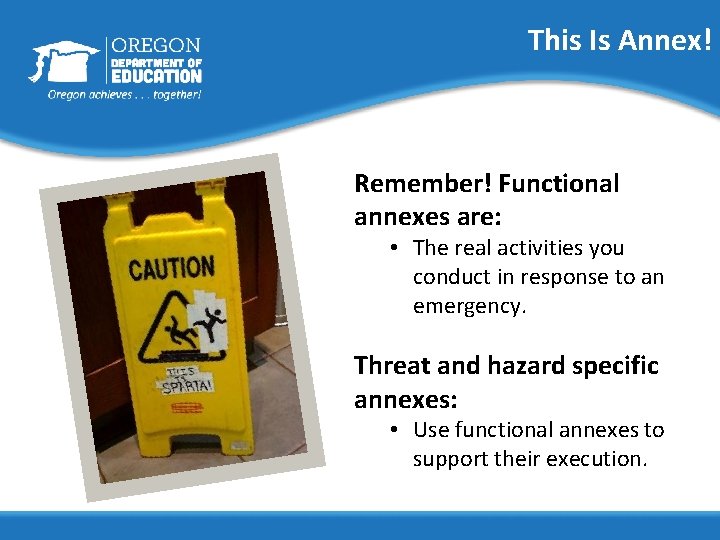
This Is Annex! Remember! Functional annexes are: • The real activities you conduct in response to an emergency. Threat and hazard specific annexes: • Use functional annexes to support their execution.
Step 6: Plan Maintenance The planning team implements a TRAINING, EXERCISE, AND MAINTENANCE plan.
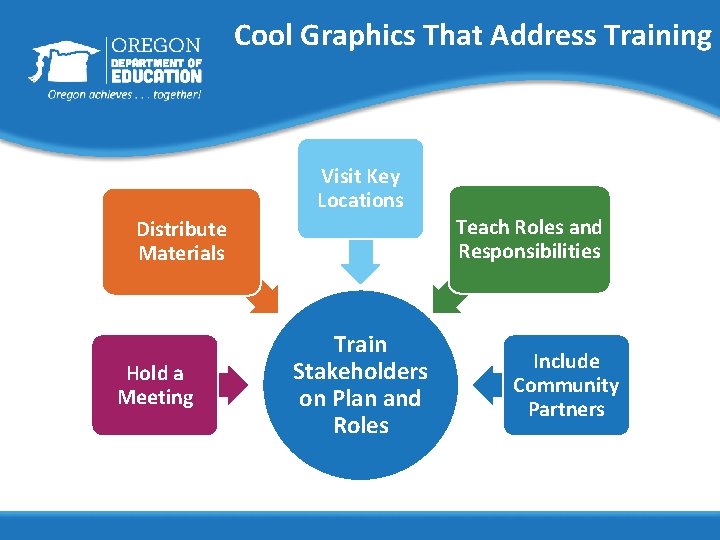
Cool Graphics That Address Training Visit Key Locations Teach Roles and Responsibilities Distribute Materials Hold a Meeting Train Stakeholders on Plan and Roles Include Community Partners
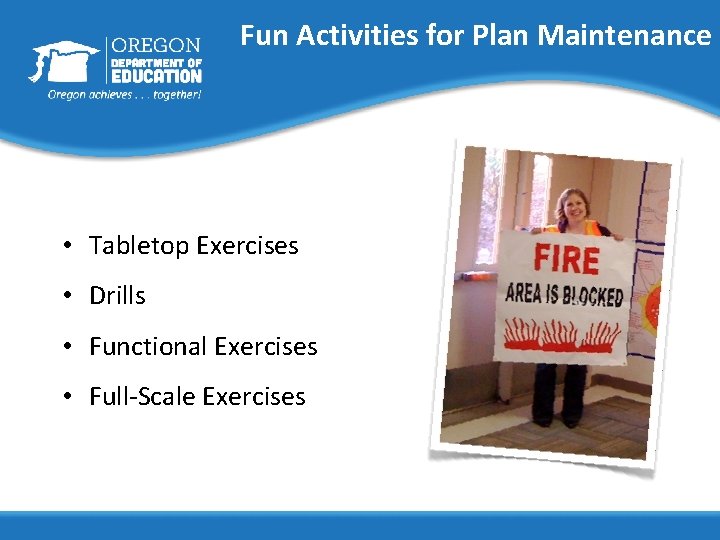
Fun Activities for Plan Maintenance • Tabletop Exercises • Drills • Functional Exercises • Full-Scale Exercises
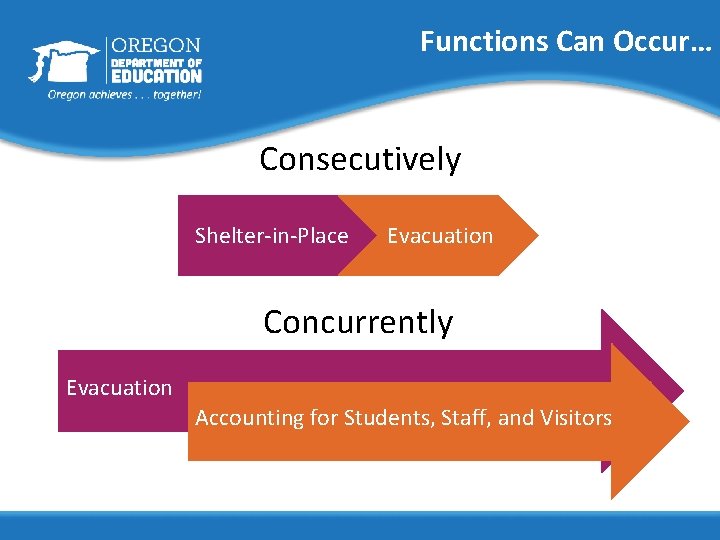
Functions Can Occur… Consecutively Shelter-in-Place Evacuation Concurrently Evacuation Accounting for Students, Staff, and Visitors
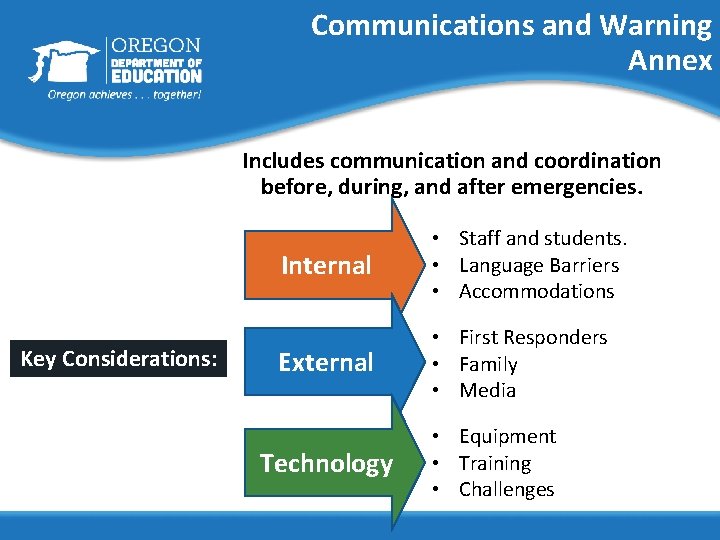
Communications and Warning Annex Includes communication and coordination before, during, and after emergencies. Key Considerations: Internal • Staff and students. • Language Barriers • Accommodations External • First Responders • Family • Media Technology • Equipment • Training • Challenges
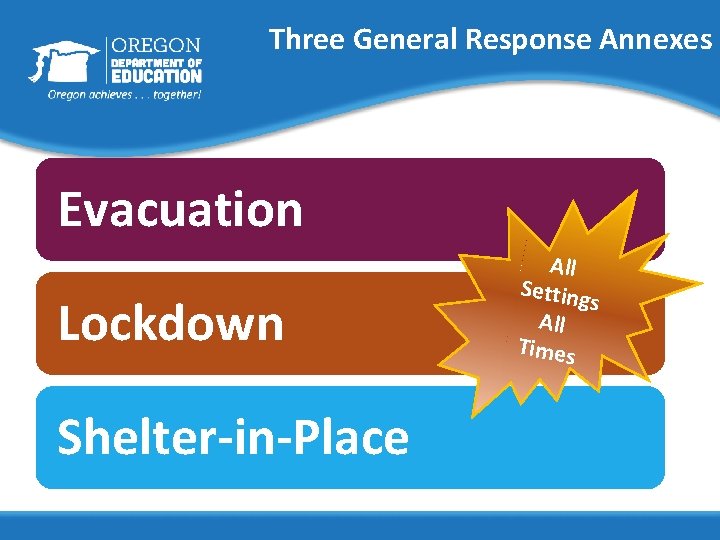
Three General Response Annexes Evacuation Lockdown Shelter-in-Place All Setting s All Times
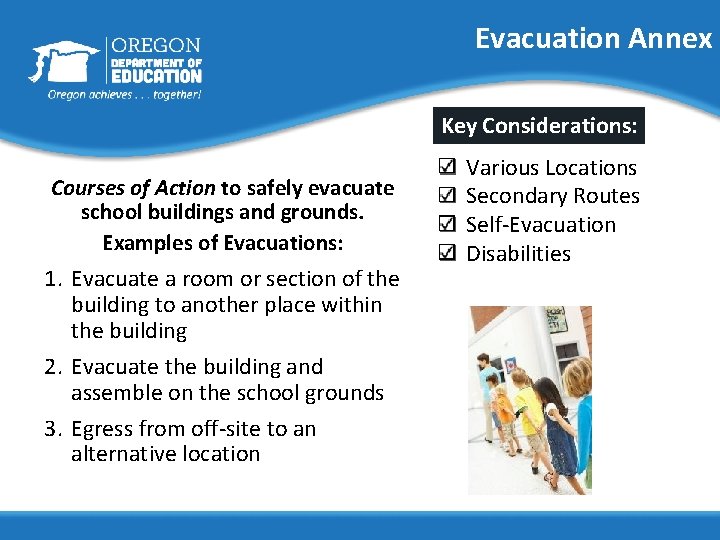
Evacuation Annex Key Considerations: Courses of Action to safely evacuate school buildings and grounds. Examples of Evacuations: 1. Evacuate a room or section of the building to another place within the building 2. Evacuate the building and assemble on the school grounds 3. Egress from off-site to an alternative location Various Locations Secondary Routes Self-Evacuation Disabilities
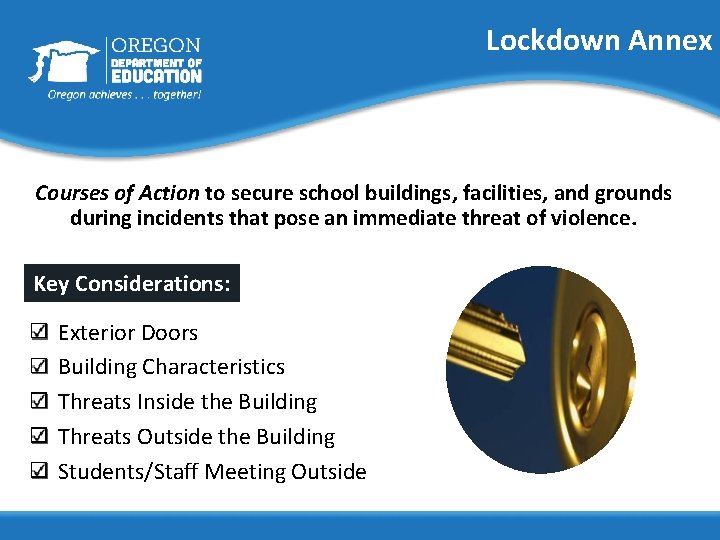
Lockdown Annex Courses of Action to secure school buildings, facilities, and grounds during incidents that pose an immediate threat of violence. Key Considerations: Exterior Doors Building Characteristics Threats Inside the Building Threats Outside the Building Students/Staff Meeting Outside
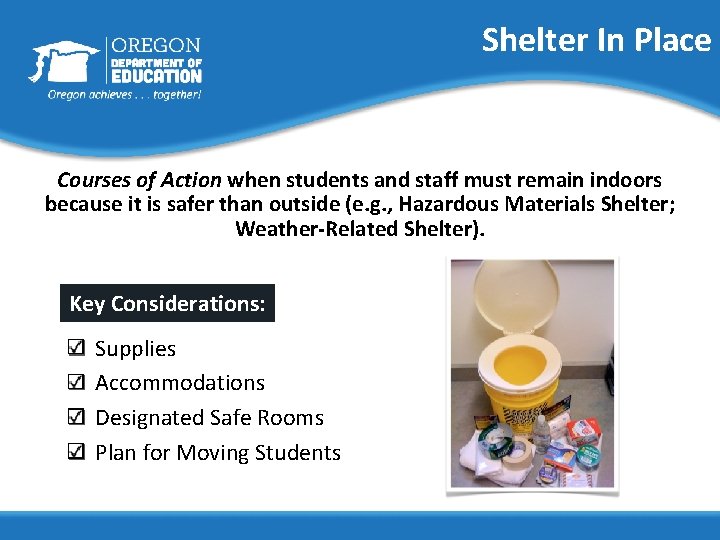
Shelter In Place Courses of Action when students and staff must remain indoors because it is safer than outside (e. g. , Hazardous Materials Shelter; Weather-Related Shelter). Key Considerations: Supplies Accommodations Designated Safe Rooms Plan for Moving Students
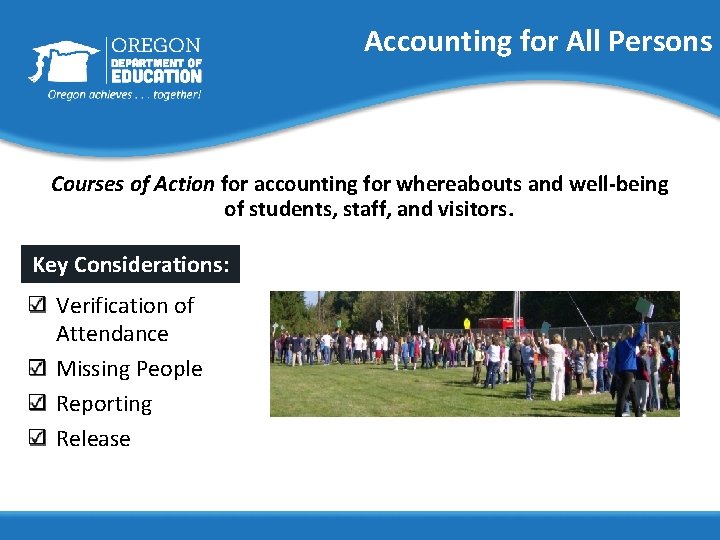
Accounting for All Persons Courses of Action for accounting for whereabouts and well-being of students, staff, and visitors. Key Considerations: Verification of Attendance Missing People Reporting Release
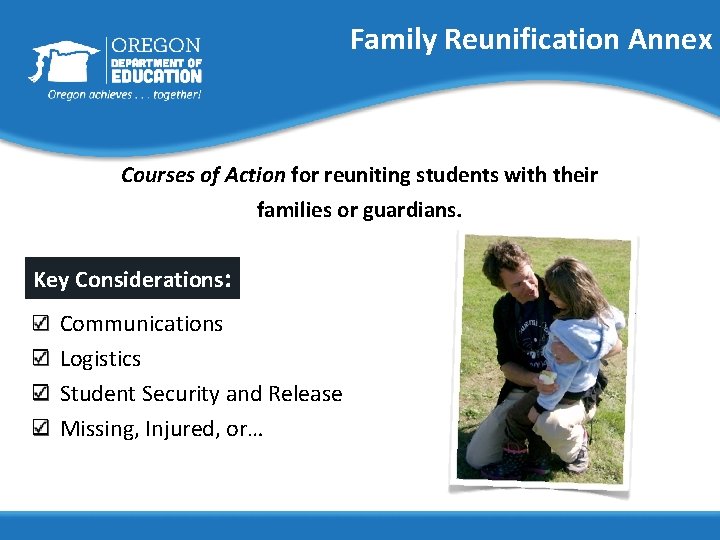
Family Reunification Annex Courses of Action for reuniting students with their families or guardians. Key Considerations: Communications Logistics Student Security and Release Missing, Injured, or…
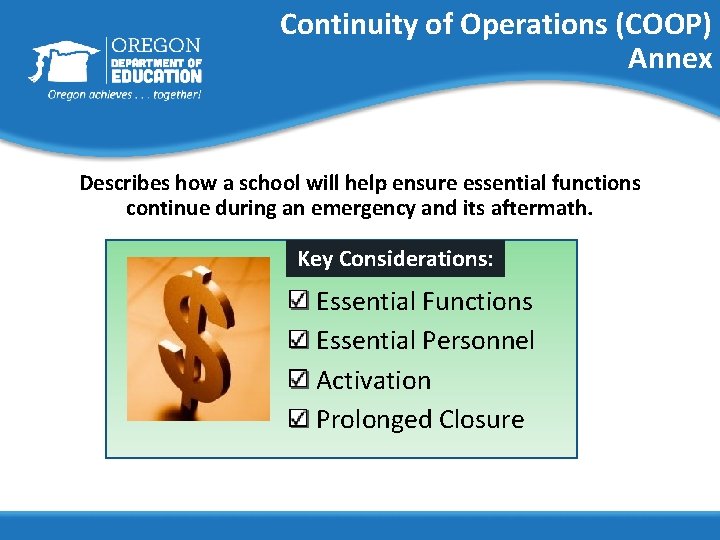
Continuity of Operations (COOP) Annex Describes how a school will help ensure essential functions continue during an emergency and its aftermath. Key Considerations: Essential Functions Essential Personnel Activation Prolonged Closure
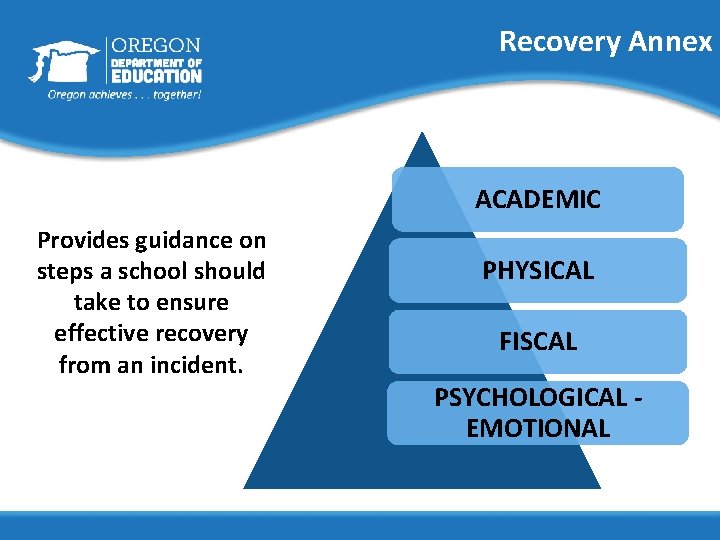
Recovery Annex ACADEMIC Provides guidance on steps a school should take to ensure effective recovery from an incident. PHYSICAL FISCAL PSYCHOLOGICAL EMOTIONAL
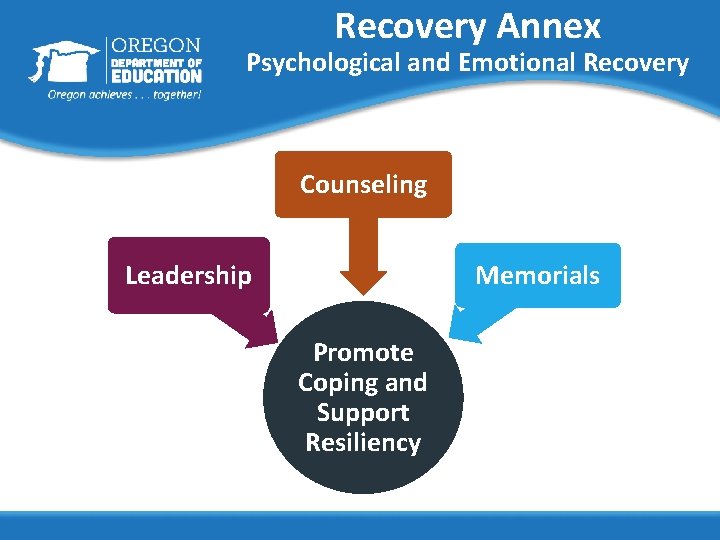
Recovery Annex Psychological and Emotional Recovery Counseling Leadership Memorials Promote Coping and Support Resiliency
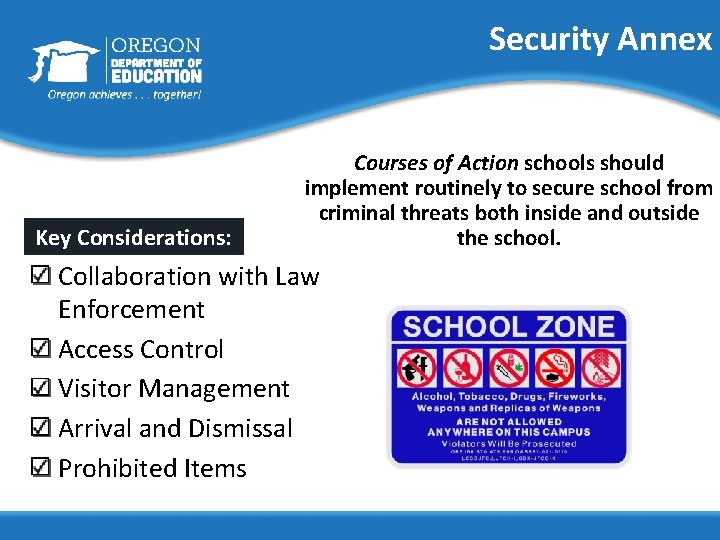
Security Annex Key Considerations: Courses of Action schools should implement routinely to secure school from criminal threats both inside and outside the school. Collaboration with Law Enforcement Access Control Visitor Management Arrival and Dismissal Prohibited Items
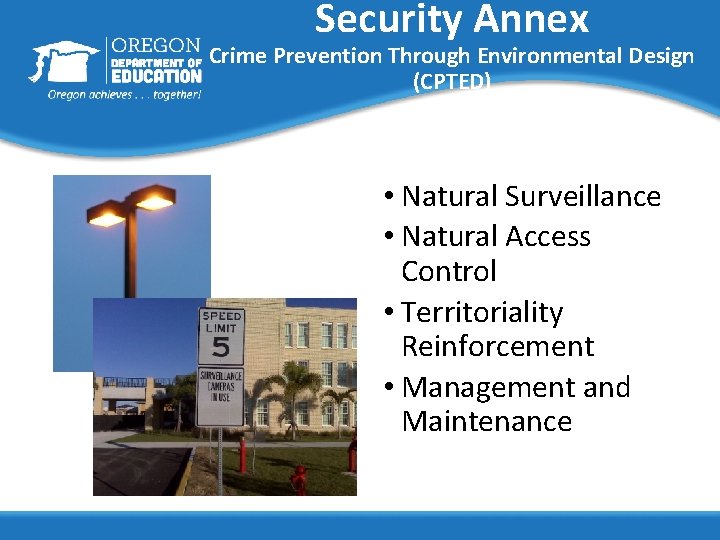
Security Annex Crime Prevention Through Environmental Design (CPTED) • Natural Surveillance • Natural Access Control • Territoriality Reinforcement • Management and Maintenance
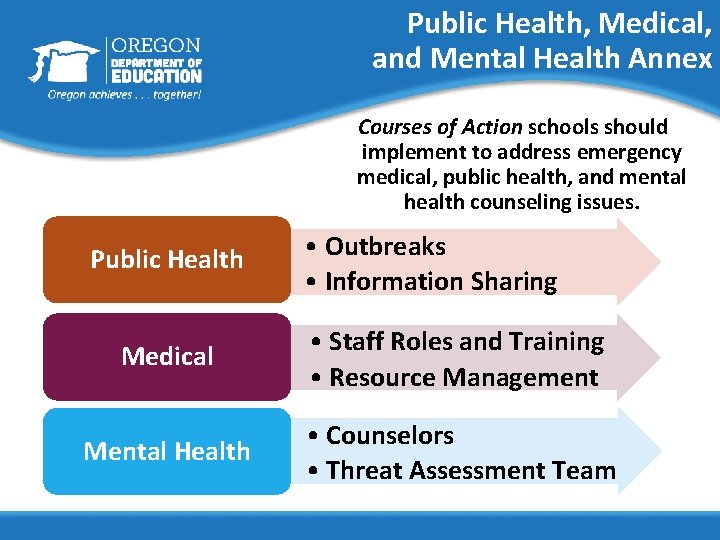
Public Health, Medical, and Mental Health Annex Courses of Action schools should implement to address emergency medical, public health, and mental health counseling issues. Public Health • Outbreaks • Information Sharing Medical • Staff Roles and Training • Resource Management Mental Health • Counselors • Threat Assessment Team
Participant Activity • Identify which of the 10 preceding Functional Annexes you already have in place. • Identify the Functional Annexes that are not currently in place and consider which ones might hold *Go through page 4 in the highest priority. workbook and conduct a needs assessment for your school.
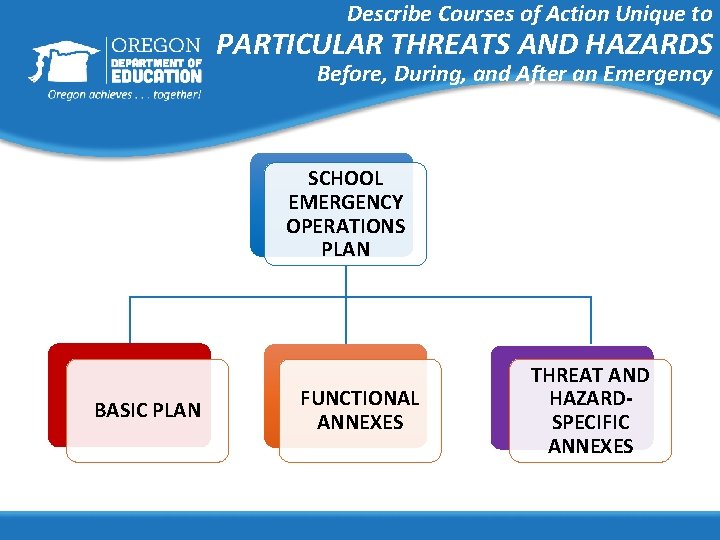
Describe Courses of Action Unique to PARTICULAR THREATS AND HAZARDS Before, During, and After an Emergency SCHOOL EMERGENCY OPERATIONS PLAN BASIC PLAN FUNCTIONAL ANNEXES THREAT AND HAZARDSPECIFIC ANNEXES
Threat- and Hazard-Specific Annexes Natural Hazards Technological Hazards Biological Hazards Adversarial, Incidental, and Human-caused Threats
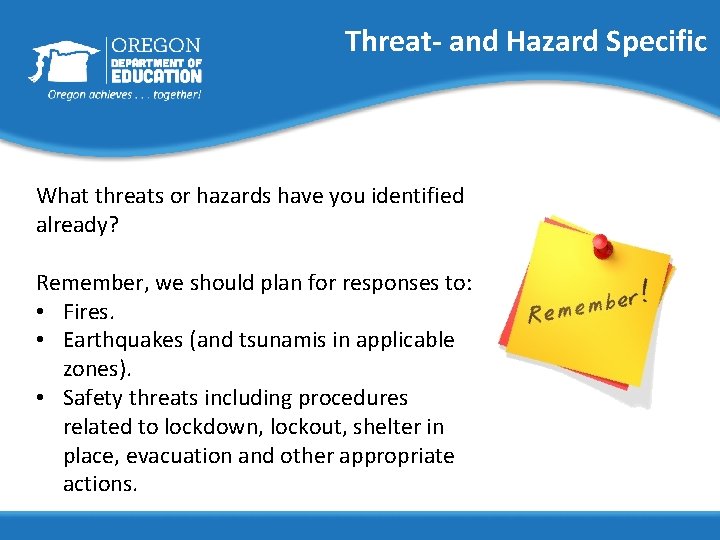
Threat- and Hazard Specific What threats or hazards have you identified already? Remember, we should plan for responses to: • Fires. • Earthquakes (and tsunamis in applicable zones). • Safety threats including procedures related to lockdown, lockout, shelter in place, evacuation and other appropriate actions.
Questions? Phone: (855) 781 -7367 (REMS) Email: info@remstacenter. org http: //rems. ed. gov Join our Community of Practice Access Virtual Trainings Get the Guide Request an On-site Training