
Developing distributed protocols formally with Ivy Ken Mc

Developing distributed protocols formally with Ivy Ken Mc. Millan Microsoft Research Joint work with: Marcelo Taube, Giuliano Losa, Oded Padon, Mooly Sagiv, Sharon Shoham, James R. Wilcox, Doug Woos
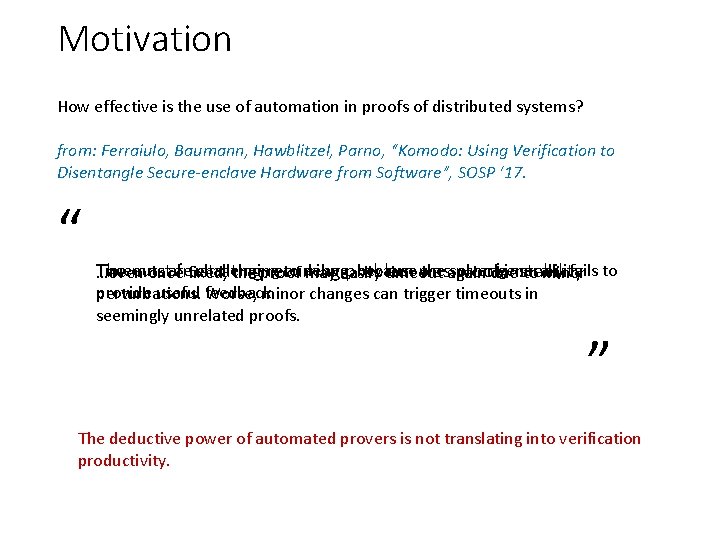
Motivation How effective is the use of automation in proofs of distributed systems? from: Ferraiulo, Baumann, Hawblitzel, Parno, “Komodo: Using Verification to Disentangle Secure-enclave Hardware from Software”, SOSP ‘ 17. “ Timeouts are challenging to debug, because the solver generally fails to The most frustrating recurring problem was proof instability …even once fixed, the proof may easily timeout again due to minor provide useful feedback perturbations. Worse, minor changes can trigger timeouts in seemingly unrelated proofs. ” The deductive power of automated provers is not translating into verification productivity.
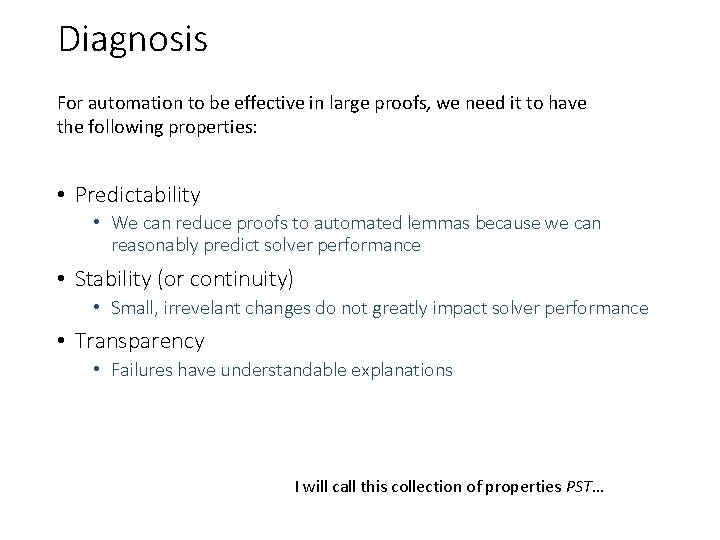
Diagnosis For automation to be effective in large proofs, we need it to have the following properties: • Predictability • We can reduce proofs to automated lemmas because we can reasonably predict solver performance • Stability (or continuity) • Small, irrevelant changes do not greatly impact solver performance • Transparency • Failures have understandable explanations I will call this collection of properties PST…
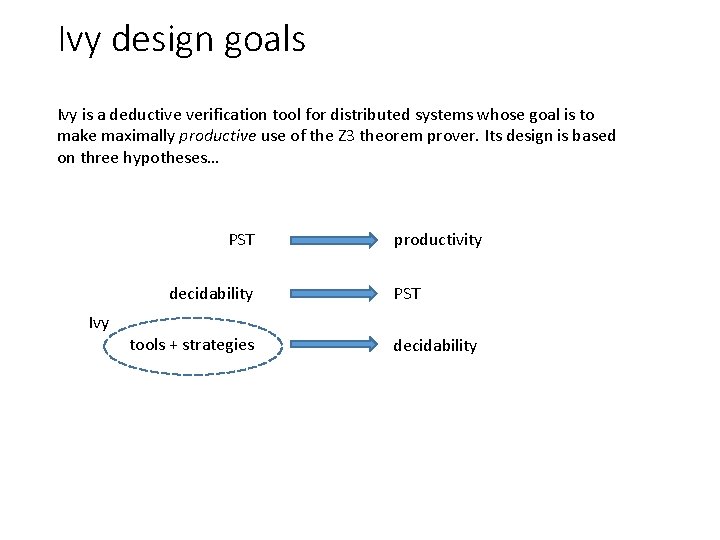
Ivy design goals Ivy is a deductive verification tool for distributed systems whose goal is to make maximally productive use of the Z 3 theorem prover. Its design is based on three hypotheses… PST decidability Ivy tools + strategies productivity PST decidability
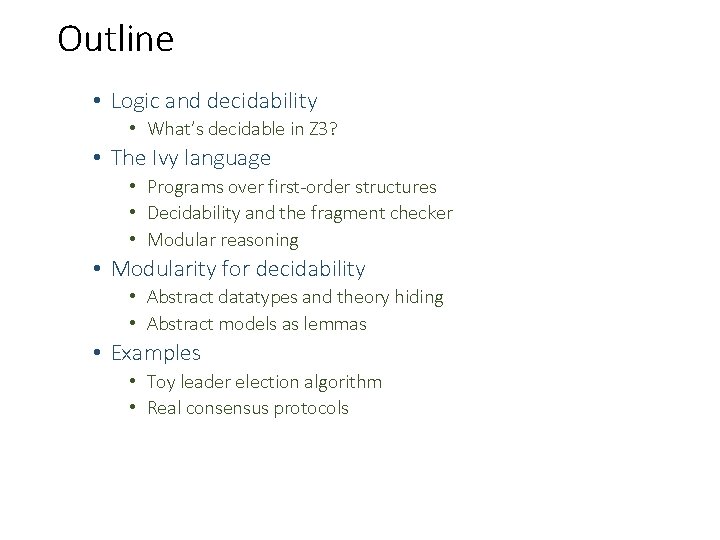
Outline • Logic and decidability • What’s decidable in Z 3? • The Ivy language • Programs over first-order structures • Decidability and the fragment checker • Modular reasoning • Modularity for decidability • Abstract datatypes and theory hiding • Abstract models as lemmas • Examples • Toy leader election algorithm • Real consensus protocols
Logic and decidability
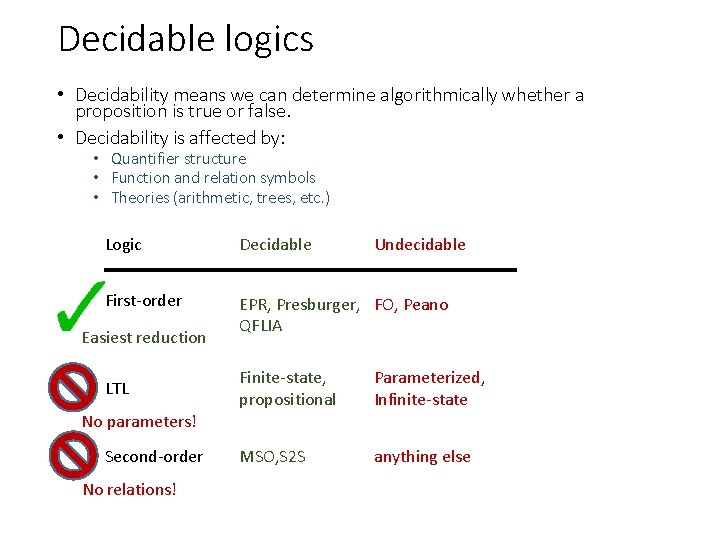
Decidable logics • Decidability means we can determine algorithmically whether a proposition is true or false. • Decidability is affected by: • Quantifier structure • Function and relation symbols • Theories (arithmetic, trees, etc. ) Logic Decidable First-order EPR, Presburger, FO, Peano QFLIA Easiest reduction LTL No parameters! Second-order No relations! Undecidable Finite-state, propositional Parameterized, Infinite-state MSO, S 2 S anything else
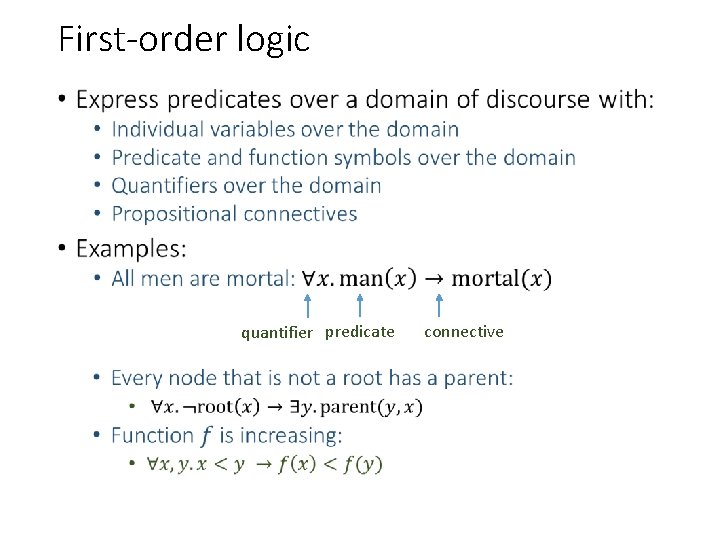
First-order logic • quantifier predicate connective
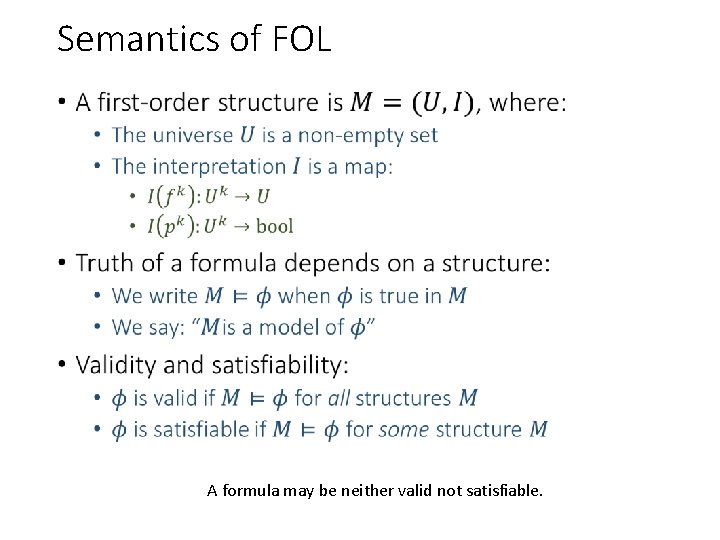
Semantics of FOL • A formula may be neither valid not satisfiable.
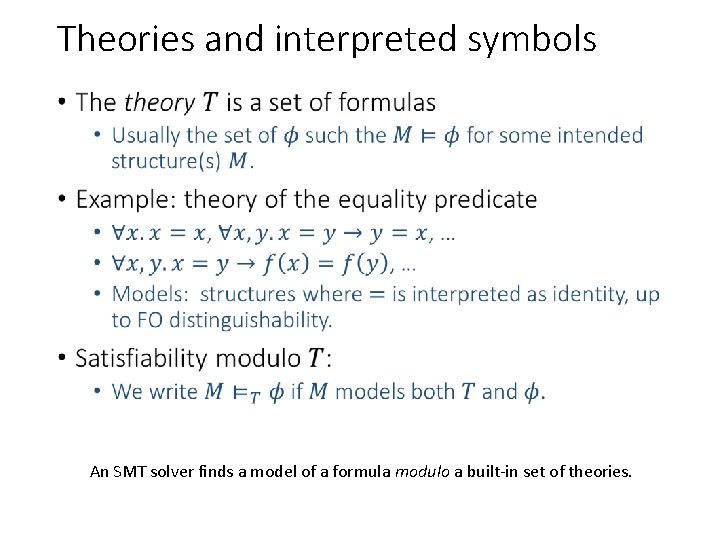
Theories and interpreted symbols • An SMT solver finds a model of a formula modulo a built-in set of theories.
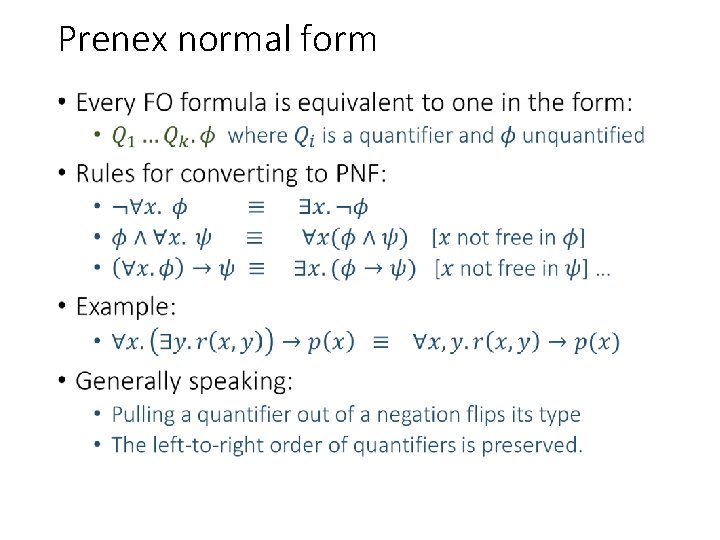
Prenex normal form •
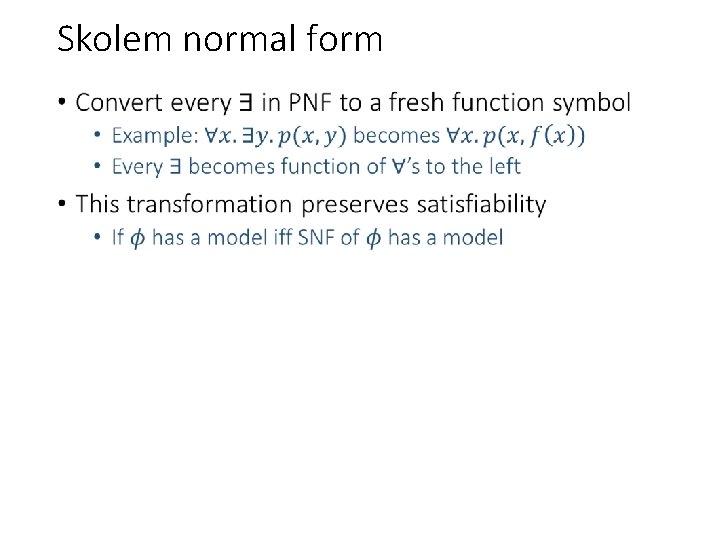
Skolem normal form •
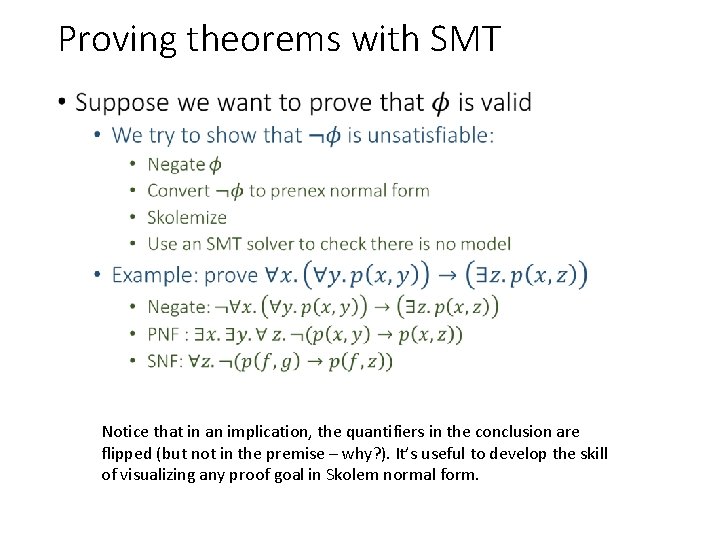
Proving theorems with SMT • Notice that in an implication, the quantifiers in the conclusion are flipped (but not in the premise – why? ). It’s useful to develop the skill of visualizing any proof goal in Skolem normal form.
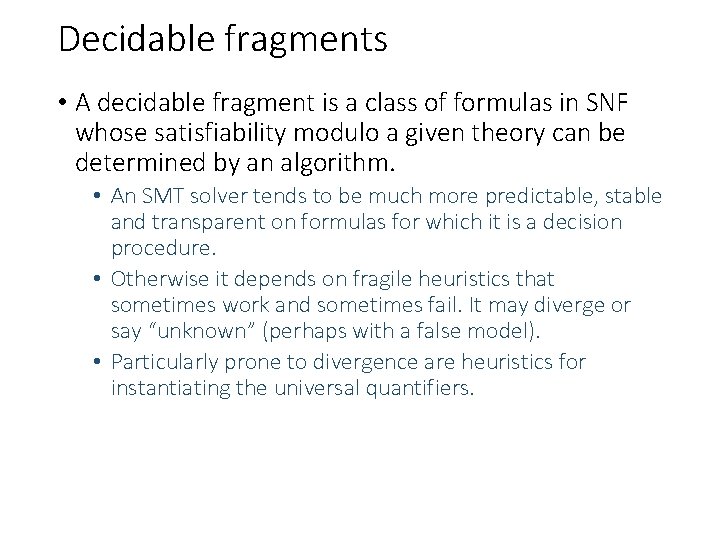
Decidable fragments • A decidable fragment is a class of formulas in SNF whose satisfiability modulo a given theory can be determined by an algorithm. • An SMT solver tends to be much more predictable, stable and transparent on formulas for which it is a decision procedure. • Otherwise it depends on fragile heuristics that sometimes work and sometimes fail. It may diverge or say “unknown” (perhaps with a false model). • Particularly prone to divergence are heuristics for instantiating the universal quantifiers.
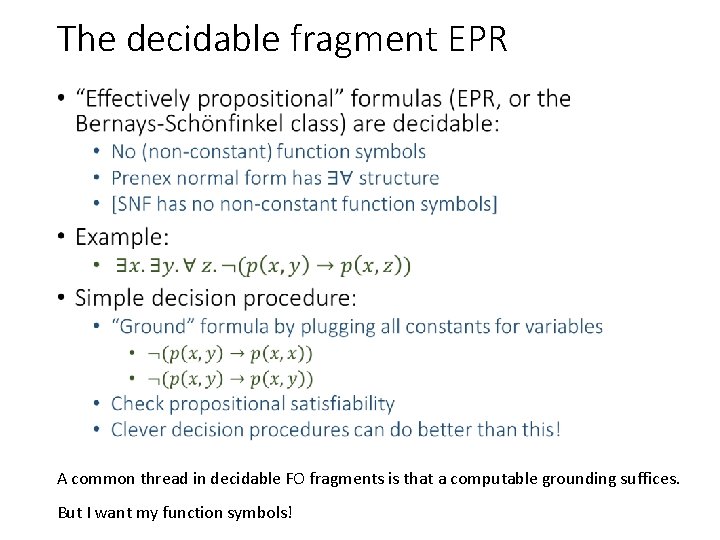
The decidable fragment EPR • A common thread in decidable FO fragments is that a computable grounding suffices. But I want my function symbols!
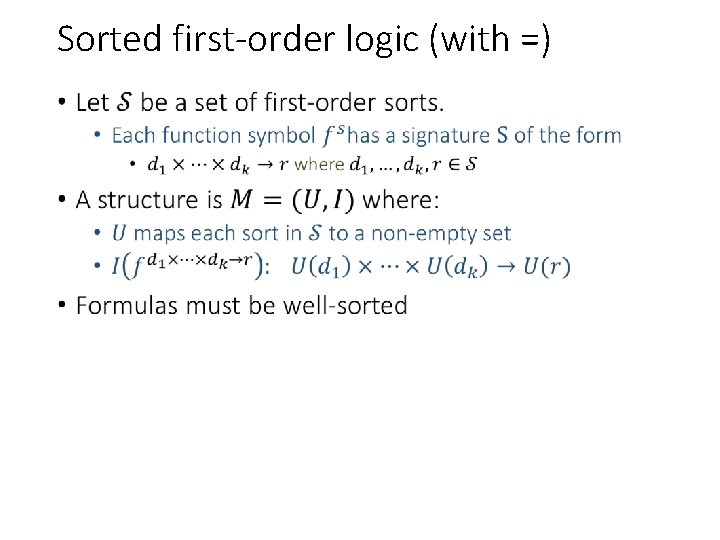
Sorted first-order logic (with =) •
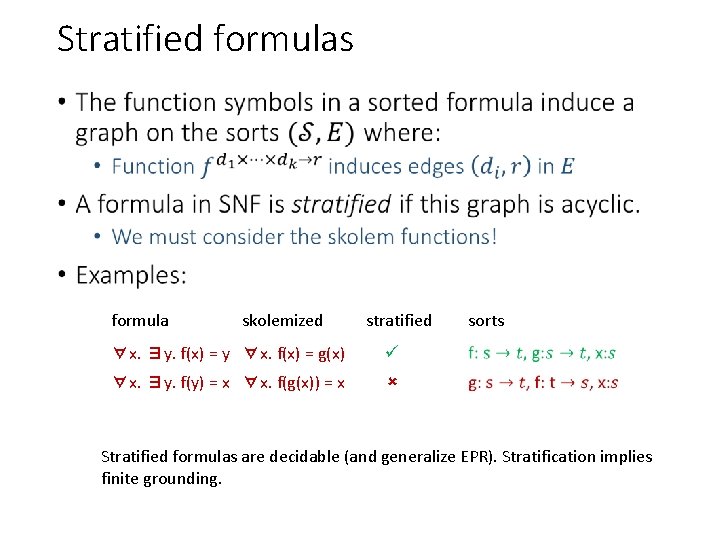
Stratified formulas • formula skolemized stratified sorts ∀x. ∃y. f(x) = y ∀x. f(x) = g(x) ∀x. ∃y. f(y) = x ∀x. f(g(x)) = x Stratified formulas are decidable (and generalize EPR). Stratification implies finite grounding.
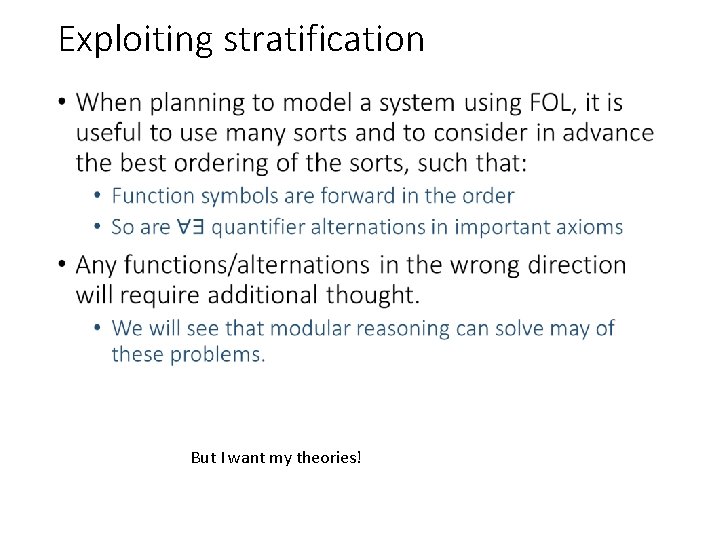
Exploiting stratification • But I want my theories!
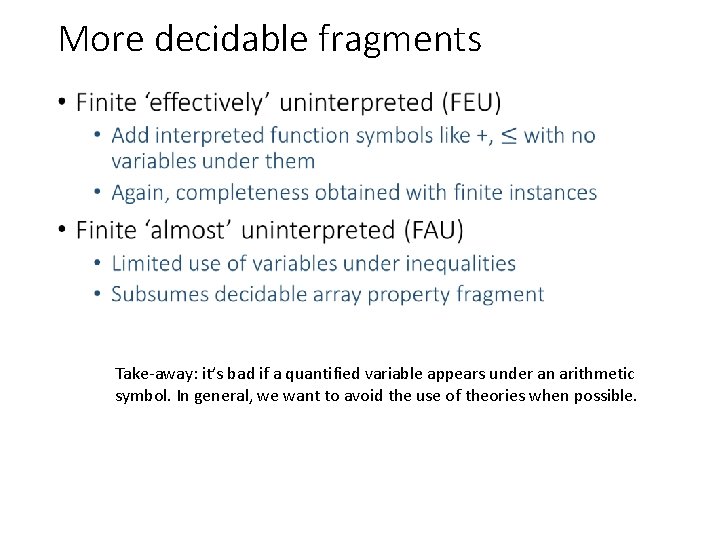
More decidable fragments • Take-away: it’s bad if a quantified variable appears under an arithmetic symbol. In general, we want to avoid the use of theories when possible.
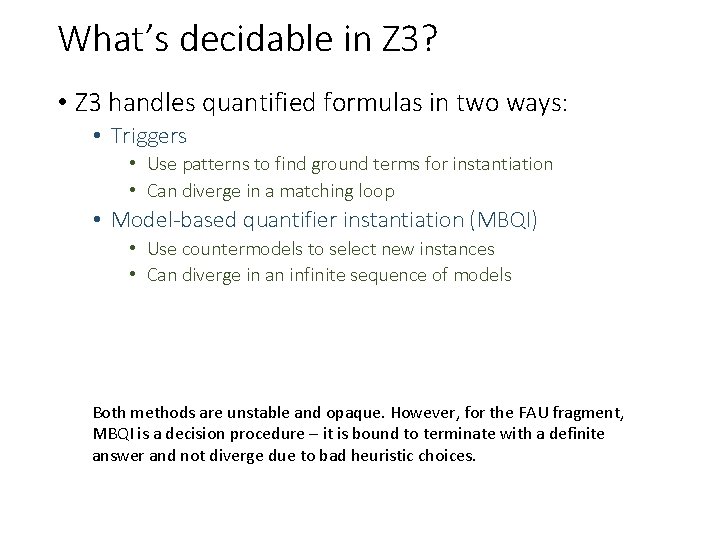
What’s decidable in Z 3? • Z 3 handles quantified formulas in two ways: • Triggers • Use patterns to find ground terms for instantiation • Can diverge in a matching loop • Model-based quantifier instantiation (MBQI) • Use countermodels to select new instances • Can diverge in an infinite sequence of models Both methods are unstable and opaque. However, for the FAU fragment, MBQI is a decision procedure – it is bound to terminate with a definite answer and not diverge due to bad heuristic choices.
The Ivy language
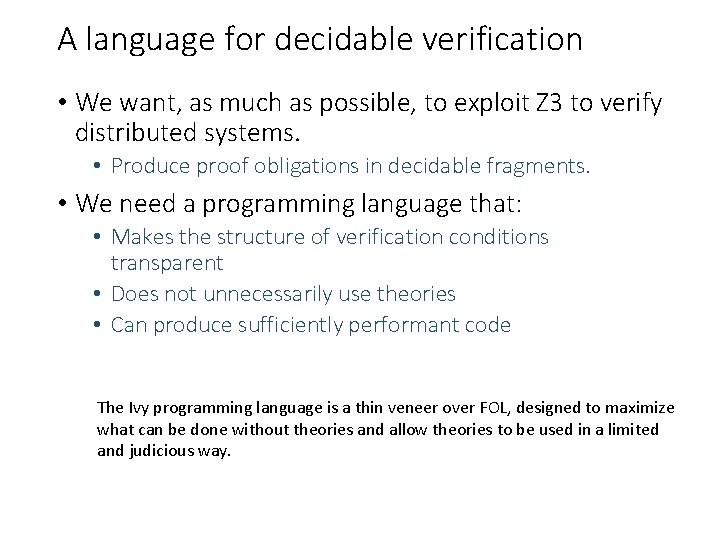
A language for decidable verification • We want, as much as possible, to exploit Z 3 to verify distributed systems. • Produce proof obligations in decidable fragments. • We need a programming language that: • Makes the structure of verification conditions transparent • Does not unnecessarily use theories • Can produce sufficiently performant code The Ivy programming language is a thin veneer over FOL, designed to maximize what can be done without theories and allow theories to be used in a limited and judicious way.
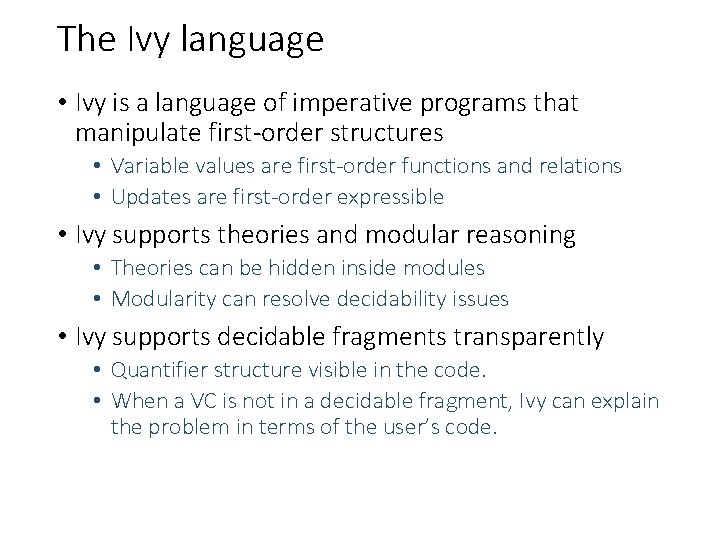
The Ivy language • Ivy is a language of imperative programs that manipulate first-order structures • Variable values are first-order functions and relations • Updates are first-order expressible • Ivy supports theories and modular reasoning • Theories can be hidden inside modules • Modularity can resolve decidability issues • Ivy supports decidable fragments transparently • Quantifier structure visible in the code. • When a VC is not in a decidable fragment, Ivy can explain the problem in terms of the user’s code.
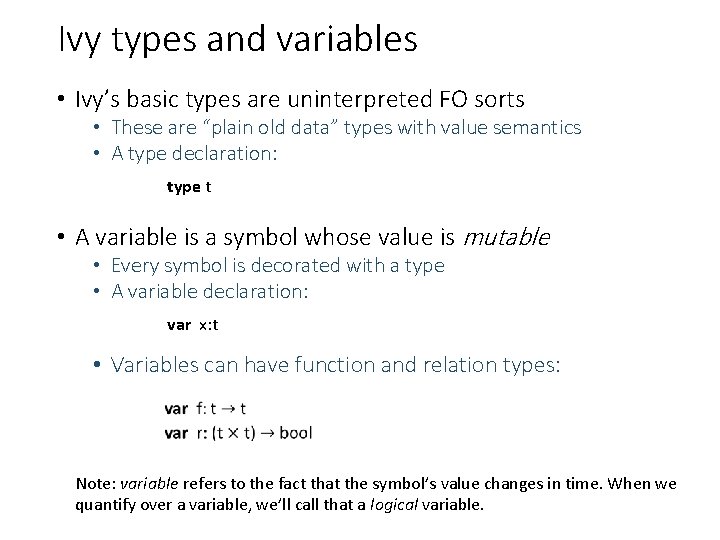
Ivy types and variables • Ivy’s basic types are uninterpreted FO sorts • These are “plain old data” types with value semantics • A type declaration: type t • A variable is a symbol whose value is mutable • Every symbol is decorated with a type • A variable declaration: var x: t • Variables can have function and relation types: Note: variable refers to the fact that the symbol’s value changes in time. When we quantify over a variable, we’ll call that a logical variable.
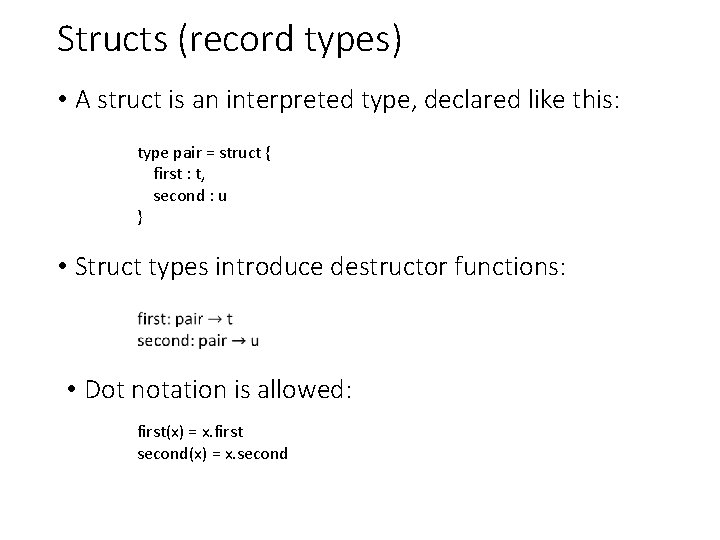
Structs (record types) • A struct is an interpreted type, declared like this: type pair = struct { first : t, second : u } • Struct types introduce destructor functions: • Dot notation is allowed: first(x) = x. first second(x) = x. second
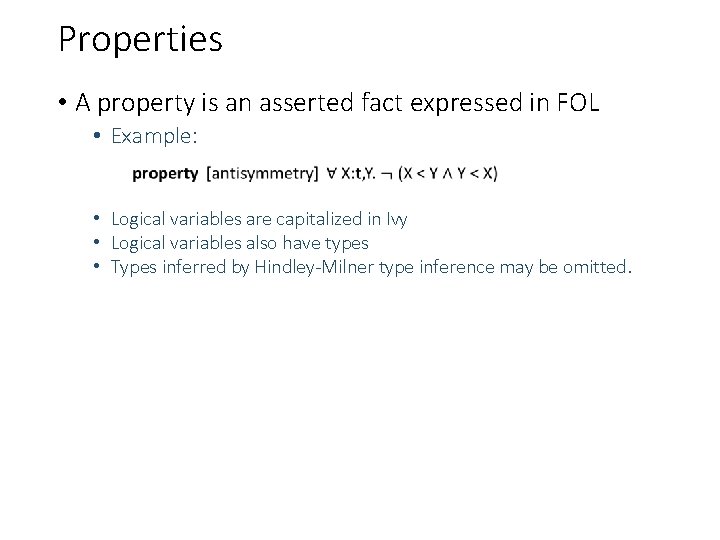
Properties • A property is an asserted fact expressed in FOL • Example: • Logical variables are capitalized in Ivy • Logical variables also have types • Types inferred by Hindley-Milner type inference may be omitted.
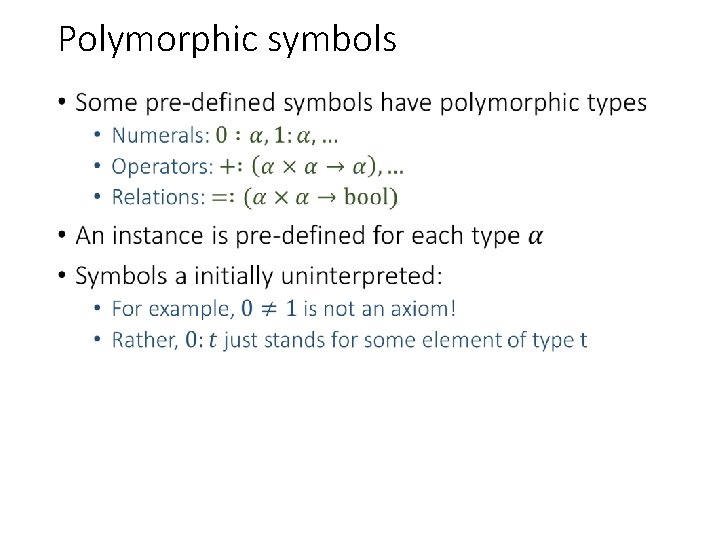
Polymorphic symbols •
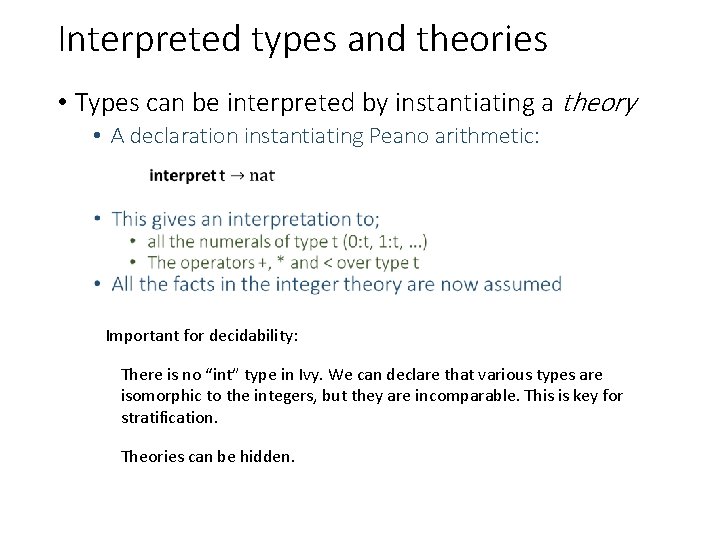
Interpreted types and theories • Types can be interpreted by instantiating a theory • A declaration instantiating Peano arithmetic: Important for decidability: There is no “int” type in Ivy. We can declare that various types are isomorphic to the integers, but they are incomparable. This is key for stratification. Theories can be hidden.
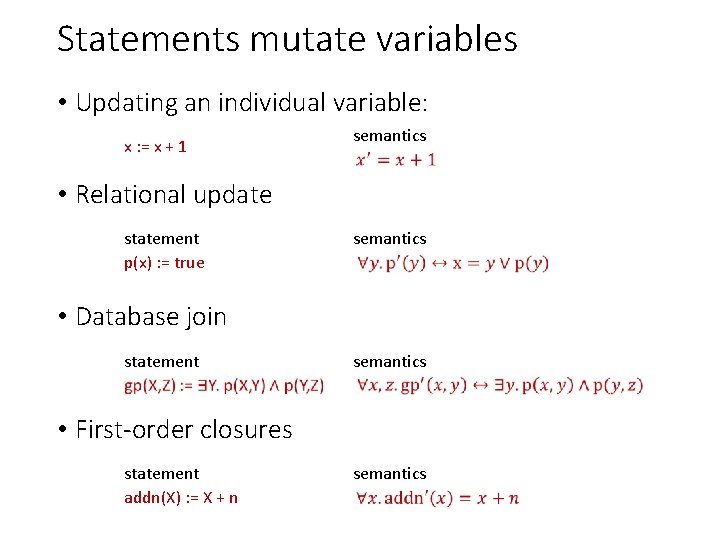
Statements mutate variables • Updating an individual variable: x : = x + 1 semantics • Relational update statement p(x) : = true semantics • Database join statement semantics • First-order closures statement addn(X) : = X + n semantics
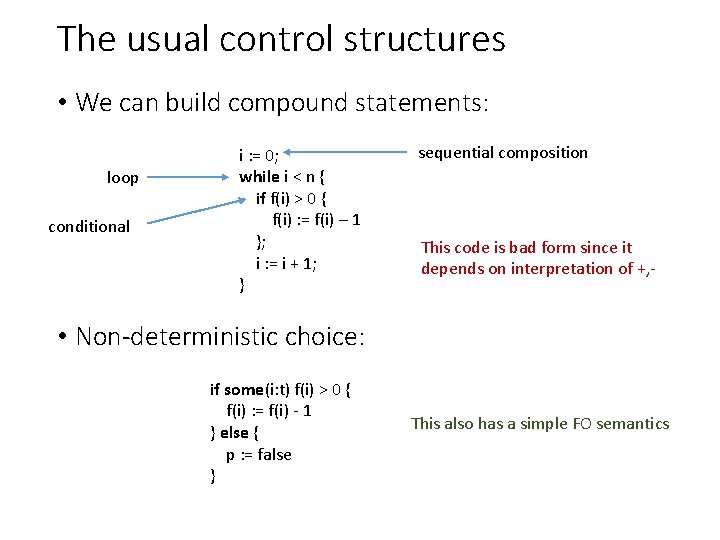
The usual control structures • We can build compound statements: loop conditional i : = 0; while i < n { if f(i) > 0 { f(i) : = f(i) – 1 }; i : = i + 1; } sequential composition This code is bad form since it depends on interpretation of +, - • Non-deterministic choice: if some(i: t) f(i) > 0 { f(i) : = f(i) - 1 } else { p : = false } This also has a simple FO semantics
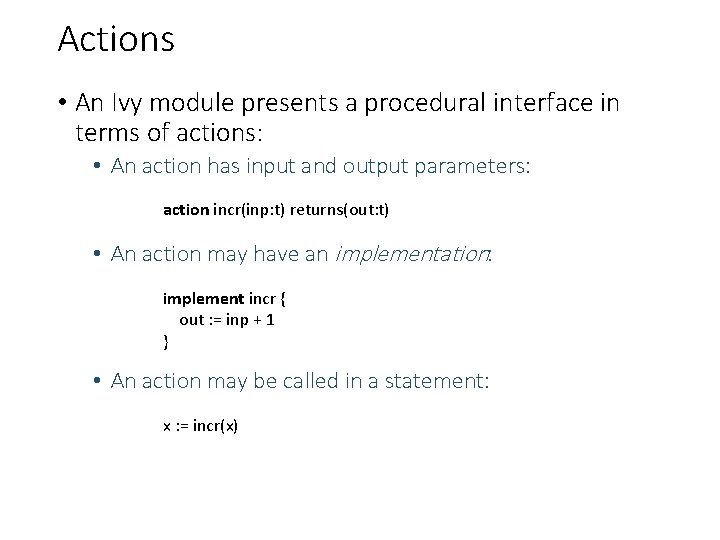
Actions • An Ivy module presents a procedural interface in terms of actions: • An action has input and output parameters: action incr(inp: t) returns(out: t) • An action may have an implementation: implement incr { out : = inp + 1 } • An action may be called in a statement: x : = incr(x)
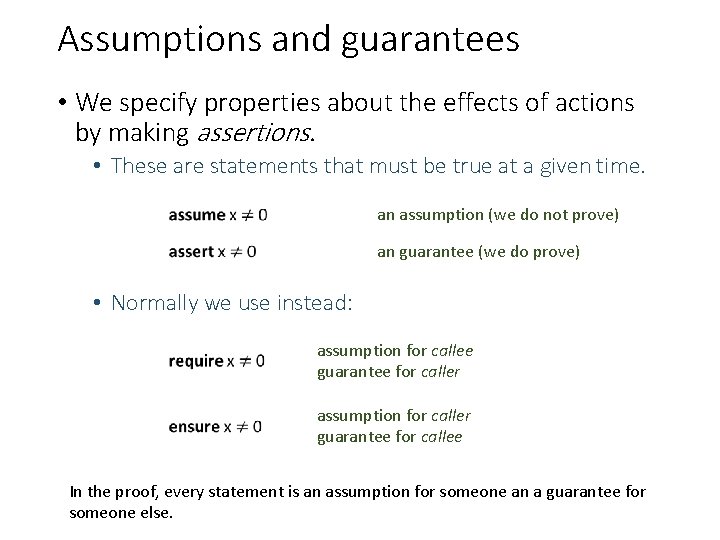
Assumptions and guarantees • We specify properties about the effects of actions by making assertions. • These are statements that must be true at a given time. an assumption (we do not prove) an guarantee (we do prove) • Normally we use instead: assumption for callee guarantee for caller assumption for caller guarantee for callee In the proof, every statement is an assumption for someone an a guarantee for someone else.
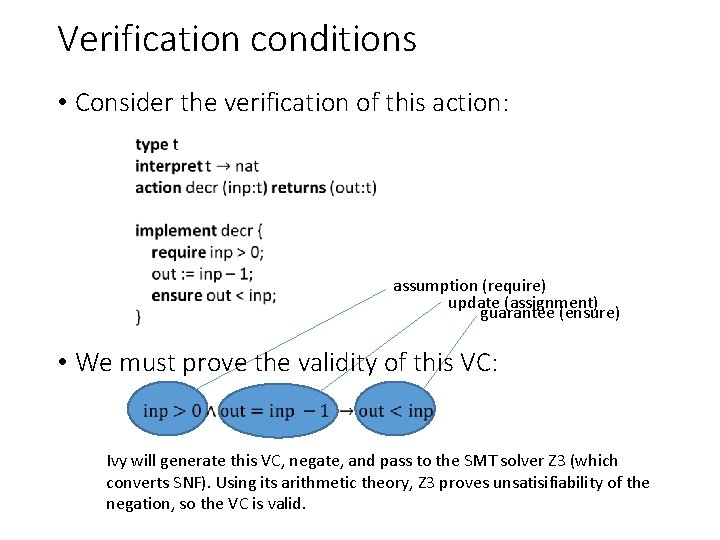
Verification conditions • Consider the verification of this action: assumption (require) update (assignment) guarantee (ensure) • We must prove the validity of this VC: Ivy will generate this VC, negate, and pass to the SMT solver Z 3 (which converts SNF). Using its arithmetic theory, Z 3 proves unsatisifiability of the negation, so the VC is valid.
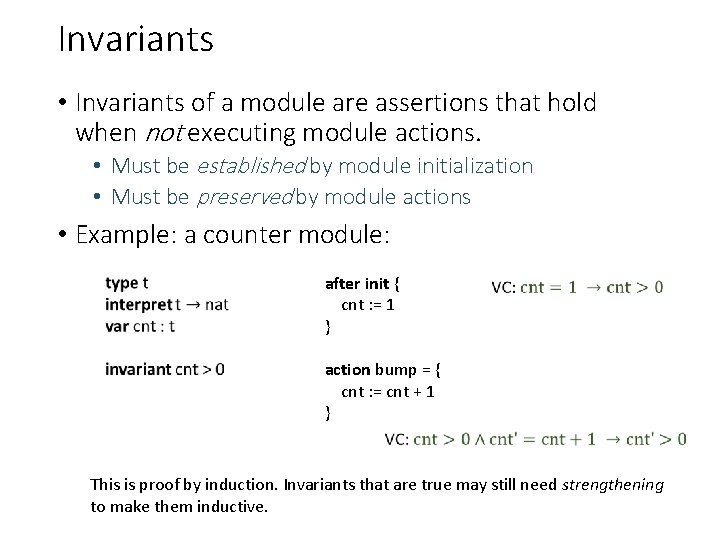
Invariants • Invariants of a module are assertions that hold when not executing module actions. • Must be established by module initialization • Must be preserved by module actions • Example: a counter module: after init { cnt : = 1 } action bump = { cnt : = cnt + 1 } This is proof by induction. Invariants that are true may still need strengthening to make them inductive.
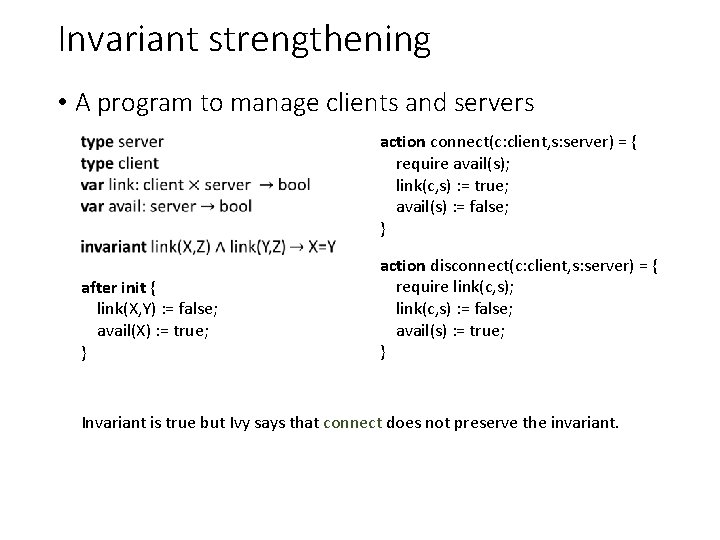
Invariant strengthening • A program to manage clients and servers after init { link(X, Y) : = false; avail(X) : = true; } action connect(c: client, s: server) = { require avail(s); link(c, s) : = true; avail(s) : = false; } action disconnect(c: client, s: server) = { require link(c, s); link(c, s) : = false; avail(s) : = true; } Invariant is true but Ivy says that connect does not preserve the invariant.
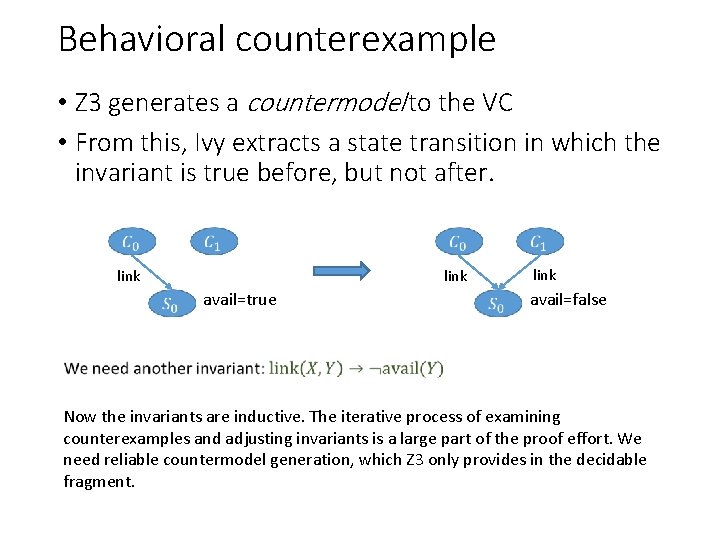
Behavioral counterexample • Z 3 generates a countermodel to the VC • From this, Ivy extracts a state transition in which the invariant is true before, but not after. link avail=true avail=false Now the invariants are inductive. The iterative process of examining counterexamples and adjusting invariants is a large part of the proof effort. We need reliable countermodel generation, which Z 3 only provides in the decidable fragment.
Modularity and abstraction • Modular proofs hide information behind an interface • Every module has: • A specification (its visible part) • An implementation (its invisible part) • In Ivy, both spec and implementations are code • Specifications are “ghost” but have visible state • Implementations are “real” but have hidden state In Ivy, information hiding is the most important means of reducing proofs to decidable proof goals.
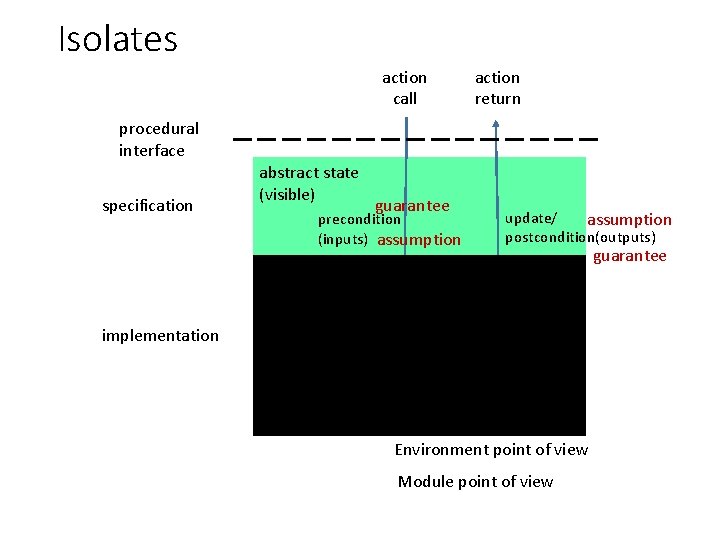
Isolates action call action return procedural interface specification abstract state (visible) guarantee precondition (inputs) assumption update/ assumption postcondition(outputs) concrete state (hidden) implementation update/output may call other isolates Environment point of view Module point of view guarantee
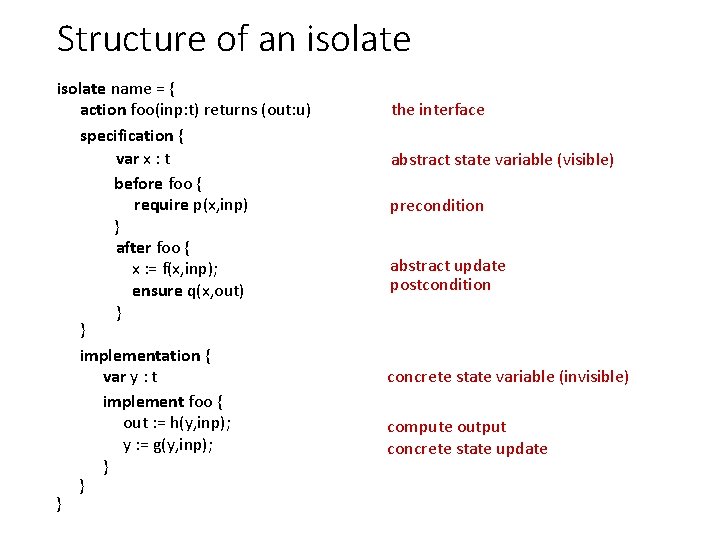
Structure of an isolate name = { action foo(inp: t) returns (out: u) specification { var x : t before foo { require p(x, inp) } after foo { x : = f(x, inp); ensure q(x, out) } } implementation { var y : t implement foo { out : = h(y, inp); y : = g(y, inp); } } } the interface abstract state variable (visible) precondition abstract update postcondition concrete state variable (invisible) compute output concrete state update
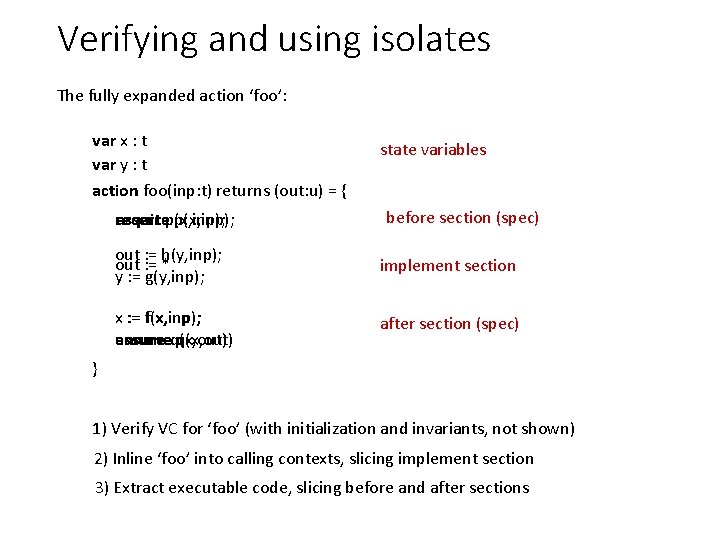
Verifying and using isolates The fully expanded action ‘foo’: var x : t var y : t action foo(inp: t) returns (out: u) = { require p(x, inp); assert p(x, inp); state variables before section (spec) out : = h(y, inp); out : = * y : = g(y, inp); implement section x : = f(x, inp); ensure q(x, out) assume q(x, out) after section (spec) } 1) Verify VC for ‘foo’ (with initialization and invariants, not shown) 2) Inline ‘foo’ into calling contexts, slicing implement section 3) Extract executable code, slicing before and after sections
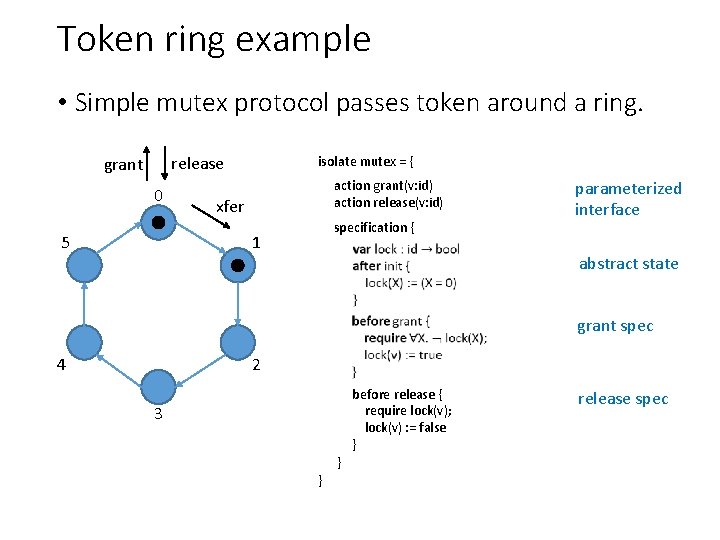
Token ring example • Simple mutex protocol passes token around a ring. release grant 0 5 isolate mutex = { action grant(v: id) action release(v: id) xfer specification { 1 4 parameterized interface abstract state grant spec before release { require lock(v); lock(v) : = false } release spec 2 3 } }
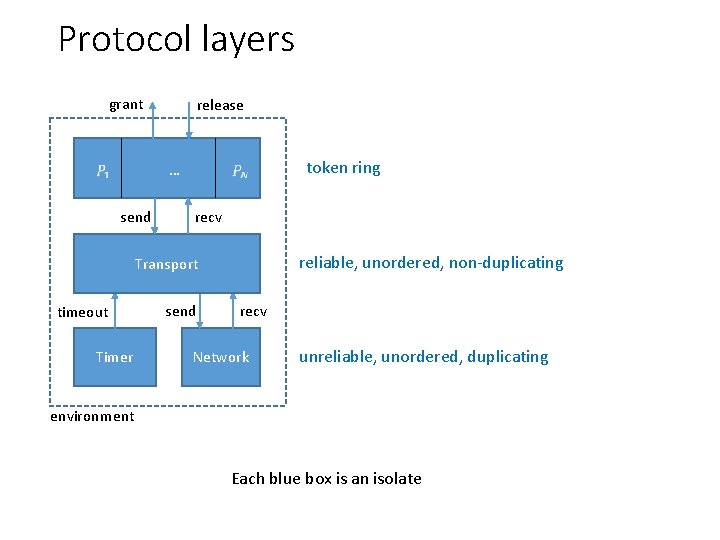
Protocol layers grant release send token ring … recv reliable, unordered, non-duplicating Transport timeout Timer send recv Network unreliable, unordered, duplicating environment Each blue box is an isolate
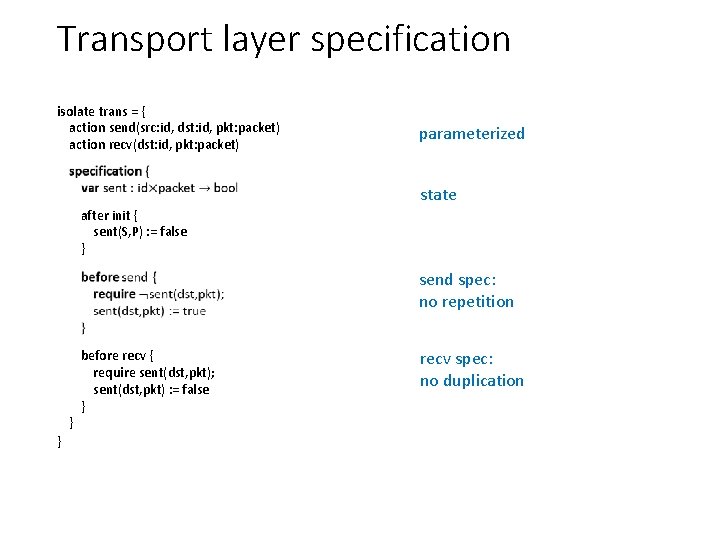
Transport layer specification isolate trans = { action send(src: id, dst: id, pkt: packet) action recv(dst: id, pkt: packet) parameterized state after init { sent(S, P) : = false } } } send spec: no repetition before recv { require sent(dst, pkt); sent(dst, pkt) : = false } recv spec: no duplication
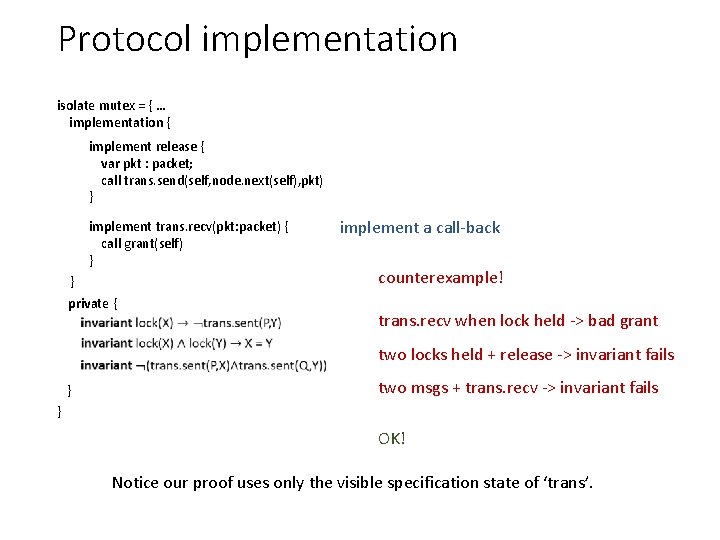
Protocol implementation isolate mutex = { … implementation { implement release { var pkt : packet; call trans. send(self, node. next(self), pkt) } implement trans. recv(pkt: packet) { call grant(self) } } private { } implement a call-back counterexample! trans. recv when lock held -> bad grant two locks held + release -> invariant fails two msgs + trans. recv -> invariant fails } OK! Notice our proof uses only the visible specification state of ‘trans’.
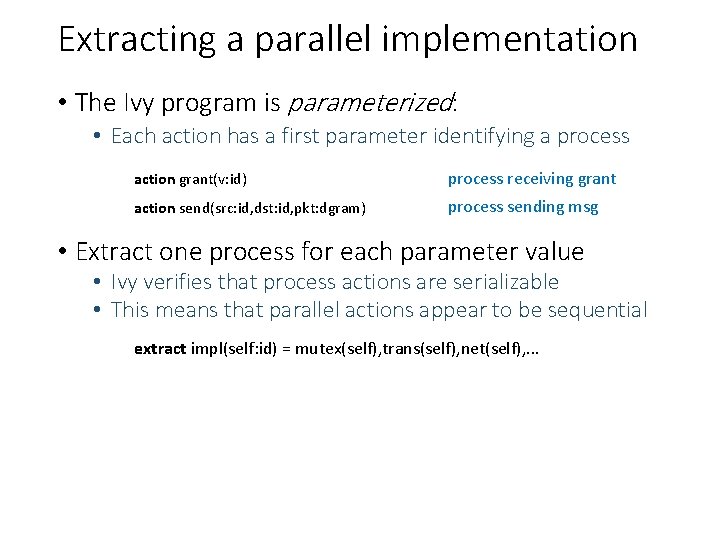
Extracting a parallel implementation • The Ivy program is parameterized: • Each action has a first parameter identifying a process action grant(v: id) process receiving grant action send(src: id, dst: id, pkt: dgram) process sending msg • Extract one process for each parameter value • Ivy verifies that process actions are serializable • This means that parallel actions appear to be sequential extract impl(self: id) = mutex(self), trans(self), net(self), . . .
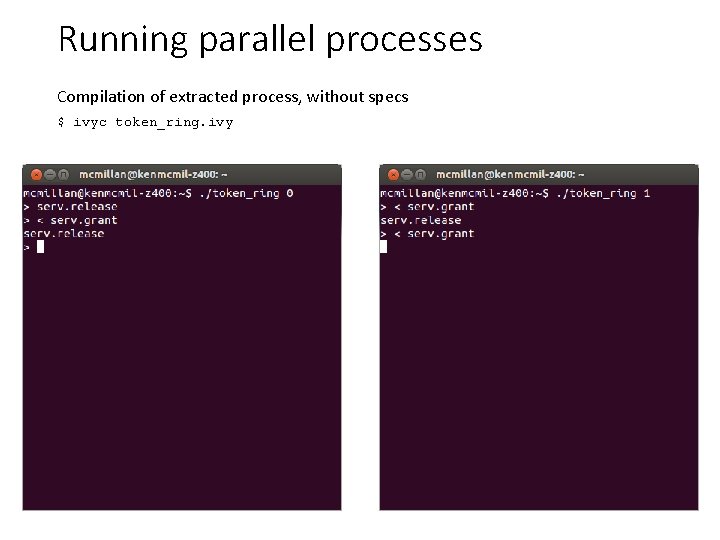
Running parallel processes Compilation of extracted process, without specs $ ivyc token_ring. ivy

Modularity for Decidability How to make use of Ivy’s features to get the most out of Z 3
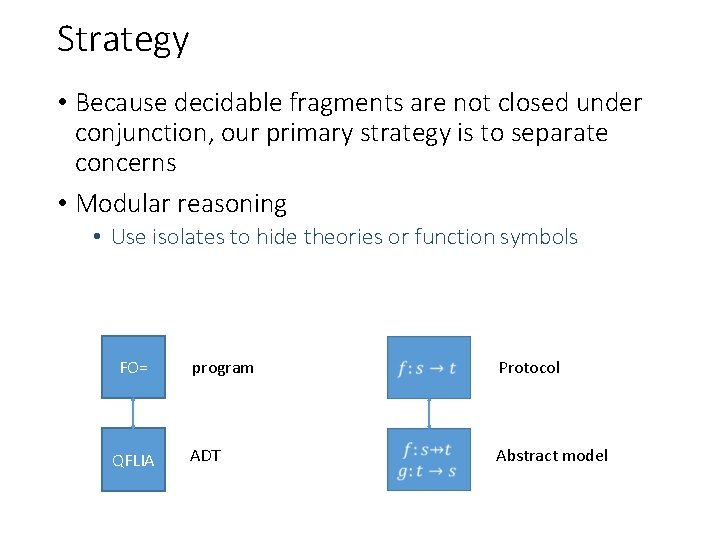
Strategy • Because decidable fragments are not closed under conjunction, our primary strategy is to separate concerns • Modular reasoning • Use isolates to hide theories or function symbols FO= QFLIA program ADT Protocol Abstract model
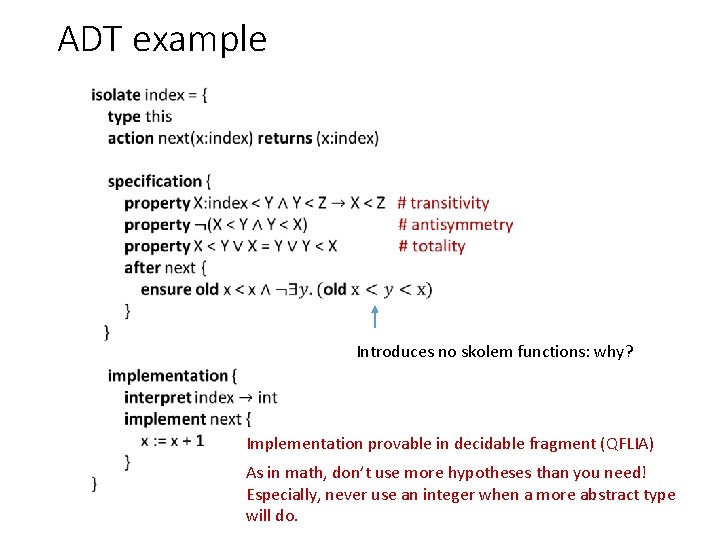
ADT example Introduces no skolem functions: why? Implementation provable in decidable fragment (QFLIA) As in math, don’t use more hypotheses than you need! Especially, never use an integer when a more abstract type will do.
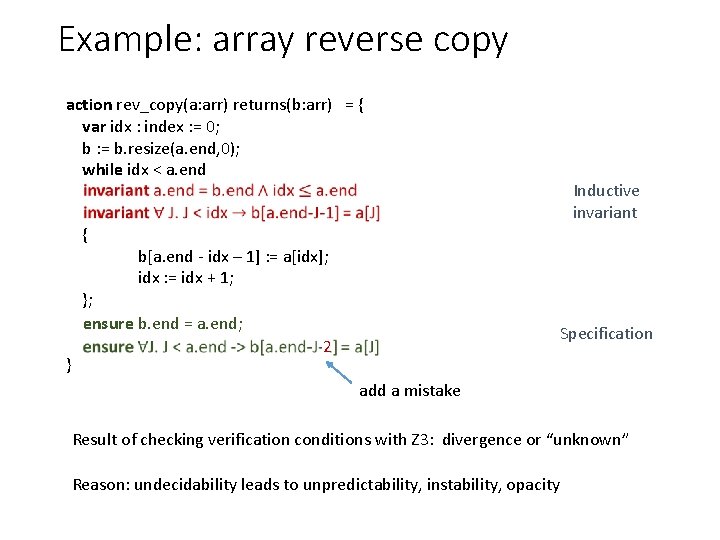
Example: array reverse copy action rev_copy(a: arr) returns(b: arr) = { var idx : index : = 0; b : = b. resize(a. end, 0); while idx < a. end { b[a. end - idx – 1] : = a[idx]; idx : = idx + 1; }; ensure b. end = a. end; 2 } add a mistake Inductive invariant Specification Result of checking verification conditions with Z 3: divergence or “unknown” Reason: undecidability leads to unpredictability, instability, opacity
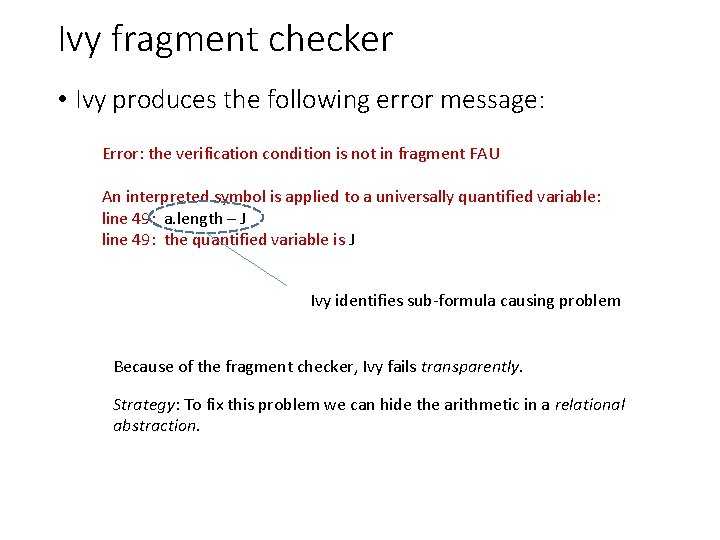
Ivy fragment checker • Ivy produces the following error message: Error: the verification condition is not in fragment FAU An interpreted symbol is applied to a universally quantified variable: line 49: a. length – J line 49: the quantified variable is J Ivy identifies sub-formula causing problem Because of the fragment checker, Ivy fails transparently. Strategy: To fix this problem we can hide the arithmetic in a relational abstraction.
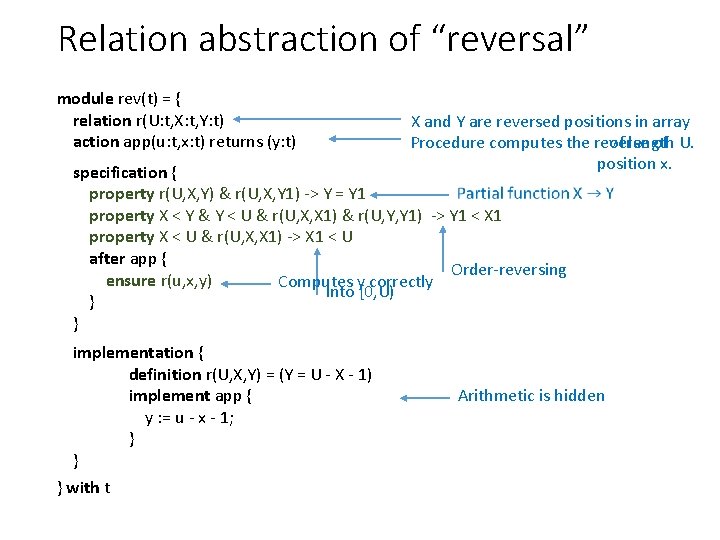
Relation abstraction of “reversal” module rev(t) = { relation r(U: t, X: t, Y: t) action app(u: t, x: t) returns (y: t) specification { property r(U, X, Y) & r(U, X, Y 1) -> Y = Y 1 X and Y are reversed positions in array Procedure computes the reverse of of length U. position x. property X < Y & Y < U & r(U, X, X 1) & r(U, Y, Y 1) -> Y 1 < X 1 property X < U & r(U, X, X 1) -> X 1 < U after app { Order-reversing ensure r(u, x, y) Computes y correctly Into [0, U) } } implementation { definition r(U, X, Y) = (Y = U - X - 1) implement app { y : = u - x - 1; } } } with t Arithmetic is hidden
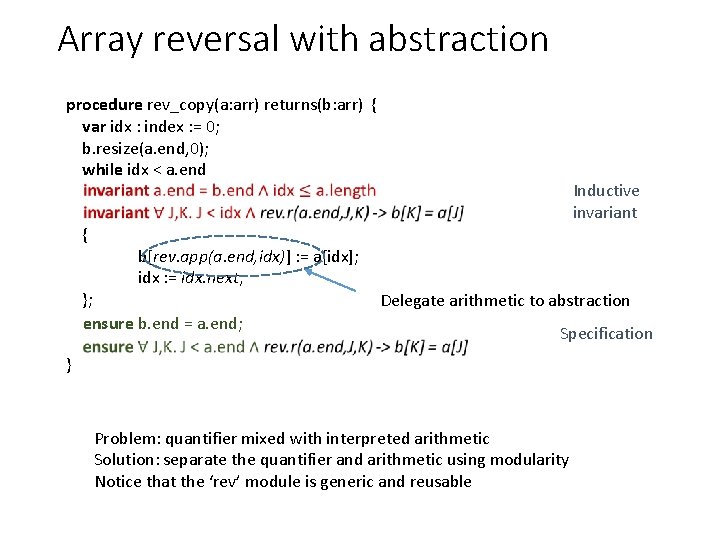
Array reversal with abstraction procedure rev_copy(a: arr) returns(b: arr) { var idx : index : = 0; b. resize(a. end, 0); while idx < a. end Inductive invariant { b[rev. app(a. end, idx)] : = a[idx]; idx : = idx. next; }; Delegate arithmetic to abstraction ensure b. end = a. end; Specification } Problem: quantifier mixed with interpreted arithmetic Solution: separate the quantifier and arithmetic using modularity Notice that the ‘rev’ module is generic and reusable
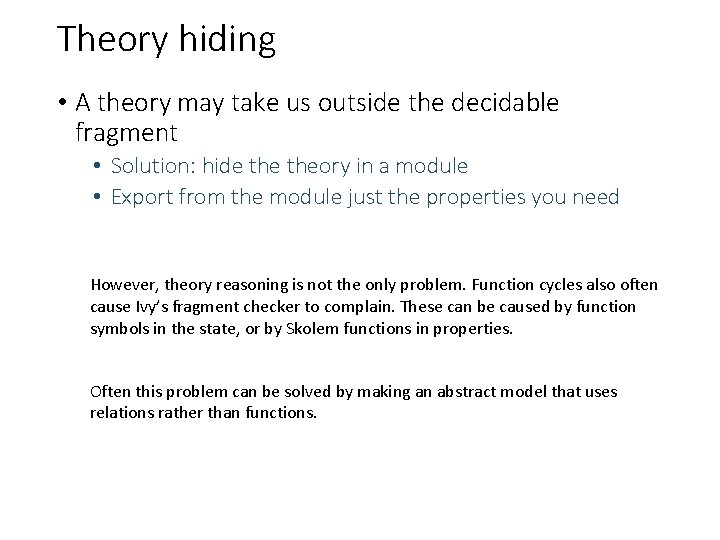
Theory hiding • A theory may take us outside the decidable fragment • Solution: hide theory in a module • Export from the module just the properties you need However, theory reasoning is not the only problem. Function cycles also often cause Ivy’s fragment checker to complain. These can be caused by function symbols in the state, or by Skolem functions in properties. Often this problem can be solved by making an abstract model that uses relations rather than functions.
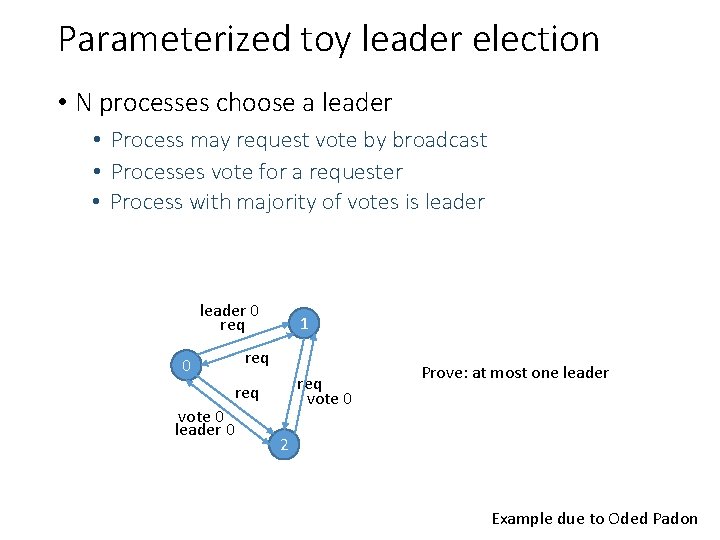
Parameterized toy leader election • N processes choose a leader • Process may request vote by broadcast • Processes vote for a requester • Process with majority of votes is leader 0 req 1 req 0 req vote 0 leader 0 Prove: at most one leader 2 Example due to Oded Padon
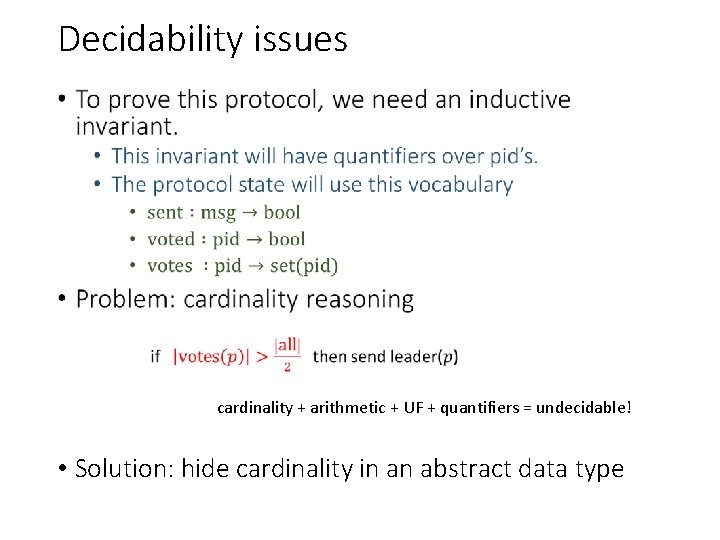
Decidability issues • cardinality + arithmetic + UF + quantifiers = undecidable! • Solution: hide cardinality in an abstract data type
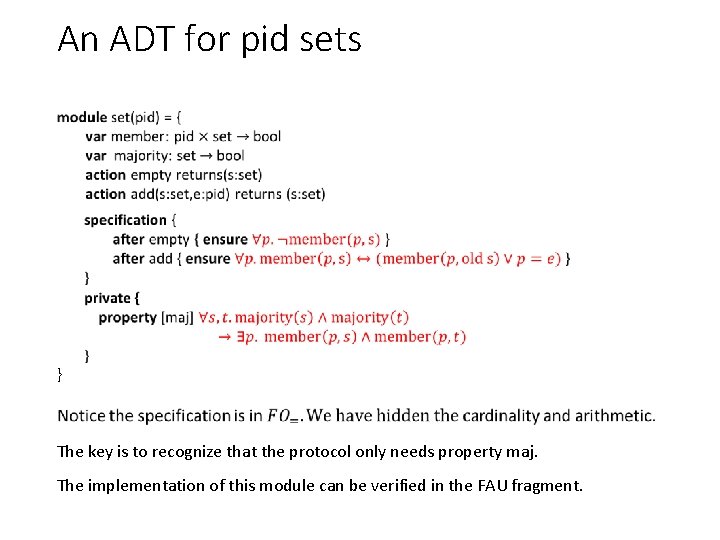
An ADT for pid sets } The key is to recognize that the protocol only needs property maj. The implementation of this module can be verified in the FAU fragment.
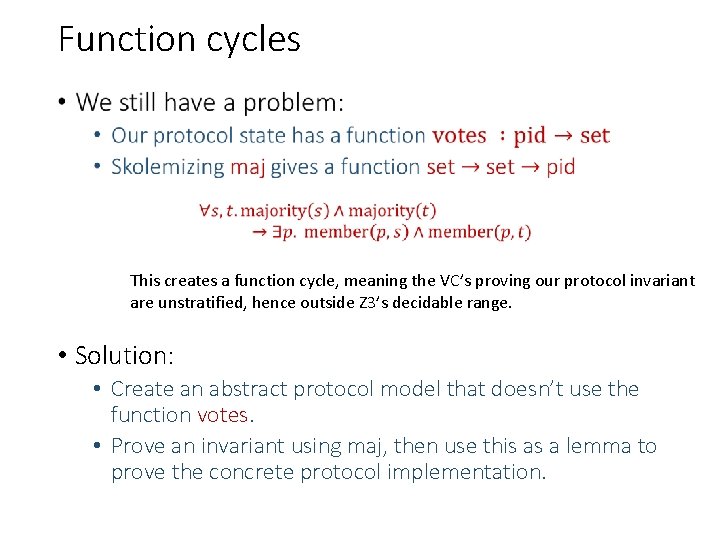
Function cycles • This creates a function cycle, meaning the VC’s proving our protocol invariant are unstratified, hence outside Z 3’s decidable range. • Solution: • Create an abstract protocol model that doesn’t use the function votes. • Prove an invariant using maj, then use this as a lemma to prove the concrete protocol implementation.
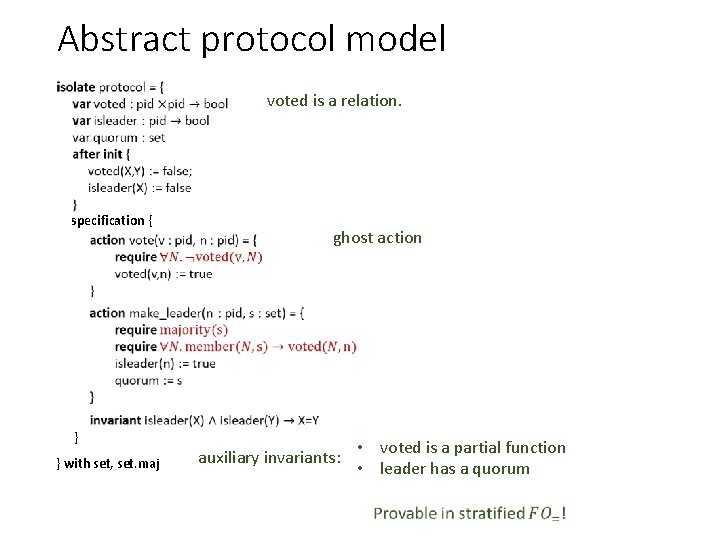
Abstract protocol model voted is a relation. specification { ghost action } } with set, set. maj auxiliary invariants: • voted is a partial function • leader has a quorum
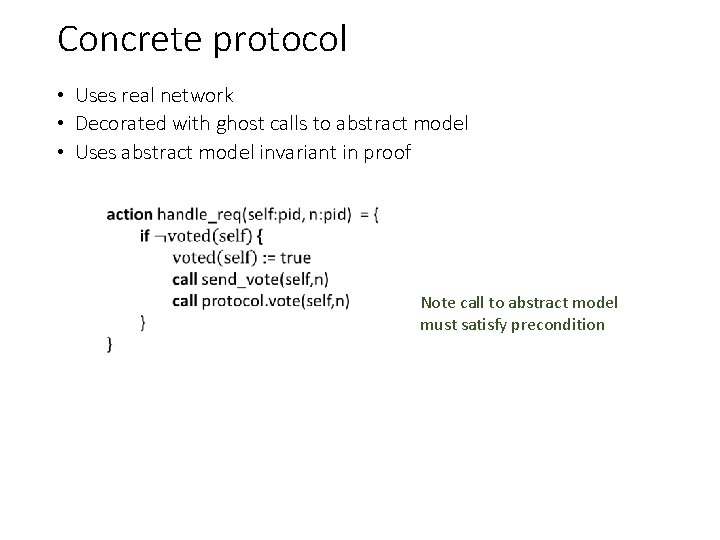
Concrete protocol • Uses real network • Decorated with ghost calls to abstract model • Uses abstract model invariant in proof Note call to abstract model must satisfy precondition
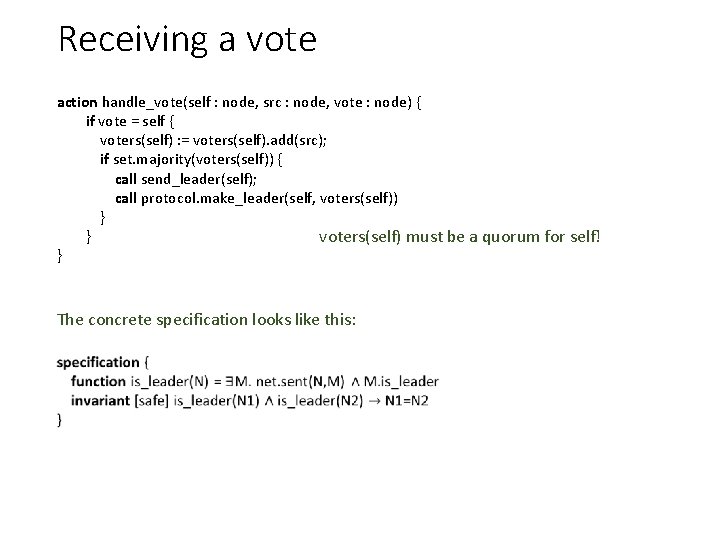
Receiving a vote action handle_vote(self : node, src : node, vote : node) { if vote = self { voters(self) : = voters(self). add(src); if set. majority(voters(self)) { call send_leader(self); call protocol. make_leader(self, voters(self)) } voters(self) must be a quorum for self! } The concrete specification looks like this:
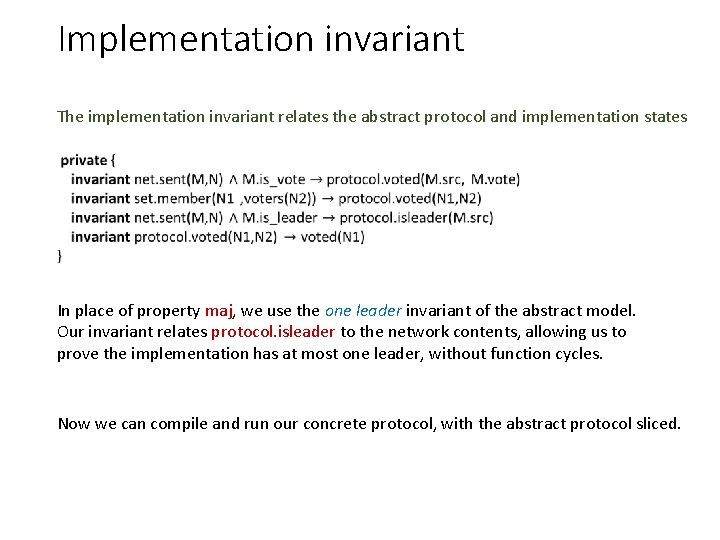
Implementation invariant The implementation invariant relates the abstract protocol and implementation states In place of property maj, we use the one leader invariant of the abstract model. Our invariant relates protocol. isleader to the network contents, allowing us to prove the implementation has at most one leader, without function cycles. Now we can compile and run our concrete protocol, with the abstract protocol sliced.
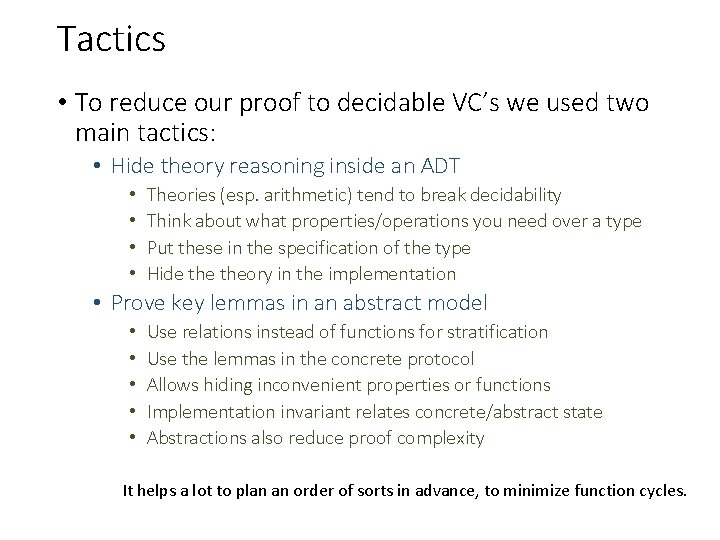
Tactics • To reduce our proof to decidable VC’s we used two main tactics: • Hide theory reasoning inside an ADT • • Theories (esp. arithmetic) tend to break decidability Think about what properties/operations you need over a type Put these in the specification of the type Hide theory in the implementation • Prove key lemmas in an abstract model • • • Use relations instead of functions for stratification Use the lemmas in the concrete protocol Allows hiding inconvenient properties or functions Implementation invariant relates concrete/abstract state Abstractions also reduce proof complexity It helps a lot to plan an order of sorts in advance, to minimize function cycles.
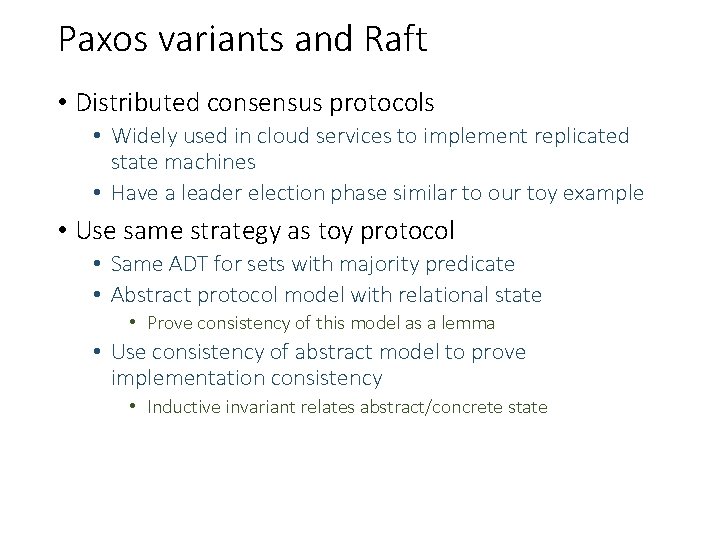
Paxos variants and Raft • Distributed consensus protocols • Widely used in cloud services to implement replicated state machines • Have a leader election phase similar to our toy example • Use same strategy as toy protocol • Same ADT for sets with majority predicate • Abstract protocol model with relational state • Prove consistency of this model as a lemma • Use consistency of abstract model to prove implementation consistency • Inductive invariant relates abstract/concrete state
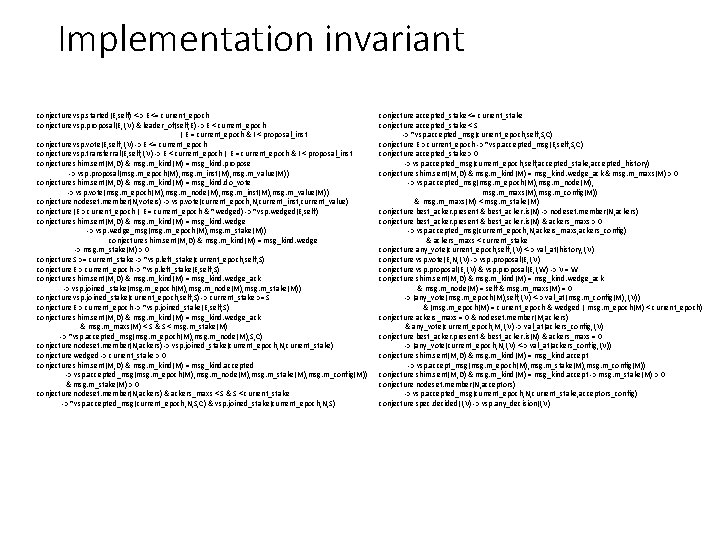
Implementation invariant conjecture vsp. started(E, self) <-> E <= current_epoch conjecture vsp. proposal(E, I, V) & leader_of(self, E) -> E < current_epoch | E = current_epoch & I < proposal_inst conjecture vsp. vote(E, self, I, V) -> E <= current_epoch conjecture vsp. transferral(E, self, I, V) -> E < current_epoch | E = current_epoch & I < proposal_inst conjecture shim. sent(M, D) & msg. m_kind(M) = msg_kind. propose -> vsp. proposal(msg. m_epoch(M), msg. m_inst(M), msg. m_value(M)) conjecture shim. sent(M, D) & msg. m_kind(M) = msg_kind. do_vote -> vsp. vote(msg. m_epoch(M), msg. m_node(M), msg. m_inst(M), msg. m_value(M)) conjecture nodeset. member(N, voters) -> vsp. vote(current_epoch, N, current_inst, current_value) conjecture (E > current_epoch | E = current_epoch & ~wedged) -> ~vsp. wedged(E, self) conjecture shim. sent(M, D) & msg. m_kind(M) = msg_kind. wedge -> vsp. wedge_msg(msg. m_epoch(M), msg. m_stake(M)) conjecture shim. sent(M, D) & msg. m_kind(M) = msg_kind. wedge -> msg. m_stake(M) > 0 conjecture S >= current_stake -> ~vsp. left_stake(current_epoch, self, S) conjecture E > current_epoch -> ~vsp. left_stake(E, self, S) conjecture shim. sent(M, D) & msg. m_kind(M) = msg_kind. wedge_ack -> vsp. joined_stake(msg. m_epoch(M), msg. m_node(M), msg. m_stake(M)) conjecture vsp. joined_stake(current_epoch, self, S) -> current_stake >= S conjecture E > current_epoch -> ~vsp. joined_stake(E, self, S) conjecture shim. sent(M, D) & msg. m_kind(M) = msg_kind. wedge_ack & msg. m_maxs(M) < S & S < msg. m_stake(M) -> ~vsp. accepted_msg(msg. m_epoch(M), msg. m_node(M), S, C) conjecture nodeset. member(N, ackers) -> vsp. joined_stake(current_epoch, N, current_stake) conjecture wedged -> current_stake > 0 conjecture shim. sent(M, D) & msg. m_kind(M) = msg_kind. accepted -> vsp. accepted_msg(msg. m_epoch(M), msg. m_node(M), msg. m_stake(M), msg. m_config(M)) & msg. m_stake(M) > 0 conjecture nodeset. member(N, ackers) & ackers_maxs < S & S < current_stake -> ~vsp. accepted_msg(current_epoch, N, S, C) & vsp. joined_stake(current_epoch, N, S) conjecture accepted_stake <= current_stake conjecture accepted_stake < S -> ~vsp. accepted_msg(current_epoch, self, S, C) conjecture E > current_epoch -> ~vsp. accepted_msg(E, self, S, C) conjecture accepted_stake > 0 -> vsp. accepted_msg(current_epoch, self, accepted_stake, accepted_history) conjecture shim. sent(M, D) & msg. m_kind(M) = msg_kind. wedge_ack & msg. m_maxs(M) > 0 -> vsp. accepted_msg(msg. m_epoch(M), msg. m_node(M), msg. m_maxs(M), msg. m_config(M)) & msg. m_maxs(M) < msg. m_stake(M) conjecture best_acker. present & best_acker. is(N) -> nodeset. member(N, ackers) conjecture best_acker. present & best_acker. is(N) & ackers_maxs > 0 -> vsp. accepted_msg(current_epoch, N, ackers_maxs, ackers_config) & ackers_maxs < current_stake conjecture any_vote(current_epoch, self, I, V) <-> val_at(history, I, V) conjecture vsp. vote(E, N, I, V) -> vsp. proposal(E, I, V) conjecture vsp. proposal(E, I, V) & vsp. proposal(E, I, W) -> V = W conjecture shim. sent(M, D) & msg. m_kind(M) = msg_kind. wedge_ack & msg. m_node(M) = self & msg. m_maxs(M) = 0 -> (any_vote(msg. m_epoch(M), self, I, V) <-> val_at(msg. m_config(M), I, V)) & (msg. m_epoch(M) = current_epoch & wedged | msg. m_epoch(M) < current_epoch) conjecture ackers_maxs = 0 & nodeset. member(M, ackers) & any_vote(current_epoch, M, I, V) -> val_at(ackers_config, I, V) conjecture best_acker. present & best_acker. is(N) & ackers_maxs = 0 -> (any_vote(current_epoch, N, I, V) <-> val_at(ackers_config, I, V)) conjecture shim. sent(M, D) & msg. m_kind(M) = msg_kind. accept -> vsp. accept_msg(msg. m_epoch(M), msg. m_stake(M), msg. m_config(M)) conjecture shim. sent(M, D) & msg. m_kind(M) = msg_kind. accept -> msg. m_stake(M) > 0 conjecture nodeset. member(N, acceptors) -> vsp. accepted_msg(current_epoch, N, current_stake, acceptors_config) conjecture spec. decided(I, V) -> vsp. any_decision(I, V)
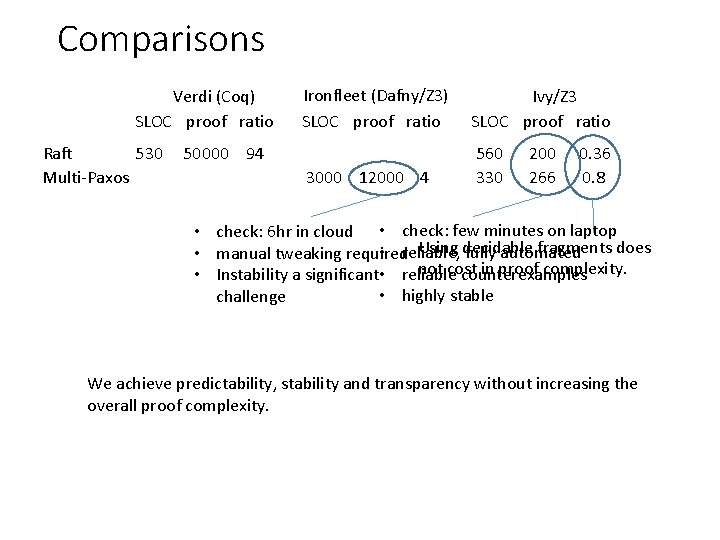
Comparisons Verdi (Coq) SLOC proof ratio Raft 530 Multi-Paxos Ironfleet (Dafny/Z 3) SLOC proof ratio Ivy/Z 3 SLOC proof ratio 3000 12000 4 560 330 50000 94 200 266 0. 36 0. 8 • check: 6 hr in cloud • check: few minutes on laptop Using decidable fragments does • reliable, fully automated • manual tweaking required not cost in proof complexity. • Instability a significant • reliable counterexamples • highly stable challenge We achieve predictability, stability and transparency without increasing the overall proof complexity.
Other Ivy capabilities • Various capabilities of Ivy not discussed here: • • • Bounded model checking Automated specification-based testing Invariant inference using finite-state model checking Verification of liveness properties Interactive theorem proving Ivy lets you do any manual reasoning you want to, regardless of decidability. Sometimes the best way to handle a property with a quantifier alternation is to use Ivy’s theorem prover to manually ground it.
Conclusion To achieve an order-of-magnitude improvement in verification productivity with automation, we must make careful choices about the division of labor between human and machine. • Because proof is iterative, we must use automation in a way that is predictable, stable and transparent. • Plan the development so that proof obligations reduce easily to subgoals that the automation can handle reliably. • Tools must provide actionable feedback when a proof goal can’t be handled (must fail transparently). Ivy is an instantiation of these ideas, based on Z 3’s decidable fragment. It provides tools and strategies for reducing proofs to sub-goals that Z 3 can handle predictably, reliably and transparently.

Resources • The Ivy website: http: //microsoft. github. io/ivy/ • Overview paper on Ivy: Kenneth L. Mc. Millan, Oded Padon: Deductive Verification in Decidable Fragments with Ivy. SAS 2018: 43 -55 • Paper on consensus protocol verification: Marcelo Taube, Giuliano Losa, Kenneth L. Mc. Millan, Oded Padon, Mooly Sagiv, Sharon Shoham, James R. Wilcox, Doug Woos: Modularity for decidability of deductive verification with applications to distributed systems. PLDI 2018: 662 -677
- Slides: 69