
Developing Decimal Place Value Working with tenths Introduction
- Slides: 38
Developing Decimal Place Value Working with tenths
Introduction This document contains: • an introduction to the lesson • points to consider as you watch each video clip. Note there is also a separate video where the teacher reflects on the lesson. This is worth watching either before or after you watch the video of the lesson.
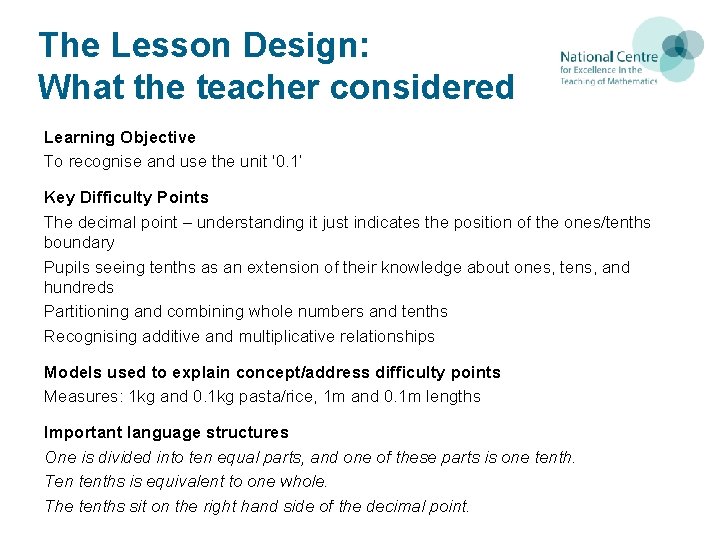
The Lesson Design: What the teacher considered Learning Objective To recognise and use the unit '0. 1‘ Key Difficulty Points The decimal point – understanding it just indicates the position of the ones/tenths boundary Pupils seeing tenths as an extension of their knowledge about ones, tens, and hundreds Partitioning and combining whole numbers and tenths Recognising additive and multiplicative relationships Models used to explain concept/address difficulty points Measures: 1 kg and 0. 1 kg pasta/rice, 1 m and 0. 1 m lengths Important language structures One is divided into ten equal parts, and one of these parts is one tenth. Ten tenths is equivalent to one whole. The tenths sit on the right hand side of the decimal point.
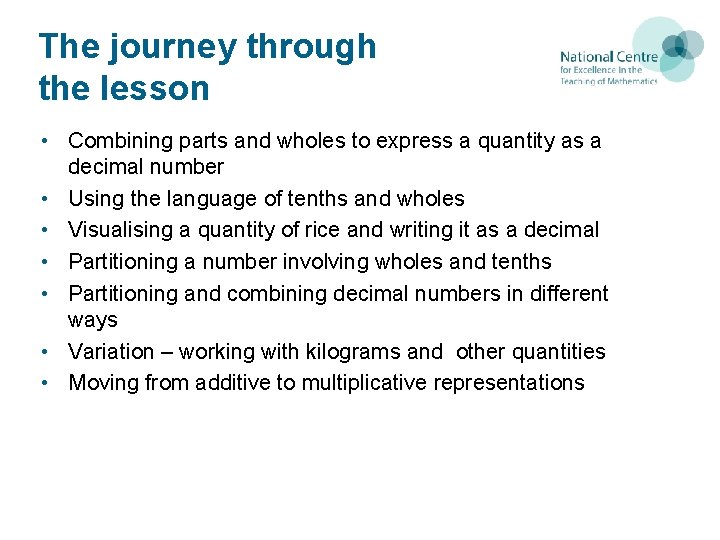
The journey through the lesson • Combining parts and wholes to express a quantity as a decimal number • Using the language of tenths and wholes • Visualising a quantity of rice and writing it as a decimal • Partitioning a number involving wholes and tenths • Partitioning and combining decimal numbers in different ways • Variation – working with kilograms and other quantities • Moving from additive to multiplicative representations
Small Focus Note that the first five lessons of this unit address only tenths. This is typical within the context of teaching for mastery. Concepts are considered for longer and in more detail in order to acquire deep learning which is sustained and readily connected to later learning.
Use of Measures The lesson uses measures as a context to explore decimal numbers. This enables children to make sense of whole numbers and parts of whole numbers (tenths).
Developing Decimal Place Value Working with tenths Y 4 Lesson Clip 1
Review of Previous lesson The children write a quantity of rice as a decimal number. Consider the use of the visual image to support their understanding. Note that the previous day they had explored the concept of tenths with real rice.
Stem Sentences Notice the sentence that is repeated throughout the lesson: The tenths sit on the right hand side of the decimal point. One purpose of stem sentences is to highlight key points and remind children of important information.
Children’s Language • Children distinguish between and use the language of wholes and tenths. • Notice the use of the word represents. Consider the purpose of this language.
Representation is central to mathematics. Mathematics is abstract and it necessary to represent it in order to understand work with it. We use a variety of ways to represent mathematics including concrete, pictorial, diagrammatic, geometric, graphical and symbolic. It is crucial that children are able to interpret and make sense of these representations. Consider developing children’s use of the word representation so it becomes natural to use it as the children do in the video. This will help them to think more deeply about the mathematics.
3. 5 kg Notice that the children are encouraged to visualise what this might look like – a step beyond seeing the pictures.
Speaking in full sentences Notice how the children respond in full sentences: The three represents three whole kilograms and the five represents five tenths of a kilogram. Consider developing the routine of speaking in full sentences. It can support children in thinking about and expressing the mathematics with greater accuracy and is thus supportive to their learning.
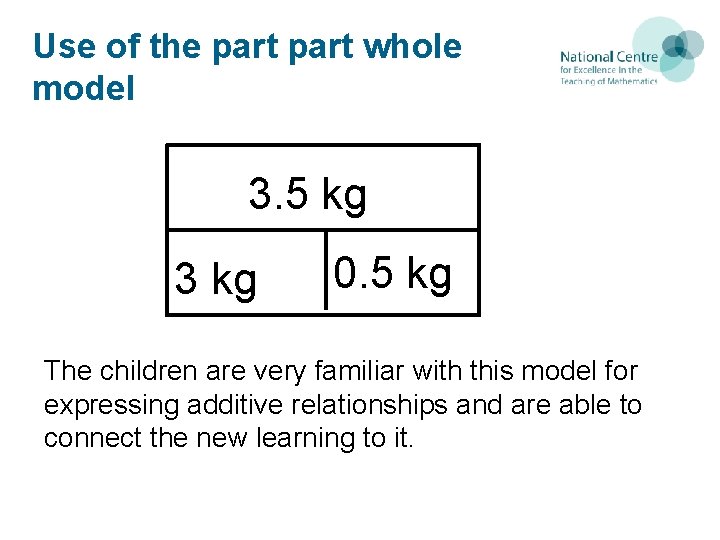
Use of the part whole model 3. 5 kg 3 kg 0. 5 kg The children are very familiar with this model for expressing additive relationships and are able to connect the new learning to it.
Writing a number sentence Notice that the next small step is to write a number sentence to express the relationship between wholes and tenths. The part whole model supports children in seeing relationships and writing the sentences.
Developing Decimal Place Value Working with tenths – Partitioning in different ways Y 4 Lesson Clip 2
Partitioning in different ways The next small step is to partition a decimal number in more than one way. This activity provides variation and develops depth and flexibility through looking at the same quantity in different ways.
Maisie’s Error Maisie writes 1. kg on the board Notice how the teacher picks up on this error. Teaching for mastery demands precision in the mathematics.
Developing Decimal Place Value Working with tenths – Exploring place value with other units Y 4 Lesson Clip 3
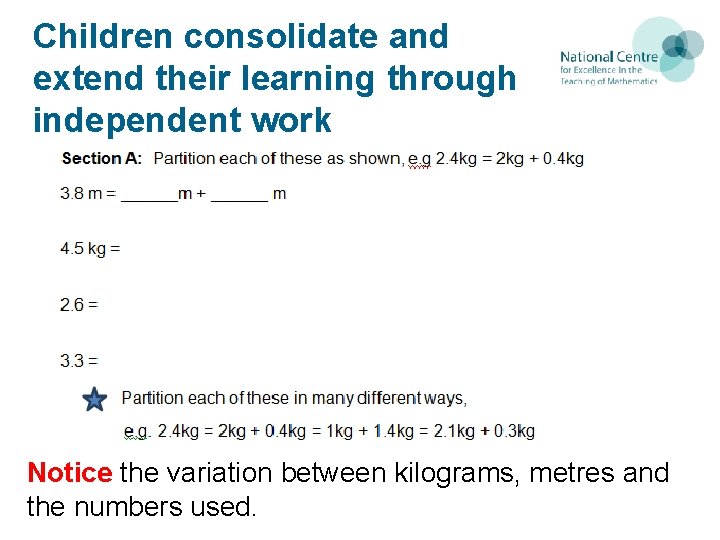
Children consolidate and extend their learning through independent work Notice the variation between kilograms, metres and the numbers used.
Developing Decimal Place Value The use of concrete Representations, leading to multiplicative reasoning Y 4 Lesson Clip 4
Using a concrete representation Consider the use of the metre ruler to explore tenths. This represents an aspect of conceptual variation (looking at the same concept in a different way).
Remaining Focused The teacher says: I’m just going to stick with the metre examples, we are not going to consider centimetres today. A mastery lesson remains focused in order to master the key point(s) of the lesson.
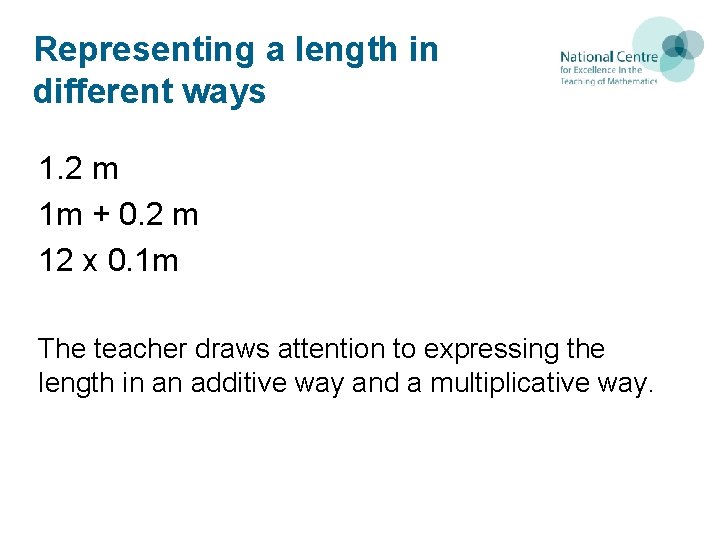
Representing a length in different ways 1. 2 m 1 m + 0. 2 m 12 x 0. 1 m The teacher draws attention to expressing the length in an additive way and a multiplicative way.
Developing Decimal Place Value Exploring equivalence using the balance model Y 4 Lesson Clip 5
Stem Sentence Ten tenths are equivalent to one whole. A key feature of the memorisation of stem sentences is to bring important information to mind to support thinking about the mathematics.
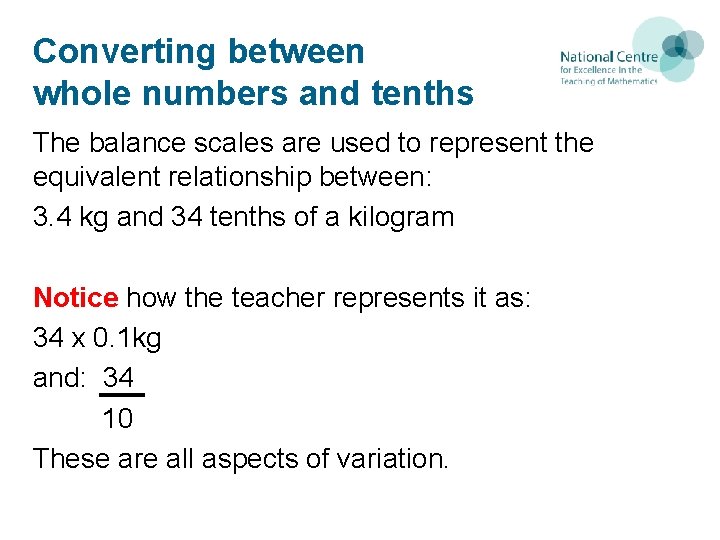
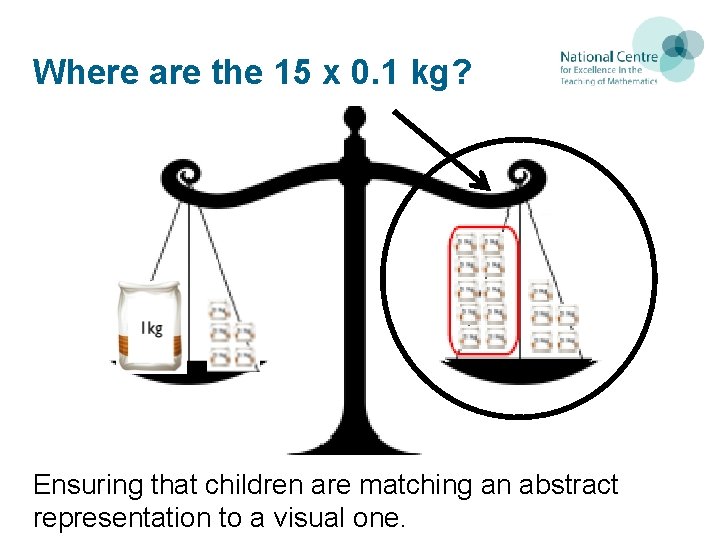
Converting between whole numbers and tenths The balance scales are used to represent the equivalent relationship between: 3. 4 kg and 34 tenths of a kilogram Notice how the teacher represents it as: 34 x 0. 1 kg and: 34 10 These are all aspects of variation.
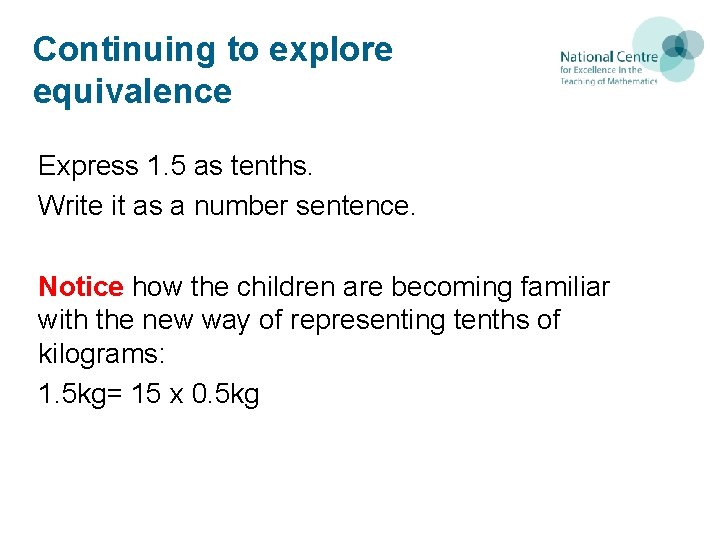
Continuing to explore equivalence Express 1. 5 as tenths. Write it as a number sentence. Notice how the children are becoming familiar with the new way of representing tenths of kilograms: 1. 5 kg= 15 x 0. 5 kg
Where are the 15 x 0. 1 kg? Ensuring that children are matching an abstract representation to a visual one.
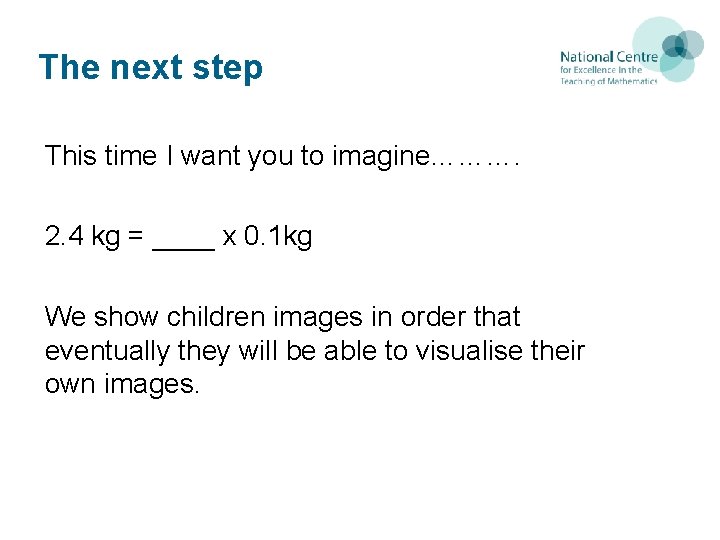
The next step This time I want you to imagine………. 2. 4 kg = ____ x 0. 1 kg We show children images in order that eventually they will be able to visualise their own images.
Developing Decimal Place Value Y 4 Lesson Clip 6 Independent work
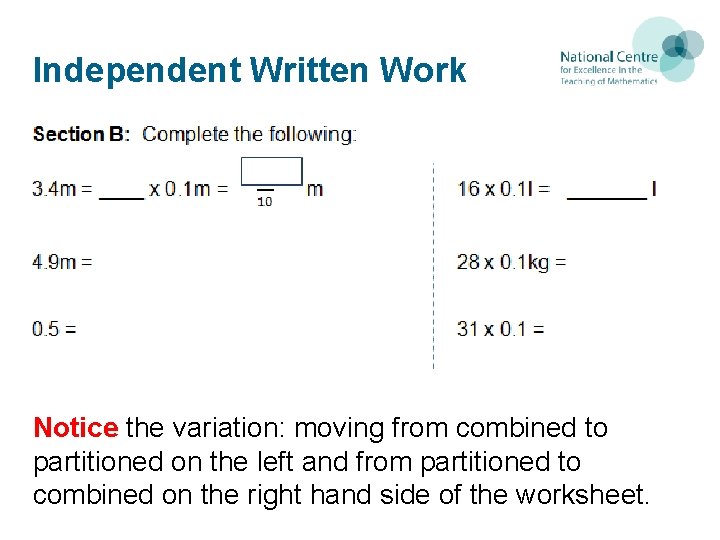
Independent Written Work Notice the variation: moving from combined to partitioned on the left and from partitioned to combined on the right hand side of the worksheet.
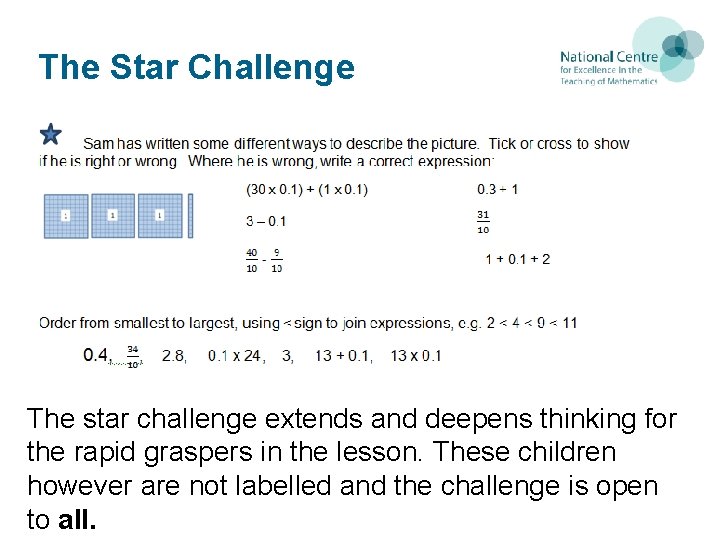
The Star Challenge The star challenge extends and deepens thinking for the rapid graspers in the lesson. These children however are not labelled and the challenge is open to all.
The Star Challenge Aims to provide the opportunity for children to: Slow down, stop, think and make connections.
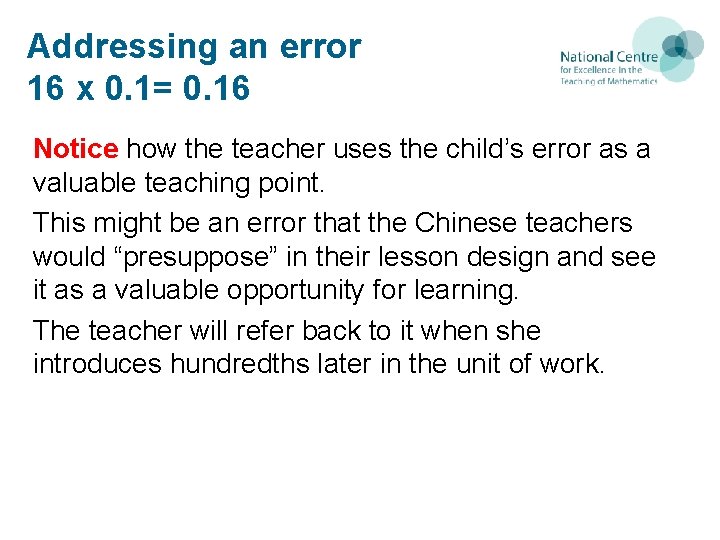
Addressing an error 16 x 0. 1= 0. 16 Notice how the teacher uses the child’s error as a valuable teaching point. This might be an error that the Chinese teachers would “presuppose” in their lesson design and see it as a valuable opportunity for learning. The teacher will refer back to it when she introduces hundredths later in the unit of work.
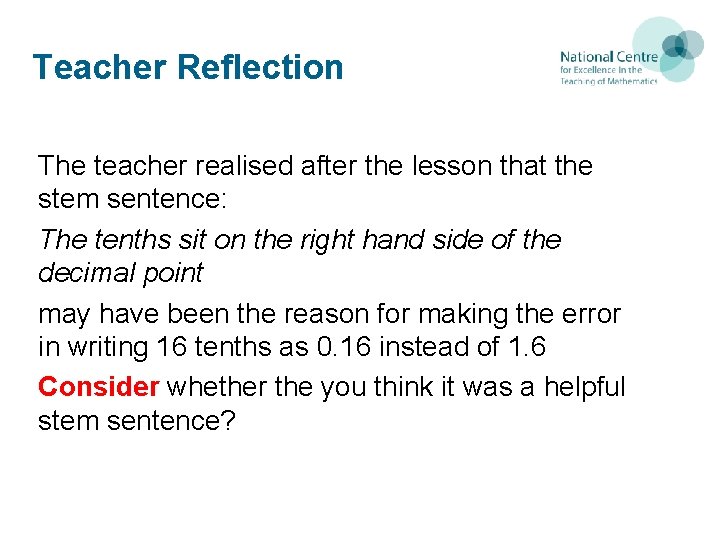
Teacher Reflection The teacher realised after the lesson that the stem sentence: The tenths sit on the right hand side of the decimal point may have been the reason for making the error in writing 16 tenths as 0. 16 instead of 1. 6 Consider whether the you think it was a helpful stem sentence?
Can you convince me? This is a key question within the context of teaching for mastery. It provides the opportunity for children to think more deeply about the mathematics and challenges them to give precise mathematical explanations.