
Developing Concepts and Operations of Multiplication and Division
- Slides: 15
Developing Concepts and Operations of Multiplication and Division By Charlie Casey
Something to think about “Children are formally introduced to the basic concepts of equal groups and other multiplication and division ideas as early as kindergarten. ” Burris
Chapter Objectives � We will be able to describe three interpretations for multiplication and correctly use multiplication notation, terminology, and properties � We will be able to describe two interpretations for division and correctly use division notation, terminology, and properties � We will be able to describe strategies to help children develop meaning for multiplication and division. � We will be able help students develop strategies to learn basic multiplication and division facts. � We will be able to help children develop algorithms for whole number multiplication and division.
Three Interpretations of Multiplication Additive: Given a number of sets, each with the same number of objects, find the total number of objects. Example: A box of breakfast bars contains 6 packages. Each package contains two bars. How many bars are in each box? � Row by Column: (This is sometimes called an array interpretation. ) Given a number of rows where each row has the same number of objects, find the total number of objects. Example: A boat has three rows of seats. Four people can sit in each row. How many people can sit in the boat? ” � Combination: One item is selected from each of two disjointed sets. Find the number of possible combinations. Example: Jan has four shirts and three pairs of pants. How many different outfits could she make? This interpretation is often the most difficult for young students because it involves two different types of objects. It is usually not introduced until around the third or fourth grade. �
Terminology, Notation, and Basic Multiplication Facts � � � In multiplication the sentence a x b = c, the terms a and b are called the factors, c is called the product, and a x b is called the product expression or just the product. A “Fact Family” can be used to describe all whole number multiplication facts with a common product. Example: There are four members in the multiplication fact family for 8. They are 1 x 8 = 8, 8 x 1 = 8, 2 x 4 = 8, and 4 x 2 = 8. An expression such as 3 x __ = 12 or __ x 4 =8 is called a missing factor equation. The Identity Element: 1 multiplied by any element does not change the identity of that element. 1 x n = n. This property also holds that n x 1 = n for any whole number n. The Zero Element: The factor 0 is a zero element for multiplication. This is, for any whole number n, both n x 0 = 0 and 0 x n = 0 are true equations.
Properties of Multiplication The Commutative Property of Multiplication: a x b = b x a (also known as Order Property) � The Number Line Model for Multiplication: A number line can provide a model to illustrate commutatively. It is always important to start the number line at zero. For very early grade, negative numbers should not be included on the number line. � The Distributive Property of Multiplication over Addition: a x (b + c) = (a x b) + (a x c) for whole numbers a, b, and c. Example: Trying to figure out 6 x 8. Easier way would be to do 5 x 8 = 40 + (1 more group of 8) = 48. Another Example: 5 x 14 = (5 x 10) + (5 x 4) = 50 + 20 = 70 � The Associative Property of Multiplication: a x (b x c) = (a x b) x c, for whole numbers a, b, and c. Example: 5 x 14 = 5 x (2 x 7) = (5 x 2) x 7 = 10 x 7 = 70. � Also called “Grouping Property”. �
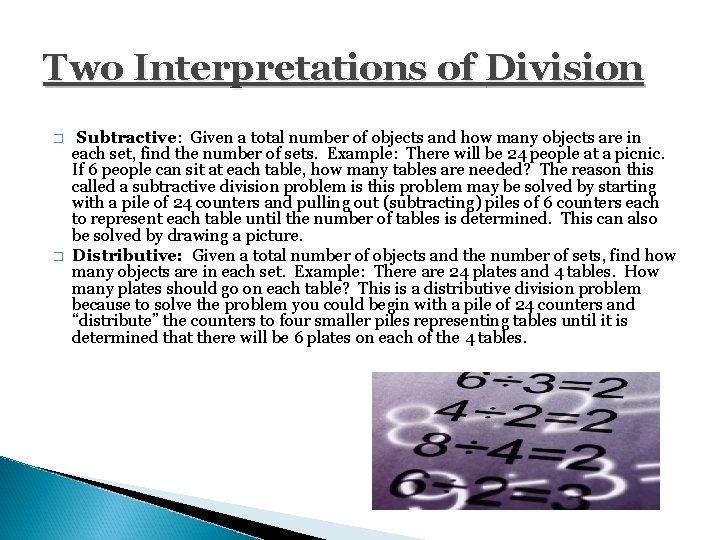
Two Interpretations of Division � � Subtractive: Given a total number of objects and how many objects are in each set, find the number of sets. Example: There will be 24 people at a picnic. If 6 people can sit at each table, how many tables are needed? The reason this called a subtractive division problem is this problem may be solved by starting with a pile of 24 counters and pulling out (subtracting) piles of 6 counters each to represent each table until the number of tables is determined. This can also be solved by drawing a picture. Distributive: Given a total number of objects and the number of sets, find how many objects are in each set. Example: There are 24 plates and 4 tables. How many plates should go on each table? This is a distributive division problem because to solve the problem you could begin with a pile of 24 counters and “distribute” the counters to four smaller piles representing tables until it is determined that there will be 6 plates on each of the 4 tables.
Division Terminology � In the division problem 3 / 17 = 5 r. 2, the 17 in the problem is called the dividend, the 3 is called the divisor, 5 is the quotient, and 2 is the reminder. **Remember that the problem is said seventeen divided by three. Not three divided by seventeen. **
Division Involving Zero � This is represented as 0 / n = 0, for n any nonzero whole number. Anything divided by zero will be zero.
A Divisor of One � This is represented as n / 1 = n. This rule can be justified by considering that when n objects are divided or distributed into one set, there are n objects in that set. Example: 1 / 1 = 1, 3 / 1 = 3
Using Algorithms for Whole Number Multiplication and Division After children understand the concepts of multiplication and division, they can be introduced to the algorithms for these operations. � Multiplication facts may be memorized for single digit factor facts, but larger problems will require more than memorization. �
Multiplication by Factor of Ten This is usually the first two digit factor type of problem introduced to students. � Children can discover an appropriate rule by completing several problems such as; 10 x 1 =; 10 x 2 = ; 10 x 3 = � Continue this until you get to 10 x 9 =. By showing this to students they will be able to see that you append a zero to the number to make the rule true. � At this point you will encourage students to see if their rule works when one factor is larger than a single digit and the other factor is ten. �
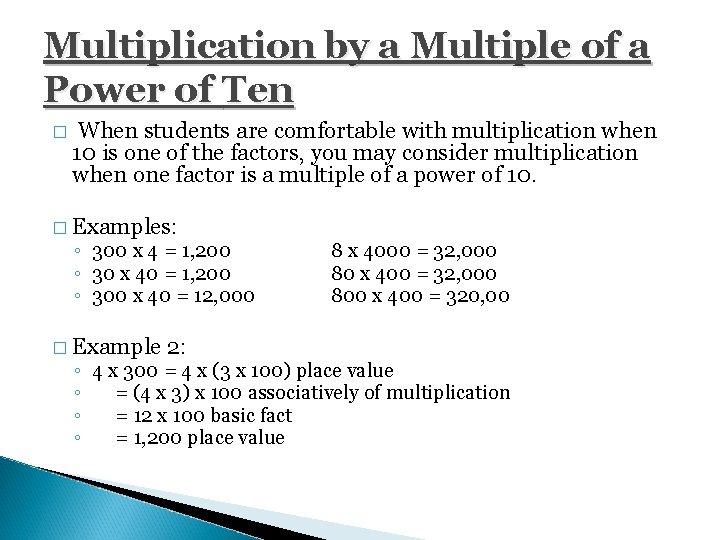
Multiplication by a Multiple of a Power of Ten � When students are comfortable with multiplication when 10 is one of the factors, you may consider multiplication when one factor is a multiple of a power of 10. � Examples: ◦ 300 x 4 = 1, 200 ◦ 30 x 40 = 1, 200 ◦ 300 x 40 = 12, 000 � Example 2: 8 x 4000 = 32, 000 80 x 400 = 32, 000 800 x 400 = 320, 00 ◦ 4 x 300 = 4 x (3 x 100) place value ◦ = (4 x 3) x 100 associatively of multiplication ◦ = 12 x 100 basic fact ◦ = 1, 200 place value
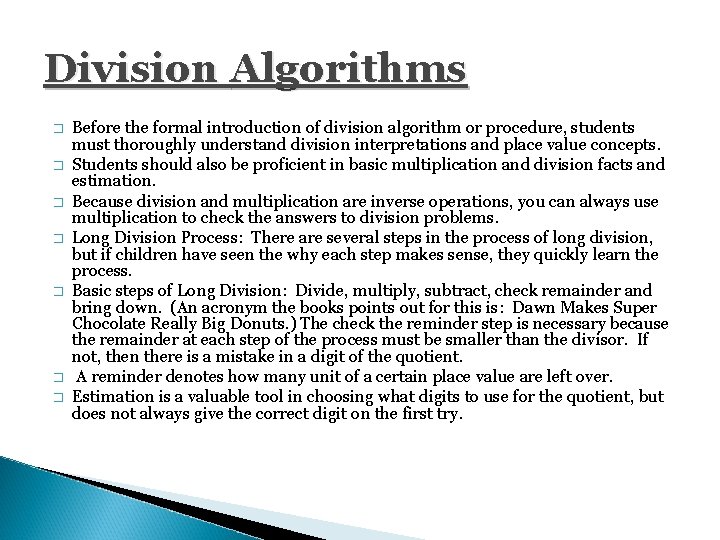
Division Algorithms � � � � Before the formal introduction of division algorithm or procedure, students must thoroughly understand division interpretations and place value concepts. Students should also be proficient in basic multiplication and division facts and estimation. Because division and multiplication are inverse operations, you can always use multiplication to check the answers to division problems. Long Division Process: There are several steps in the process of long division, but if children have seen the why each step makes sense, they quickly learn the process. Basic steps of Long Division: Divide, multiply, subtract, check remainder and bring down. (An acronym the books points out for this is: Dawn Makes Super Chocolate Really Big Donuts. ) The check the reminder step is necessary because the remainder at each step of the process must be smaller than the divisor. If not, then there is a mistake in a digit of the quotient. A reminder denotes how many unit of a certain place value are left over. Estimation is a valuable tool in choosing what digits to use for the quotient, but does not always give the correct digit on the first try.
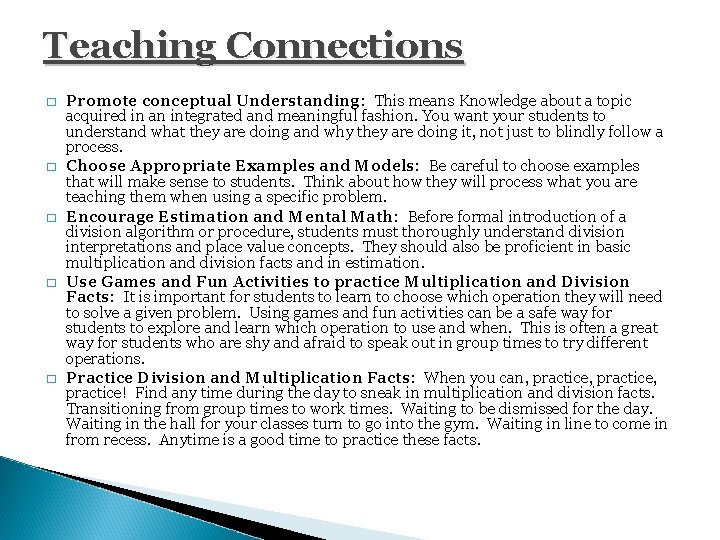
Teaching Connections � � � Promote conceptual Understanding: This means Knowledge about a topic acquired in an integrated and meaningful fashion. You want your students to understand what they are doing and why they are doing it, not just to blindly follow a process. Choose Appropriate Examples and Models: Be careful to choose examples that will make sense to students. Think about how they will process what you are teaching them when using a specific problem. Encourage Estimation and Mental Math: Before formal introduction of a division algorithm or procedure, students must thoroughly understand division interpretations and place value concepts. They should also be proficient in basic multiplication and division facts and in estimation. Use Games and Fun Activities to practice Multiplication and Division Facts: It is important for students to learn to choose which operation they will need to solve a given problem. Using games and fun activities can be a safe way for students to explore and learn which operation to use and when. This is often a great way for students who are shy and afraid to speak out in group times to try different operations. Practice Division and Multiplication Facts: When you can, practice, practice! Find any time during the day to sneak in multiplication and division facts. Transitioning from group times to work times. Waiting to be dismissed for the day. Waiting in the hall for your classes turn to go into the gym. Waiting in line to come in from recess. Anytime is a good time to practice these facts.